

What an AI chatbot for education actually is
Strip away the jargon and an AI chatbot for education is a helper that sits on your website, student portal, or help widget and answers questions in plain language. A student types "when is the FAFSA deadline?" or "how do I reset my campus password?" and gets an instant, correct answer, at 2am, in whatever language they asked in.
The important word is modern. The scripted chatbots schools deployed five years ago were glorified decision trees: if the student didn't phrase the question exactly right, they hit a dead end. A modern AI chatbot works differently. It reads your actual content (help center articles, policy pages, the registrar's FAQ, past support tickets) and generates an answer from that source material. That's the difference between a bot that frustrates students and one they actually thank.
This is the same underlying technology as any AI customer service tool. Education just happens to be one of the cleanest use cases for it, because so much of student support is the same handful of questions asked thousands of times.
Why education support is different from a normal helpdesk
If you've run support anywhere, the shape of a student-services queue will feel familiar. But four things make it its own beast, and they change which AI helpdesk you should pick.
The volume is brutally seasonal. A retail helpdesk gets a Black Friday spike. Education gets several: the enrollment window, FAFSA and financial-aid deadlines, the start of every term, and exam season. Georgia State's 50,000 messages flowed heaviest around the "summer melt" window, the stretch where 10 to 20% of admitted students quietly never show up. A tool that absorbs that surge without you hiring seasonal temps is the whole point.
The stakes are personal. A wrong answer about a shipping date is annoying. A wrong answer about a financial-aid appeal, a disability accommodation, or a mental-health resource is a real harm. That raises the bar on both accuracy and, more importantly, on knowing when not to answer.
Privacy is regulated. Student records are covered by FERPA, and that shapes what a chatbot is allowed to touch. More on that below.
Your students are multilingual. International-student offices, ESL programs, and immigrant-family communications all mean a single-language bot leaves people behind, so multilingual support matters more here than almost anywhere.
What students actually expect
Here's the uncomfortable reality: students are consumers, and they carry consumer expectations onto campus. In Statista's survey work, 57% of Gen Z expect a customer-service response within 24 hours and a chunk expect it within a few hours. A student who can order food, book a ride, and message a bank instantly does not understand why the registrar's office is closed until Monday.
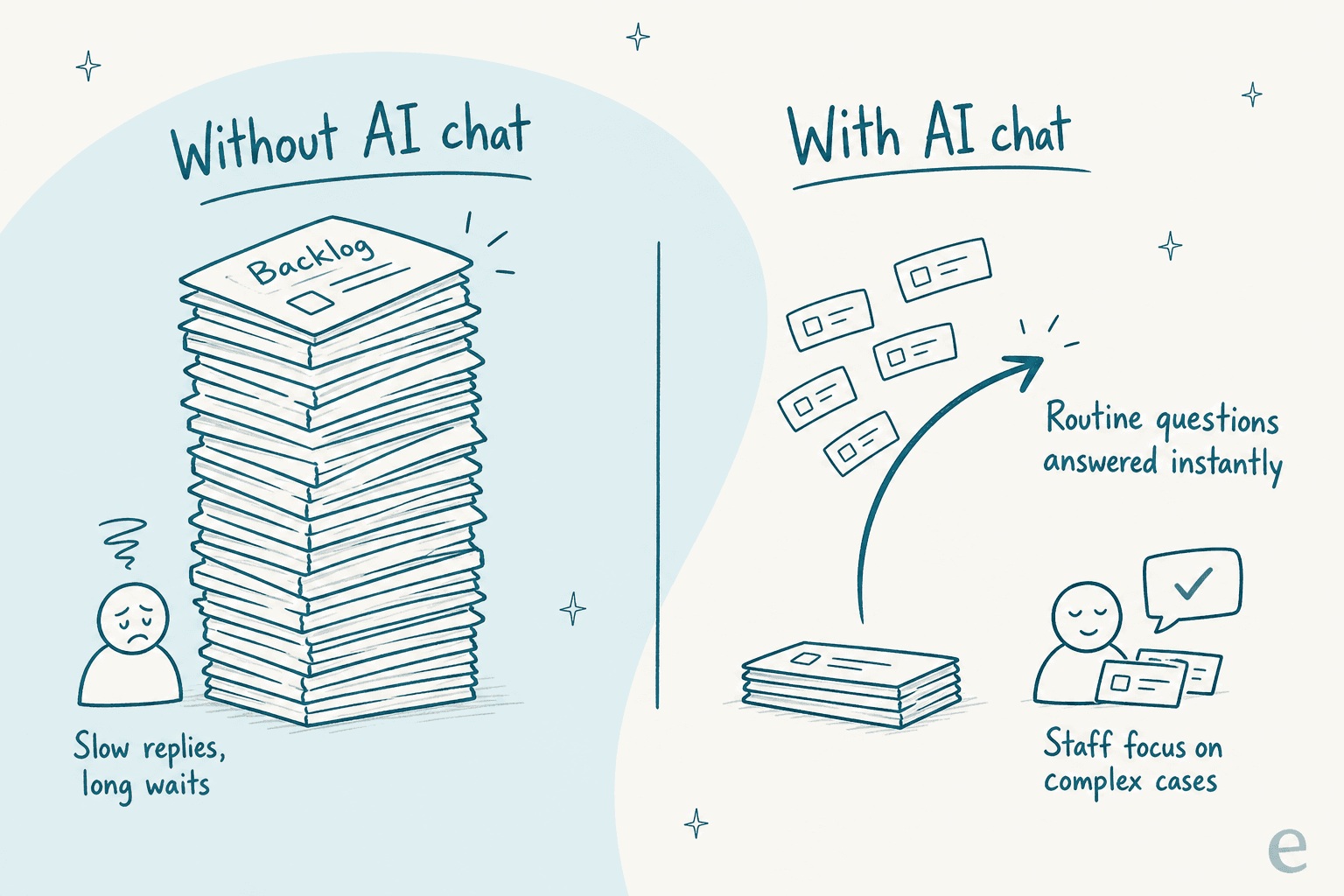
That "always-on" expectation is exactly what a good AI chatbot is built for. It doesn't replace the human relationship a student has with their advisor; it handles the 24/7 logistics layer so the humans can spend their time on the conversations that matter.
What to automate first (and what to keep human)
This is the decision that makes or breaks a rollout, so I'll be blunt about it. The instinct is to try to automate everything on day one. Don't. The right first target is high-volume, low-sensitivity questions.
Think about it as a grid. Volume on one axis, sensitivity on the other.
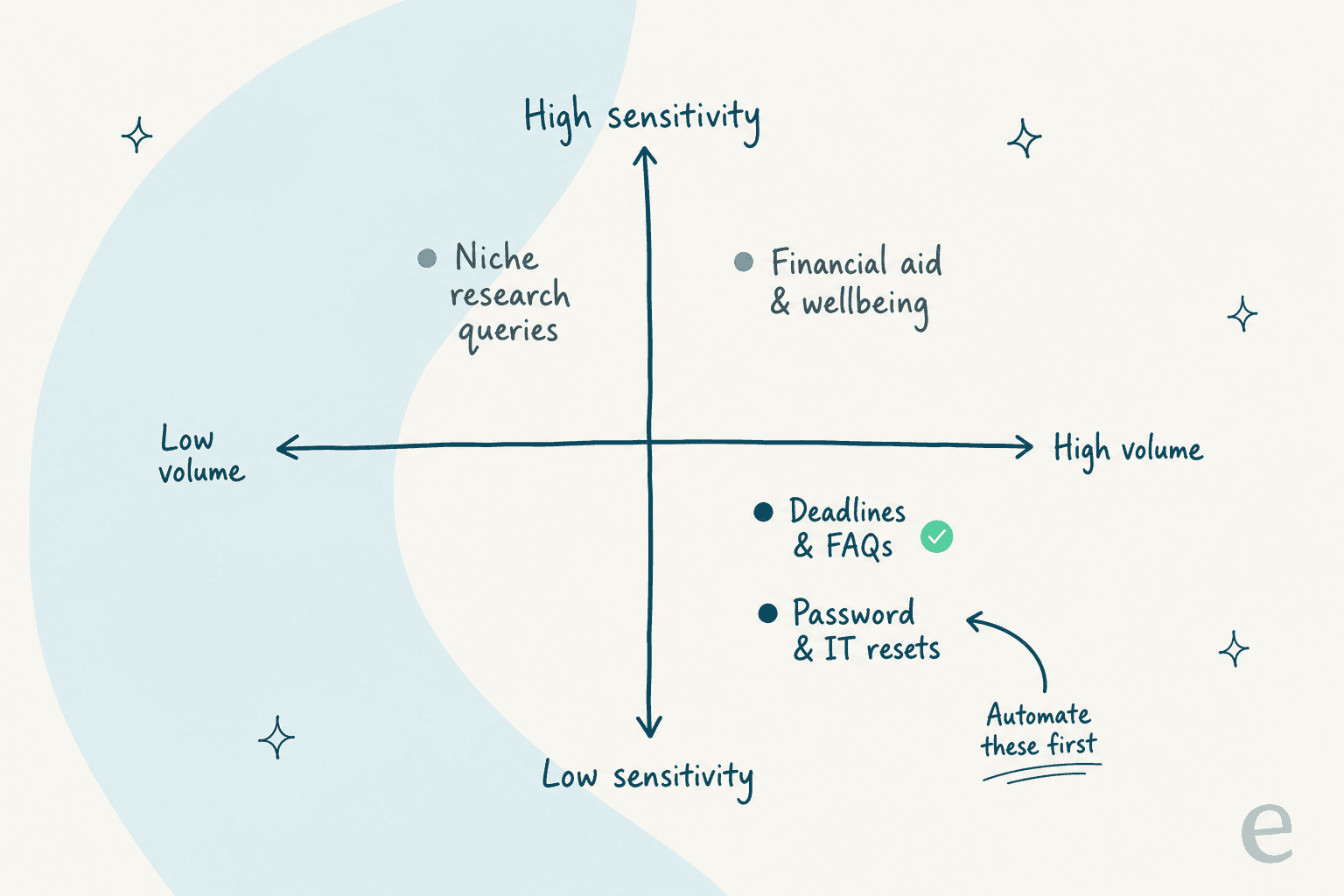
The bottom-right quadrant (high volume, low sensitivity) is where a chatbot earns its keep immediately: deadlines, office hours, "where do I find X," password and IT resets, basic registration and financial-aid FAQs. The top-right (sensitive, still common) is where a good tool answers the factual part and hands off the rest. And the top-left (sensitive, rare) should almost always go straight to a person.
For students who need repeated, one-on-one explanations, a school chatbot can direct families to human tutoring. Brighterly math offers live online lessons with a tutor.
To make that concrete, here's a quick triage you can walk through for any question type on your own queue.
How an AI chatbot handles a student question
Under the hood, a good education chatbot follows the same loop every time, and understanding it helps you trust it (and configure it).
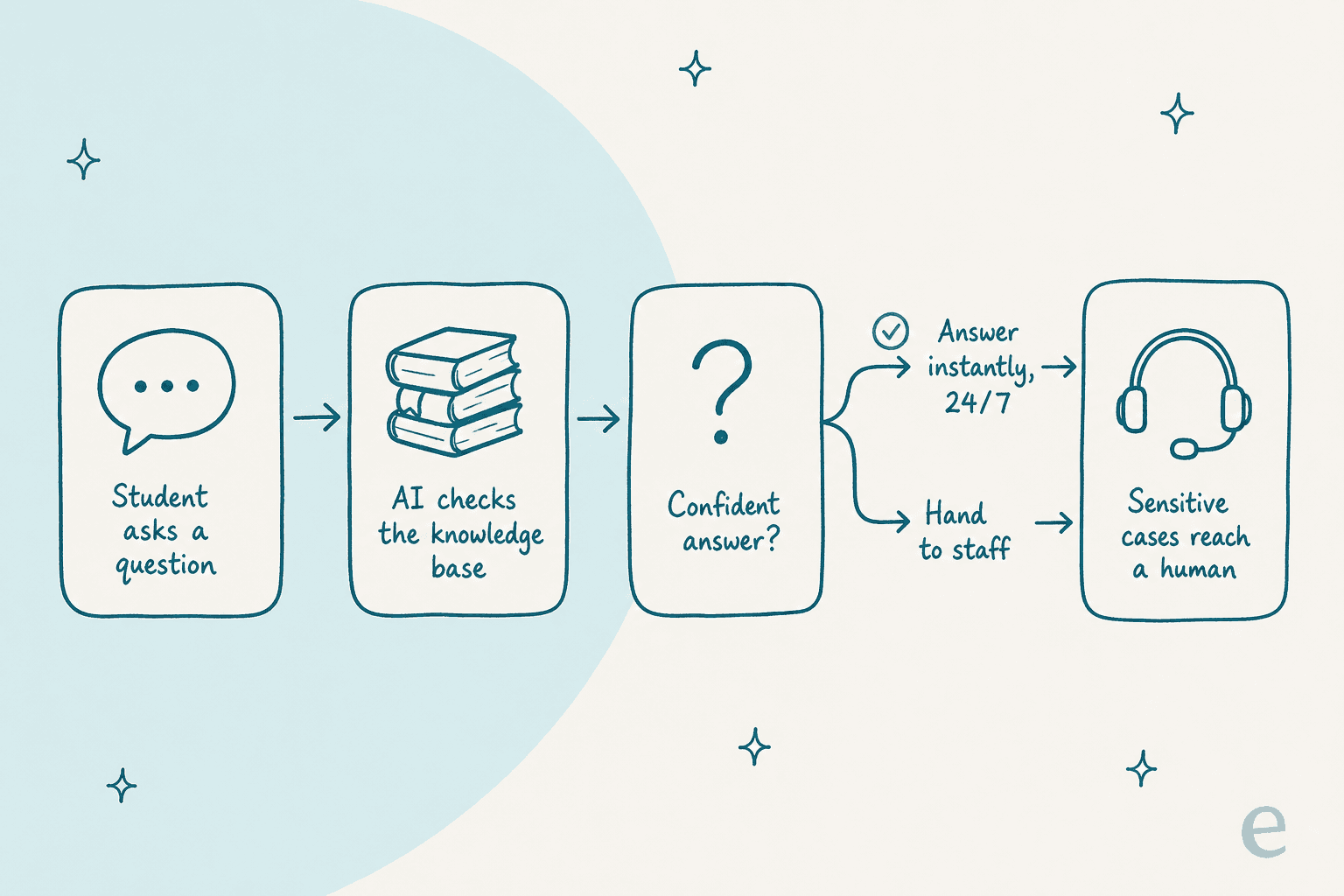
The student asks, the AI searches your connected knowledge base, and then the critical step: it decides whether it's confident enough to answer. If yes, it responds instantly with a source. If no, it hands off to a human instead of guessing. That confidence gate is the single most important feature in education, because a bot that would rather stay silent than make something up is a bot you can actually put in front of students.
This is also where a lot of cheaper tools fall down. If you've ever wondered why chatbots give wrong answers, it's almost always because it has no real confidence gate, or its knowledge base is out of date. Both are fixable, and both are things to test before you go live.
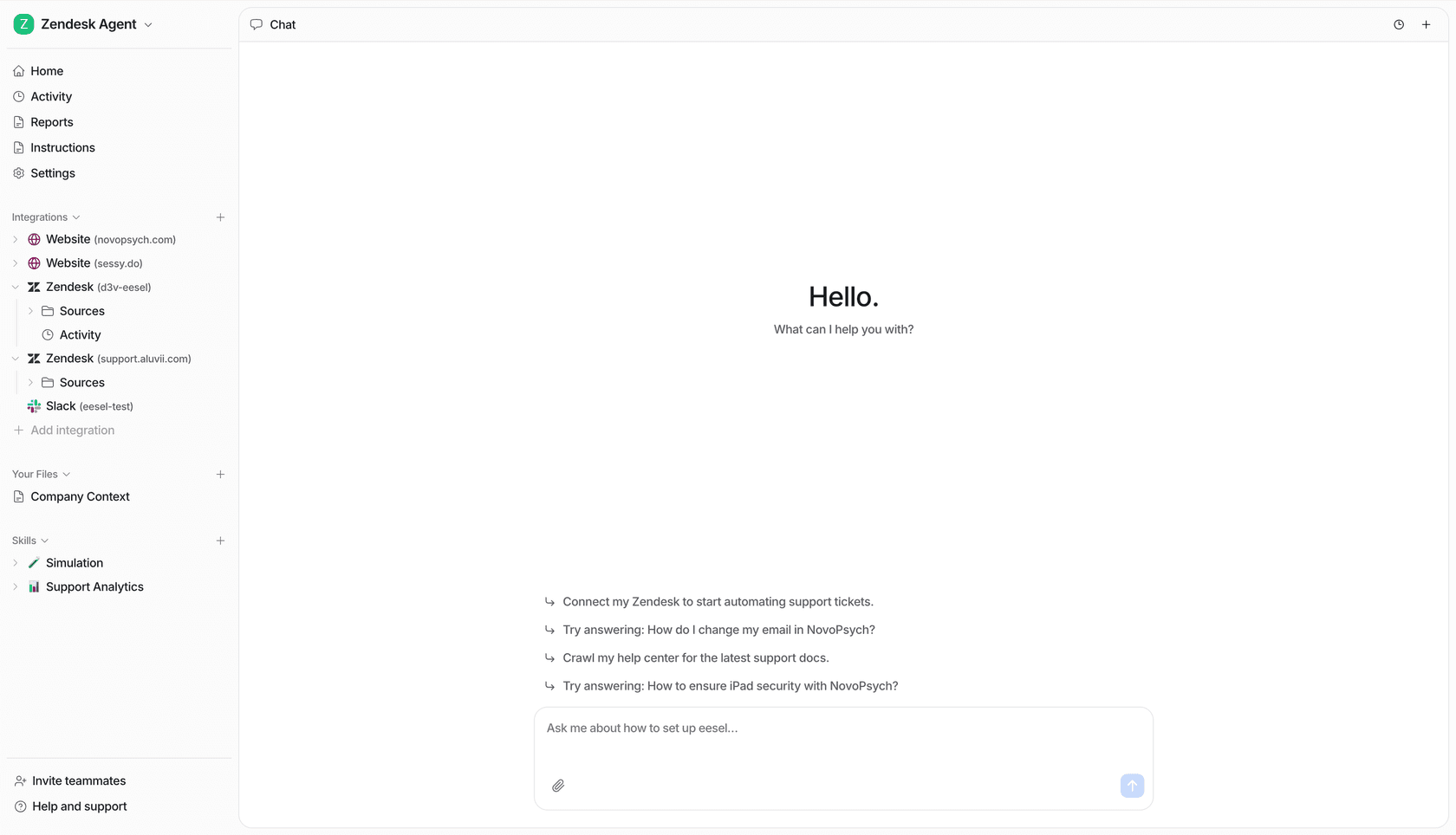
At eesel, this is the part I'd point a school to first. Before any eesel agent talks to a student, you can run it in simulation mode against your own historical questions, so you see exactly what it would have said and how many it would have resolved. We built that because we've watched confident-sounding bots quietly give wrong answers, and simulating against real past tickets is the only honest way to know your resolution rate before launch.
What schools are already seeing
The best argument for any of this is what's already happening on real campuses.
Georgia State University is the landmark case. Its "Pounce" chatbot fielded 50,000+ messages with under 1% needing staff intervention, drove a 21.4% reduction in summer melt, and reached underserved students harder (31.7% more messages from Pell-eligible students). Independent Brookings analysis found texted students were 3.3 percentage points more likely to start their fall semester. GSU's admissions VP described it memorably:
"It was like wearing an Ironman suit for communication."
The results were strong enough that GSU's National Institute for Student Success later won a $7.6M Department of Education grant to study AI chatbots in the classroom.
Arizona State University's "Sunny" chatbot saved an estimated 492 staff hours in its first year, though student reactions there were more mixed, a useful reminder that deployment quality matters as much as the tech.
The adoption trend backs this up. Ellucian's Higher Education AI Survey found 90% of higher-ed professionals now use AI, up from 84% a year earlier. And the broader market reflects it: HolonIQ pegs global EdTech at $404B in 2026, growing 16.3% a year, with AI its fastest-growing slice.
What real users say (the good and the frustrating)
Case-study numbers are the sunny side. To see the reality, it's worth reading what the people running these bots say in reviews. Here's the upside, from a financial-aid director:
"Students can ask their questions and get answers 24/7, eliminating much of the phone and email traffic that would have come to Financial Aid staff."

And here's the frustration that shows up again and again, which tells you exactly what to test for:
"Many of the answers offered by the service are generic and students / inquirers almost always have follow-up questions that require a live person."
That "generic answers, then need a human" pattern is the number-one complaint about education chatbots, and it comes straight from a bot that can't answer specifically and can't hand off cleanly. There's also the maintenance trap:
"This product is only as good as you build it. If you do not populate answers to questions, users will not find value in using this product."
That last one is the argument for choosing a tool that learns from your existing content rather than one that makes you hand-build and hand-maintain an answer library. A bot fed by your live help center stays current on its own; a bot fed by a manual FAQ tree rots the moment a deadline changes.
The FERPA and privacy question
This is the part that (rightly) stalls a lot of education deals, and Ellucian's survey confirms it: data security and privacy is the #1 barrier, cited by 61% of professionals personally.
FERPA governs how student education records can be disclosed (studentprivacy.ed.gov is the authoritative reference). The practical risk with a consumer-grade chatbot is that student conversations become training data for a model you don't control and can't audit. That's the thing to rule out. When you evaluate any tool, insist on three things:
- Authentication before any student record is surfaced. A bot can answer "when is the deadline" for anyone; it must not reveal a specific student's aid amount or grades without verifying who's asking.
- A written commitment that your data won't train the vendor's models. This is the FERPA-critical one.
- Recognized security posture (SOC 2, and ideally your own data residency and audit rights).
eesel is built for exactly this kind of scrutiny: it's SOC 2 Type II certified, your data isn't used to train models, and you control precisely which questions the AI is allowed to handle. That control is what lets you keep aid amounts, conduct issues, and wellbeing conversations firmly on the human side of the line.
Getting it right: the pitfalls to avoid
Pulling the research together, the schools that succeed with an AI support agent and the ones that waste money on it differ on a few specific things:
- They scope it. They automate the high-volume FAQs first and expand from there, rather than trying to boil the ocean on day one.
- They keep the knowledge base fresh. The "outdated bot gives wrong answers" failure is entirely a content-maintenance problem. Tools that read your live help center avoid it.
- They design the handoff. A confidence gate plus a clean escalation to a real person is what keeps a bot safe for sensitive cases.
- They test before launch. Simulating against real historical questions tells you your resolution rate before a single student is affected.
- They watch the pricing model. Per-seat or per-resolution billing can balloon during enrollment spikes. Usage-based pricing keeps costs predictable when volume is seasonal.
Do those five and an AI chatbot stops being a gamble and becomes what GSU got: an Ironman suit for a stretched student-services team.
Try eesel for student support
If you're weighing an AI chatbot for your school, university, or edtech product, eesel is built for the exact constraints education throws at you. It connects to your existing help center, past tickets, and portals, then answers routine student questions instantly across chat, email, and your helpdesk, in the student's own language.
The two things that matter most here are the two eesel leans hardest on: a simulation mode that shows your real resolution rate against historical questions before you go live, and granular control over which questions the AI handles, so deadlines and IT resets get answered automatically while financial aid and wellbeing cases route straight to your team. Pricing is a fixed monthly price from $299/month for 500 credits with no seat fees, sized to volume, so you can move up a plan when enrollment triples. We've even taken eesel onto a university campus ourselves.

You can try eesel free and simulate it against your own questions in an afternoon, no sales call required to see whether it would actually resolve your queue.