AI blog writer vs ChatGPT: Which tool creates content that actually ranks?

Stevia Putri

Katelin Teen
Last edited January 15, 2026
We have all been there. You ask an AI to write a blog post, and what you get back is okay. It is grammatically correct and on-topic, but it is also generic content that may require significant editing to rank.
As some folks on Reddit have pointed out, even with the best prompts, the raw text is never "publishable" as is. The real job is not just making content; it is making good content fast enough to matter.You really, really shouldn't use AI to write things for you and publish it out of the box. These tools should be used for specific things to prepare your writing, such as collecting ideas, research, and creating outlines but you should make your writing your own.

This leaves you with two main paths: a general-purpose tool like ChatGPT, or a specialized AI blog writer built for one specific task.
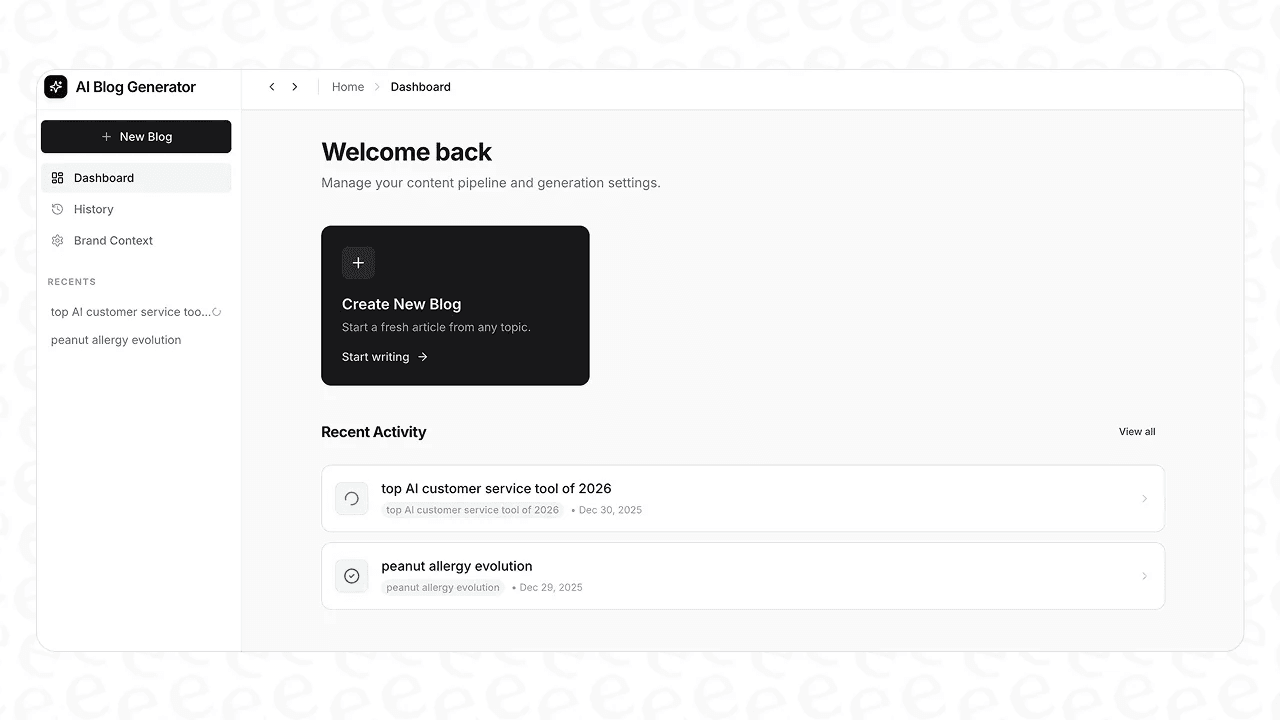
This guide is a straightforward, head-to-head comparison to help you pick the right tool for your content plan.
What is an AI blog writer?
An AI blog writer is a purpose-built platform that turns a single keyword into a complete, publish-ready, and SEO-optimized article. Think of it less like a blank text editor and more like an automated content team in a box.
Unlike general models that need constant hand-holding, these tools are designed to manage the entire content process, from the initial research to the final formatting.
Here are the key traits of a modern AI blog writer, which you can see visualized in the infographic below:
- Single-input workflow: You give it a keyword and your website URL, and it does the rest. The research, outlining, writing, and even creating assets happen on their own.
- Context-aware research: It does deep research that fits the type of blog post. For example, it can pull pricing data for comparison articles or grab technical specs for product reviews, digging much deeper than surface-level info.
- SEO and AEO are built-in: Its features are designed from the ground up to help content rank in search engines (SEO) and get featured in AI answer engines like Google AI Overviews (AEO).
- Media-rich output: The final result is not just a block of text. It is a complete post with images, relevant videos, data tables, and social proof, ready to go live.
An infographic showing the streamlined process of a specialized AI blog writer, a key point in the AI blog writer vs ChatGPT comparison.
In short, it is the right tool for content teams focused on one thing: scaling organic traffic efficiently without letting quality slide.
What is ChatGPT?
When it comes to blogging, its general-purpose nature means it operates as a hands-on, DIY tool. You have to be the strategist, researcher, writer, editor, and designer. As content experts often say, you already need to be a good writer and editor to get high-quality stuff out of it.
The process is typically manual and multi-step.
You have to prompt for an outline, then prompt for each section one by one. After that, you have to stitch the text together, check for factual errors, find and create all your images and videos, format everything, and manually tune it for SEO. ChatGPT provides the foundational text, not the finished product.ChatGPT is intuitive, but you will need to be very good at the prompts to get the most out of it. A dedicated AI writing tool on another hand may give you a better UI when it comes to writing a certain type of content...But ultimately, AI writing should only serve as an assistant, I wouldn't encourage you to just use the written content as it is.
Feature showdown: AI blog writer vs ChatGPT
Content quality and authenticity
ChatGPT:
- Pros: It can churn out grammatically correct text on almost any topic. With very specific, detailed prompts, you can guide it to mimic different tones and styles.
- Cons: The output may be general. It does not always have unique insights and can create factual inaccuracies or "hallucinate," which means you have to be on your toes with fact-checking. The text usually needs significant editing to add a human touch and get rid of common AI-generated phrases.
eesel AI blog writer:
- Pros: It is built for depth and authenticity. The eesel AI blog writer does context-aware research and automatically includes real social proof, like relevant quotes from Reddit threads and helpful YouTube videos, to add real value. It also learns your brand from your website, so it can weave in natural product mentions without sounding clunky.
- Cons: It is a specialist. It is made to create excellent blog content, so it is not what you need if you are trying to write a poem or debug some Python code.
Workflow and speed
ChatGPT:
- Process: The workflow is a manual, multi-step process. You prompt for an outline, then for each section, then for a conclusion. Then you paste it all into a document. After that, you still need to find images, add internal and external links, format your headings, and do your SEO checks. A single blog post can take hours to produce.
- Speed: While the text generation is quick, the total time to get a post ready for publishing is long because of all the manual work.
eesel AI blog writer:
- Process: It offers a more automated workflow. You enter a keyword and your website URL. The tool generates a complete post that includes an introduction, a structured body with H2s and H3s, a conclusion, an FAQ section, AI-generated images, infographics, and relevant internal and external links.
- Speed: It turns a multi-hour process into just a few minutes. You go from a keyword to a finished, publish-ready article in a fraction of the time.
SEO and traffic potential
ChatGPT:
- SEO: It can sprinkle in keywords if you tell it to, but it does not inherently understand SEO best practices. Things like meta descriptions, proper heading structure, or smart internal linking all need detailed, manual instructions from you.
- AEO (Answer Engine Optimization): It is not designed for this. It does not automatically structure content with things like FAQs or data tables in a way that is optimized for Google's AI Overviews. With Gartner predicting that traditional search volume will drop 25% by 2026 because of AI answer engines, this is a major consideration.
eesel AI blog writer:
- SEO: It is built-in from the start. The eesel AI blog writer automatically includes the target keyword in the title, meta description, and headings. It uses a logical H1-H2-H3 structure that search engines prefer, and it handles linking for you.
- AEO: It is specifically optimized for answer engines. It generates structured data like FAQs and comparison tables that are designed to be picked up and featured by platforms like Google AI Overviews and Perplexity. This helps position your content as an authoritative source for the future of search.
Pricing breakdown: AI blog writer vs ChatGPT
ChatGPT Pricing:
- Free: Gives you access to older models with usage caps and other limits.
- Plus: Costs $20 per month for one person. This gets you access to better models like GPT-4o, faster responses, and tools like DALL-E.
- Team: Costs $25 per user per month (when billed annually). It includes everything in Plus, plus a larger context window and a shared workspace for teams.
- Enterprise: Custom pricing for big companies that need advanced security, admin controls, and unlimited high-speed access.
eesel AI blog writer Pricing:
- Free to Try: You can generate your first complete blog post for free to see the quality for yourself. No credit card needed.
- Credit-Based: It is a pay-as-you-go model. You can buy a pack of credits, like $99 for 50 blog generations. There are no monthly subscription fees, so you only pay for what you create.
Here is a quick comparison:
| Feature | ChatGPT (Plus/Team) | eesel AI blog writer |
|---|---|---|
| Model | Subscription for a general tool | Pay-per-output for a finished product |
| Cost | ~$20-$25/user/month | ~$1.98 per complete blog post |
| Primary Value | Access to a powerful LLM | Time saved and a predictable, high-quality result |
| Hidden Cost | Your time (hours of prompting, editing, formatting) | None, the price is for a finished asset |
To see how different AI models stack up against each other, check out this video review that tests multiple tools side-by-side.
AI blog writer vs. ChatGPT: Which should you choose?
This is not about one tool being flat-out "better" than the other. It is about picking the right tool for the job. You would not use a screwdriver to hammer a nail, and you should not use a generalist AI when you need a specialist.
Use ChatGPT when:
- You need a flexible assistant for brainstorming, summarizing text, or drafting a quick email.
- You have the time and expertise to manage the whole content creation process yourself, from prompting to publishing.
- You just need raw text, and you are ready to handle the research, asset creation, and SEO on your own.
Use an AI blog writer like eesel AI when:
- Your main goal is to consistently publish high-quality, SEO-optimized blog content at scale to grow organic traffic.
- You need to cut the time it takes to get from a keyword to a published post from hours down to minutes.
- You want a tool that handles the complete workflow, including research, writing, asset creation, and optimization for both SEO and AEO.
The best way to see the difference is to try it. You can generate your first complete, media-rich blog post for free and judge the quality for yourself.

Frequently Asked Questions
Share this article

Article by
Stevia Putri
Stevia Putri is a marketing generalist at eesel AI, where she helps turn powerful AI tools into stories that resonate. She’s driven by curiosity, clarity, and the human side of technology.