6 top AI blog writer use cases to scale your content

Katelin Teen
Katelin Teen
Last edited January 14, 2026
AI content tools have really grown up. Just a few years ago, they were a fun gimmick. Now, they're a legitimate part of any content creator's toolkit. But here's the catch: most people are only using a fraction of what these tools can actually do.
If you're just using an AI blog writer to generate a rough first draft, you're leaving a lot of value on the table. The real value appears when you apply AI to specific tasks across your entire content workflow, from brainstorming all the way to promotion. It’s not about replacing your skills; it’s about making them way more powerful.
This post covers six practical ways to use AI that go beyond just generating text. These are the strategies that help you save time, improve the quality of your work, and get better results from search engines. We used these exact ideas to build the eesel AI blog writer, the tool that helped us grow our blog impressions from 700 to over 750,000 per day in just three months.
What are AI blog writer use cases, anyway?
When we talk about an "AI blog writer use case," we're not just talking about hitting a "generate" button and hoping for the best. It means using AI to solve a specific problem somewhere in the long process of creating and publishing a piece of content.
Think of it as having a smart assistant who can handle specialized tasks. This covers the entire content lifecycle:
- End-to-End Production: Taking a single idea and turning it into a complete, ready-to-publish blog post.
- Creative & Ideation: Smashing through writer's block, brainstorming new topics, and creating solid outlines.
- Optimization & Research: Making sure your content is perfectly tuned for search engines and supported by real data.
- Repurposing & Promotion: Getting more out of every article by turning it into social media posts, emails, and more.
Instead of just being a text generator, a good AI writer becomes your partner for brainstorming, research, structuring, optimizing, and even promoting your work.
Our criteria for choosing these high-impact AI blog writer use cases
To cut through the hype, we picked the use cases on this list based on a few straightforward but important criteria. We wanted to focus on strategies that actually deliver measurable results for content teams.
Here’s what we looked for:
- Time Savings: Does it reduce the manual, repetitive work that slows writers down?
- Quality Enhancement: Does it actually make the final blog post better: more detailed, engaging, or authoritative?
- SEO & Traffic Impact: Does it directly help you rank higher and bring in more organic traffic?
- Scalability: Is it a repeatable process you can use to consistently produce high-quality content?
- Accessibility: Can a regular content writer use it without needing a degree in prompt engineering?
Quick comparison of tools for top AI blog writer use cases
Here’s a quick look at the main tools we’ll be discussing. This table gives you a high-level overview of where each one shines in the content creation workflow.
| Feature | eesel AI blog writer | ChatGPT | Jasper AI | Wordtune |
|---|---|---|---|---|
| Primary Use Case | End-to-end Blog Generation | Brainstorming & Outlining | Repurposing & On-brand Copy | Editing & Readability |
| SEO Optimization | Built-in (SEO & AEO) | Manual Prompting | Basic | None |
| Automatic Assets | Yes (Images, Videos, Quotes) | No | AI images only | No |
| Human-like Tone | High (Learns from site) | Variable | Good (Brand Voice feature) | N/A (Editor) |
| Pricing Model | Credit-based (50 blogs for $99) | Subscription (Plus at $20/mo) | Per-seat Subscription (Starts at $59/mo) | Subscription (Starts at $4.89/mo) |
| Free Trial/Plan | Yes (Free to try) | Yes (Free version) | Yes (7-day trial) | Yes (Free plan) |
6 powerful AI blog writer use cases
Let's dive into the specific ways you can use AI to level up your content game.
1. Generate a complete blog post: An end-to-end AI blog writer use case with eesel AI
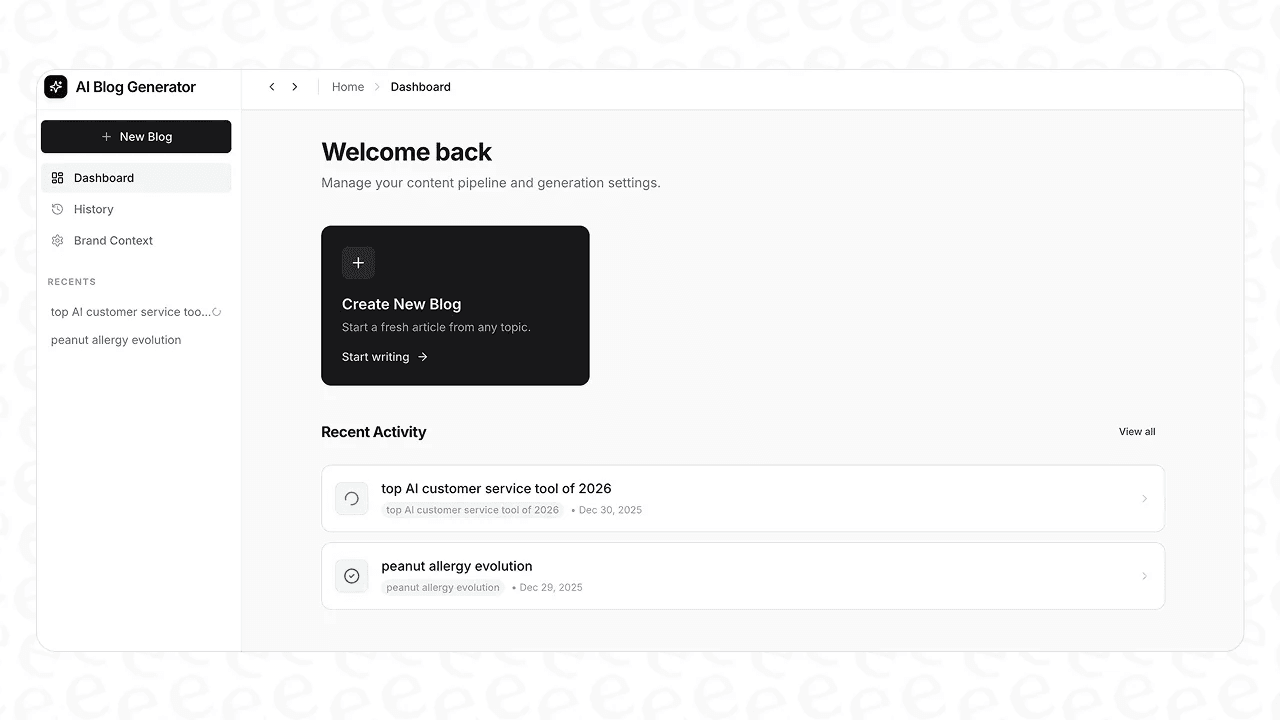
A key goal for content efficiency is generating a full blog post that's almost ready to publish right away. This use case focuses on producing a well-structured, SEO-optimized article that includes rich media, rather than just a preliminary text draft. The eesel AI blog writer was built for this exact purpose, designed to turn a single keyword into a comprehensive article.
- Pros: This approach is a huge time-saver because it combines research, writing, SEO, and asset creation into one step. Its context-aware research aims to provide depth on your topic, resulting in more detailed content. It's also optimized for Answer Engine Optimization (AEO), which prepares your content for new search features like Google's AI Overviews. It also automatically generates and embeds AI images, tables, relevant YouTube videos, and even real quotes from Reddit to add social proof.
- Cons: While the quality is very high, it’s not meant to be a completely hands-off process. You’ll still want to do a final human review to add your unique brand perspective and make sure it aligns perfectly with your strategy. We actually see this "human-in-the-loop" design as a feature, not a bug.
- Pricing:
- It's completely free to try for your first blog post.
- The paid plan is a simple, one-time purchase of $99 for 50 blog credits.
- Why it's on the list: This is the use case that lets you scale content production without sacrificing quality. Instead of juggling five different tools for writing, SEO, and visuals, you get a nearly-finished product from one platform. It's how we were able to grow our own blog traffic so dramatically in a few short months.
2. Brainstorm topics and create outlines: A creative set of AI blog writer use cases with ChatGPT
Staring at a blank page is the absolute worst. Using a conversational AI like ChatGPT to brainstorm titles, explore different angles, and build out detailed outlines is a great way to get moving and ensure your article has a logical structure from the get-go.
- Pros: ChatGPT is excellent for generating a large volume of ideas quickly. You can chat with it, ask for different perspectives, and refine your topic in real-time. It's a highly effective tool for breaking through a bad case of writer's block.
Hey fanfic writer here im, I 100% agree with what's been said here and ontop of that AI is by far the best tool to use in order to get out of a writers block especially when that block centers on word choice. I often find myself obsessing over each word in my writing because thats just the kind of person I am, and AI is wonderful for quickly iterrating and trying new things.

3. Repurpose content for social media: Smart AI blog writer use cases with Jasper AI
One great blog post can fuel your social media calendar for weeks. AI tools like Jasper AI are highly effective at taking a long-form article and slicing it into engaging tweets, insightful LinkedIn posts, or concise email newsletter snippets.
- Pros: Jasper has specific templates and workflows like Content Pipelines that are built for this kind of repurposing, saving you hours of manual work. Its Brand Voice feature also does a pretty good job of keeping the tone consistent across all your different channels. It’s a great way to maximize the return on every single blog post you write.
- Cons: The repurposed content still needs a human touch. You'll probably need to add timely hashtags, tag relevant accounts, or inject your brand's unique personality. Sometimes the AI can miss the most interesting "hook" from the original article, so you’ll need to guide it.
- Pricing:
- Jasper offers a 7-day free trial.
- The Pro plan starts at $59/month per seat if you pay annually.
- Why it's on the list: Content promotion is just as important as content creation. This use case ensures that the hard work you put into writing a blog post actually gets seen by the widest possible audience.
4. Enhance readability and edit drafts: AI blog writer use cases for polishing content with Wordtune
Once the first draft is done, the real work of editing begins. AI-powered editors like Wordtune are designed to help you improve clarity, tighten up your phrasing, and adjust the tone of your writing without losing your core message.
- Pros: Wordtune is great for finding different ways to say the same thing, making your writing feel more dynamic and less repetitive. It can quickly shorten long, rambling paragraphs and help you maintain a consistent tone throughout the piece. It’s like having a co-editor on call to polish your work.
- Cons: It’s an editor, not a writer. It can't generate new ideas, structure an argument, or fix a poorly researched article. Its focus is strictly on the sentence level, so it won't help with the overall flow or structure of your content.
- Pricing:
- A free plan is available that gives you 10 rewrites per day.
- The Unlimited plan is $6.99/month when billed annually.
- Why it's on the list: Readability is a big deal for both user engagement and SEO. If people can't easily read and understand your content, they'll leave. This use case helps you deliver a clear, professional piece that keeps readers on the page longer.
5. Generate custom visuals: An essential part of modern AI blog writer use cases with Midjourney
A wall of text is a recipe for a high bounce rate. Visuals are essential for breaking up your content and making it more engaging. AI image generators like Midjourney let you create completely custom header images, infographics, and illustrations from simple text prompts.
- Pros: You can create unique, royalty-free images in seconds without needing any design skills or a budget for stock photos. This allows you to develop a distinct visual style for your blog. Midjourney, in particular, is known for producing high-quality results that are visually impressive.
- Cons: Getting great results consistently takes some skill in "prompt engineering," as it's a bit of an art. The output can sometimes be unpredictable. This also means adding another tool and another subscription to your stack. In contrast, tools like the eesel AI blog writer include automatic asset generation, so you don't need a separate tool.
- Pricing:
- It's a subscription-based tool, with the Basic Plan starting at $10/month. There is no free trial.
- Why it's on the list: High-quality, relevant visuals don't just improve the user experience; they also make your content way more shareable on social media. AI makes this level of custom imagery accessible to everyone.
6. Perform keyword research: Strategic AI blog writer use cases with SEMrush
You can write the best blog post in the world, but it's useless if nobody can find it. Understanding what people are searching for is the foundation of any good content strategy. SEO platforms like SEMrush are now integrating AI to analyze keywords, spot content gaps, and suggest article structures that are built to rank.
- Pros: AI can sift through huge amounts of search data to spot patterns and opportunities that a human might miss. Features like Personal Keyword Difficulty analyze your specific domain to help you find keywords you can actually rank for. It's about moving beyond just matching keywords to truly understanding what the user wants.
- Cons: These are enterprise-level tools, and they come with a hefty price tag. They're powerful but can also be overwhelming for beginners. The AI features are a huge help, but they don't eliminate the need for a solid understanding of basic SEO principles.
- Pricing:
- SEMrush is a premium tool with subscription costs that are typically aimed at businesses rather than individual writers.
- Why it's on the list: This use case ensures your content creation efforts are tied to a data-driven strategy right from the start. It's the key to making sure your work actually gets found.
Pro tips for getting the most out of these AI blog writer use cases
No matter which tool or use case you choose, a few best practices will help you get much better results.
- Give it context, not just a keyword: The quality of the output is directly tied to the quality of the input. Don't just give the AI a keyword; give it a detailed brief. Tell it about your audience, your desired tone, and key points to include. Treat it like a junior writer who needs clear instructions.
- Always be the editor-in-chief: Never, ever publish AI-generated content without a thorough review. Your job is to fact-check every claim, refine the tone to match your brand, and sprinkle in your own unique insights and stories. That human touch is a significant advantage.
LLMs are powerful tools, but they'll just make your poor communication skills even more obvious. You can get better at writing *without* letting the AI do it for you. Just ask it for options, work with it, even argue with it. It's a great way to improve your own content.
The future of AI blog writer use cases is human-led
The real value of AI in content creation isn't about replacing writers. It's about giving them a suite of powerful, specialized skills to augment their workflow.
As we've seen, AI can be a huge help at every single stage of the content lifecycle, from coming up with the initial idea to promoting the finished piece. The key is to shift your mindset from just "prompting an AI" to strategically managing a modern, tech-enabled content workflow.
To see a complete, AI-assisted content creation process in action, check out this video. It combines human creativity with the efficiency of AI to produce high-quality blog posts that rank.
By embracing these tools, you can become a more efficient, data-driven, and ultimately more effective content creator.
If you're ready to see how a single platform can handle the entire blog creation process, try eesel AI for free and generate your first publish-ready article in just a few minutes.

Frequently Asked Questions
Share this article

Article by
Katelin Teen
Katelin is an operations specialist at eesel where she uses her psychology training and education experience to optimize B2B SaaS processes. Outside of work, she unwinds with story-driven games, writing, and keeping up with latest tech innovations.