A practical guide to AI blog conversion optimization

Stevia Putri

Stanley Nicholas
Last edited January 15, 2026
Expert Verified
It's a frustratingly common story. You pour hours, maybe even days, into the perfect blog post. You get the SEO just right, it starts to rank, and traffic climbs. But then... nothing. Visitors come and go, but that traffic spike doesn't lead to sign-ups, sales, or whatever you were hoping for. It's a classic headache: your content is great at getting attention but falls flat when it comes to turning readers into customers.
Traditional conversion rate optimization (CRO) has its merits, but it can feel like a slow game of trial and error. You A/B test a headline, tweak a button color, and then wait weeks to see if anything happened. The good news is that there’s a smarter way to work. AI-driven marketing can boost conversion rates by 20%, which is exactly what AI blog conversion optimization is all about. It’s the tool that finally connects the dots between traffic and actual revenue.
Tools like the eesel AI blog writer are now designed to build these conversion principles right into the content creation process, helping you turn that traffic into real action from the get-go.
What is AI blog conversion optimization?
Before we get into the "how," let's clarify what we're talking about. Optimizing a blog for conversions with AI isn't just about changing a few things on the page. It’s a completely different way of thinking about how we create and improve content. It's no wonder that 84% of marketers use AI in their work.
Moving from traffic to tangible action
For years, the main goals for a blog were simple: rank for keywords and get as much organic traffic as possible. Those things still matter, but they're just vanity metrics if they don't lead to anything else. Conversion-focused goals are about real business results, like getting a reader to subscribe to a newsletter, book a demo, or buy something.
Blog CRO is the practice of systematically improving your content and user experience to nudge readers toward taking one of those actions. It’s about turning passive readers into active ones.
Traditional vs. AI-powered CRO
The difference between the old way of doing CRO and the new AI-powered method is huge. One is slow and manual; the other is fast, automated, and full of insights.
| Aspect | Traditional CRO | AI-Powered CRO |
|---|---|---|
| Testing | Manual A/B testing of single elements (like a headline), which can take weeks to show meaningful results. | Automated multivariate testing that checks thousands of variations at once and adjusts in real-time. |
| Analysis | Depends on a person looking at heatmaps and session recordings after the fact. | Uses machine learning to analyze user behavior, spot friction points like rage clicks, and predict what a user will do next. |
| Personalization | Broad segmentation based on demographics or other static info. | Dynamic 1-to-1 personalization that changes content and CTAs based on what each user is doing right now. |
| Speed | Slow, step-by-step improvements based on educated guesses. | A continuous optimization loop that gets faster, data-backed results with less hands-on work. |
The core components of AI-powered conversion optimization
AI isn't meant to replace the human element in content; it's here to give it a major boost. It adds incredible speed and intelligence to the CRO process by handling the boring, data-heavy tasks that used to eat up so much time. This change lets teams move from making small, slow changes to a cycle of constant improvement. Here’s how it works.
Automated hypothesis generation
One of the biggest hurdles in traditional CRO is simply thinking of good ideas to test. You're often just going with a gut feeling or a "best practice" that might not even work for your audience. AI tools flip this on its head. They can analyze a topic, your target audience, and existing data to generate multiple data-supported ideas for what might improve conversions.
Instead of a marketer spending an hour brainstorming three different headlines, an AI can spit out thirty in a few seconds, each with a unique angle or emotional hook. This works for everything from intros and subheadings to calls to action (CTAs), letting you test a huge range of creative ideas without the human slowdown.
Behavioral analysis and friction detection
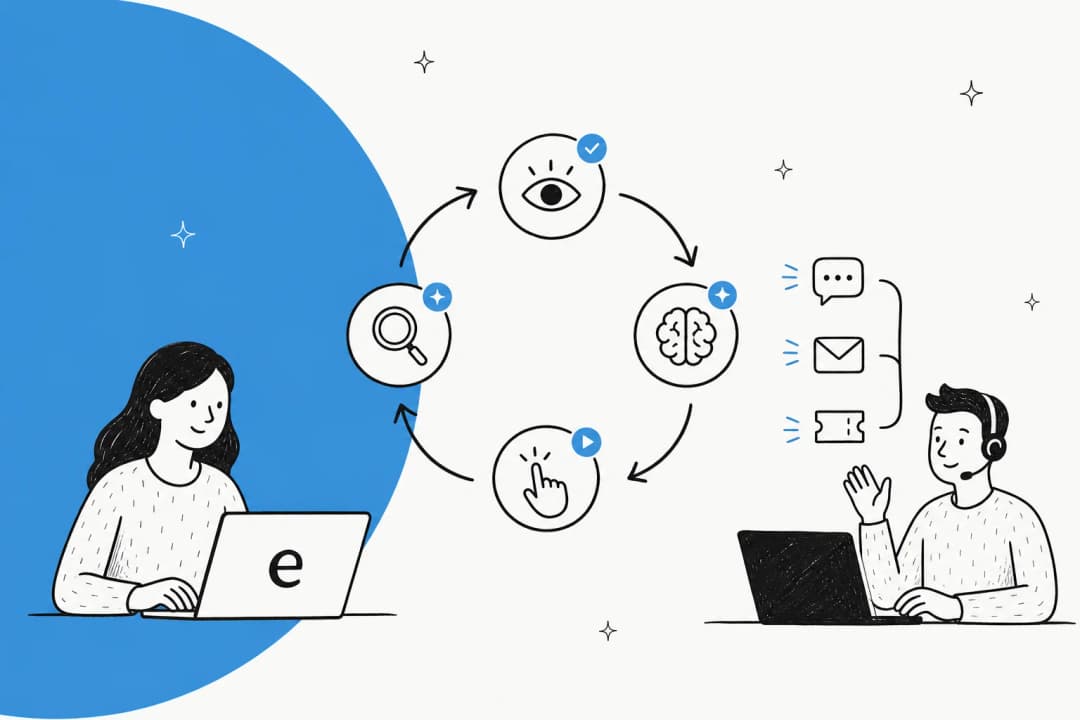
Ever wondered where exactly you lose a reader's attention in a long blog post? AI can show you. By analyzing user interaction data as it happens, AI tools can identify the exact spots where things go wrong. They can automatically calculate a Friction Score by tracking things like scroll depth, rage clicks, and dead clicks.
- Scroll depth: reveals how far down the page people get before they leave.
- Rage clicks: happen when a user clicks over and over on something that isn't clickable, which is a clear sign of frustration.
- Dead clicks: occur when a user clicks on something they think should be interactive, but it isn't.
An infographic explaining how AI detects user friction through scroll depth, rage clicks, and dead clicks, a core part of AI blog conversion optimization.
This kind of information is incredibly valuable. It takes the guesswork out of the equation and shows you the exact parts of a post that need to be rewritten, clarified, or reorganized to keep readers engaged and moving toward your conversion goal.
Using predictive analytics for a smarter strategy
This is where it gets really interesting. Beyond just tweaking existing content, AI can help you create a smarter content plan from the very beginning. Predictive analytics models can estimate the conversion potential of different blog topics or formats before you even start writing.
By looking at historical data and market trends, AI can tell you which topics are most likely to connect with your most valuable audience segments and encourage them to act. According to McKinsey, companies that use this approach are 2.5 times more likely to improve conversions. This means you can build a content calendar based not just on search volume, but on the topics that are most likely to produce real business results.
Practical strategies for blog conversion optimization
Knowing the theory is one thing, but putting it into practice is what gets results. The good news is you don't need a data science degree to get started. Adding AI to your blog workflow can be simple and highly effective. Here are a few practical ways to begin optimizing your content for conversions today.
Step 1: Use the eesel AI blog writer
Instead of writing a blog post and then trying to shoehorn in conversion elements afterward, start with a tool that builds them in from the start. The eesel AI blog writer is made to create complete, publish-ready blog posts that are optimized for action, not just search engines. It's the same tool we used here at eesel to grow our daily impressions from 700 to over 750,000 in just three months.

It works by automatically generating assets that are known to increase engagement and build trust:
- Tables and Infographics: Walls of text can kill conversions. eesel AI breaks down complex info into easy-to-read tables and visuals, helping readers quickly understand your point and feel more confident.
- Authentic Social Proof: It automatically finds and embeds relevant Reddit quotes and discussions right into your post. Since 95% of consumers read reviews before buying, this adds a strong layer of real-world credibility.
- Video Embeds: To keep people on the page longer, the tool includes relevant YouTube videos. This increases engagement and gives readers more reasons to trust your expertise.
An 'AI' writers will simply take a search query you specify. Download the text of the top 10 results. Text mine the results and find common words. Use the most popular semantic linking profile. Write the first iteration of text and then paraphrase.
Step 2: Craft high-impact CTAs
We've all seen them: common, generic CTAs like "Learn More," "Click Here," or "Submit." They are often less effective because they're vague and don't offer any clear value for a click. They create friction because the user has to guess what happens next.
AI can help you write benefit-focused CTAs that match the blog post's content and the reader's intent. For example, instead of a generic "Contact Us" at the end of a post about SEO, an AI might suggest "Get your free, personalized SEO report." This small change lowers the perceived commitment and makes the next step feel like a natural, valuable part of their journey, not a sales pitch.
Step 3: Personalize content for different segments
A single blog post often needs to appeal to different types of people, but a one-size-fits-all message doesn't convert well. AI makes it easy to create multiple versions of a blog post tailored to different industries, job titles, or stages of the buyer's journey.
You can take one core topic, like "The Benefits of Project Management Software," and use AI to quickly create variations for different groups. One version could be for small business owners, focusing on cost and ease of use. Another could be for enterprise managers, emphasizing scalability and security. Each version can have a slightly different angle and a more relevant CTA, which can seriously improve conversion rates without you having to rewrite the whole article over and over.
For a deeper dive into the practical steps of improving your blog's conversion rates, the following video offers some excellent expert insights and answers common questions about the process.
A video from Optimist that offers expert insights on improving your blog's conversion rate.
Why AEO is the new frontier in conversion optimization
A big part of modern conversion optimization is just being present where high-intent users are already looking for answers. These days, that means showing up in AI-powered answer engines.
Answer Engine Optimization (AEO) is the process of optimizing your content to be the direct source for answers in places like Google AI Overviews, ChatGPT, and Perplexity. The link between AEO and conversions is strong. When an AI engine cites your brand in its answer, it's like getting a powerful, unbiased recommendation. It builds a ton of trust before the user even lands on your website.
This is a pretty big deal. Gartner predicts that by 2026, 25% of search traffic will shift to AI chatbots. This is why tools like the eesel AI blog writer are built with AEO in mind. It structures content with the clear headings, lists, factual summaries, and data that AI models are designed to find and use. This "pre-conversion" work builds your authority and makes visitors much more likely to take action once they arrive on your page.
Building a smarter content engine
AI blog conversion optimization isn't about replacing human creativity. It’s about giving your skills a boost with data-driven speed and accuracy. It’s a change in perspective that lets you move beyond just getting traffic and start focusing on what really counts: turning readers into loyal customers.
By using AI to analyze user behavior, automate testing, and build conversion-focused elements directly into your content, you can stop thinking of your blog as just a content calendar to fill and start seeing it as a reliable engine for growth.
Ready to see how easy it is to create content that not only ranks but also converts? Start generating complete, SEO-optimized blog posts with the eesel AI blog writer. It's entirely free to try.
Frequently Asked Questions
Share this post

Article by
Stevia Putri
Stevia Putri is a marketing generalist at eesel AI, where she helps turn powerful AI tools into stories that resonate. She’s driven by curiosity, clarity, and the human side of technology.