

The way people find information online is changing, and it's changing fast. For years, we've all been obsessed with ranking on Google. But now, with AI-powered answer engines like ChatGPT and Google AI Overviews popping up, the game is shifting. It’s not enough to be a blue link on a results page anymore; your brand needs to be the answer.
This isn't just a small trend. According to Gartner predictions, we can expect traditional search engine volume to drop by a huge 25% by 2026. That means getting your brand cited and recommended directly by AI is becoming essential for survival. This new practice is called Generative Engine Optimization (GEO), and it's the next big thing for digital marketing.
This guide will break down the best tools out there to help you master GEO, from keeping an eye on your AI visibility to creating content that AI engines love. We’ll even share the exact tool we used to go from 700 to 750,000 impressions a day in just three months: the eesel AI blog writer.
What are generative engine optimization tools?
So, what exactly is Generative Engine Optimization (GEO)? You can think of it as the next step up from SEO. It’s the entire process of tweaking your content and brand signals so that AI answer engines can understand, trust, and ultimately, cite you in their responses.
The main job of GEO tools is to help businesses see how they're appearing in AI answers, check out what competitors are up to, and create new content that AI models are likely to pick up and reference. These platforms track a whole new set of metrics that didn't even exist a few years ago, like your citation rate, share of voice in AI chats, and even the sentiment of how AI talks about your brand.
How we chose the best generative engine optimization tools for this list
To make this list genuinely useful, we didn't just pull names out of a hat. We looked at each tool based on a few key things to make sure we covered the entire GEO workflow.
- Core Function: Is the tool built for monitoring your brand, creating new content, or technically optimizing what you already have? We looked for a good mix of all three.
- Actionability: Does it just dump a bunch of data on you, or does it give you clear, actionable steps to actually improve your AI visibility? We gave extra points to tools that help you do something.
- Platform Coverage: Does it track your performance across the big players like ChatGPT, Perplexity, and Google AI Overviews? The more engines a tool covers, the better.
- Ease of Use: Is the platform simple enough for a marketing team to use right away, or do you need a data scientist to figure it out? We leaned towards user-friendly options.
Comparison of the top generative engine optimization tools
Here’s a quick look at how the top GEO tools stack up against each other.
| Tool | Best For | Key Function | Starting Price |
|---|---|---|---|
| eesel AI blog writer | Content Creation & AEO | Content Generation | Free to try |
| Profound | Enterprise Brands | AI Visibility Monitoring | $499/month |
| Semrush | Existing Semrush Users | Unified SEO & GEO Analytics | $99/month (add-on) |
| Writesonic | All-in-one SEO & GEO | Monitoring & Content | $199/month (billed annually) |
| Otterly.AI | Budget Monitoring | AI Visibility Monitoring | $29/month |
| Surfer SEO | On-page Content Optimization | Content Optimization | $79/month (billed annually) |
The top 6 generative engine optimization tools to try
Now let's get into the details of each platform.
1. eesel AI blog writer

It's the tool we used to grow our own daily impressions from just 700 to over 750,000 in three months by publishing more than 1,000 GEO-optimized blogs. It works by understanding your brand and then generating deeply researched content that sounds like a human wrote it, not a robot.
Key features include its context-aware research and automatic asset generation. It doesn't just give you a wall of text. It builds a complete article with AI-generated images, charts, and tables. It even pulls in social proof by embedding relevant YouTube videos and real quotes from Reddit forums, which helps build the kind of trust and authority that AI models look for.
- Pros: It creates a full content package, not just a text draft. The content is well-researched, sounds human, and includes all the media assets that AI engines prefer, saving you hours of work. It is also completely free to try.
- Cons: It’s hyper-focused on creating new blog content. If your main goal is to monitor your brand's existing visibility across a ton of different AI prompts, you’ll probably want to pair it with a dedicated analytics platform.
- Pricing:
- Free to try.
- Paid plan: $99 for 50 blog credits.
- Why we included it: It’s an effective tool for the creation part of GEO. It helps you consistently produce the kind of high-quality, structured, and media-rich content that generative engines are built to cite.
2. Profound
Profound is an enterprise-level GEO platform that’s all about monitoring and analytics. It’s a comprehensive tool for large teams, backed by $35M in Series B funding from Sequoia Capital. It gives you deep insights into how your brand is being mentioned in AI answers across more than 10 different engines, including big names like ChatGPT, Claude, and Grok.
- Pros: It offers incredibly detailed data for large organizations and comes with enterprise-grade compliance like SOC 2 Type II and HIPAA. Its "Conversation Explorer" feature analyzes over 400 million real user prompts to give you unique insights into how people are using AI.
- Cons: The Lite plan starts at $499/month, which may be a consideration for smaller teams. Some user reviews mention a data-heavy learning curve and occasional technical glitches, so you might need a dedicated analyst to get the most out of it. Plus, there's no free trial; you have to book a demo.
- Pricing:
- Lite plan starts at $499/month.
- Enterprise plans are custom-priced.
- Why we included it: If you're a large company that needs a full command center for AI visibility and requires strong compliance, Profound offers the most extensive monitoring features on the market.
3. Semrush
Semrush is already a big name in the SEO world, and it has expanded its massive toolkit to include GEO with its AI Visibility Toolkit. It’s designed to help marketers bridge the gap between their traditional SEO efforts and the new world of AI search, all within a platform they already know how to use.
- Pros: The biggest plus is convenience. If your team is already living in Semrush, this is an easy way to start tracking AI visibility without adding another new tool to your stack. You can monitor how you're showing up in AI, analyze competitors, and connect GEO metrics to your broader SEO campaigns in one place.
- Cons: The GEO features are part of a larger SEO suite rather than a standalone GEO platform. The standalone toolkit costs $99/month for each additional domain you want to track, and it's limited to only 3-4 AI engines, which might be too restrictive for some.
- Pricing:
- The AI Visibility Toolkit is part of the Semrush One plans (starting at $165.17/mo annually) or can be bought as a $99/month standalone add-on.
- Why we included it: It's a powerful and practical option for teams that want to manage both their traditional SEO and their emerging GEO strategies from a single, unified platform.
4. Writesonic
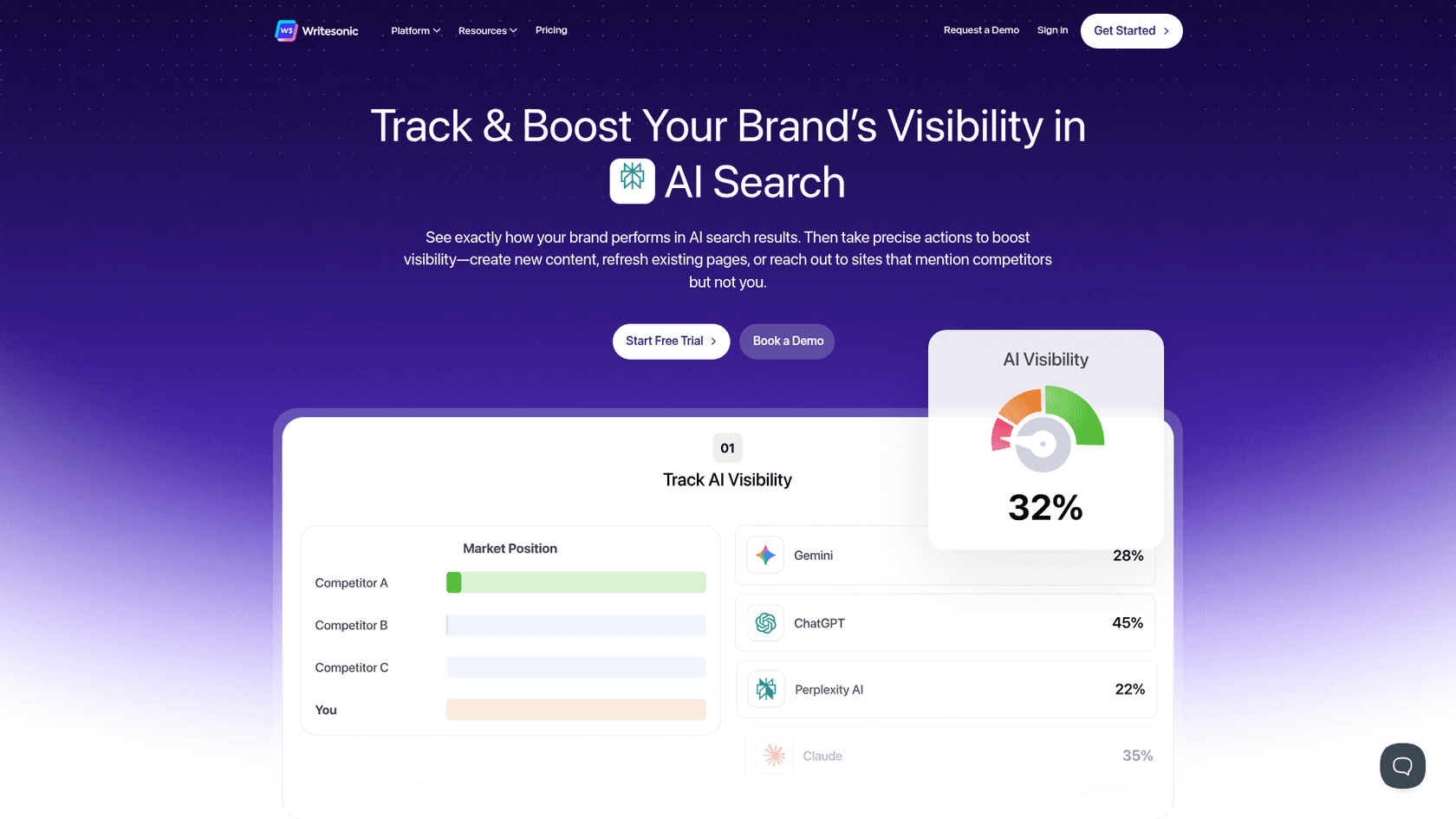
Writesonic tries to bring the best of both worlds together by combining AI content creation with GEO analytics. The idea is to give teams a single platform to generate content that's already pre-optimized for AI and then track how that content performs across engines like ChatGPT, Gemini, and Claude.
- Pros: The platform is built for speed, offering a complete workflow from tracking to creation. Its AI Traffic Analytics feature helps you see visits from AI crawlers that tools like Google Analytics might miss.
- Cons: While it's fast, some users have noted that the AI-generated content can sometimes lack a distinct human touch and require a good amount of editing. Also, the GEO features are only available on the Professional plan and higher, which makes the price of entry for AI visibility tracking a bit more expensive.
- Pricing:
- GEO-focused plans start with the Professional plan at $199/month when billed annually.
- Why we included it: For teams focused on publishing a high volume of content quickly, Writesonic is a strong all-in-one option with both SEO and GEO features baked in.
5. Otterly.AI
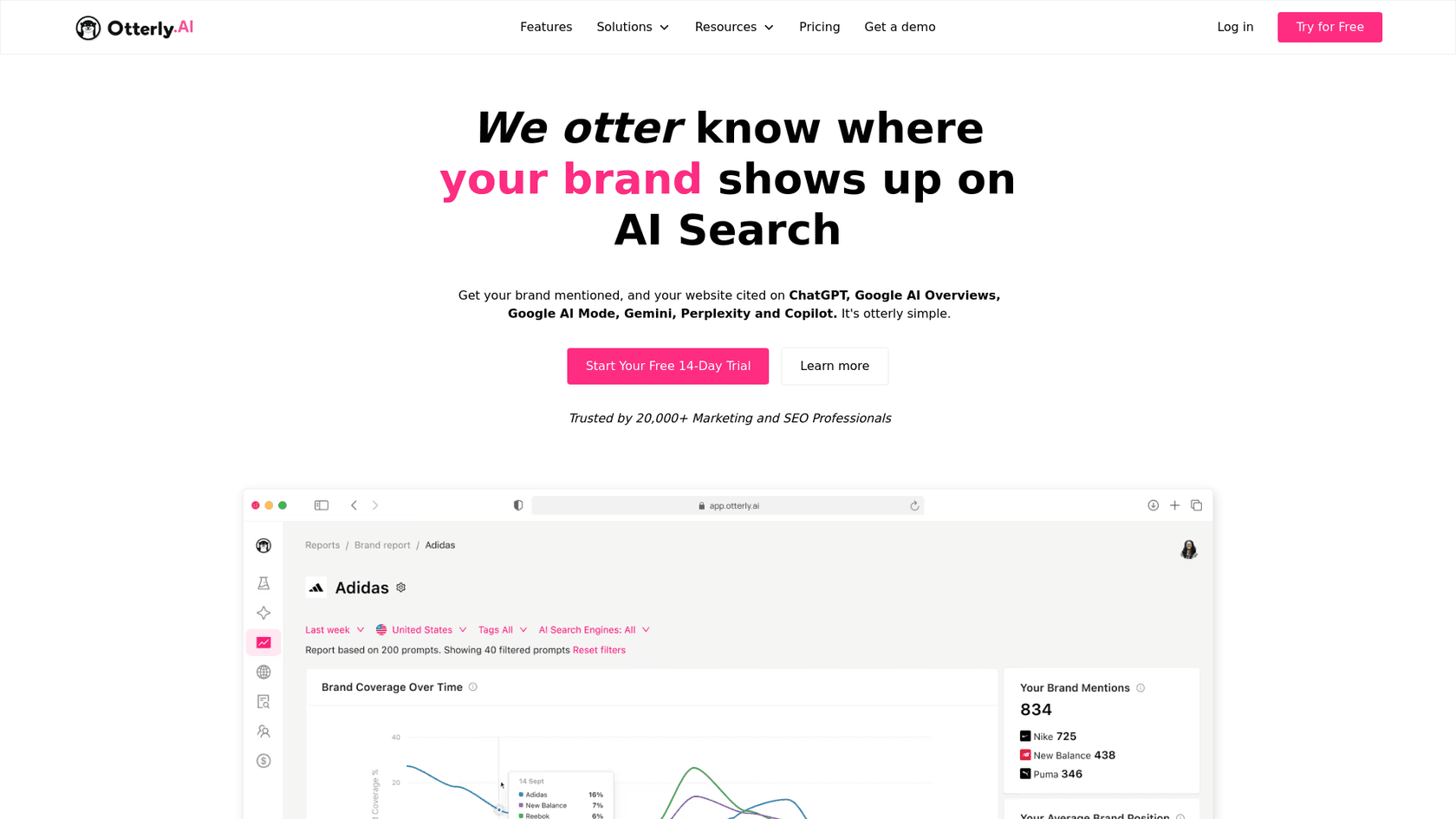
Otterly.AI is a specialized monitoring tool that does one thing: it tracks your brand mentions, link citations, and general visibility across six major AI engines, including ChatGPT, Perplexity, and Google AI Overviews. It's a focused tool that was named a Gartner Cool Vendor in 2025.
- Pros: It’s incredibly user-friendly and very affordable, making it a great entry point into GEO. It even offers a 14-day free trial. The automated weekly reports and the detailed GEO audit tool (which analyzes over 25 on-page factors) are perfect for keeping an eye on your visibility without needing to log in and check manually every day.
- Cons: Otterly is strictly a monitoring tool. It's great at telling you what's happening, but it doesn't have any features to help you create content to fix any issues it finds. One aspect to note is its weekly data refresh, which means the insights you're looking at could be up to a week old.
- Pricing:
- Lite plan starts at $29/month.
- Why we included it: It's an excellent, budget-friendly choice for teams whose main priority is to monitor their AI search presence and get detailed audit reports without the cost and complexity of an enterprise suite.
6. Surfer SEO
Surfer SEO has been a go-to tool for on-page SEO for a while, helping marketers structure their content to rank better. It has recently expanded its feature set to address GEO with its AI Tracker and an "Auto Optimize for Google and AI answers" feature, making it relevant for this new landscape.
- Pros: Surfer is effective at the individual page level. It gives you a clear score and a checklist of actionable tips to make your content more relevant and authoritative. The AI Tracker lets you monitor your mentions in ChatGPT, Perplexity, and Google AI Overviews, which helps you connect your on-page efforts directly to your AI visibility.
- Cons: Surfer's focus is on optimizing specific pieces of content, not your overall brand or entity authority. It doesn't offer the deep, prompt-level analytics or market-wide share of voice tracking that you'd get from a dedicated GEO platform. It's an important piece of the GEO puzzle, but it's not a complete solution on its own.
- Pricing:
- Essential plan starts at $79/month when billed annually.
- The AI Tracker is included in the Scale plan or available as a $95/month add-on.
- Why we included it: It’s a super valuable tool for the optimization phase of your GEO strategy. It helps you make sure the content you’re creating is perfectly tuned to be understood and favored by AI engines.
How to choose the right generative engine optimization tools for your business
- Start with your main job: If your day-to-day is all about creating new content and growing traffic, a tool like the eesel AI blog writer is the most direct path to results. If you're in a brand or PR role and need to monitor your company's reputation, an analytics platform like Profound or Otterly.AI makes more sense.
- Consider your team's workflow: Are you already heavily invested in a suite like Semrush? Starting with their add-on is probably the easiest route. If you want a single tool that combines monitoring and creation, then something like Writesonic is worth a look.
- Figure out your budget: GEO tools have a huge price range, from the super affordable Otterly.AI ($29/mo) to the enterprise-grade Profound ($499/mo). Know what you can realistically invest and start there.
- Don't forget the "O" in GEO: Remember that "optimization" means taking action. A tool that just gives you a pretty dashboard full of data without a way to act on it won't actually move the needle.
To see some of these principles in action, check out this helpful overview on how to get started with Generative Engine Optimization and what it means for your marketing strategy.
Staying ahead with the right generative engine optimization tools
As AI search continues to become the new normal, having a solid GEO strategy is quickly moving from a "nice-to-have" to a "must-have." The right set of tools will depend on your specific goals, team, and budget.
But no matter which monitoring or analytics platform you choose, the foundation of any successful GEO strategy will always be the same: high-quality, well-structured, and trustworthy content that AI models are confident in citing. Creating that content is the most important first step.
Ready to create content that gets cited by AI? Generate your first publish-ready blog post for free with the eesel AI blog writer and see the difference for yourself.