Adding customer support directly into your Android app is one of those features that seems simple until you actually try to implement it. Users expect to get help without leaving your app, and Zendesk's mobile SDKs are designed to make that happen. But here's the thing: Zendesk offers multiple SDK options, and picking the wrong one can mean extra work down the road.
In this guide, I'll walk you through integrating the Zendesk mobile SDK into your Android app. We'll cover both the modern Messaging SDK and the classic Support SDK, so you can choose what fits your needs. I'll also introduce you to eesel AI, which takes a different approach to in-app support that might save you some development time.
Understanding your SDK options for Zendesk mobile SDK Android integration
Before writing any code, you need to decide which SDK to use. Zendesk currently maintains two main Android SDKs, each serving different use cases.
Zendesk Messaging SDK (recommended)
The Messaging SDK is Zendesk's modern approach. It provides a conversational chat interface where users can message with support agents in real time. Think of it like embedding a chat app directly into your application.
This SDK works best when:
- You want real-time, conversational support
- Your team uses Zendesk Agent Workspace
- You need features like typing indicators and read receipts
- Push notifications for new messages matter to your users
Zendesk Support SDK (classic)
The Support SDK is the older but still maintained option. It focuses on help center access and ticket creation rather than live chat.
This SDK works best when:
- You want users to browse help articles before contacting support
- Your workflow is ticket-based rather than chat-based
- You need extensive UI customization options
- You're already using the classic Zendesk interface
Sunshine Conversations SDK
For more complex use cases, there's also the Sunshine Conversations SDK. This is typically overkill for basic app support but worth considering if you need omnichannel messaging across multiple platforms.
Bottom line? If you're starting fresh, go with the Messaging SDK. It's where Zendesk is investing development effort, and the user experience feels more modern.
Prerequisites for Zendesk mobile SDK Android integration
Before you start coding, make sure you have:
- A Zendesk Support or Suite account (you can start with a free trial)
- Android Studio with Gradle
- Minimum SDK: API level 21 (Android 5.0) - this covers about 95% of active Android devices
- Java 8 or higher
- Your channel key (for Messaging SDK) or app credentials (for Support SDK) from your Zendesk admin
You'll also need to register your mobile app in the Zendesk Admin Center. A Zendesk admin needs to generate the initialization credentials you'll use in your code. This step is easy to miss, so get it done before you start the integration.
Step-by-step Zendesk mobile SDK Android integration guide
Let's walk through integrating the Messaging SDK, since that's what most teams should be using in 2026.
Step 1: Configure your Zendesk account
First, log into your Zendesk Admin Center and navigate to the Channels section. You'll need to register your Android app to get a channel key.
While you're there, decide on your authentication approach:
- Anonymous: Users don't need to log in (simplest option)
- JWT: For authenticated users, requiring your backend to generate tokens
For most apps, anonymous authentication is fine to start. You can always add JWT later.
Step 2: Add the SDK to your project
Open your project in Android Studio. First, add the Zendesk Maven repository to your settings.gradle.kts:
dependencyResolutionManagement {
    repositoriesMode.set(RepositoriesMode.FAIL_ON_PROJECT_REPOS)
    repositories {
        google()
        mavenCentral()
        maven { url = uri("https://zendesk.jfrog.io/zendesk/repo") }
    }
}
Next, add the dependency to your app-level build.gradle:
dependencies {
    implementation "zendesk.messaging:messaging-android:2.37.0"
}
Don't forget to configure Java 8 compatibility:
android {
    compileOptions {
        sourceCompatibility JavaVersion.VERSION_1_8
        targetCompatibility JavaVersion.VERSION_1_8
    }
}
Sync your project with Gradle files before moving to the next step.
Step 3: Initialize the SDK
Create or open your Application class and add the initialization code. Here's how it looks in Kotlin:
class MyApplication : Application() {
    override fun onCreate() {
        super.onCreate()

        Zendesk.initialize(
            context = this,
            channelKey = "your_channel_key_here",
            successCallback = {
                // SDK initialized successfully
                Log.d("Zendesk", "Messaging SDK initialized")
            },
            failureCallback = { error ->
                // Handle initialization failure
                Log.e("Zendesk", "Failed to initialize: ${error.message}")
            }
        )
    }
}
And in Java:
public class MyApplication extends Application {
    @Override
    public void onCreate() {
        super.onCreate();

        Zendesk.initialize(
            this,
            "your_channel_key_here",
            () -> Log.d("Zendesk", "Messaging SDK initialized"),
            error -> Log.e("Zendesk", "Failed to initialize: " + error.getMessage())
        );
    }
}
Make sure to replace "your_channel_key_here" with the actual channel key from your Zendesk Admin Center.
Step 4: Display the messaging interface
Now for the fun part: showing the chat interface. From any Activity, you can launch messaging with a single line:
Kotlin:
Zendesk.instance.messaging.showMessaging(context)
Java:
Zendesk.instance.messaging().showMessaging(context);
You can also get an Intent if you need to launch it later or use it with a PendingIntent:
val messagingIntent = Zendesk.instance.messaging.getMessagingIntent(context)
startActivity(messagingIntent)
The SDK handles everything: conversation history, agent availability, and message threading. Your users get a seamless chat experience without you writing UI code.
Step 5: Test your integration
Before shipping to production, verify everything works:
- Basic functionality: Launch the app and open messaging. You should see the chat interface load.
- Message flow: Send a test message. It should appear in your Zendesk Agent Workspace.
- Agent replies: Reply from Zendesk. The message should appear in your app.
- Push notifications: If you configured Firebase, test that notifications arrive when the app is backgrounded.
Test on multiple Android versions if possible, especially if you're supporting older devices.
Common Zendesk mobile SDK Android integration issues and solutions
After working through several integrations, here are the problems that come up most often:
URL format confusion
When configuring the Support SDK, developers sometimes use their email address instead of the subdomain. The correct format is yoursubdomain.zendesk.com, not email@company.zendesk.com.
Initialization order
The SDK must be initialized before you try to show messaging. If you see "SDK not initialized" errors, check that you're calling Zendesk.initialize() in your Application class's onCreate(), not in an Activity.
Proguard/R8 minification
If you're using code shrinking, you might need to add Proguard rules to keep Zendesk classes. The SDK documentation has specific rules to add to your proguard-rules.pro.
Push notification configuration Push notifications require Firebase Cloud Messaging setup. Make sure you've added the FCM dependency and uploaded your server key to Zendesk. This is a common step that gets skipped.
Authentication token errors If using JWT, token expiration can cause mysterious failures. Implement token refresh logic and ensure your backend generates valid tokens.
Customization options for your Zendesk mobile SDK Android integration
The SDKs offer several ways to match your app's look and feel.
For the Support SDK, you can:
- Apply Material Design themes (light, dark, or light with dark action bar)
- Customize colors via
colorPrimary,colorPrimaryDark, andcolorAccent - Override CSS for help center article styling
- Replace default icons with your own drawables
The Messaging SDK has fewer customization options by design. You can configure the theme to match your brand colors, but the interface is more standardized. This is actually a benefit: less to configure, and users get a familiar chat experience.
Localization is handled automatically if your app supports multiple languages. The SDK detects the device locale and displays translated strings where available.
When to consider an AI-powered alternative to Zendesk mobile SDK Android integration
Here's something worth considering: SDK integration isn't the only way to deliver great mobile support. At eesel AI, we take a different approach that might fit your needs better.
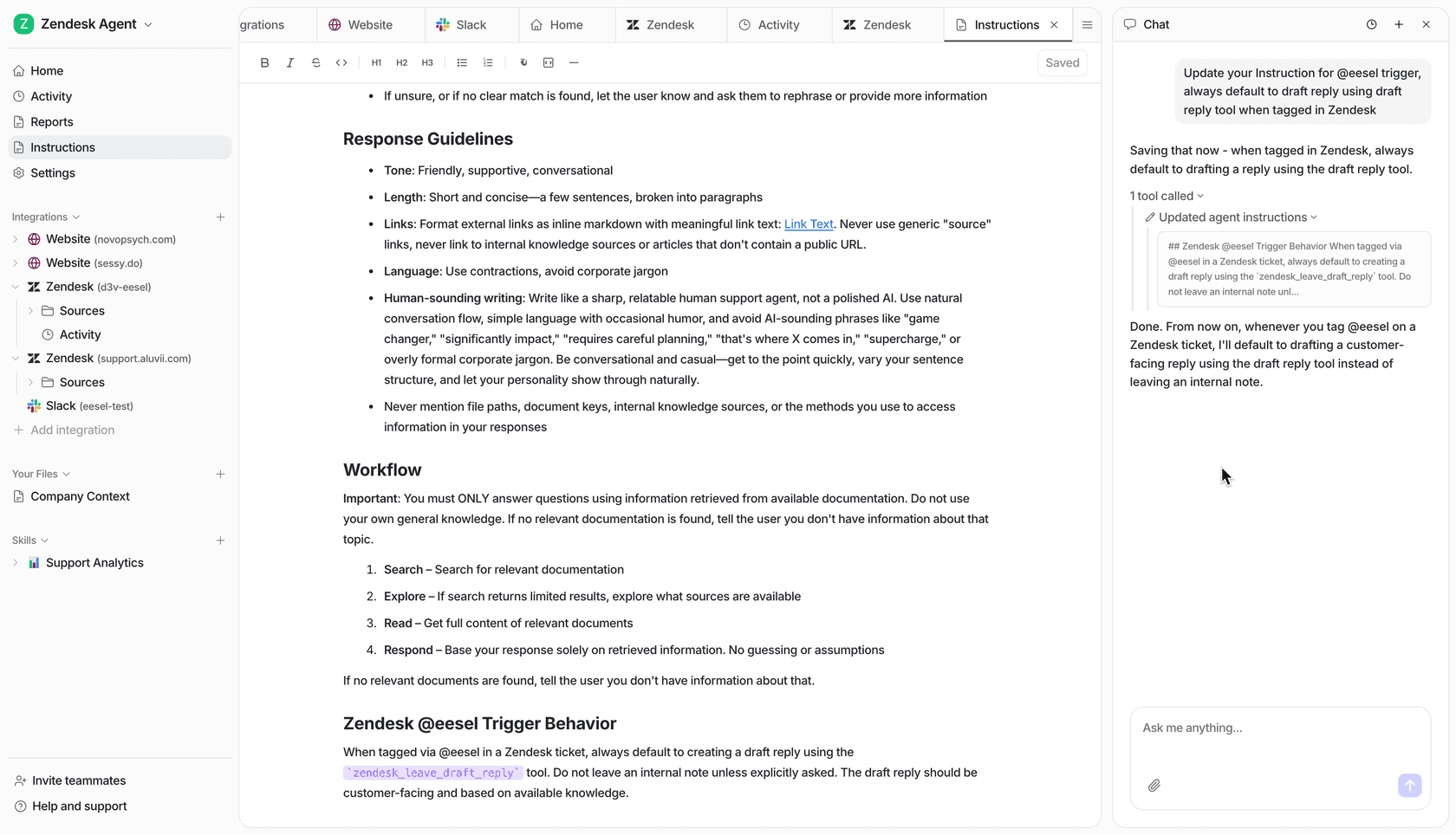
Instead of embedding an SDK into your app, our AI agent integrates directly with your help desk. This means:
- No mobile development required: Your support team can deploy AI without waiting for app store approvals
- Works across all channels: Email, chat, social, and tickets simultaneously
- Learns from multiple sources: We train on your past tickets, help center, Confluence, Google Docs, and more
- Test before going live: Run simulations on thousands of past tickets to measure performance
Our AI handles frontline support autonomously, escalating to humans only when necessary. You define the escalation rules in plain English, like "Always escalate billing disputes to a human" or "For VIP customers, CC the account manager."
Pricing starts at $299/month for the Team plan, which includes AI Copilot for drafting replies and Slack integration. The Business plan at $639/month adds the full AI Agent for autonomous support.
If you're already using Zendesk, we integrate in one click. No SDK, no app updates, no waiting.
Start building better mobile support today with Zendesk mobile SDK Android integration
You now have everything you need to integrate Zendesk into your Android app. Let's recap the key points:
- Choose the Messaging SDK for modern chat-based support
- Ensure you have your channel key from the Zendesk Admin Center before coding
- Initialize the SDK in your Application class, not an Activity
- Test thoroughly, especially push notifications if you're using them
The integration process typically takes a few hours for a basic setup, or a day or two if you're customizing heavily and testing across devices.
If you find yourself wanting more automation than the SDK provides, or if you need AI-powered responses that learn from your existing support history, try eesel AI. We complement your existing Zendesk setup without any mobile development work.
Whichever approach you choose, your users will appreciate getting help without leaving your app. That's the goal, after all.