If you've spent any time trying to get your website to rank on Google, you've probably heard of Yoast SEO and Semrush. They're both giants in the world of search engine optimization, but this is where it gets a little confusing: they aren't really direct competitors. Think of them as specialists who handle different parts of the same big project.
It’s a common mix-up. One is a plugin that lives inside your website, helping you with the nuts and bolts of on-page SEO (that's Yoast). The other is a massive, all-in-one platform you use for big-picture strategic research (that's Semrush).
Let's clarify the Yoast vs Semrush comparison. We'll break down their core features, what they cost, and who they're for. By the end, you'll know which one (or perhaps both) is right for you. We'll also touch on a modern SEO challenge: the gap between keyword research and actually writing the content. It's a time-consuming part of the process where AI tools like the eesel AI blog writer are making a significant impact.
What is Yoast?
Yoast is the go-to SEO plugin for anyone using WordPress or Shopify. With over 13 million users, it has become the standard for simplifying the often-tricky worlds of on-page and technical SEO.
Its main strength is that it works right inside your content editor. As you're writing a blog post or creating a product page, Yoast gives you real-time feedback. It's like having a helpful SEO coach looking over your shoulder, telling you what you're doing right and what needs a little work.
Yoast SEO Pro is great for meta tags, redirects and essential SEO stuff. Our agency recommends it to clients all the time.

Here’s what it does for content creators:
- SEO Analysis: This is its most famous feature. You pick a "focus keyphrase," and Yoast checks if you've used it in your title, headings, meta description, and throughout your text. It’s a simple checklist that keeps your content focused.
- Readability Analysis: SEO isn't just about keywords; it's about creating content that people actually want to read. Yoast scores your writing based on things like sentence length, paragraph structure, and use of transition words, helping you make your content clearer and more engaging.
Beyond the content, Yoast also handles some foundational technical SEO tasks without you having to lift a finger. It automatically creates things like XML sitemaps and schema markup, which help search engines understand your site's structure.
Bottom line: Yoast is the perfect tool for bloggers, small business owners, and content teams who need direct, actionable guidance right where they work.
What is Semrush?
While Yoast is a focused specialist, Semrush is the jack-of-all-trades, and a master of quite a few. It's a massive digital marketing suite that goes way beyond just SEO. It’s a standalone web platform packed with tools for advertising, social media, competitive analysis, and content marketing.
Think of Semrush as your strategic command center. You log in to plan your entire marketing strategy, find opportunities your competitors are missing, and track your performance over time. It’s less about giving you real-time feedback on a single blog post and more about providing the data you need to make smart decisions for your entire website.
According to their site, their main toolkits cover pretty much everything:
- SEO Toolkit: This is the core of the platform. It's where you do deep keyword research, analyze your backlink profile, and track your keyword rankings.
- Content Toolkit: This helps you brainstorm topic ideas, create detailed SEO content briefs for writers, and even optimize drafts.
- AI Visibility Toolkit: A newer addition that helps you see how your brand is showing up in AI-powered search results, like ChatGPT and Google AI Overviews.
- Local, Social, Advertising, and AI PR Toolkits: These are specialized suites for running campaigns in other areas of digital marketing.
In short, Semrush is the go-to platform for professional SEOs, marketing agencies, and businesses that need a firehose of data and competitive insights to drive their online growth.
Feature comparison: Yoast vs Semrush
To really get to the bottom of this, let's break down how these two tools stack up across three key SEO functions. This should make it crystal clear where they shine and where they differ.
On-page content optimization
- Yoast: This is Yoast's home turf. Its real-time, in-editor feedback in WordPress and Shopify is incredibly intuitive. The free version keeps you honest with one focus keyword, but with Yoast SEO Premium, you can optimize for up to five keywords per page, including synonyms and related terms. They've also added AI-powered suggestions for titles and meta descriptions, which is a nice touch to speed things up.
- Semrush: Semrush tackles this with its SEO Writing Assistant. It's a powerful tool that analyzes the top-ranking pages for your target keyword and gives you recommendations based on what's already working. It suggests semantically related terms to include, checks your readability, and even analyzes your tone of voice. It’s very data-driven.
- Verdict: Yoast is more integrated and convenient for on-the-fly optimization while you're writing in your CMS. Semrush provides a deeper, competitor-focused analysis, but you have to use it outside of your native writing environment, which adds an extra step to the workflow.
Keyword research and strategy
- Yoast: The free version of Yoast doesn't have a keyword research tool. It’s built to help you implement a keyword you've already chosen, not to help you find one in the first place. Yoast SEO Premium does integrate with Semrush to pull in some related keyphrases, but the heavy lifting of discovery and analysis has to happen elsewhere.
- Semrush: This is a core strength and arguably what Semrush is most famous for. Its Keyword Magic Tool is very powerful, drawing from a database of over 27 billion keywords. It gives you all the data you need to build a powerful strategy: search volume, keyword difficulty, search intent, and endless related ideas.
- Verdict: Semrush is the definitive choice for keyword discovery, in-depth analysis, and long-term strategic planning.
Technical SEO and site audits
- Yoast: Yoast handles the basics of technical SEO automatically, which is a lifesaver for non-technical users. It generates your XML sitemaps, adds canonical URLs to avoid duplicate content issues, and implements foundational schema markup so Google understands what your content is about. Its job is to prevent common technical problems before they start.
- Semrush: The Site Audit tool in Semrush is a powerful diagnostic tool. It crawls your entire website and flags over 140 different technical and on-page issues, like broken links, crawl errors, slow-loading pages, and more. Its job is to diagnose and fix existing problems across your whole site, no matter how big it is.
- Verdict: The tools are perfectly complementary here. Yoast lays a strong technical foundation on your WordPress or Shopify site from day one. Semrush provides the deep-dive audits you need to monitor and maintain your site's health as it grows.
Pricing comparison: Yoast vs Semrush
The way Yoast and Semrush price their products tells you a lot about who they're for. One is accessible for solo creators, while the other is an investment for serious marketing teams.
Yoast pricing plans
Yoast keeps things pretty straightforward with a few annual subscription tiers, mostly focused on WordPress.
- Yoast SEO Free: Gives you the core on-page analysis for a single keyword, readability checks, and automatic XML sitemaps. It's powerful enough for many beginners.
- Yoast SEO Premium: This plan costs $118.80 per year. It unlocks multi-keyword analysis, a handy redirect manager for when you change URLs, internal linking suggestions, and bundles in their Local, Video, and News SEO plugins.
- Yoast WooCommerce SEO: For e-commerce sites, this plan is $178.80 per year. It includes everything in Premium plus specific optimizations for product pages.
- Yoast SEO AI+: At $358.80 per year, this tier includes everything above plus their AI Brand Insights tool, which tracks how your brand appears in AI search platforms like ChatGPT and Gemini.
- Yoast SEO for Shopify: If you're on Shopify, it's $19 per 30 days.
Semrush pricing plans
Semrush recently updated its pricing to focus on "Semrush One" bundles, which pack its traditional SEO tools with its newer AI visibility features.
- Starter: This plan begins at $165.17 per month (when billed annually). It’s designed for freelancers and small businesses, letting you monitor 5 websites and track 500 keywords.
- Pro+: For growing brands, this plan starts at $248.17 per month (billed annually). It bumps your limits up to 15 websites and 1,500 keywords and adds historical data access.
- Advanced: Aimed at agencies and large enterprises, this plan starts at $455.67 per month (billed annually). It includes API access and lets you track up to 40 websites and 5,000 keywords.
Bridging the gap from research to writing with eesel AI
Consider the typical workflow. You use Semrush to find a great, low-competition keyword. Then you sit down to write, using Yoast to make sure the final article is optimized perfectly. But what about the part in the middle? The actual research, outlining, writing, and finding images for a 2,000-word blog post? That’s still a huge manual effort that can take hours, if not days.
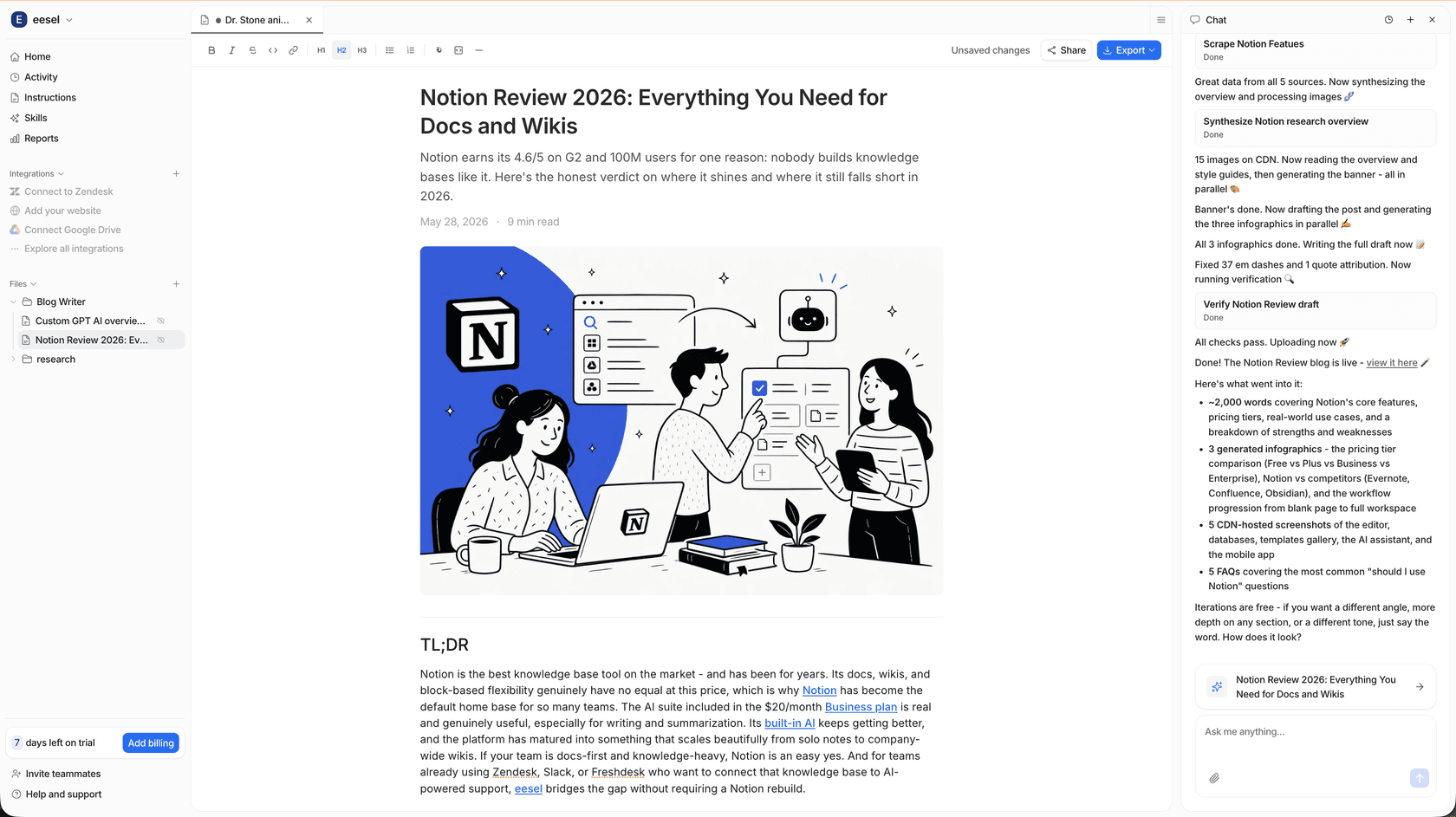
It’s built to solve the biggest bottleneck in the content creation process. Here's how it's different:
- From Keyword to Complete Post: It doesn't just give you an outline or a rough draft. It does the research and writes the entire article, structured with headings, intros, and conclusions.
- Automatic Assets: A huge time-saver. The final article includes AI-generated images, infographics, and data tables, so you get a media-rich post without having to source visuals yourself.
- Built for Modern Search: It understands that SEO in 2026 is about more than just keywords. It pulls in relevant Reddit quotes and embeds YouTube videos to add authenticity and is optimized for AI Answer Engines (AEO) like Google's AI Overviews.
We used this exact tool to grow our own blog at eesel AI from 700 to 750,000 daily impressions in just three months. The best part? It's completely free to try, so you can see the quality of the content for yourself without any risk.
Yoast vs Semrush: How to choose the right tool for you
After all that, it should be clear that you don't really have to choose between Yoast and Semrush. They are not direct competitors. In fact, they work best when used together as part of a complete SEO strategy.
with Semrush, consider Yoast SEO or Rank Math as your main SEO plugin... Both integrate well with Semrush and offer comprehensive features...
But if you have to pick just one to start with, here’s a simple guide:
- Choose Yoast if: You're a content creator, a blogger, or a small business owner using WordPress or Shopify. Your main goal is to make sure the content you're already writing is optimized correctly. You need simple, real-time guidance to get your on-page SEO and readability right without getting lost in data.
- Choose Semrush if: You're an SEO professional, you work at a marketing agency, or you're part of a business that needs deep data to drive its strategy. Your job involves comprehensive keyword research, competitor analysis, backlink building, and technical site audits.
And if your biggest problem isn't research or final checks, but the sheer time and effort it takes to produce high-quality content at scale, that's a different challenge altogether. A tool like the eesel AI blog writer bridges that gap, turning the strategic insights you get from Semrush into fully optimized articles that are ready for publication.