How to reduce content decay: A practical guide to reviving your traffic

Stevia Putri

Katelin Teen
Last edited January 19, 2026
You’ve probably seen it happen. A blog post that once brought in thousands of visitors now barely gets a trickle of traffic. Your rankings are slipping, and a piece of content you poured hours into is slowly gathering digital dust. This isn't just bad luck; it’s content decay, and as Neil Patel has pointed out, it happens to every single marketer.
What is content decay?
Think of it like a car that needs regular maintenance. Even your best-performing content needs a tune-up to stay relevant. What was a perfect answer to someone's question two years ago might be incomplete or just plain wrong today. If you ignore it, content decay quietly undoes your SEO efforts and can hurt your site's overall authority by making your content seem less helpful to people and search engines.
Why your content is decaying and how to spot it
Before you can fix the problem, you need to know what’s causing it. Content decay isn't a punishment from Google; it's just what happens in a fast-moving digital world. Here are the main reasons your content loses its edge and the specific warning signs to look for in your analytics.
The main causes of content decay
- Outdated information: This is the big one. Your stats are old, your screenshots show outdated software, and your examples just don't hit the same way. This leads to a bad user experience, which tells search engines your page isn't the best resource anymore.
An infographic detailing the four main reasons for content decay: outdated information, shifting search intent, competition, and keyword cannibalization, which helps in learning how to reduce content decay. - Shifting search intent: How people look for information changes. As Moz points out, a keyword that used to be for finding information might now be for buying something. If your content doesn't match what users want now, Google will favor pages that do.
- Tougher competition: While your article was sitting there, your competitors were busy. They published newer, more detailed, or better-looking content for the same keywords, slowly pushing your post down the search results.
- Keyword cannibalization: As your site gets bigger, you might accidentally create several pages that target the same keyword and intent. According to Yoast, this eats up your chances to rank by confusing search engines and making your own pages fight each other for the top spot.
Key warning signs to monitor
Catching decay early makes a huge difference. Keep an eye on these metrics in your analytics tools:
- A gradual slide in organic traffic: In Google Analytics, look at your top-performing posts from over a year ago. A guide to diagnosing traffic drops highlights that a slow, steady decline over several months is a classic symptom.
- Slipping keyword rankings: Use Google Search Console to track where you stand for your target keywords. To find pages that are slipping, use the "Compare" tab to see the "click difference" between two time periods, a trick recommended by SEO professionals. A consistent drop in clicks or average position is a clear sign decay has started.
- A declining click-through rate (CTR): If your impressions are still high but your clicks are falling, it probably means your title and meta description feel old compared to the newer results on the page.
- Lower engagement metrics: A rising bounce rate or a drop in the average time on page can mean that people are landing on your content and quickly realizing it’s not the fresh answer they were hoping for.
A framework for reducing content decay
Reviving decaying content is one of the best bangs for your buck in SEO. It takes way less effort to update an existing article that already has some authority than to rank a new one from scratch. Follow this framework to systematically bring your old content back to life.
Both matter, but updating old content often gives faster results. The page already has some history, so even small improvements can move it up.

Step 1: Conduct a content audit
First, you need to figure out which pages are worth saving. A good content audit, like the one in this 8-step framework, means pulling data from a few different places.
- Find your candidates: Using Google Search Console or Google Analytics, look for pages published over a year ago that used to bring in a lot of organic traffic but have seen a clear drop in traffic, clicks, or rankings.
- Gather performance data: For each page you're considering, pull the key metrics. A Semrush guide on content audits suggests collecting data on organic traffic, current keyword rankings, and backlinks.
- Analyze with a crawler: Use a tool like Screaming Frog to check for technical problems like broken internal links or accidental "noindex" tags that could be hurting performance.
A three-step workflow diagram illustrating the content audit process, a key step in how to reduce content decay.
Step 2: Choose your strategy: Update, consolidate, or prune
| Strategy | When to Use It | Example |
|---|---|---|
| Update / Refresh | The content is still very relevant, but the information is stale (e.g., outdated stats, old examples). | A "Best Laptops" post from last year that needs the latest models and specs. |
| Consolidate | You have multiple, smaller articles targeting the same keyword and intent, causing keyword cannibalization. | Merging three separate, weak posts on "SEO basics" into one killer guide, just as Yoast did to boost performance. |
| Prune | The content is irrelevant, obsolete, or low-quality, with no traffic or valuable backlinks. | Deleting a blog post about a product feature you got rid of three years ago. |
Pro tip
When you prune or consolidate content, always set up a 301 redirect from the old URL(s) to the most relevant live page. This preserves any existing link equity and makes sure users don't land on a 404 error page.
Step 3: Execute a content refresh
Once you've picked a page to update, it's time to roll up your sleeves. A real refresh is more than just changing the publication date.
- Update all outdated information: Swap old statistics for the latest data, replace old screenshots with new ones, and fix any broken links.
- Re-optimize for search intent: Google your target keyword and look at the top-ranking results. What format are they using? What subtopics are they covering? Rework your content to better match what's currently winning.
- Add depth and new media: Expand on sections to provide more value. Embed a relevant YouTube video, create a new infographic, or add some real-world perspective by including real quotes from Reddit threads.
- Strengthen internal linking: Add new internal links from the refreshed article to other relevant pages on your site. Just as important, find spots on your newer posts to link back to the updated article to show search engines it's important again.
A four-step workflow showing the process of a content refresh, a practical method for how to reduce content decay.
Visual learners might find it helpful to see these strategies in action. The video below from WPBeginner offers a great overview of practical ways to solve content decay, reinforcing the steps we've just discussed.
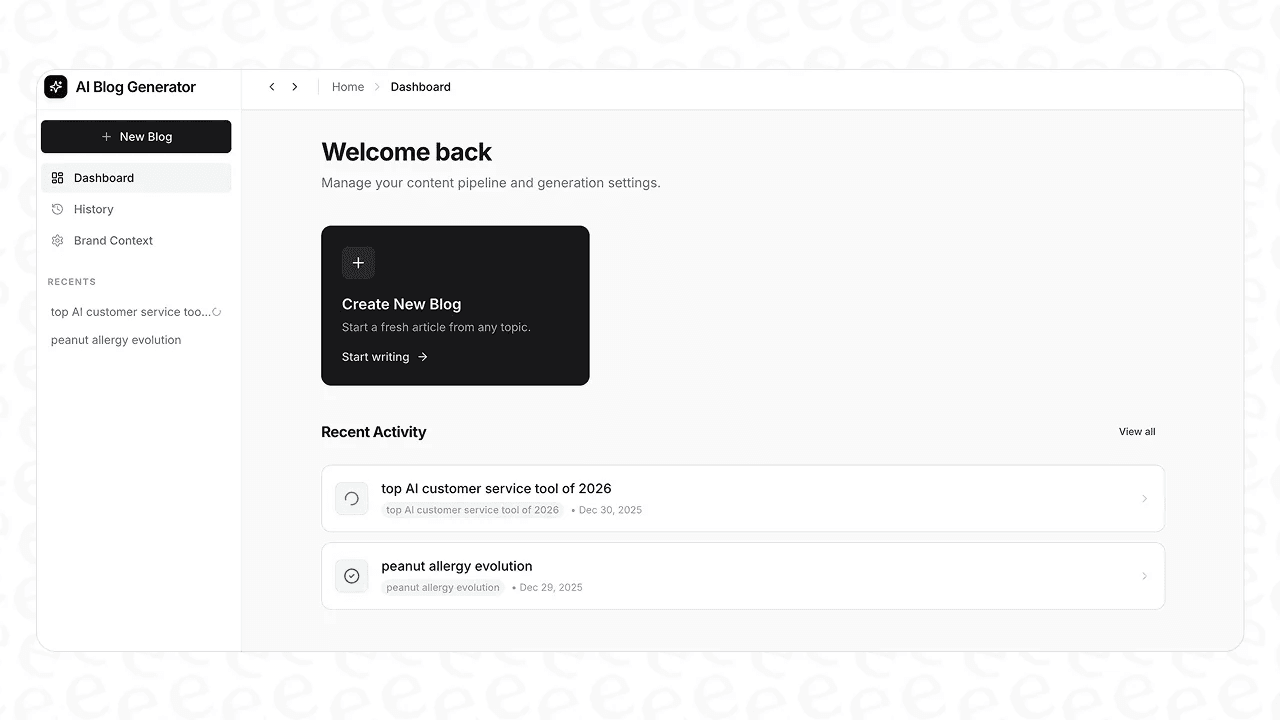
How the eesel AI blog writer helps prevent content decay
Here’s how it helps you stay ahead of the curve:
- It integrates current media and social proof: One of the quickest ways for content to feel dated is old information. The eesel AI blog writer gets around this by embedding relevant, up-to-date YouTube videos and pulling real quotes from recent Reddit threads. This makes sure your content reflects what people are talking about right now.
- It builds on an AEO-optimized foundation: The tool automatically structures content with proper headings and meta descriptions. More importantly, it's optimized for both traditional search and AI Answer Engines like Google's AI Overviews. This modern structure gives your content a stronger base to withstand algorithm changes.
- It includes automatic asset generation: Instead of just a wall of text, you get a complete, media-rich article. The eesel AI blog writer generates modern assets like images, charts, and tables as part of the process, so your visuals don't become obsolete overnight.
- It makes future updates a breeze: When it is eventually time for a refresh, the process is so much easier. Instead of a full manual overhaul, you can use the built-in AI editor to quickly tweak or expand sections. You can also generate a new, updated version on the same topic in minutes, saving a ton of time.
An infographic explaining how the eesel AI blog writer's features like media integration and easy updates help with how to reduce content decay.
Make content maintenance a regular habit
Content decay is a natural part of SEO, but it doesn't have to mean losing traffic and authority. By shifting your mindset from "publish and forget" to "publish and maintain," you can keep your most valuable content working for you indefinitely.
The plan is simple:
- Audit your content every 6-12 months to catch the slow slide of decay early.
- Refresh your aging articles with updated info, better visuals, and a closer match to current search intent.
- Prevent decay from the start by using tools that build freshness and optimization right into the creation process.
Stop letting your hard work go to waste. Instead of constantly playing catch-up, focus on creating resilient content from the get-go.
Ready to see how easy it is to generate a complete, SEO-optimized blog post that's built to last? Try the eesel AI blog writer for free and publish your first article today.

Frequently Asked Questions
Share this article

Article by
Stevia Putri
Stevia Putri is a marketing generalist at eesel AI, where she helps turn powerful AI tools into stories that resonate. She’s driven by curiosity, clarity, and the human side of technology.