Writesonic vs Semrush: Which tool is right for your content strategy?

Stevia Putri

Katelin Teen
Last edited January 18, 2026
Modern marketing feels like a juggling act, doesn't it? You're expected to churn out great content consistently, but each piece also needs to have a real shot at ranking on Google. It's the classic tug-of-war: creation versus strategy. This is exactly where tools like Writesonic and Semrush enter the picture, each tackling a different side of that challenge.
Writesonic is a well-known name in AI content generation, helping teams write everything from ad copy to full articles. In the other corner, you have Semrush, a powerhouse for SEO and digital marketing analytics. So, the real question isn't about which tool is better, but which one is right for the specific job you need to do. Are you stuck trying to create the content itself, or are you struggling with the strategy behind it?
And if your main goal is to scale up your blog production with content that's ready to publish, you might find that a more specialized tool is what you need. For example, the eesel AI blog writer is built specifically to take a keyword and turn it into a complete, optimized post, closing that gap between a good idea and a published article.
What is Writesonic?
Think of Writesonic as your AI writing assistant. It’s designed to help you generate a ton of different types of written content, and do it fast. If you're staring at a blank page for a social media update, a product description, or a long article, Writesonic likely has a template for it.
Its main features are all about getting words on the page:
- AI Article Writer: This is their tool for long-form content. You give it a topic or an outline, and it generates a draft for you.
- Chatsonic: This is their take on a conversational AI, similar to ChatGPT. It's handy for brainstorming ideas, doing some quick research, or just getting another perspective.
- Photosonic: An AI image generator is built right into the platform, so you can create visuals for your content without having to switch tools.
- Brand Voice: A feature that lets you train the AI on your existing content so it can try to learn and write more in your brand's style.
So, who is this for? It’s a good fit for copywriters, social media managers, and marketers who are judged by the volume of content they produce. If your biggest hurdles are writer's block and a fast-approaching deadline, Writesonic is there to help you get something down.
What is Semrush?
Semrush functions more as a marketing strategist than a content writer. It is a large, all-in-one platform that gives you a comprehensive view of the digital marketing landscape. While it does have some writing assistance features, its true power comes from the data it provides.
Here’s a look at its core toolkit:
- Keyword Research: This is what Semrush is famous for. It has incredibly detailed tools for finding keywords, checking their competitiveness, and tracking your rankings for them.
- Site Audit: A powerful feature that crawls your website and flags technical SEO issues that could be hurting your performance, from broken links to slow page speeds.
- Competitor Analysis: Ever wonder what keywords your competitors rank for or where their backlinks come from? Semrush shows you, giving you a clear path to compete.
- Content Marketing Platform: This set of tools helps you research topics, gives you SEO suggestions as you write, and tracks your content's performance over time.
It's important to be clear: Semrush's AI features are there to optimize content based on data, not to generate whole articles from scratch. It’s built for the SEO specialist or the marketing manager who needs to build a strategy backed by solid data.
Feature breakdown: Writesonic vs. Semrush
When you put these two tools side-by-side, it's clear they were built with different goals in mind. It’s not about which one has more features, but what those features are meant to achieve.
Writesonic's Focus: Content velocity and variety This platform is all about speed and output. It’s an execution tool. With tons of templates, you can quickly generate a specific piece of content, whether it's a tweet, an email, or the first draft of a blog post. The aim is to get you from zero to a draft as quickly as possible.
Semrush's Focus: Data-driven marketing strategy Semrush, on the other hand, is all about insight. Its features are designed to give you the data you need to make smart decisions. It helps you figure out what to write about, how to optimize it for search, and who you’re up against. The goal is to inform your entire marketing strategy.
| Feature Area | Writesonic | Semrush |
|---|---|---|
| Primary Goal | Content Generation & Drafting | SEO & Market Analysis |
| Core Tools | AI Article Writer, Chatsonic, Templates | Keyword Research, Site Audit, Rank Tracking |
| AI's Role | The core product for content creation | An integrated feature to assist strategy |
| Ideal User | Content Creator, Copywriter | SEO Specialist, Marketing Manager |
| Primary Output | Written drafts, images, ad copy | Data reports, strategic plans, content briefs |
A deep dive into AI writing capabilities
Okay, let's zoom in on the actual AI writing capabilities of each platform, because that's where the differences really stand out. And for teams that are serious about using AI for blog growth, we'll look at a dedicated alternative that focuses purely on that.
Writesonic's AI writing engine
Using Writesonic’s AI Article Writer is a pretty simple, step-by-step process. You give it an idea, it helps you generate an intro and an outline, and then it writes the full draft.
Its biggest strengths are its speed and ease of use. You can go from a vague concept to a 1,500-word draft in just a few minutes. The huge number of templates is also a major plus for teams that need to create many different types of content.
The output typically functions as a first draft. It often requires significant editing to refine the tone, verify accuracy, and add the depth needed to rank for competitive keywords. The tool helps initiate the writing process but doesn't always produce a final, publish-ready piece.
Semrush's SEO writing assistant
Semrush has a completely different approach. Its tool is an optimizer, not a generator. You bring your own content into its editor (or write it there), and it provides real-time SEO suggestions as you write.
It analyzes the top-ranking pages for your target keyword and gives you suggestions on which keywords to include, how to improve readability, and how to match the tone of other successful articles.
Its strength is clear: it connects vital SEO data directly to the writing process. You’re not just writing; you’re writing with a specific, data-backed target. A key distinction is that it does not generate content for you. It is designed to enhance human-written text, not replace it.
An alternative for blog content: eesel AI
This brings us to a third option. What if your main goal isn't just to write faster or optimize what you've already written, but to scale your organic traffic by publishing high-quality blog content consistently? For that, you need a tool built for that specific outcome.
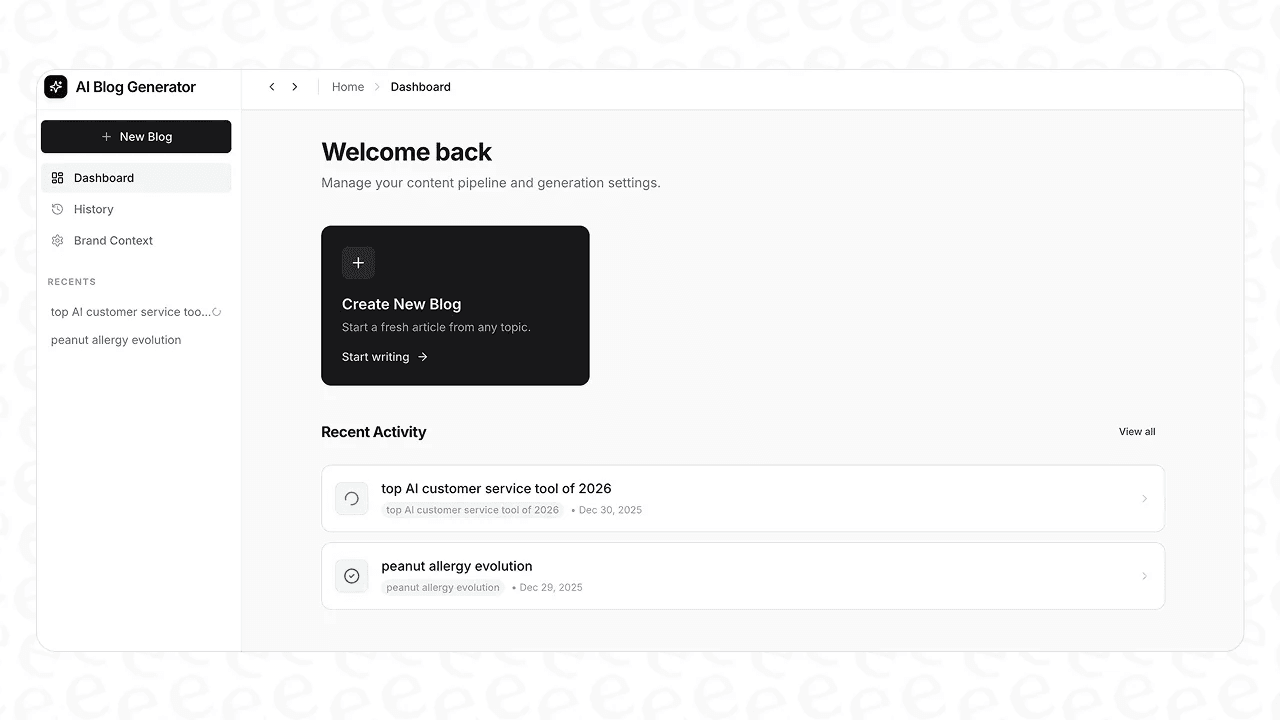
It is designed to generate complete blog posts, addressing the gap between drafting and publishing. The tool focuses on several key areas to create content intended to rank in 2026:
- Complete Asset Generation: It doesn't just produce a wall of text. It automatically creates and embeds tables, AI-generated images, and infographics to make the content more engaging.
- Context-Aware Research & Social Proof: The AI goes beyond surface-level information. It does deep research and integrates relevant YouTube videos and real Reddit quotes to add a layer of authority and authenticity that most AI content is missing.
- AEO Optimization: The content isn't just optimized for traditional SEO. It's also structured for AI Answer Engines like Google's AI Overviews, which is becoming more and more important for visibility.
We know this works because it's the same platform we used to grow our own traffic from [700 to 750,000 impressions](https://www.eesel.ai/blog) per day in just three months by publishing over 1,000 optimized blogs.Most AEO “tools” right now are just analytics/monitoring (think SERP scrapers, snippet trackers), not actual guided workflows. What’s missing and what enterprises really need are platforms that structure content into Q&A, apply schema at scale, and optimize content for AI engines, not just pages.

Pricing and value: Writesonic vs. Semrush
Of course, a big part of any decision comes down to cost. Both Writesonic and Semrush are notable investments, so it’s important to understand what you’re paying for.
Writesonic pricing
Writesonic's pricing is typically based on the number of words you generate. They use a credit system, where different quality levels consume different amounts of credits.
- Free Plan: They offer a free trial that gives you a limited number of words to test out the platform.
- Paid Plans: Plans like "Small Team" and "Enterprise" give you much higher word limits and more features like Brand Voice, starting around $19/month for individuals and scaling up for teams.
- Value: If you need to produce a high volume of short-form content (like ads or social posts) or just need help getting first drafts done quickly, Writesonic offers good value.
Semrush pricing
Semrush uses a more standard subscription model with different tiers that unlock more features and higher usage limits.
- Pro Plan: This is their entry-level plan, starting around $129.95/month. It gives you access to the core SEO, PPC, and research tools, and it's aimed at freelancers and small businesses.
- Guru & Business Plans: These plans, starting at $249.95/month and $499.95/month respectively, add more advanced features like the Content Marketing Platform, historical data, and much higher limits. These are built for agencies and larger companies.
- Value: Semrush is a serious investment. But its value comes from being a comprehensive toolkit that can potentially replace several other marketing tools. You’re paying for the depth of its data and strategic power.
Seeing these tools in action can also help clarify their different approaches. For a quick take on how various SEO and writing tools stack up in terms of value, check out this review:
Making the right choice for your team
So, when it comes to the Writesonic vs Semrush debate, the answer really depends on your team's biggest bottleneck. The choice comes down to whether your team needs a "creator tool" or an "analyst tool."
- Choose Writesonic if your main problem is getting words on the page. If you need to generate first drafts for a wide variety of formats at high speed, it's a powerful assistant.
- Choose Semrush if your priority is strategy. If you need deep SEO analytics, keyword research, and competitive intelligence to build a winning marketing plan, it's one of the best tools out there.
But if your most important goal is to scale the production of rank-ready blog content, not just drafts, but finished pieces designed to attract organic traffic, then a specialized tool is almost always the most efficient path.
From keyword to published blog in minutes
Stop wrestling with drafts and start publishing content that actually performs. The eesel AI blog writer turns a single keyword into a complete, SEO-optimized post in minutes. See for yourself how context-aware AI can transform your content strategy.
Try it for free and generate your first blog today.

Frequently Asked Questions
Share this article

Article by
Stevia Putri
Stevia Putri is a marketing generalist at eesel AI, where she helps turn powerful AI tools into stories that resonate. She’s driven by curiosity, clarity, and the human side of technology.