Writesonic vs NeuronWriter: Which AI blog writer should you choose?

Kenneth Pangan

Stanley Nicholas
Last edited January 18, 2026
Expert Verified

Picking the right AI writing tool can feel like a bit of a chore. The market is flooded with options, and every content team knows they need more than just a robot that spits out text. You need a solid workflow that helps you create high-quality, complete articles that people actually want to read and that search engines will rank.
Two popular names in this space are Writesonic and NeuronWriter, and they approach content creation from different angles. Writesonic focuses on generating initial drafts quickly, while NeuronWriter is centered on SEO optimization to help content rank. This guide will help you determine which tool is the right call for you.
At eesel, we also focused on scaling our content, which led us to develop an AI writer that handles the entire process, from a single keyword to a fully formatted, publish-ready post. This tool helped take our blog from 700 to 750,000 daily impressions in three months.
In this guide, we’ll break down the comparison between Writesonic and NeuronWriter. We’ll also introduce the eesel AI blog writer as an alternative to consider, giving you a complete picture to inform your content strategy.
What is Writesonic?
Think of Writesonic as a multi-purpose tool for getting your first draft on the page. It's an AI writing assistant built to generate a huge variety of content. Whether you need a blog post, a Google Ad, a social media update, or a product description, Writesonic has a template for it. It’s designed to help you get past that blinking cursor and get words down fast.
Key features
- AI article writer: This is its main feature for long-form content. You give it a topic, and it generates a structured draft, usually with an intro, body, and conclusion. It's a decent starting point for a blog post.
- Sonic editor: Once you have your draft, you can use the Sonic Editor to polish it. It works a lot like Google Docs but has built-in AI tools that can help you rewrite sentences, expand on ideas, or trim down paragraphs.
- Brand voice: Writesonic can scan your website to get a feel for your brand's tone. This helps make sure the content it generates feels a bit more like you and less like generic AI filler.
- Content templates: It has a huge library of over 100 pre-built templates for specific formats. This is pretty handy if you're creating a wide range of marketing copy beyond just blog posts.
Pricing
Writesonic’s pricing is based on word count, how many users you have, and access to certain features. They offer a few different tiers:
- Free Trial: Gives you a limited number of words to try things out.
- Business: A plan for individuals and small teams that offers a bigger word count and more features.
- Enterprise: A custom plan for larger companies that need things like SSO and custom AI model training.
The monthly cost really depends on your content volume, so it can change quite a bit.
Limitations
Writesonic's output is designed to be a first draft. It serves as a strong starting point, but users should plan to spend time fact-checking, editing, and formatting the content before it is ready to publish. The tool does not automatically create or add assets like charts, infographics, or YouTube videos, so those elements must be sourced separately.
What is NeuronWriter?
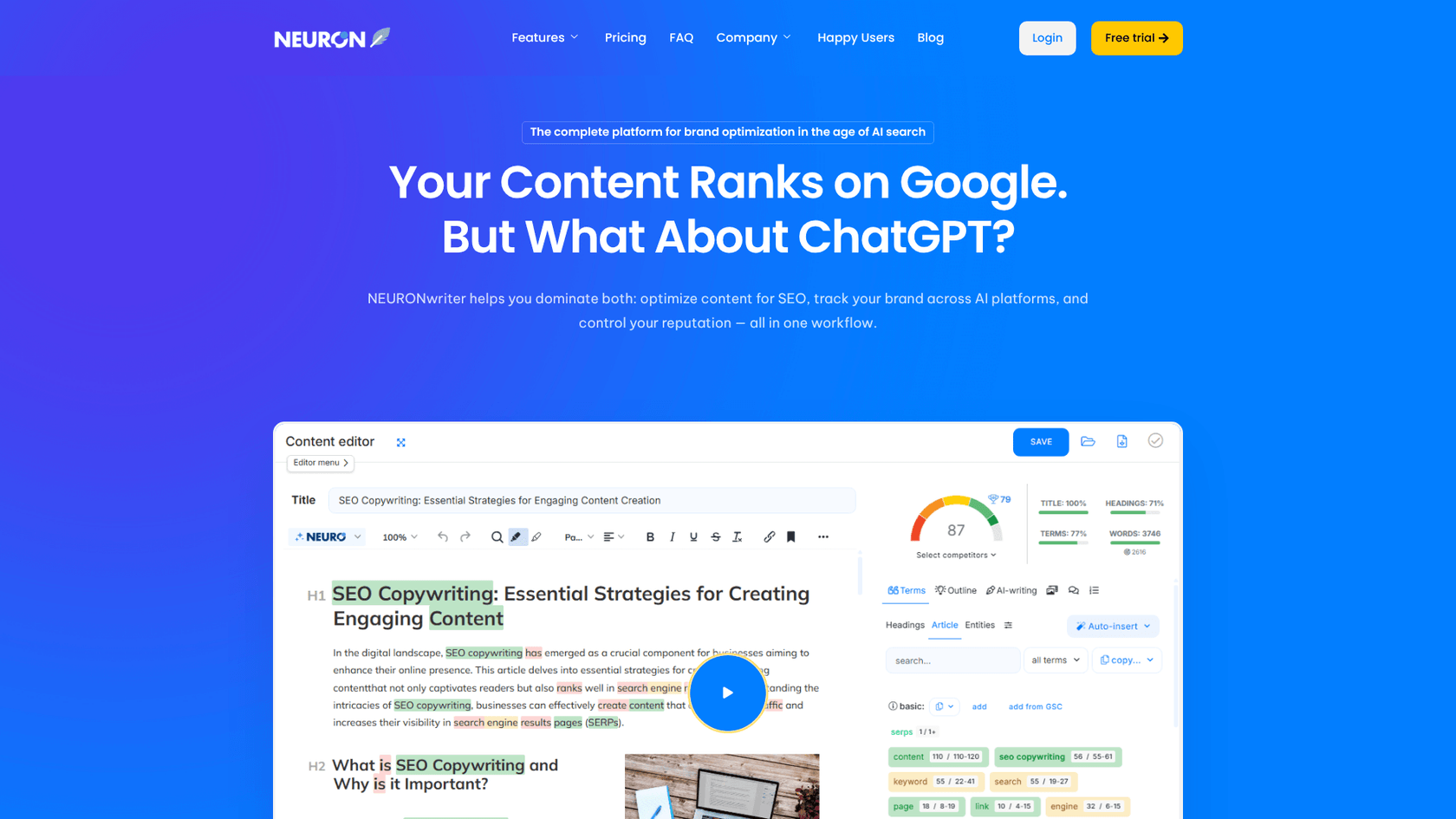
NeuronWriter is an SEO content optimization tool first and an AI writer second. Its main purpose isn't just to write for you, but to give you a data-driven blueprint for creating articles that will actually rank on Google. It’s for folks who are serious about SEO and want to fine-tune their content based on what's already working.
Key features
- SERP analysis: This is NeuronWriter’s specialty. You give it a target keyword, and it analyzes the top-ranking pages. From there, it provides detailed guidelines on what topics to cover, what keywords to include, and how to structure your article.
- Content editor with NLP: Its editor gives you a real-time "Content Score" as you write. This score is based on how well you’re using its NLP (Natural Language Processing) recommendations, like including specific terms and answering relevant questions.
- AI writing assistance: NeuronWriter does have AI writing features, but they’re mostly there to help you hit your SEO targets. You can use it to generate paragraphs that include specific keywords or to fill in parts of your outline. It’s less focused on creating a cohesive article from scratch.
- Content planning: It also has tools to help you organize content ideas, research keywords, and build out a content calendar.
Pricing
NeuronWriter's pricing is tiered, usually based on the number of projects, content analyses per month, and AI writing credits you get. The plans generally include:
- Bronze Plan: A starter plan for individuals with a handful of projects.
- Silver Plan: A step up with more analyses and credits.
- Gold Plan: A popular option for small teams and agencies.
- Platinum & Diamond Plans: Higher-tier plans for heavy users who need a large volume of analyses and AI credits.
Limitations
Because NeuronWriter is focused on SEO, its AI-generated text is optimized to meet specific keyword and NLP targets. This may require additional editing to refine the tone and prose. The workflow is hands-on, as it guides the writer through the process of structuring the content and sourcing visuals based on its data-driven recommendations.
An alternative to consider: eesel AI blog writer
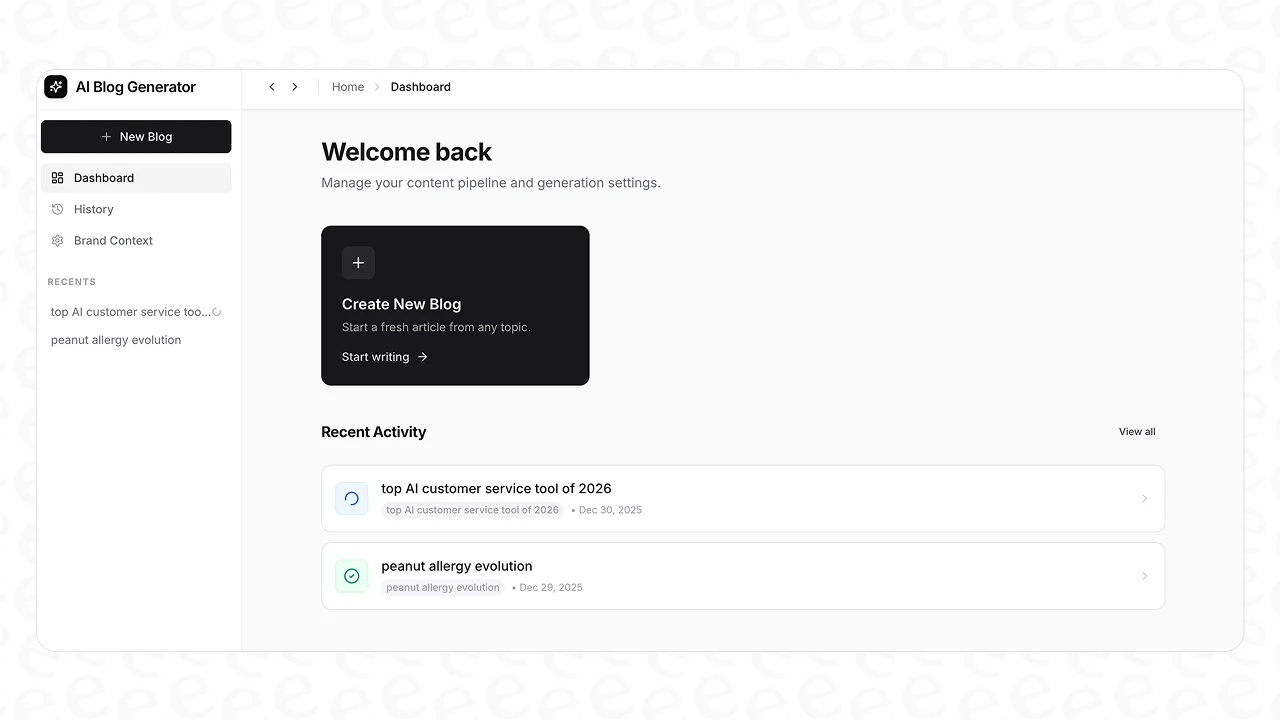
So, what if you don't want to choose between a draft generator and an SEO checklist? That's where the eesel AI blog writer comes in. We built it to bridge that gap. It’s designed to generate a complete, media-rich, and publish-ready blog post from just a single keyword.
How the eesel AI blog writer is different
Instead of giving you one piece of the puzzle, our tool handles the entire workflow from start to finish. Here’s what makes it different:
- From draft to done: The eesel AI blog writer doesn't just hand you a block of text. It produces a fully structured article with an introduction, proper H2s and H3s, a conclusion, and even an FAQ section based on what people are actually searching for.
- Automatic assets and social proof: This feature is designed to save time. It automatically generates and embeds AI images, tables, and infographics right into the post. It also finds relevant YouTube videos and real quotes from Reddit threads to add authority and a human touch.
- Context-aware research: The AI does deep research tailored to the type of blog post you're creating. If you're writing a comparison post, it will look for pricing data. If it's a product review, it will pull in technical specs. It’s not just scraping the surface.
- AEO (Answer Engine Optimization): We optimize content not just for traditional search results, but also for AI Overviews and other answer engines. This gets your content ready for the future of search.

The workflow that scales content
The process is about as simple as it gets. You just enter a keyword or topic, add your website URL so it can learn your brand context, and let it generate a complete, SEO-optimized post.
This is the exact system we used at eesel to grow our own organic traffic from 700 to 750,000 daily impressions. It’s not just a tool we sell; it’s the engine behind our own content success.
Pricing and trying it for free
We like to keep pricing simple. It costs just $99 for 50 high-quality blog posts, and you can buy more credits whenever you need them.
Better yet, it’s completely free to try. You can see the quality of a complete, publish-ready blog post for yourself without any commitment. Generate your first post here.
Writesonic vs. NeuronWriter: A side-by-side comparison
To make it even clearer, let's see how the three platforms stack up side-by-side on the features that matter most for scaling your blog.
Feature comparison table
| Feature | eesel AI blog writer | Writesonic | NeuronWriter |
|---|---|---|---|
| Primary Goal | Generate complete, publish-ready blog posts | Generate first drafts for various content types | Optimize content based on SERP analysis |
| Output Quality | A complete article with intro, FAQs, and assets | A first draft for further editing and refinement | A structured outline with AI-assisted text |
| SEO Focus | Built-in SEO and AEO (Answer Engine Optimization) | Basic on-page SEO suggestions | Advanced NLP and competitor analysis |
| Asset Generation | Automatic AI images, tables, and infographics | AI images available as a separate feature | Not a core feature |
| Media Integration | Automatic YouTube videos and Reddit quotes | Not a core feature | Not a core feature |
| Ease of Use | Simple workflow: enter a keyword, get a post | Simple prompt-based interface | Steeper learning curve, data-heavy |
| Best For | Teams scaling high-quality blog production | Marketers needing quick copy for various formats | SEO specialists fine-tuning content for rankings |
As you can see, the right tool really boils down to your goal. If you need a quick paragraph for an ad, Writesonic is a useful option. If you prefer to work with SEO data and manually tweak every detail, NeuronWriter provides the necessary tools. If your goal is to scale your blog production with high-quality, complete articles, the eesel AI blog writer offers an end-to-end solution.
For a broader look at the AI writing tool landscape, this video provides a comprehensive review of over 30 different options, helping you understand where tools like Writesonic, NeuronWriter, and others fit in the market.
This video review compares over 30 AI SEO writing tools to see which ones live up to the hype.
Choosing between Writesonic and NeuronWriter
The best choice between Writesonic and NeuronWriter depends on the specific problem you're trying to solve.
- Writesonic is a good choice for generating quick text drafts for a wide range of marketing assets. It's a versatile tool for starting the creative process.
- NeuronWriter is designed for in-depth SEO analysis, guiding content creation with competitor data to help you optimize for search engines.
- The eesel AI blog writer is an alternative for teams that want to generate a complete, media-rich, and SEO-optimized blog post from a single keyword.
For teams aiming to scale blog production and drive organic traffic, an efficient workflow is key. If you are looking for a tool that produces a more complete first draft, including formatting and assets, it can help reduce manual effort. You can generate a blog post for free with the eesel AI blog writer to see how an end-to-end workflow functions.
Frequently Asked Questions

Share this post
Article by
Kenneth Pangan
Writer and marketer for over ten years, Kenneth Pangan splits his time between history, politics, and art with plenty of interruptions from his dogs demanding attention.