SEO.ai vs HyperWrite: An in-depth comparison

Kenneth Pangan

Stanley Nicholas
Last edited January 18, 2026
Expert Verified

Trying to keep up with content demands can feel like a second full-time job. It's no wonder everyone's looking for an edge, and AI content writers have become the go-to for scaling up SEO and marketing efforts without completely burning out.
In the crowded world of AI tools, SEO.ai and HyperWrite are two names you'll hear often. Both claim they'll make your life easier, but they take very different paths to get there. One is a dedicated tool for building SEO articles, while the other is more of a general-purpose writing assistant.
So, how do you choose? This guide will break down what you need to know about SEO.ai vs HyperWrite, comparing their features, who they're for, and what they cost, so you can pick the one that actually makes sense for your work.
What is SEO.ai?

SEO.ai is an AI platform built to help you create long-form content that ranks on search engines. We're talking blog posts, articles, and guides. Its main purpose isn't just to write for you, but to walk you through the entire SEO content workflow in one spot.
The whole concept is to merge an AI writer with the essential tools of an SEO specialist. It’s made to streamline everything, from figuring out which keywords to target all the way to polishing the final draft. Instead of juggling a keyword tool, a competitor analysis tool, and a blank document, SEO.ai puts it all under one roof. It analyzes SERP data to see what competitors are doing, suggests keywords to include, and helps you structure your article for both readers and search engines.
What is HyperWrite?
HyperWrite takes a much wider view. It’s less of a specialized tool and more of a flexible AI writing assistant that can help with almost any writing task you can think of. Whether you're struggling with a tricky email, trying to brainstorm a catchy social media post, or drafting a long article, HyperWrite is designed to lend a hand.
Its primary focus is on improving your writing speed and clarity. It can finish your sentences, rewrite a clunky paragraph to sound better, or summarize a long document in a few seconds. A huge part of its appeal is its flexibility. It usually works as a browser extension, so it follows you around the web and plugs directly into platforms you already use, like Google Docs, Gmail, or your CMS. It’s like having a co-writer on standby, ready to help whenever you're writing.
Feature deep dive: SEO.ai vs HyperWrite
While both tools use AI to generate text, their feature sets are built for very different purposes. Let's dig into where they excel and where they differ to help you see which one lines up with your goals.
Content generation
SEO.ai is all about structured, long-form content. Its entire workflow is designed to take you from a single keyword to a finished, optimized article. It guides you through creating an outline based on top-ranking content and then helps you fill out each section. This process helps you build a coherent piece that covers the topic from all angles, which is exactly what search engines are looking for.
HyperWrite, on the other hand, is about versatility and quick assistance. It's great for both short-form copy (like emails, tweets, and product descriptions) and long-form content. It feels more like a creative partner you can prompt to write or rewrite sentences, brainstorm ideas, or adjust the tone of a paragraph. It’s less about a rigid, step-by-step process and more about offering instant help whenever you get stuck.
SEO optimization tools
This is where the two tools really part ways.
SEO.ai has SEO functionality at its core. It analyzes the top-ranking articles for your keyword to give you a data-backed content brief. It will suggest related keywords and topics to include, recommend an article length, and highlight questions you need to answer. It even gives you an on-page optimization score to make sure you’ve covered all your bases before publishing.
HyperWrite’s approach to SEO is much more manual. You can instruct it to write about a topic and include certain keywords, and it will. But it lacks the built-in SERP analysis or automated content briefing features that SEO.ai offers. You have to do the SEO research on your own and then use HyperWrite to help write the content based on your strategy.
User experience and workflow
SEO.ai provides a very project-based, linear workflow. You kick off a new project with a keyword, and the platform guides you through each stage: research, outline, draft, optimize, all inside its own interface. It's a self-contained environment built specifically for producing SEO articles.
HyperWrite’s workflow is more fluid and integrated. Since its main feature is a browser extension, it works wherever you do. You aren't logging into a separate platform to write; it’s just there, ready to help inside your email, CMS, or a Google Doc. This makes it feel more like an "always-on" assistant than a specific destination for a task.
| Feature | SEO.ai | HyperWrite |
|---|---|---|
| Primary Use Case | Long-form SEO articles | General-purpose writing assistant |
| SERP Analysis | Built-in | Not a core feature |
| Content Briefs | Automated generation | Manual creation required |
| Browser Extension | Limited or none | Core feature |
| Content Templates | Focused on blog/article formats | Wide range (email, social, etc.) |
Use cases and limitations
Choosing the right tool means matching its strengths to your needs. Let's look at who these platforms are actually for and discuss some of the universal truths of using AI for content.
Who is SEO.ai best for?
Ideal Users: This tool is a great match for SEO specialists, content marketers, and agencies focused on producing a high volume of optimized blog content at scale. If your job revolves around a content calendar full of articles meant to rank, SEO.ai is made for you.
Use Case: Your marketing team needs to publish ten 2,000-word articles this month, each targeting a different keyword. SEO.ai gives you a streamlined process that handles keyword research, competitor analysis, outlining, drafting, and optimizing, all in one platform.
Who is HyperWrite best for?
Ideal Users: HyperWrite is a solid choice for professionals, students, and anyone who needs quick, reliable writing help for various daily tasks, not just SEO articles.
Use Case: A manager needs to draft a press release, write five social media posts to promote it, and answer a dozen important emails in one afternoon. HyperWrite’s flexibility and "everywhere" presence make it a powerful sidekick for that kind of multitasking.
The reality of AI writing tools
AI writers like SEO.ai and HyperWrite aren't magic.

You should expect to spend a fair bit of time editing out fluff, rewriting bland sentences, and checking facts. Getting the AI to nail your brand's voice and give readers what they're actually looking for often takes a lot of back-and-forth with prompts. The biggest danger is ending up with content that's technically optimized but feels empty and doesn't connect with anyone. That human touch is non-negotiable and can be the most time-consuming part.
SEO.ai vs HyperWrite: Pricing comparison
Pricing for AI tools can be all over the map, often based on word counts, features, and user numbers. Here’s a quick rundown of what you can expect to pay for SEO.ai and HyperWrite.
SEO.ai pricing
SEO.ai has a few tiers for different levels of content output:
- Free: A good starting point with 4,000 AI words and 1 user seat, letting you test the platform.
- Standard: For $49/month, this plan includes 40,000 AI words, 1 user seat, and access to their main SERP analysis and optimization tools.
- Enterprise: At $99/month, you get a significant increase to 100,000 AI words and 3 user seats, making it a good fit for small teams.
HyperWrite pricing
HyperWrite’s plans are built around individual productivity and access to better AI models:
- Free: A basic plan with a limited number of words and actions per month, fine for very light use.
- Premium: For $19.99/month, you get unlimited generations and access to more advanced features, making it a strong option for most individual users.
- Ultra: At $44.99/month, this plan unlocks HyperWrite’s most powerful AI model for higher-quality and more personalized writing.
To see how different AI writing tools perform in real-world tests, it can be helpful to watch a head-to-head comparison. The video below offers a detailed review of several popular AI writers, giving you a better sense of their strengths, weaknesses, and which one might be the best fit for your specific content needs.
This video review of top AI writing tools provides valuable context for the SEO.ai vs HyperWrite comparison, showcasing how different platforms perform in practice.
Beyond SEO.ai vs HyperWrite: From content creation to knowledge automation
While tools like SEO.ai and HyperWrite are great for creating new content, many businesses are sitting on a treasure trove of existing knowledge that's going unused. It's stuck in help desks, wikis, old support tickets, and internal docs. The problem isn't always about writing another blog post; it's about using the expertise you already have. This is where knowledge automation AI enters the picture.
eesel AI: An alternative for knowledge automation
eesel AI is built to understand your company’s specific knowledge base and use it to automate answers and workflows. It uses a source-first architecture, meaning it securely connects to your Zendesk, Confluence, Google Docs, PDFs, and even past support tickets. It learns from your content to provide answers that are accurate, on-brand, and immediately helpful.
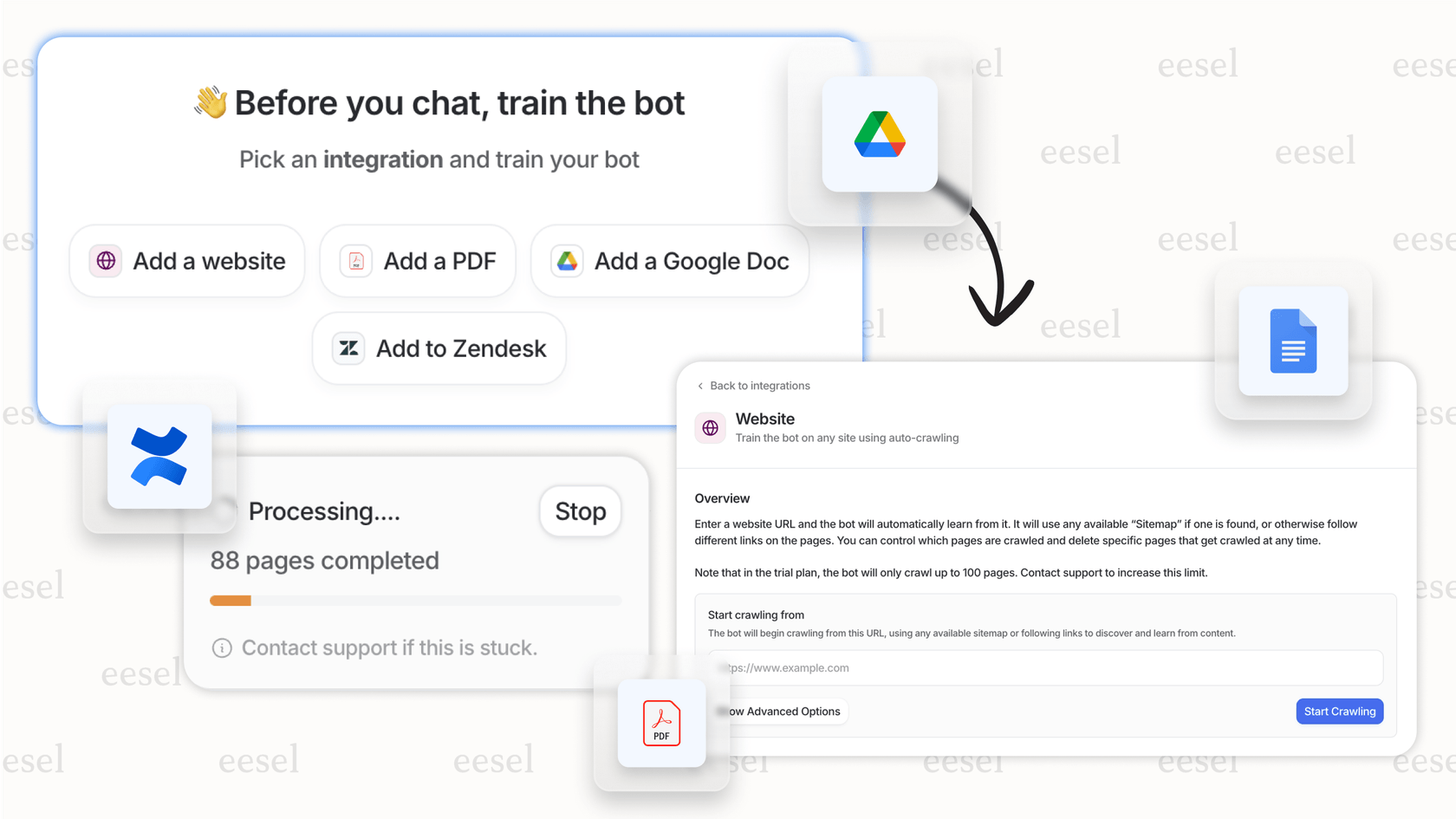
This approach powers a full suite of automation tools for support teams:
- AI Agent: Steps in to autonomously handle and resolve incoming support tickets based on your knowledge.
- AI Copilot: Works alongside your human agents, helping them draft perfect, accurate replies in a fraction of the time.
- AI Triage: Works in the background to automatically tag, route, and close tickets, keeping your support queue tidy.
- AI Internal Chat: Gives your employees an instant way to get answers from internal documentation right inside Slack or Microsoft Teams.
For companies that want to make their existing content do the work, eesel AI is the solution. CartonCloud saw up to 80% time savings on repetitive support tasks and onboarding after getting set up.
SEO.ai vs HyperWrite: Choosing the right tool
When it comes to SEO.ai vs HyperWrite, there isn't a single winner. The right pick is all about what you're trying to achieve.
SEO.ai is the specialized tool you grab when your main goal is to create new, SEO-focused articles efficiently. HyperWrite is the flexible assistant you choose when you need a writing partner for a wide range of daily tasks.
Just remember that both tools still need a lot of human input to make sure the final result is high-quality, accurate, and actually sounds like your brand.
The choice boils down to the problem you need to solve:
- If you need to create new marketing content from scratch, SEO.ai and HyperWrite are both strong options.
- But if you need to automate and scale your support by using the knowledge you already have, you need a different tool like eesel AI.
Explore knowledge automation
If your goal is to reduce repetitive tickets and give both your customers and employees instant, accurate answers pulled directly from your own documentation, it’s time to see what eesel AI can do.
Start your 7-day free trial and find out how you can turn your existing knowledge into your most efficient team member.
Frequently Asked Questions



Share this post
Article by
Kenneth Pangan
Writer and marketer for over ten years, Kenneth Pangan splits his time between history, politics, and art with plenty of interruptions from his dogs demanding attention.