I tried the top 5 SEO tools for AI mode to see what really works in 2026

Stevia Putri
Last edited January 7, 2026
The way people find information online is changing. With Google's AI Overviews and other answer engines becoming more common, just ranking on the first page isn't the only goal anymore. This new environment calls for a different strategy: Generative Engine Optimization (GEO), which is also known as Answer Engine Optimization (AEO). The idea is to make your content the source that AI tools use to generate their answers.
This article looks at five of the top tools that can help businesses adjust to this change. We'll go over everything from creating content that's optimized for AI to tracking how visible you are in these new generative answers. At the heart of any AEO strategy is high-quality, well-structured content. That's why this list begins with a content creation platform like the eesel AI blog writer before getting into tracking and analytics tools.
What are SEO tools for AI mode?
SEO tools for AI mode are platforms built for GEO. They aim to help your content get found, cited, and featured in the AI-generated summaries on platforms like Google AI Overviews, ChatGPT, and Perplexity. Instead of just trying to rank in a list of blue links, the goal is to become a primary source cited within the AI's answer.
These tools typically offer a few core features to help you do this:
-
They keep track of brand mentions and visibility across different large language models (LLMs) and answer engines.
-
They help you structure content so it's easy for AI crawlers to understand, often by promoting an answer-first format, clear headings, and the use of structured data.
-
They let you see how your competitors are doing within AI-generated answers.
-
They can point out content gaps that might be stopping your site from being seen as an authoritative source by an AI.
Criteria for selecting the best SEO tools for AI mode
To ensure a useful and trustworthy list, each tool was evaluated based on specific criteria. The goal was to identify platforms that offer tangible benefits for updating an SEO strategy for an AI-driven search landscape.
-
AI visibility tracking: The tool needed to offer reliable tracking for major AI platforms, including Google AI Overviews, ChatGPT, and Perplexity. The more engines it covered, the better.
-
Content optimization for AI: It had to have features that help create new content or optimize existing content to be "citation-worthy" and properly structured for AI to process.
-
Actionable insights: The data it provides must be clear and helpful for making strategic choices. Just showing off vanity metrics without any context doesn't cut it.
-
Value and use case: Each tool has to serve a clear purpose, whether for a large enterprise, a solo content creator, or a marketing agency, and show a clear return on investment.
Comparison of the best SEO tools for AI mode
| Tool | Best For | Key AI Feature | Starting Price |
|---|---|---|---|
| eesel AI blog writer | Scaling AEO-optimized content creation | Generates complete, citation-worthy blog posts | Free to try ($99 for 50 blogs) |
| Surfer SEO | Content teams needing an integrated workflow | AI Tracker for visibility in AI Overviews, ChatGPT, Perplexity | $95/month (AI Tracker add-on) |
| Semrush | Teams wanting an all-in-one SEO and AEO platform | AI Visibility Toolkit tracks mentions across Google, ChatGPT, Gemini | $165.17/month |
| Rankscale.ai | SEO specialists needing granular, dedicated AI tracking | Tracks 10+ AI engines including Claude, Mistral, and Grok | $20/month (credit-based) |
| SE Ranking | SMBs and agencies looking for a cost-effective solution | AI Results Tracker for AIOs, AI Mode, ChatGPT, Perplexity | $95.20/month |
The 5 best SEO tools for AI mode in 2026
Here’s a closer look at each tool, including what it does, its main features, and how much it costs.
1. eesel AI blog writer
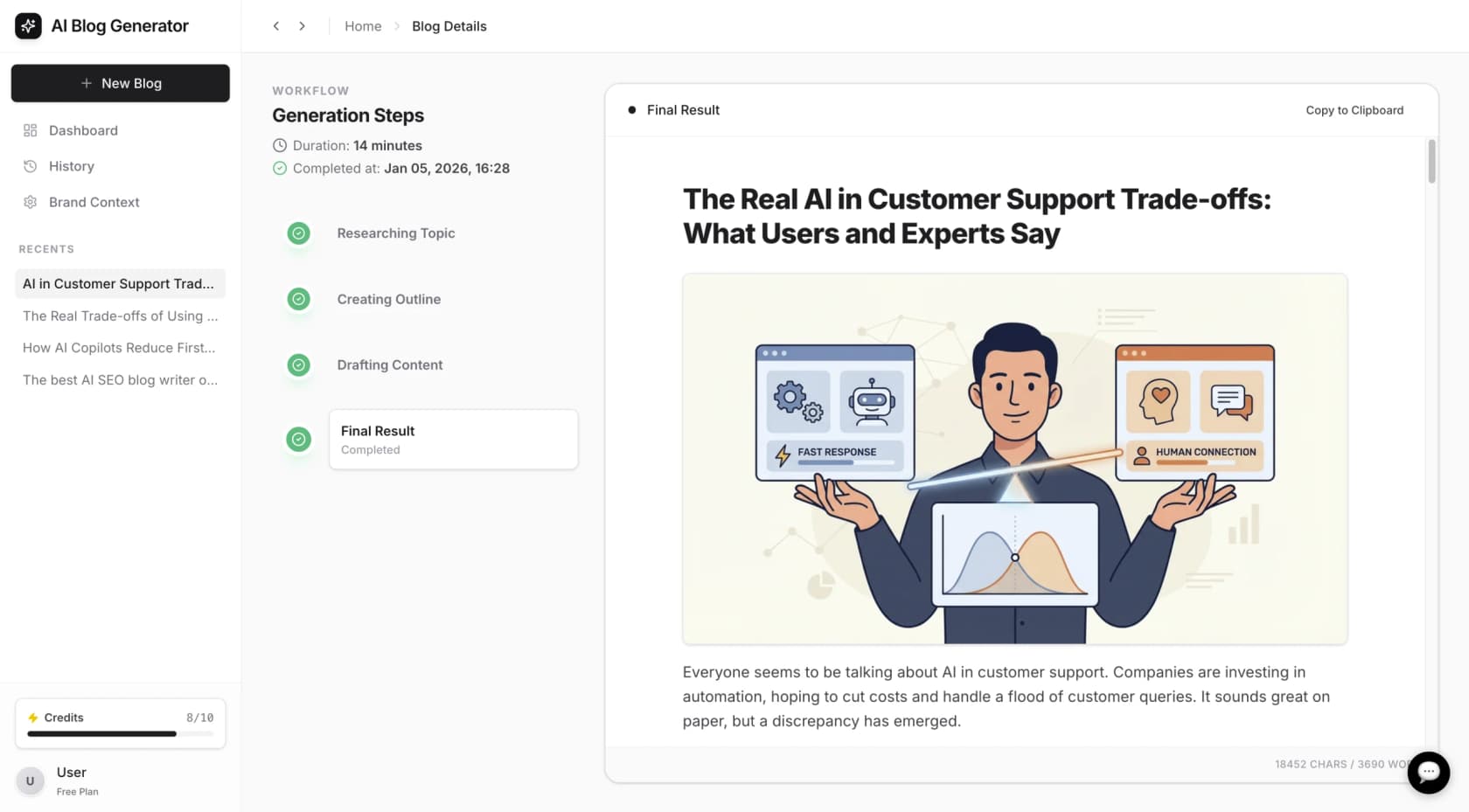
The eesel AI blog writer is a tool for creating AEO-optimized content at scale. Since visibility in AI answers requires citation-worthy content, this platform is built to turn a single keyword into a full, publish-ready blog post for both users and AI crawlers. It automatically includes structured data, answer-first formatting, relevant media like YouTube videos, and internal links. This helps create the assets needed to appear in AI-generated answers.
Our own team at eesel AI used this tool to grow from 700 to 750,000 daily impressions in just three months. The platform is context-aware, so it generates assets and data relevant to the kind of blog you're creating, and it was designed with Answer Engine Optimization (AEO) as a priority from the start.
-
Pros and Cons: The biggest plus is being able to produce a complete, media-rich, and AEO-optimized article from just one prompt, which saves a lot of time on research, writing, and finding assets. The main drawback is that it's a content generation platform, not a performance tracker. To see how your content is doing in AI mode, you'll need to use it with one of the other tools on this list.
-
Pricing: You can try it for free. Paid plans are credit-based, starting at $99 for 50 posts.
2. Surfer SEO
Surfer SEO offers an integrated workflow for content creation and AI tracking. It is a familiar name in content optimization that has added features for AI search. Its AI Tracker monitors your brand's mention rate, average position, and overall visibility across Google AI Overviews, ChatGPT, and Perplexity. It gets its data from real answers, not just API outputs, for better accuracy. This makes Surfer an integrated solution for teams that want to create, optimize, and track their content all in one place.
-
Pros and Cons: Surfer's main strength is its all-in-one workflow, which combines its well-known Content Editor with AI visibility tracking. The Topical Map feature is also handy for building the kind of subject matter authority that AI engines look for. On the downside, its AI visibility tracking is an add-on, and it currently supports fewer AI engines than more specialized tracking tools.
-
Pricing: The AI Tracker is an add-on that starts at $95 per month for 25 prompts. The base plans for the main Surfer platform begin at $99 per month.
3. Semrush
For teams seeking a comprehensive, enterprise-ready platform, Semrush is a major provider of SEO software. Its AI Visibility Toolkit makes it a candidate for AI mode optimization. This set of tools, which is part of the Semrush One plan, tracks how your brand appears on platforms like ChatGPT, Gemini, and Perplexity. It gives you an overall AI Visibility Score, shows how often your brand is mentioned, and lets you track specific prompts. Its AI assistant, Copilot, also offers tips to improve your site's general SEO health, which is a good foundation for AEO.
-
Pros and Cons: The key benefit of Semrush is that AI tracking is built into its already extensive SEO platform, making it a good option for teams that like having all their data in one spot. The platform is robust and widely used. The main drawback is the price, as the AI features are included in the higher-tier Semrush One subscription, which might be too expensive for smaller businesses.
-
Pricing: The Semrush One Starter plan starts at $165.17 per month when billed annually.
4. Rankscale.ai
Rankscale.ai is designed for specialized and granular AI visibility tracking. It is a specialized Generative Engine Optimization (GEO) tool made specifically to track brand visibility in AI answers. It monitors performance on more than 10 different AI engines, including ChatGPT, Perplexity, Claude, Google AI Overviews, Mistral, and Grok. The platform lets users track their rankings by keyword, AI engine, and location, and it also provides sentiment analysis of brand mentions.
-
Pros and Cons: The tool's biggest strength is its focus and precision. For teams that need deep, accurate data on their AI visibility across many different platforms, Rankscale provides a focused option. The pay-as-you-go credit model also provides flexibility. Its main limitation is that it's only a tracking tool; it doesn't offer content creation or on-page optimization features. The API is also listed as "coming soon", which could be an issue for teams needing immediate integration.
-
Pricing: Rankscale uses a monthly credit-based model, with the Essentials plan starting at $20 per month for 120 credits.
5. SE Ranking
SE Ranking provides a cost-effective, all-in-one solution for SEO and AEO. It is a full-stack SEO platform that provides a more affordable alternative to some of the bigger, more expensive options. The company has added AI search tracking to its platform with its AI Results Tracker and AI Overviews Tracker. These features monitor your presence in Google's AI-generated answers and track performance for specific prompts across ChatGPT, Gemini, and Perplexity. They help you measure brand mentions, link presence, and competitor visibility across different LLMs.
-
Pros and Cons: SE Ranking offers a good mix of SEO features and AI tracking at a reasonable price, making it a practical all-in-one tool for small to mid-size businesses. One potential drawback is that its AI tracking is based on manually added prompts, which might make it less suited for broad, automatic brand discovery than some of the other tools here.
-
Pricing: The Pro plan, which includes AI tracking, starts at $95.20 per month when billed annually.
Best practices for using SEO tools for AI mode
Adjusting to an AI-first search world involves more than just new tools; it also requires changes to content strategy. Here are a few tips to consider.
-
Create "citation-worthy" content: The main goal is to be the source for AI answers. Focus on creating answer-first content that directly addresses what users are asking. Use clear, simple language and include original data, unique insights, or helpful visuals. A tool like the eesel AI blog writer is made to produce these kinds of assets for you.
-
Implement structured data: Use Schema markup (like Article, FAQ, or Person schemas) to give AI engines clear context about your content. This helps them understand what your page is about and why it's a credible source, making it more likely to be cited.
-
Strengthen E-E-A-T signals: Experience, Expertise, Authoritativeness, and Trust are more important than ever for AI visibility. Show off author credentials, share first-hand experiences (using phrases like "we tested" or "in our analysis"), and use original screenshots and data to back up your expertise.
-
Track AI visibility, not just clicks: As AI provides more direct answers, clicks are becoming a less reliable way to measure performance. Start paying attention to metrics like brand mentions, citation frequency, and your visibility score in AI results. The tracking tools on this list are designed to help you measure what matters now.
The right SEO tools for AI mode depend on your strategy
Navigating the new world of AI-driven search means shifting from traditional SEO to a broader AEO approach. A good strategy will likely involve using a combination of different tools: one for creating high-quality, structured content that AI can understand, and another for monitoring how it performs in AI answers.
The tools on this list provide solutions for every part of this process, from creating content to tracking performance. But a successful AEO strategy always starts with having content that is worth citing in the first place.
For a deeper dive into how these strategies come together, the following video provides a comprehensive checklist for optimizing for Generative Engine Optimization and AI search in 2026.
To start building your foundation of citation-worthy content, try the eesel AI blog writer for free. You can generate your first complete, AEO-optimized blog post in just a few minutes.

Frequently asked questions
Their main functions are to help your content get cited in AI-generated answers on platforms like Google AI Overviews and ChatGPT. They do this by helping you create AI-friendly content, tracking your visibility and brand mentions across various AI engines, and analyzing competitor performance in those same spaces.
For a small business, look for a tool that offers a good balance of features and affordability. A cost-effective, all-in-one solution like SE Ranking can be a great start. Also, consider a content creation tool like the eesel AI blog writer to efficiently produce the high-quality, structured content needed for AEO.
Yes, some tools offer free trials or limited free plans that can be very effective for getting started. For instance, you can use the eesel AI blog writer for free to generate your first few AEO-optimized articles. This allows you to build a foundation of citation-worthy content without an initial investment.
AI answer engines aim to provide users with the most accurate and authoritative information. They prioritize content that is well-researched, clearly structured, and demonstrates expertise (E-E-A-T). Even the best tracking tools can't make low-quality content visible. Your content must be "citation-worthy" on its own for the tools to be effective.
These tools typically work by monitoring a set of keywords or prompts across various AI engines. They then analyze the generated answers to see if your brand or a link to your website is mentioned as a source. They compile this data to give you metrics like a visibility score, mention frequency, and average position within the AI's response.
Share this article

Article by
Stevia Putri
Stevia Putri is a marketing generalist at eesel AI, where she helps turn powerful AI tools into stories that resonate. She’s driven by curiosity, clarity, and the human side of technology.