SEO for startups: A complete guide to organic growth

Stevia Putri

Katelin Teen
Last edited January 27, 2026
If you're running a startup, you know the deal: tight budgets, even tighter timelines, and a constant need for growth that doesn't break the bank. Paid ads can give you a quick visibility boost, but it's like renting an apartment. The moment you stop paying, you're out.
Search Engine Optimization (SEO) is more like buying a house. It's an asset you build over time. It’s all about creating a steady stream of good leads by publishing helpful content that your ideal customers are already searching for.
This guide is a no-fluff look at how startups can do SEO right. We’ll cover the technical basics to get your site in good shape, how to create content that people actually want to read, and the steps to build enough trust to go toe-to-toe with the big names in your industry.
And since every startup needs to move fast, tools like the eesel AI blog writer can be a huge help. It helps you scale up your content creation without sacrificing quality, turning one of the most tedious parts of SEO into a much smoother process. That way, you can worry about the big picture.
What is SEO for startups and why does it matter?
In simple terms, SEO for startups is about tweaking your website so it shows up more often when people search for things related to what you sell. For a new company, this is everything. It puts you in front of people who are already looking for a solution you offer, exactly when they're ready to buy.
And that's a big deal. Research shows that 71% of B2B researchers kick off their search with a general query, not your company's name. They're typing in "best tool for X," not "YourBrand." If you don't show up, you might as well be invisible.
The traffic you get from SEO is "organic," meaning you aren't paying for each click like you do with ads. But let's be honest, it's not exactly "free." It costs you time and effort. You can expect to wait around 3-6 months to see real results, so the sooner you start, the better.
For a startup, the long-term benefits are huge:
- It's cost-effective. The effort you put in today continues to pay off for months, even years. This brings down how much it costs to get a new customer over time.
- It builds trust. Ranking high on Google gives you instant street cred. It tells people you're a serious player in your field.
- It's sustainable. Ads disappear when you stop paying. A good piece of content can bring in traffic and leads long after you've published it.
- You get better leads. The people who find you through search are already looking for a solution. They're way more qualified than someone who just happened to see your ad while scrolling through social media.
An infographic explaining the key benefits of SEO for startups, including cost-effectiveness, trust-building, sustainability, and lead quality. An example of SEO for startups.
The basics of a strategy for SEO for startups
Before you jump into writing blog posts, you need to get your website's foundation right. Nailing these technical and strategic details early on will save you a ton of headaches later. It might seem a bit boring, but it's the stuff that really sets you up to win.
Technical SEO for startups: Getting your house in order
Technical SEO is just about making it easy for search engines to find, crawl, and understand your site. If Google's little bots get stuck or confused, they'll just move on, and all your great content will go unseen.
First up is mobile-friendliness. This isn't optional anymore. Your site has to work perfectly on a phone. Most searches happen on mobile, so if your site is a disaster on a small screen, you're shooting yourself in the foot.
Next is site speed. Nobody likes a slow website. People expect pages to load almost instantly. You can use tools like Google's PageSpeed Insights to see how you're doing and get tips on speeding things up.
You also need a clear URL structure. Keep your URLs simple and easy to read. For example, yourstartup.com/features/project-management is much better than something cryptic like yourstartup.com/p?id=123.
Finally, create an XML sitemap. Think of it as a map of your website that you hand directly to search engines. You can create one and submit it through Google Search Console to help Google find all your important pages.
Keyword research for SEO for startups: Finding your sweet spot
Keyword research is just figuring out what your customers are actually typing into Google. As a startup, you're not going to win by targeting huge keywords like "CRM software." You'll just get buried by the competition.
You should look for keywords with a low-to-medium Keyword Difficulty (KD). Semrush says a KD score of 15-29 is "Easy," which is a perfect target for a new site with good content.
And don't get obsessed with search volume. The page that ranks #1 for a keyword usually gets way more traffic than the search volume number suggests, because it also ranks for hundreds of other related phrases. Always look at the top-ranking pages to see how much traffic they're really getting.
| Metric | "Project Management Software" | "Best Project Management Tool for Freelancers" |
|---|---|---|
| Monthly Search Volume | 90,000 | 1,500 |
| Keyword Difficulty (KD) | 85 (Very Hard) | 15 (Easy) |
| Search Intent | Broadly informational or commercial | Highly specific, commercial |
| Chance for a Startup to Rank | Very Low | High |
Creating content that ranks with SEO for startups
Once your technical house is in order, it's time for the main event: your content. Google is getting smarter all the time, and its main goal is to show people helpful, reliable, people-first content. Every piece of content you publish should have one goal: answer a specific question for your reader and subtly show them how you can help.
Matching search intent for your SEO for startups
Search intent is just the "why" behind a search. When someone types something into Google, what are they trying to do? If your content doesn't match their goal, it's not going to rank, no matter how great it is. The main types are informational ("how to..."), navigational ("eesel AI blog"), commercial ("best..."), and transactional ("buy...").
Pro tip
Before you write anything, Google your target keyword. Look at what's already on the first page—blog posts, comparison tables, or videos. Google is showing you what format people want for that search. Your job is to create something similar, but better.
How to scale your SEO for startups with the eesel AI blog writer
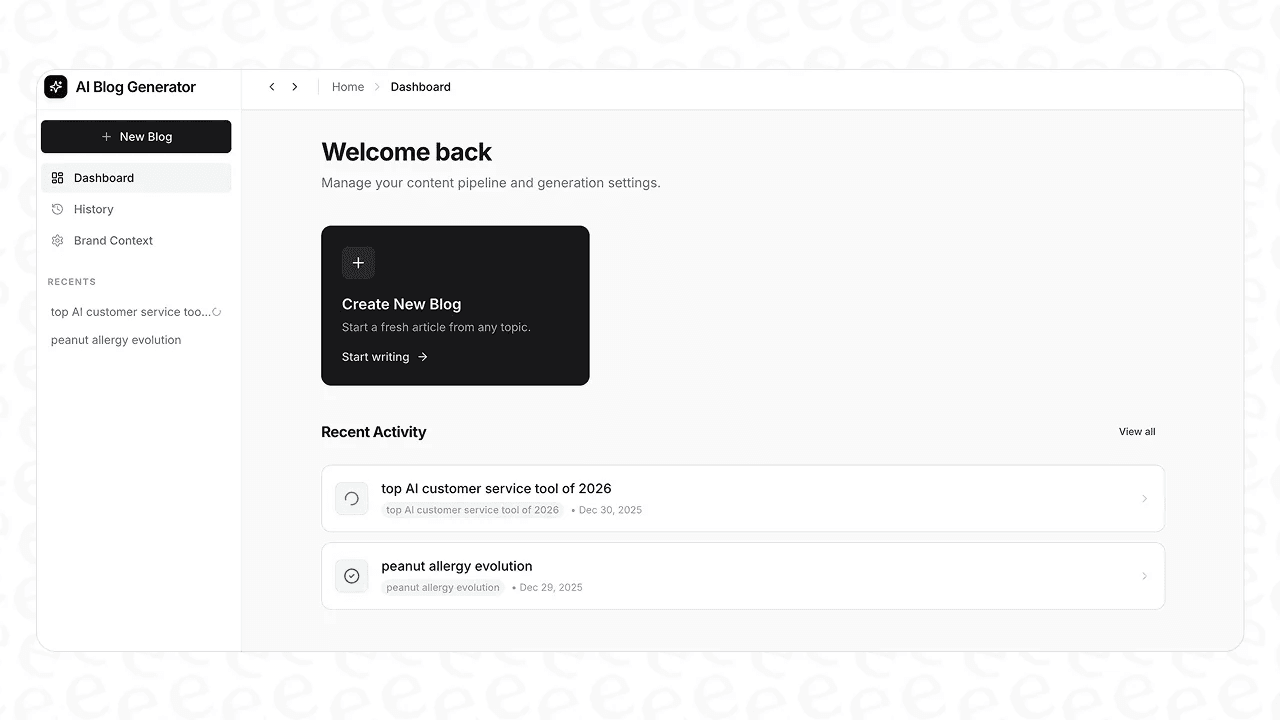
The eesel AI blog writer was built to solve this exact problem for startups. It doesn't just give you a messy first draft that needs hours of work. It takes a single keyword and turns it into a full, publish-ready blog post that's already optimized to rank.
We used this exact tool ourselves at eesel AI. It helped us grow our daily search impressions from just 700 to over 750,000 in only three months after we published over 1,000 blogs with it.
Didn't just copy and paste copy, I used AI (quite heavily) as a tool to help with research (I also did my own to gain nuances AI perhaps wouldn't find) and then help me write detailed posts of anything from 800 to 3600 words. Client traffic went from 800 active users a year to almost 36,000 (8000 landed on the home page alone). Perhaps the not so lazy way ;P

Here’s how it helps you scale up your content:
- It creates complete posts. You get a full article with an intro, headings, a conclusion, and an FAQ section. This saves a ton of time on outlining and writing from a blank page.
- It adds assets for you. The tool automatically includes AI-generated images, tables, and infographics to make your posts more interesting and scannable.
- It finds social proof. It can pull in relevant Reddit quotes and YouTube videos to make your articles feel more authentic and grounded in real-world experience.
- It's optimized for search. The content is designed to rank on Google and is also ready for AI Answer Engines like Google's AI Overviews, which are becoming a bigger deal.
By letting AI handle the heavy lifting of research and drafting, your team can spend more time on strategy and promotion. It’s about speeding up your content process, not replacing your thinking.
How to build authority and trust for your SEO for startups
When you have a new website, great content sometimes isn't enough to get you to page one. You also have to show Google that you're a trustworthy source. You do this with a mix of off-page SEO and consistently proving you know your stuff.
Link building for SEO for startups: It's about quality, not quantity
Backlinks are just links from other websites to yours. Google sees them as votes of confidence. But not all votes are the same. As Google's John Mueller has said, quality is way more important than quantity. One good link from a respected site in your industry is worth more than hundreds of links from spammy websites.
Don't waste your time on shady link-building tactics. Instead, focus on things that actually provide value.
You can try Digital PR. This means creating something newsworthy, like an original study or a strong opinion piece, and then showing it to journalists and bloggers who might want to write about it and link to you.
Another great approach is to create linkable assets. This is stuff that people naturally want to link to. Think free tools, the most detailed guide on a topic, or a great-looking infographic that makes a complicated subject easy to understand.
Why you can't fake E-E-A-T with SEO for startups (and what to do instead)
You'll probably hear SEO folks talk about adding E-E-A-T (Experience, Expertise, Authoritativeness, Trust) to your site. It sounds like something you can just check off a list. But it doesn't work that way. As Google's own people have said, E-E-A-T isn't something you add; it's something you earn by consistently publishing helpful and accurate content.
- Who created it? Be transparent. Write detailed author bios that show off your team's real experience. Link to their social media or a good "About Us" page. Prove that actual experts are writing your stuff.
- How was it created? Be open about your process. If you're reviewing a product, include your own screenshots to show you really used it. If you use AI to help write, just say so. A little disclosure goes a long way in building trust.
- Why was it created? This is the big one. The answer should always be "to help my audience." If your main reason for creating content is just to get clicks from Google, you're not going to win in the long run.
If you focus on these things, you'll naturally send all the right signals to Google that you're a source worth trusting.
For a quick and authoritative overview of the most important SEO concepts for a new business, this video from Google Search Central is a great starting point. In just a few minutes, it covers the core principles that can set you up for long-term success.
Your next steps for startup SEO
SEO can seem intimidating for a startup, but it is a straightforward process. Get your technical basics right so Google can read your site. Find the keywords your customers are using. Then, consistently create helpful content that answers their questions better than anyone else. After that, it's about building your reputation by earning good links and showing off your team's real expertise. SEO is a long game, but the right tools can help you move faster. Using AI to handle content creation frees you up to focus on the bigger strategy and build momentum right away.

Frequently Asked Questions
Share this article

Article by
Stevia Putri
Stevia Putri is a marketing generalist at eesel AI, where she helps turn powerful AI tools into stories that resonate. She’s driven by curiosity, clarity, and the human side of technology.
