If you've been in the SEO game for a while, you probably remember the keyword-stuffing era. You'd pick a phrase like "best running shoes," sprinkle it everywhere, and cross your fingers. It was simple, if a bit clumsy. Well, those days are over. Google grew up, and now it understands what words mean, not just what they are.
The trouble is, many content strategies haven't caught up. People are still churning out keyword-heavy articles and wondering why they aren't ranking. Especially with things like Google's AI Overviews, just targeting keywords is a fast track to being invisible. The focus has shifted from winning keywords to owning entire topics.
I do agree that many SEOs have trouble with intermediate language/linguistic concepts (regardless of actual language) and how they are leveraged in information retrieval.

This is what semantic SEO is all about. It’s about building authority and creating content that genuinely answers people's questions. It's less about stuffing keywords and more about satisfying curiosity. Of course, creating this kind of in-depth, connected content can be a huge time sink. That’s where tools like the eesel AI blog writer come into play, helping you execute a smarter content strategy without all the grunt work.
What is semantic SEO?
So, what is semantic SEO, really? In short, it’s about creating content around topics to match a user's intent, rather than just targeting isolated keywords. The goal is to build context, helping search engines see the relationships between different words, concepts, and ideas on your site and the wider web.
Think about it like this: when you type something into Google, it’s not just scanning for pages with those exact words. It’s trying to figure out your meaning. The classic example is "Apple." If you've been browsing tech sites, Google assumes you mean the company, not the fruit. The context clues (your search history, other words on a page) help it determine the meaning. That's semantics at work.
From strings to things: Understanding entities
To really get this, you have to know about "entities." An entity is just a specific, defined thing or concept that Google understands, like a person, place, company, or even an idea. Steve Jobs, California, and "customer service" are all entities. Google’s Knowledge Graph is essentially a massive encyclopedia of these entities and how they all connect.
The whole idea behind semantic SEO is to make it incredibly clear to Google which entities your content is about. When you nail this, there’s no confusion. Google knows what your page is about and can serve it up to the right audience with confidence.
A practical example of search intent
Let's go back to the running shoe example. A search for "best running shoes" is completely different from a search for "how to tie running shoes."
- "Best running shoes": The user is researching and getting ready to buy. This is commercial intent.
- "How to tie running shoes": The user needs instructions to learn something. This is informational intent.
Google gets this distinction. It shows product reviews for the first query and step-by-step tutorials for the second. It’s matching the content format to the user’s goal. That’s the heart of semantic SEO, stop focusing only on the words and start obsessing over the intent behind them.
The evolution of search: From keywords to context
This change didn't just happen one day. It was a gradual process, pushed forward by major Google algorithm updates that moved search from simple word matching to a much deeper understanding of language. Knowing a bit about these updates helps explain why semantic SEO isn't just a fad, but the new standard.
A brief history: Hummingbird, RankBrain, and BERT
Three updates really changed the landscape:
- Hummingbird (2013): This was the update that kicked things off. Hummingbird helped Google understand "conversational search." People started asking Google questions in plain language ("Where can I find coffee near me?"), and Hummingbird was the engine that figured out the meaning behind these longer queries.
- RankBrain (2015): Next up was RankBrain, a machine-learning system. Its job is to interpret ambiguous or totally new search queries. It makes educated guesses about what you mean and learns from the results, getting smarter over time. It's a big reason why Google feels so intuitive.
- BERT (2019): BERT (Bidirectional Encoder Representations from Transformers) was another huge step. As Google mentioned on its own blog, BERT helps the search engine understand the subtle context of words in a sentence. It looks at small but important words like "for" and "to," which can completely alter the meaning. For instance, it helps Google understand that "math practice books for adults" is very different from "adult practice books for math."
These updates built on each other, giving us the smart, context-aware search engine we have today.
Understanding the four types of user search intent
Aligning content with user intent is the bedrock of any good semantic SEO strategy. If you miss this, nothing else you do will matter much. Every search query fits into one of four main types.
| Intent Type | Description | Example Query |
|---|---|---|
| Informational | The user wants to learn something. | “what is semantic seo?” |
| Navigational | The user wants to find a specific website. | “eesel ai login” |
| Commercial | The user is researching before a purchase. | “best ai blog writers” |
| Transactional | The user is ready to complete an action. | “eesel ai pricing” |
Your task is to figure out the intent for the topics you want to rank for and create the right kind of content to match it. Someone with informational intent needs a blog post, while someone with transactional intent is looking for a product page. It's that straightforward.
Core elements of a winning strategy
Alright, we've covered the what and the why. Now, how do you actually put this into practice? A solid semantic SEO strategy comes down to three main pillars. If you get these right, you'll be on your way to building an effective content engine.
Instead of just clustering keywords, build an entity map around key topics, terms, and relationships in your niche. Create different content types—guides, comparisons, FAQs—that cover every search intent linked to those entities.
Build topical authority with content clusters
It's time to move on from one-off blog posts. The modern way to organize your content is with the pillar-cluster model. It works like this: you create a huge, detailed "pillar" page on a broad topic (like "customer service automation"). Then, you create several "cluster" pages that go deep into specific subtopics (like "AI chatbots for e-commerce" or "benefits of automated ticketing"). Finally, you link all the cluster pages back to the main pillar page.
This structure sends a powerful signal to Google that you're an expert on the whole topic. You haven't just mentioned it; you've covered it from all sides. This is called "topical authority," and as noted by leading SEO resources, it's critical for ranking for competitive terms and getting featured in those AI Overviews.
Using structured data
Structured data, also known as Schema markup, is like a special code you can use to talk directly to search engines. You add this standardized code to your site to explicitly tell Google what your content is about. For example, you can use it to label a block of text as a recipe or a number as a product rating.
Why does this matter? It helps Google understand your content with zero ambiguity, which can earn you "rich results" in the search listings, things like review stars, event dates, and prices showing up right on the results page. According to Google, this can lead to much higher click-through rates.
Pro tip
This area moves quickly. For example, Google recently shared that [FAQ rich results](https://developers.google.com/search/blog/2023/08/howto-faq-changes) are now mostly shown for high-authority health and government sites. It's worth keeping an eye on which types of Schema are most effective right now.
Create a web of meaning with internal linking
Your internal linking strategy is one of the most overlooked parts of SEO. It’s not just for helping people get around your site; it’s for drawing a map for search engines. Every time you link from one page on your site to another, you're showing Google how they relate to each other.
The best way to do this is with descriptive, topic-focused anchor text. Instead of using generic phrases like "click here," use text that describes the page you're linking to. For instance, linking to your pillar page with the anchor text "our complete guide to semantic SEO" sends a clear contextual signal to Google about that page's topic.
How to implement semantic SEO with the eesel AI blog writer
After reading all this, you might be thinking, "This sounds great, but it also sounds like a lot of work." You're not wrong. Manually researching topics, finding related concepts, building out content clusters, and writing quality articles is a massive time investment.
This is exactly why we built the eesel AI blog writer. It’s a practical tool designed to help you execute a complex strategy like this, but at scale and without the huge time commitment.
From deep research to a publish-ready draft in minutes
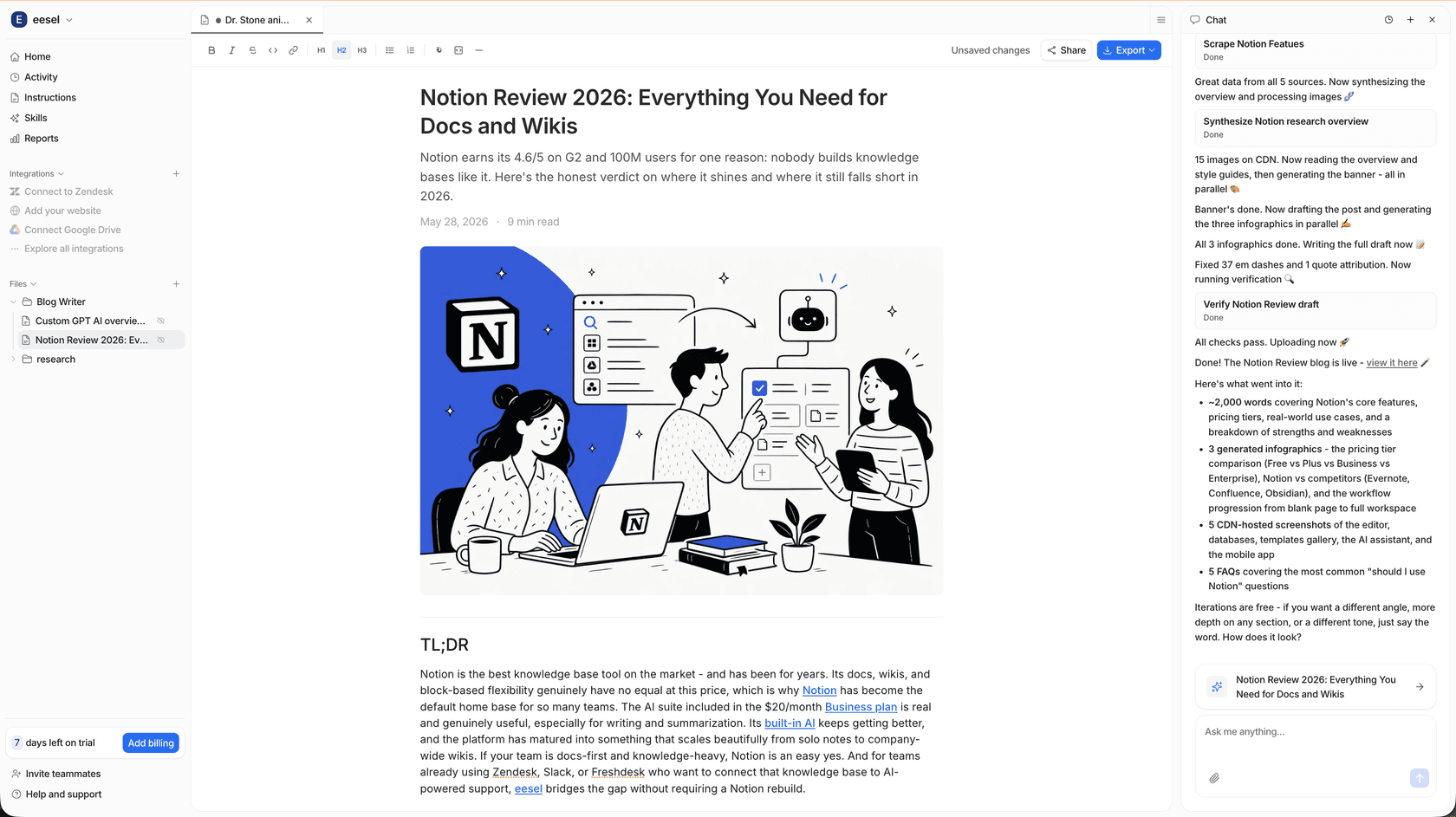
The eesel AI blog writer is more than just a content spinner. When you give it a keyword, it does deep research to understand the topic, user intent, and what's already ranking. It then generates a complete, structured article that sounds human and is optimized for both traditional SEO and Answer Engine Optimization (AEO), meaning it’s designed to get featured in AI Overviews. You get a fully-formed article with an intro, conclusion, and logical headings, ready for you to review and publish.
Scale your content with a proven growth engine
We don't just sell this tool; we use it ourselves. We used the very same eesel AI blog writer to take our own organic traffic from 700 to over 750,000 daily impressions in just three months. We achieved this by publishing over 1,000 semantically optimized blog posts designed from the start to build topical authority. This isn't just about writing articles faster; it's about consistently creating content that actually drives traffic and growth.
Add semantic context with automatic assets and social proof
Semantic context is about more than just text. Visuals, data, and social proof are all strong signals that tell users and search engines your content is valuable. The eesel AI blog writer gets this. It automatically enhances your articles with AI-generated images, infographics, data tables, and even relevant quotes pulled from Reddit forums. This adds layers of context and credibility that help your content stand out.
To see these concepts in action, here's a helpful video that breaks down how semantic search works and why it's crucial for creating content that ranks high and delivers value.
Let's wrap this up. The move to semantic SEO isn't just another trend; it's the new reality of search. It’s about leaving behind the old tactic of keyword stuffing and adopting a more complete strategy built on topics, user intent, and context. By building topical authority with content clusters, using structured data, and creating a smart internal linking structure, you're not just optimizing for today's search algorithms; you're setting up your content strategy for the future.
This approach is how you get noticed in an increasingly crowded and AI-powered search world. It’s time to stop guessing and start creating content that’s strategically built to perform from the moment you publish it.
Ready to see what a semantic SEO strategy can do for your traffic? Try eesel AI blog writer for free and generate your first complete, optimized article in minutes.