Re:amaze vs Zendesk: Which helpdesk platform fits your business in 2026

Stevia Putri
Last edited March 12, 2026
Choosing the right helpdesk software feels like picking a long-term business partner. Get it right, and your support team operates like a well-oiled machine. Get it wrong, and you're stuck with clunky workflows, frustrated agents, and customers who feel the friction.
Two names that come up constantly in this conversation are Re:amaze and Zendesk. Both are established players with solid reputations, but they serve very different types of businesses. Re:amaze has built a loyal following among e-commerce operators and small teams who want something that just works out of the box. Zendesk, meanwhile, powers support operations for some of the world's largest companies with enterprise-grade features and advanced AI capabilities.
At eesel AI, we integrate with both platforms, so we see how teams actually use them day-to-day. This comparison draws on that real-world perspective, plus detailed research into each platform's current pricing, features, and positioning. Let's break down what actually matters when choosing between them.
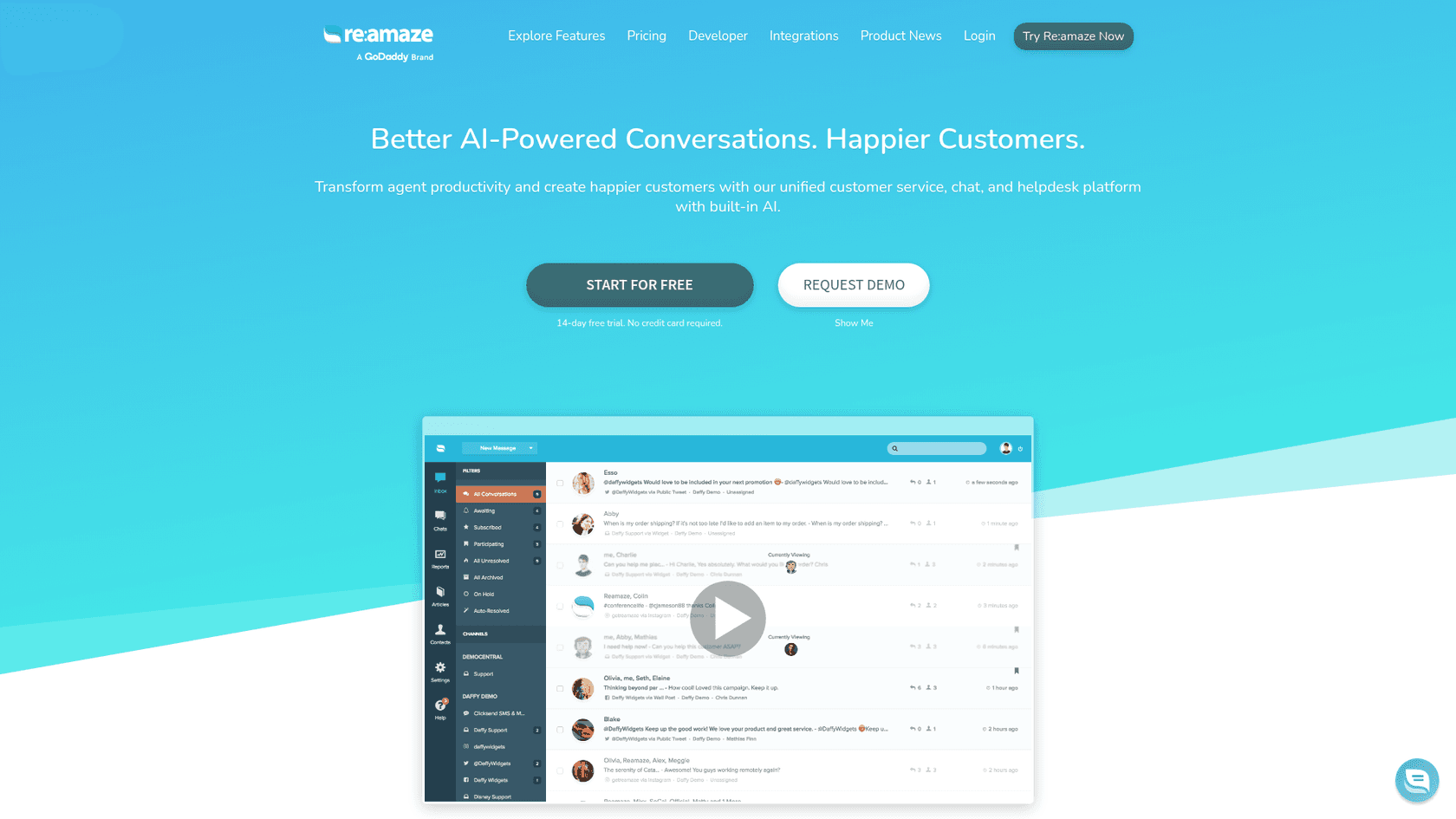
What is Re:amaze?
Re:amaze is a customer service and helpdesk platform founded in 2012 with a clear focus: making multi-channel support simple for online businesses. The platform consolidates email, live chat, social media, SMS, and voice into a single shared inbox.
Where Re:amaze really distinguishes itself is e-commerce integration. The platform offers deep native connections with Shopify, BigCommerce, and WooCommerce. Support agents can view customer orders, process refunds, and even create draft orders without leaving the conversation. For online stores handling order-related questions, this tight integration eliminates the constant tab-switching that slows teams down.
Re:amaze also emphasizes real-time customer engagement. Features like live visitor monitoring, proactive messaging (called "Cues"), and in-chat video calls help businesses engage customers while they're actively browsing. The platform includes chatbots, FAQ management, and recently added AI-powered response assistance (currently in Beta).
The company targets small to medium businesses that want powerful features without enterprise complexity. Their customers include brands like Printful, BuiltBar, and Caraway.
What is Zendesk?
Zendesk is one of the most recognized names in customer service software. Founded in 2007 and publicly traded since 2014, the platform serves over 100,000 companies including Uber, Squarespace, and Tesco.
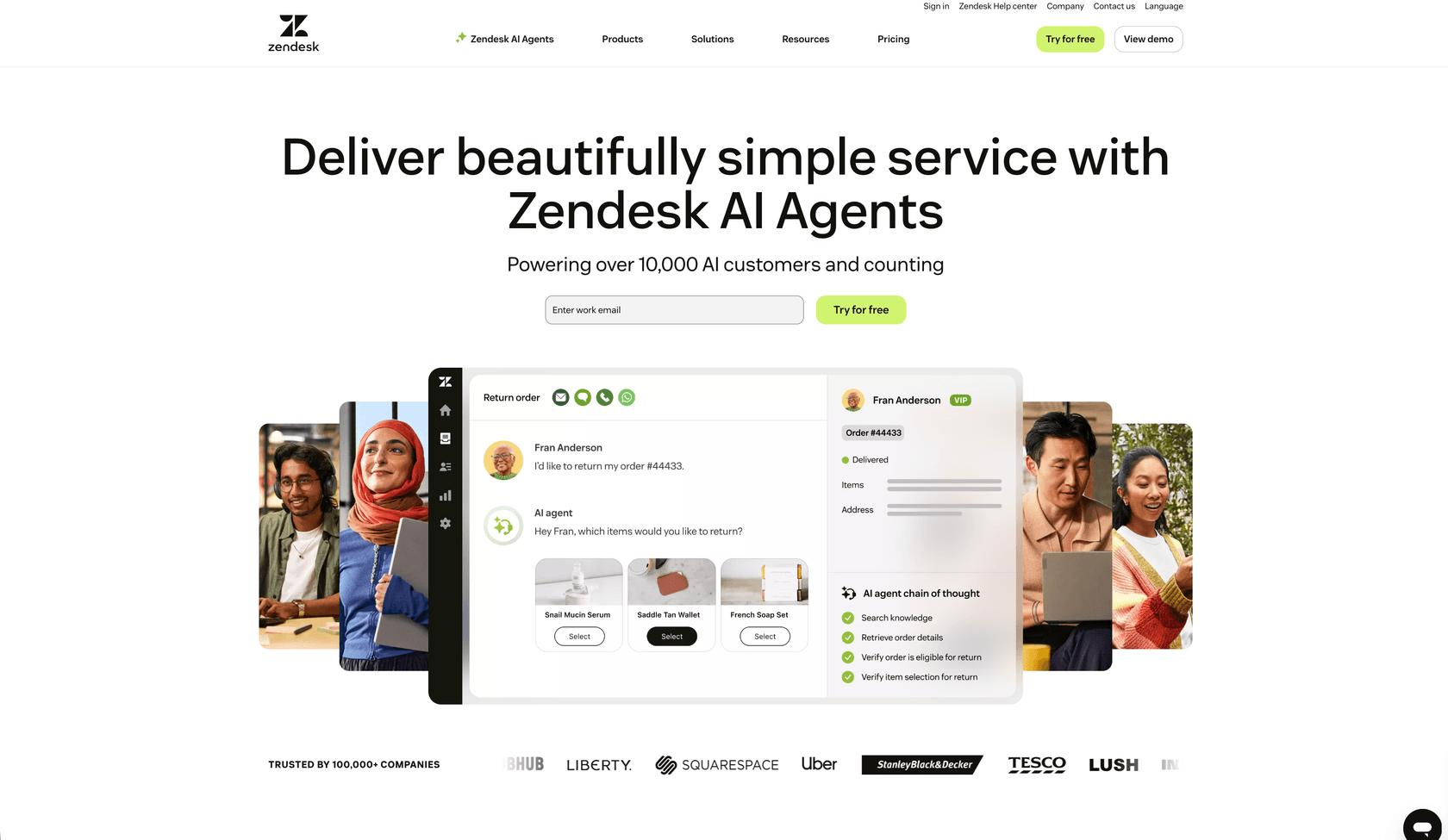
Zendesk's approach centers on AI-powered service resolution. The platform's AI agents can autonomously resolve complex customer issues across any channel, with the company claiming over 80% automation rates for mature deployments. The Copilot feature acts as a proactive assistant for human agents, providing insights, suggested replies, and the ability to execute approved actions.
Beyond AI, Zendesk offers comprehensive ticketing, messaging, voice, help center, quality assurance, and workforce management tools. The platform integrates with over 1,000 apps through the Zendesk Marketplace and provides enterprise-grade security and customization options.
Zendesk serves businesses of all sizes but has particular strength in mid-market and enterprise segments where complex workflows, advanced analytics, and workforce management become critical.
Re:amaze vs Zendesk: Key differences at a glance
Let's cut through the marketing speak and look at how these platforms actually compare across the dimensions that matter most:
| Factor | Re:amaze | Zendesk |
|---|---|---|
| Target audience | SMBs, e-commerce stores | All sizes, strong in enterprise |
| Starting price | $29/agent/month | $19/agent/month |
| G2 rating | 4.6/5 (139 reviews) | 4.3/5 (6,703 reviews) |
| Best for | Shopify/e-commerce, simple setup | Complex workflows, advanced AI |
| AI capabilities | Basic (Beta features) | Market-leading, autonomous agents |
| E-commerce depth | Deep native integration | Via third-party apps |
| Setup complexity | Minutes, minimal config | Hours to days, more customization |
The pattern here is clear. Re:amaze wins on simplicity and e-commerce-specific features. Zendesk wins on AI sophistication, enterprise scalability, and breadth of capabilities.
Pricing comparison
Pricing structures reveal a lot about who each platform is built for. Let's look at the actual numbers.
Re:amaze pricing
| Plan | Monthly Price | Annual Price | Key Features |
|---|---|---|---|
| Basic | $29/agent | $26.10/agent | Email, chat, social, FAQ, basic chatbots, workflows |
| Pro | $49/agent | $44.10/agent | Multi-brand, live visitor view, SMS/voice, advanced reporting |
| Plus | $69/agent | $62.10/agent | Screensharing, departments, performance reporting, video calls |
| Starter | $59 flat | Same | All Basic features, unlimited agents, 500 conversations/month cap |
Re:amaze offers a 14-day free trial with no credit card required. Annual billing saves 10%. There's also an Enterprise tier with custom pricing for high-volume businesses.
Zendesk pricing
| Plan | Price | Key Features |
|---|---|---|
| Suite Team | $19/agent/month | Core ticketing, messaging, help center, basic AI |
| Suite Growth | $55/agent/month | Omnichannel routing, SLA management, light agents |
| Suite Professional | $99/agent/month | Custom workflows, advanced analytics, sandbox |
| Suite Enterprise | $150/agent/month | Advanced security, data residency, multiple sandboxes |
Zendesk also offers a 14-day free trial. The key thing to note: AI agents and Copilot features cost extra beyond these base prices. For teams wanting Zendesk's full AI capabilities, the actual cost runs significantly higher than the entry-level pricing suggests.
Which offers better value?
For small teams (2-5 agents), Re:amaze's straightforward per-agent pricing and included AI features make it the more predictable choice. A team of three on Re:amaze Pro pays $147/month with no surprise add-ons.
Zendesk becomes competitive at scale. The Suite Team plan at $19/agent is cheaper than Re:amaze's entry point, but once you factor in AI capabilities and advanced features, costs converge. For teams of 20+ agents needing workforce management and quality assurance, Zendesk's higher-tier plans deliver capabilities that Re:amaze simply doesn't offer.
The Starter plan from Re:amaze ($59 flat for unlimited agents) is unique in the market and worth considering for very small teams or seasonal businesses.
Feature comparison
Multi-channel support
Both platforms handle the essentials: email, live chat, social media (Facebook, Instagram, X), and SMS. Re:amaze adds voice and in-chat video calls as native features on higher tiers. Zendesk offers voice through integration.
Re:amaze emphasizes real-time engagement with live visitor monitoring and proactive messaging triggers. Zendesk focuses more on intelligent routing and omnichannel conversation continuity.
E-commerce integration
This is where Re:amaze pulls ahead significantly for online retailers. The platform's Shopify, BigCommerce, and WooCommerce integrations let agents:
- View complete order history within conversations
- Process refunds and cancellations directly
- Create draft orders for customers
- See loyalty program data (via Smile.io, LoyaltyLion)
- Access shipping information from ShipStation
Zendesk offers e-commerce integrations through its app marketplace, but they're typically view-only or require external links to take action. For high-volume e-commerce support, Re:amaze's native order management saves significant agent time.
AI and automation
Zendesk dominates this category. Their AI agents operate autonomously, reasoning through complex issues and resolving them without human intervention. The Resolution Learning Loop means the system improves itself over time based on every interaction.
Customer results back this up. Next achieved 66% one-touch resolution and 92% decrease in email handle time. UrbanStems hit 39% automated resolution with $100K in savings within three months.
Re:amaze's AI features are newer and currently in Beta. They offer AI-powered response suggestions, article generation for FAQs, and conversation summarization. For teams wanting cutting-edge AI, Zendesk is the clear choice. For teams satisfied with basic automation and chatbots, Re:amaze covers the essentials.
Knowledge base and self-service
Both platforms include customizable help centers. Re:amaze focuses on FAQ management with AI-powered article generation. Zendesk adds community forums and more sophisticated knowledge management.
Re:amaze's knowledge base directly trains its AI chatbots and agents, which creates a tighter loop between self-service content and automated responses.
Reporting and analytics
Zendesk offers more comprehensive analytics out of the box, including real-time monitoring, custom dashboards, and AI-powered insights. Re:amaze provides solid team performance reporting and conversation metrics but lacks the depth of workforce analytics and predictive insights that larger organizations need.
Use case recommendations
Choose Re:amaze if:
- You run an e-commerce store, especially on Shopify
- You're a small to medium business (under 20 support agents)
- You want straightforward setup without extensive configuration
- Order management and customer data visibility are priorities
- Real-time engagement features like live chat and visitor monitoring matter
- You prefer predictable pricing without AI add-ons
Re:amaze shines for businesses that need to get up and running quickly with a focus on sales and support for online customers. The platform's e-commerce DNA means less time wrestling with integrations and more time helping customers.
Choose Zendesk if:
- You're a mid-market or enterprise company with complex support needs
- Advanced AI capabilities and autonomous resolution are priorities
- You need workforce management, quality assurance, and advanced analytics
- Your support workflows involve multiple departments or sophisticated routing
- You have the resources to invest in implementation and optimization
- Scalability to hundreds or thousands of agents is a future requirement
Zendesk is built for organizations where customer service is a strategic function with dedicated operations teams. The platform's depth comes with complexity, but for teams that can leverage it, the ROI is substantial. Forrester research shows 301% average ROI over three years for Zendesk customers.
Considering a modern AI alternative?
Both Re:amaze and Zendesk represent established approaches to helpdesk software. They require configuration, training, and ongoing management to get right. If you're looking for something different, eesel AI takes a fundamentally different approach: you don't configure our AI, you hire it.
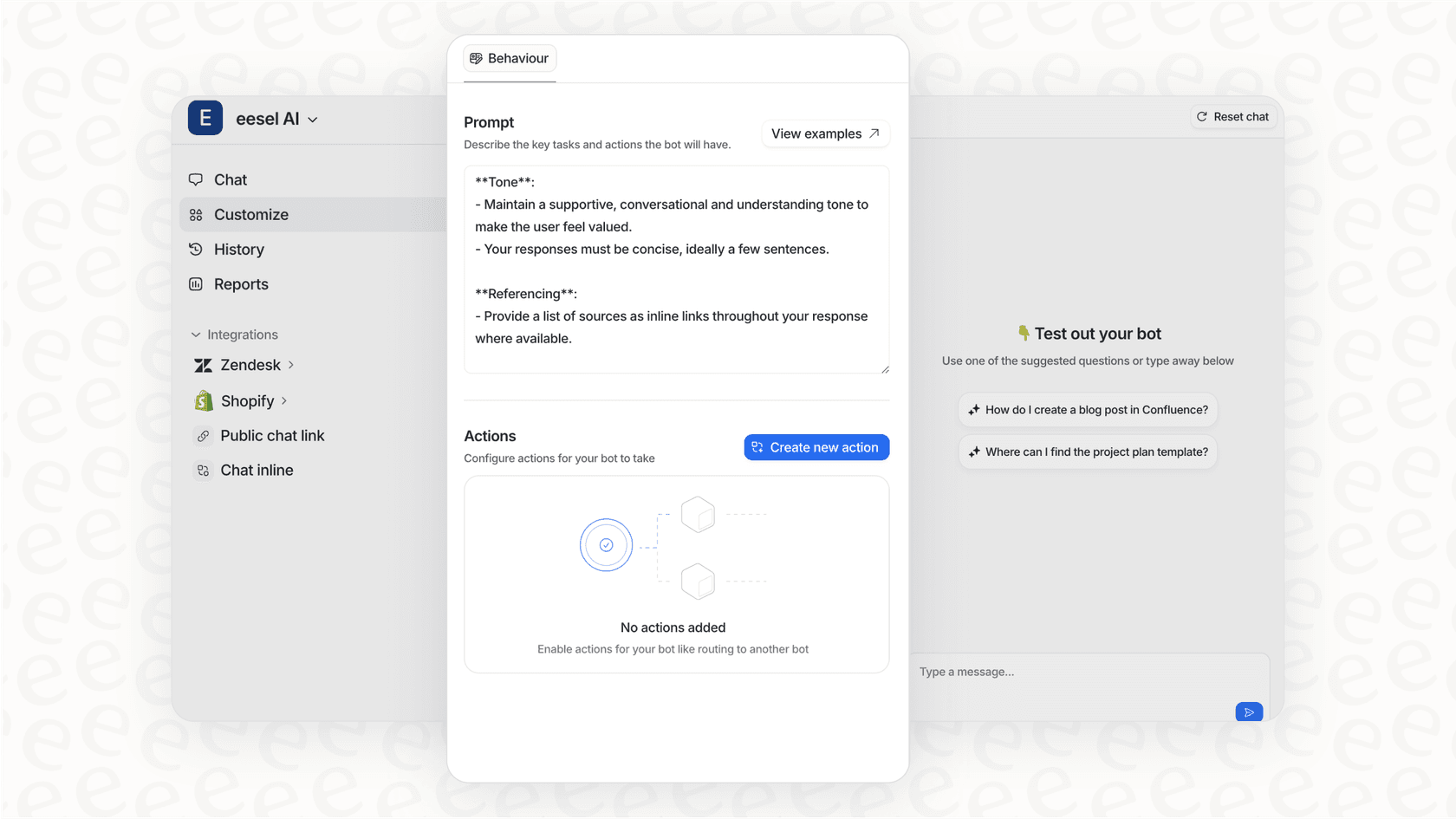
Here's what that means in practice. Instead of spending weeks setting up workflows and training bots, you connect eesel AI to your existing help desk (including Zendesk or Re:amaze), and it learns your business from day one by reading your past tickets, help center articles, and macros.
Like any new team member, eesel starts with guidance. You can have it draft replies for review before sending, limit it to specific ticket types, or set business hours when it operates. As it proves itself, you expand its scope until it's handling full frontline support autonomously.
The key differentiator is autonomous resolution. While both Re:amaze and Zendesk focus on assisting agents or basic chatbot flows, eesel AI resolves tickets end-to-end, including taking actions like processing refunds, updating ticket fields, or creating issues in connected systems. Mature deployments achieve up to 81% autonomous resolution with payback periods under two months.
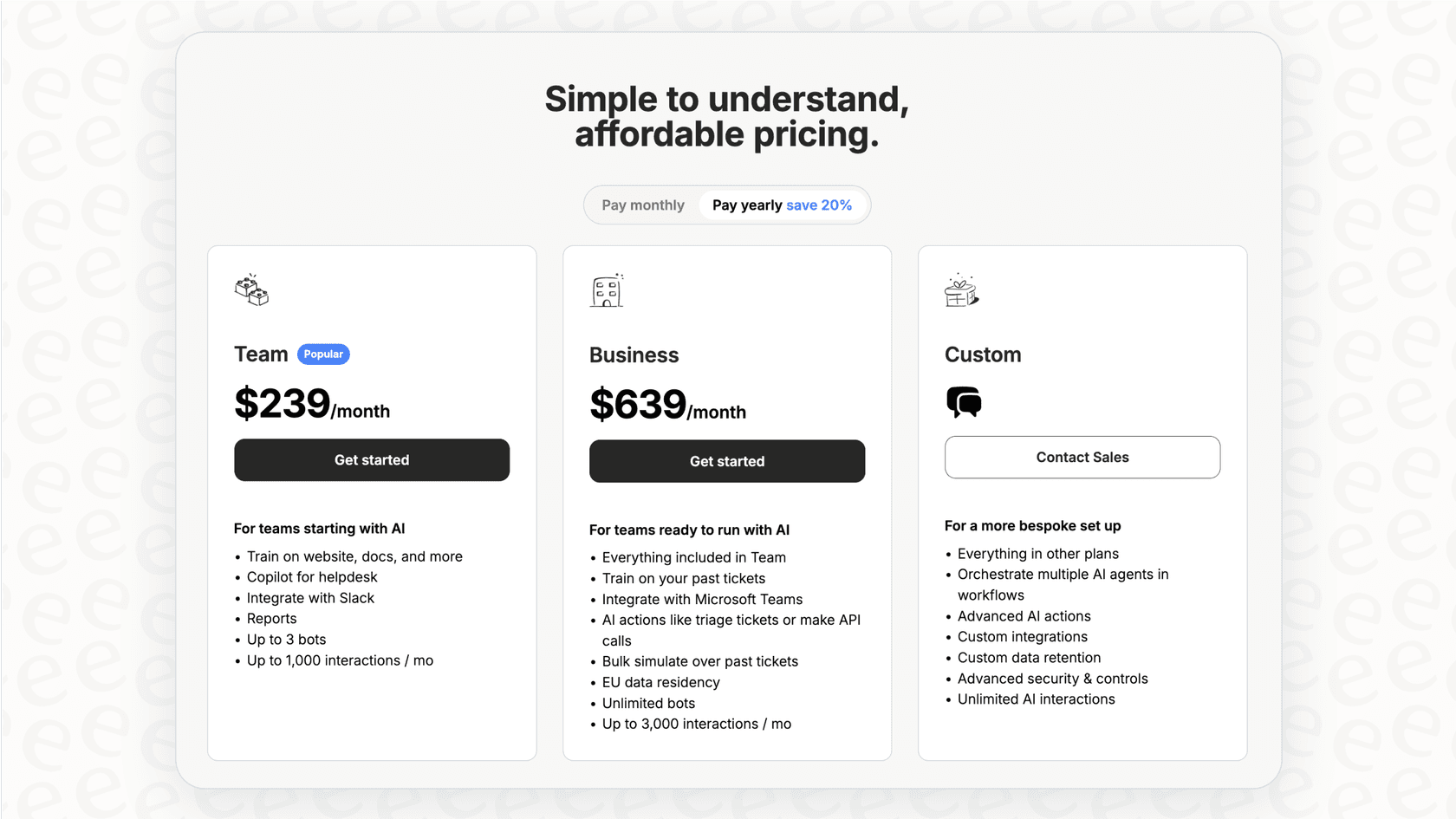
Our pricing is based on AI interactions rather than seats, which means you're not paying for licenses during slow periods or scaling up agent costs as you grow. The Team plan starts at $299/month for 1,000 interactions across up to 3 bots.
If you're evaluating helpdesk solutions and want to see how an AI-native approach compares, you can try eesel AI free or book a demo to see it in action on your actual tickets.
Making your decision
There's no universal "winner" between Re:amaze and Zendesk. The right choice depends entirely on your specific situation.
Go with Re:amaze if you want a helpdesk that feels like it was built for online stores, with minimal setup time and straightforward pricing. It's particularly strong for Shopify merchants who need order visibility integrated directly into support conversations.
Go with Zendesk if you need enterprise-grade capabilities, market-leading AI, and the scalability to support complex operations. The investment in implementation and higher-tier plans pays off for organizations where customer service is a core competitive advantage.
Consider your timeline, too. Re:amaze gets you operational in hours. Zendesk typically requires days or weeks of configuration to fully leverage its capabilities. Both offer free trials, so you can test with your actual workflow before committing.
The helpdesk you choose will shape how your team works and how your customers experience your brand. Take the time to evaluate both against your actual requirements, not just feature checklists. Your future self (and your support team) will thank you.


Frequently Asked Questions
Share this article

Article by
Stevia Putri
Stevia Putri is a marketing generalist at eesel AI, where she helps turn powerful AI tools into stories that resonate. She’s driven by curiosity, clarity, and the human side of technology.
