Re:amaze chatbot: Features, pricing, and alternatives in 2026

Stevia Putri
Last edited March 12, 2026
Managing customer support across multiple channels can feel like juggling flaming torches. You have emails piling up, social media comments to answer, live chat pings, and order inquiries coming from every direction. Helpdesk platforms like Re:amaze promise to unify everything into one manageable inbox.
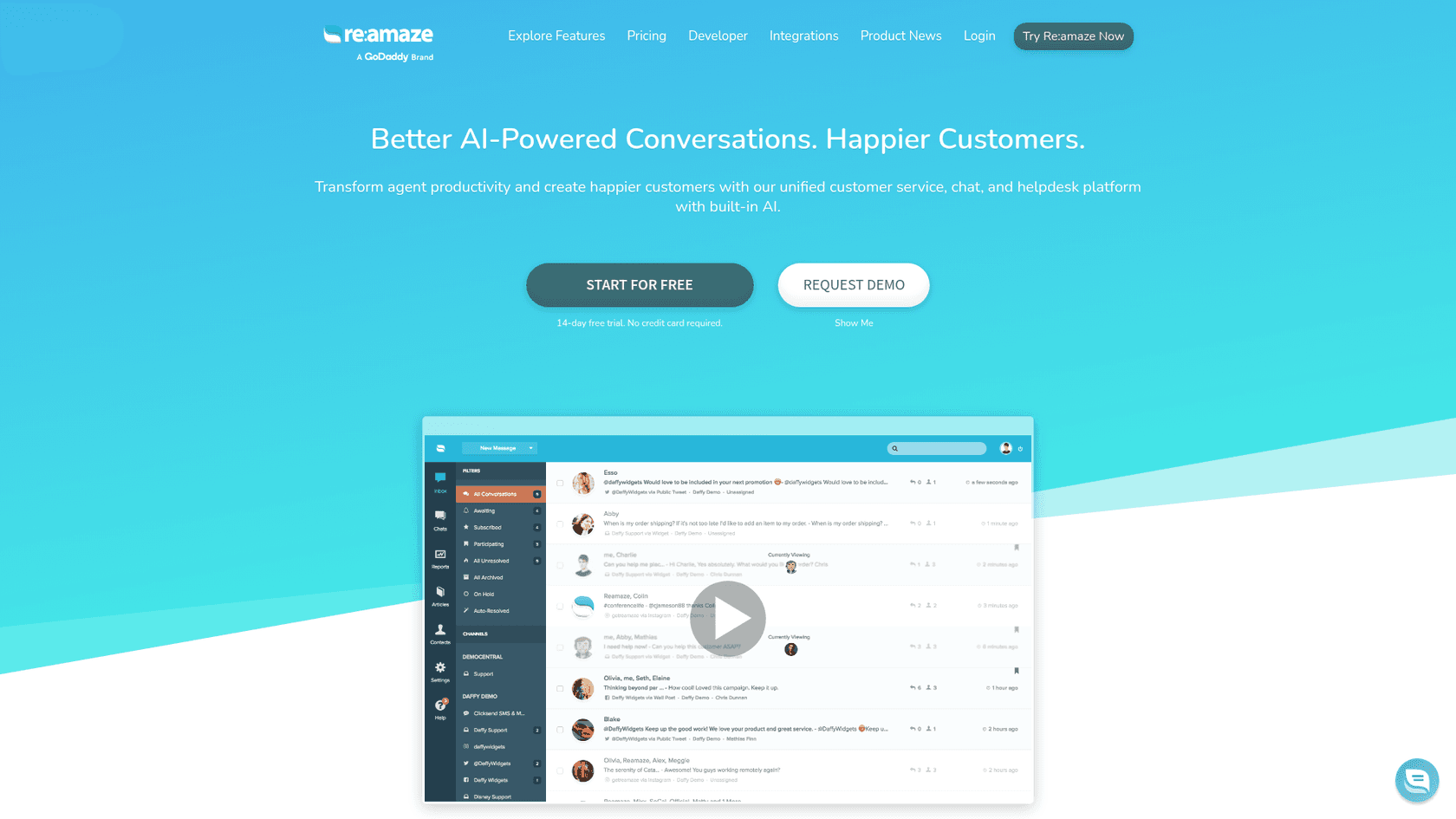
But is Re:amaze the right fit for your business? Let's break down what their chatbot can actually do, how much it costs, and where it fits in the broader customer support landscape.
What is Re:amaze?
Re:amaze is an AI-powered helpdesk platform built primarily for e-commerce businesses and online retailers. It combines email, live chat, social media, SMS, voice calls, and push notifications into a single shared inbox. Think of it as a command center where your team can see and respond to every customer interaction, regardless of where it started.
The platform targets small to medium businesses running on Shopify, BigCommerce, or WooCommerce. Its core pitch is reducing the chaos of multi-channel support while adding automation through chatbots and AI features. Companies like BuiltBar, Printful, and Animatron use it to manage customer conversations at scale.
That said, Re:amaze represents the traditional helpdesk approach: you configure workflows, set up chatbot flows, and manage everything through a centralized dashboard. If you're looking for something that feels less like software configuration and more like hiring a teammate, eesel AI takes a different approach. Instead of building chatbot flows, you invite eesel to your team and it learns your business from existing data.
Re:amaze chatbot types and capabilities
Re:amaze offers several chatbot flavors depending on your needs. Some work out of the box, while others require building custom conversation flows.
Pre-built chatbots
Re:amaze includes three ready-to-use bots that require minimal setup:
-
Hello Bot Greets customers when they start a chat and collects initial information before routing to an agent. It handles those vague "Hello?" messages that clog up queues.
-
Order Bot Integrates with Shopify, BigCommerce, and WooCommerce to pull order status, tracking information, and shipping details. Customers get instant answers about where their package is without waiting for a human.
-
FAQ Bot Suggests relevant help articles based on customer questions. The AI FAQ Bot version uses machine learning to improve suggestions over time.
-
Shopper Bot Acts as a virtual shopping assistant, guiding customers through product selections and offering personalized recommendations.
These bots work through Re:amaze's live chat widget and can be triggered automatically based on customer behavior or manually through Cues (their proactive messaging system).
Custom chatbots
For businesses wanting more control, Re:amaze offers a visual bot builder for creating custom conversation flows. You design these using a node-based interface where each step branches based on customer responses.
Building a custom bot involves:
- Creating nodes with specific bot responses
- Adding quick response buttons that guide the conversation path
- Setting escalation points where conversations hand off to humans
- Connecting bots to Cues for automatic triggering
The visual approach means non-technical team members can build bots without coding. However, it still requires planning out conversation trees and maintaining them as your business evolves.
AI-powered features (Beta)
Re:amaze has been adding AI capabilities, though many are marked as Beta. Their AI features include:
- AI Suggested Responses Generates reply drafts based on customer messages and order information
- Conversation Summaries Automatically summarizes conversations after 10 messages (helpful when tickets bounce between agents)
- Sentiment Analysis Scans conversations to gauge whether customers are frustrated, satisfied, or neutral
- AI Content Creation Helps write FAQ articles and response templates
- Translation On-demand translation of customer messages
The AI runs on OpenAI's GPT models and integrates with Re:amaze's existing channels. However, the Beta label suggests these features are still evolving, and AI usage is capped per user per month depending on your plan.
Re:amaze pricing breakdown
Re:amaze uses per-user pricing, which means costs scale linearly with your team size. Here's the complete breakdown:
| Plan | Monthly Price | Annual Price | Key Features | AI Resolutions |
|---|---|---|---|---|
| Basic | $29/user | $26.10/user | Unlimited email, social, live chat, chatbots, basic reporting | 20/user/month |
| Pro | $49/user | $44.10/user | + Multi-brand, live view, advanced reports, SMS/voice, status page | 50/user/month |
| Plus | $69/user | $62.10/user | + Peek screensharing, departments, staff reporting, video calls, satisfaction ratings | 100/user/month |
| Starter | $59 flat | Same | Basic features for unlimited users, limited to 500 conversations/month | Not specified |
| Enterprise | Custom | Custom | White-glove onboarding, dedicated support | Custom |
A few things to note about Re:amaze pricing:
- The 14-day free trial includes all Plus features, so you can test everything before committing
- Annual billing saves 10% across all plans
- AI resolutions are capped per user, so heavy AI usage could require plan upgrades
- The Starter plan's 500-conversation limit makes it suitable only for very small operations
For a 10-person support team on the Pro plan, you're looking at $490/month ($441/month annually). That adds up quickly as you grow.
What users say about Re:amaze
Re:amaze holds a 4.4/5 star rating on the Shopify App Store from 173 reviews. The feedback patterns are revealing.
What users like:
Merchants consistently praise the channel unification. One long-term user noted: "We needed consolidation of email, voice, SMS, social and Shopify. Reamaze does all this very well." Setup also gets positive mentions, with users reporting they were "up and running in under 5 minutes."
The Shopify integration specifically earns praise for letting agents see order history, process refunds, and create draft orders without leaving the conversation.
Where users struggle:
Support quality gets mixed reviews. Some long-term users (4+ years) report frustration with frontline support gatekeeping technical help. One merchant wrote: "Customer support is very poor. The front line customer service team gate keep proper technical support."
Others mention the interface feeling dated compared to newer alternatives, with one reviewer saying the app "lives in the stone ages" regarding certain UX decisions.
The bottom line? Re:amaze works well for channel consolidation, but some users feel the product hasn't evolved as quickly as competitors.
Re:amaze vs. eesel AI: Choosing the right approach
Re:amaze and eesel AI both handle customer support, but they approach the problem differently. Understanding these differences helps you choose what fits your team.
Re:amaze: The traditional helpdesk
Re:amaze follows the classic model: you get a shared inbox, configure chatbot flows, set up workflows, and manage everything through dashboards. It works well if you:
- Need deep e-commerce integrations (Shopify, BigCommerce, WooCommerce)
- Want visual bot builders for custom conversation flows
- Prefer per-user pricing that scales predictably with headcount
- Need multi-channel support (email, social, SMS, voice) in one place
The trade-off is configuration overhead. Getting the most from Re:amaze means setting up workflows, maintaining chatbot flows, and managing user permissions.
eesel AI: The teammate approach
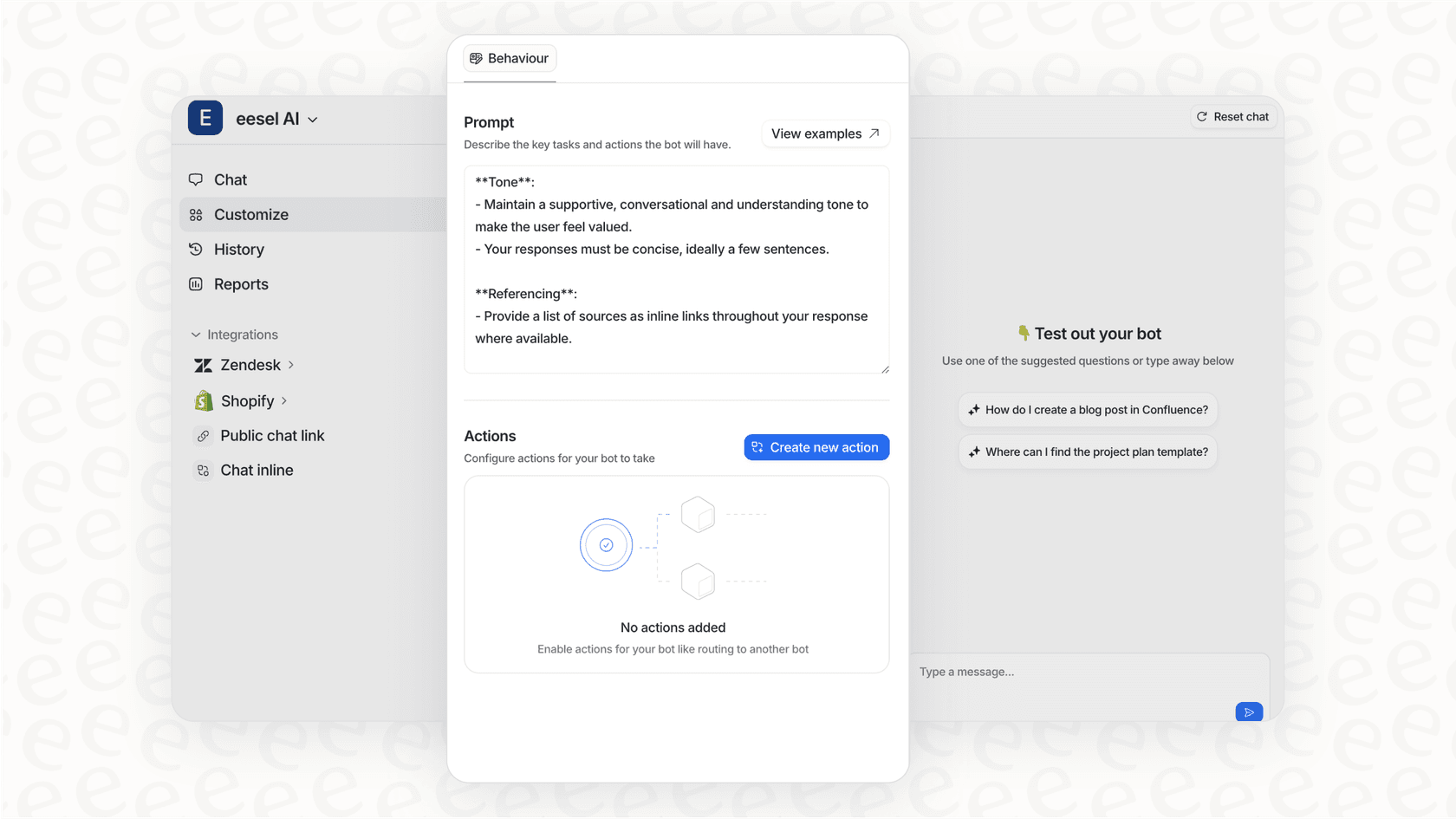
eesel AI treats AI as a teammate you hire rather than software you configure. Instead of building chatbot flows, you connect eesel to your helpdesk and it learns from your past tickets, help center, and documentation. You start with eesel drafting replies for review, then gradually give it more autonomy as it proves itself.
Key differences:
| Factor | Re:amaze | eesel AI |
|---|---|---|
| Setup | Configure workflows and bot flows | Connects and learns from existing data |
| AI approach | Beta features added to helpdesk | Core product built around AI |
| Pricing | Per-user ($29-69/month) | Per-interaction (Team from $299/month) |
| Rollout | All-at-once configuration | Progressive: draft → review → autonomous |
| Control | Visual flow builders | Plain-English instructions |
eesel works particularly well if you want AI handling frontline support without the configuration complexity. You define escalation rules in natural language ("Always escalate billing disputes to a human") rather than building decision trees.
For teams already using Re:amaze who want to add AI capabilities, eesel integrates with Re:amaze to augment your existing setup.
Getting started with AI-powered customer support
Whether you choose Re:amaze, eesel AI, or another solution, a few principles help you implement AI support successfully:
Start with your volume and channels
Map out where customer questions come from and how many you handle monthly. High-volume e-commerce stores have different needs than B2B SaaS companies. Re:amaze excels at multi-channel e-commerce, while eesel AI focuses on autonomous resolution regardless of channel.
Plan your rollout
Don't flip the switch to full automation on day one. Start with AI drafting replies for human review, measure quality, then gradually expand scope. Both Re:amaze and eesel AI support this progressive approach, though eesel builds it into the core experience.
Measure what matters
Track resolution rates, customer satisfaction, and time-to-response. AI should improve these metrics, not just reduce headcount. Re:amaze provides built-in reporting, while eesel AI offers simulation tools to test performance on past tickets before going live.
Consider your growth trajectory
Per-user pricing (Re:amaze) becomes expensive as you scale. Per-interaction pricing (eesel AI) can be more predictable for growing teams. Run the numbers based on your projected headcount and ticket volume.
If you're evaluating AI support options, our guide to customer support automation walks through the decision framework we recommend.

Frequently Asked Questions
Share this article

Article by
Stevia Putri
Stevia Putri is a marketing generalist at eesel AI, where she helps turn powerful AI tools into stories that resonate. She’s driven by curiosity, clarity, and the human side of technology.