Let's talk about off-page SEO. It's basically all the work you do away from your website to show search engines like Google that you're a big deal. Think of it like building up street cred, but for the internet. In 2026, this isn't an optional extra; it's a massive piece of the puzzle if you actually want to rank.
The main headache? Off-page SEO has a lot of moving parts. You need to create content people actually want to share, find the right eyeballs to put it in front of, and then figure out if any of it is making a difference. Trying to manage all that with a spreadsheet is a fast track to a migraine.
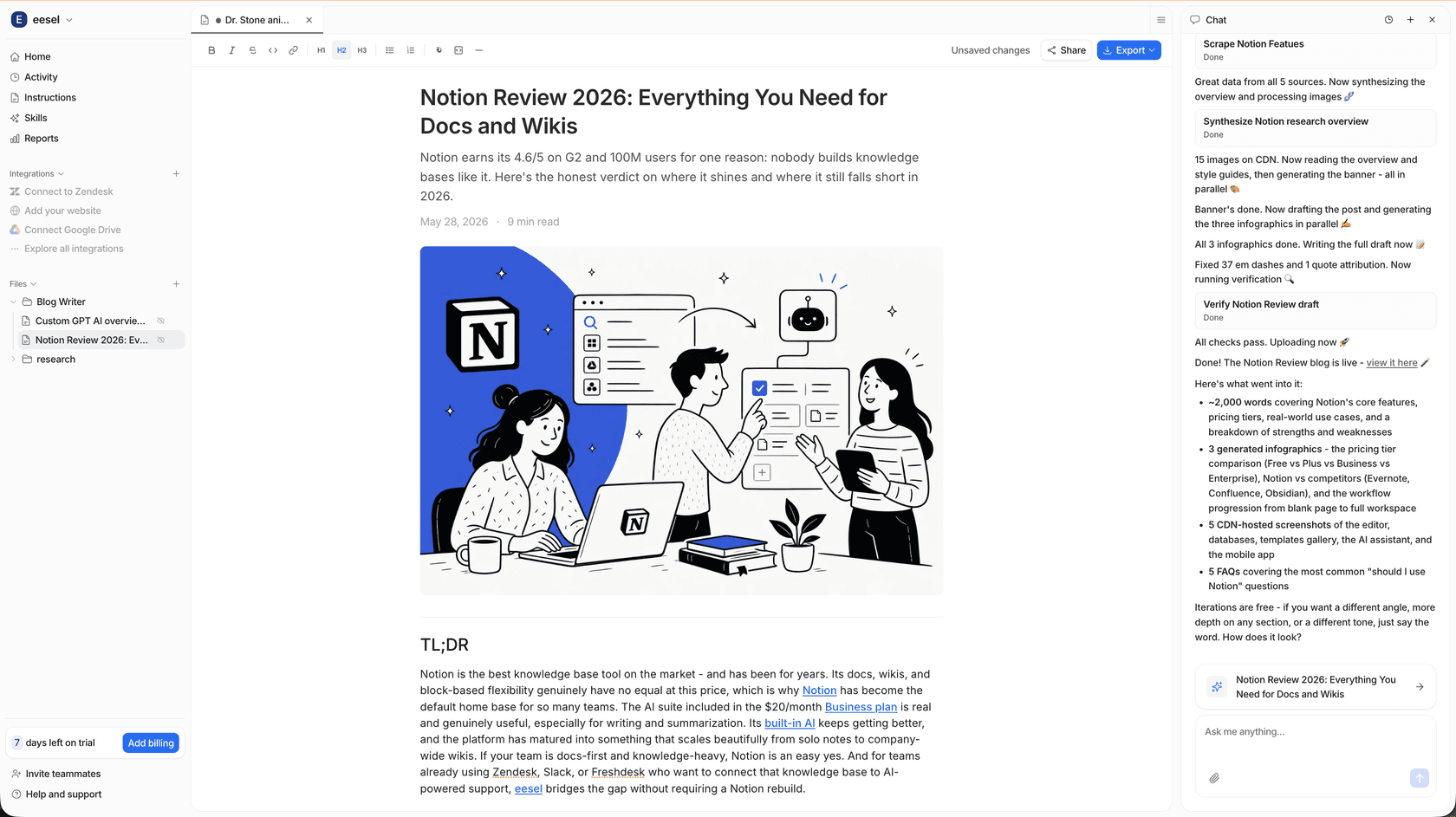
The real secret to a good off-page plan is starting with great, linkable content. It's the bedrock of everything. With the right platform, you can scale this part of the job like crazy. That's exactly what we did with the eesel AI blog writer; it's the tool that helped us jump from 700 to 750,000 impressions a day.
What are off-page SEO tools?
So, what are these tools, really? They're just pieces of software that help you manage all the stuff that happens off your site. They're built to turn the messy art of building authority into something a bit more scientific.
These tools generally cover a few key areas, which you'll see reflected in the list below:
- Making linkable stuff: This is about creating high-quality content that other sites will actually want to link to. We're talking deep-dive articles, ultimate guides, and reports packed with data.
- Checking your backlinks: These features let you peek at your own backlink profile (and your competitors'). You can see who's linking to you, how good those links are, and spot chances you might be missing.
- Spying on competitors: This is where you get to see what's working for the big names in your industry. Find out where they get their links and then figure out how to get in on the action.
- Handling outreach: After you've made great content and have a list of people to contact, you need an organized way to send emails and manage those connections.
- Watching your brand: These tools scan the web for mentions of your brand. Every time someone talks about you without linking, that's a perfect chance to pop in and ask for one.
To give you a clearer picture, here's a visual breakdown of the core functions you can expect from these platforms.
Our criteria for choosing the best tools
We didn't just pull these names out of thin air. This list comes from us actually using these tools in our own strategies. To keep things fair and make sure we were recommending things that work, we judged each tool on a few key points:
- Core feature set: How well does the tool do its main job? For a backlink tool, that means having a massive, up-to-date index of links. For a content tool, it means creating something you'd actually be happy to publish.
- Data accuracy: Can you trust the information? Making decisions on bad data is a nightmare.
I have always found Ahrefs data to be more accurate... so as long as you know what to do with it... thats your winner. Don't use hrefs to crawl sites and don't listen to their rubbish around 'link quality' etc.
- Ease of use: Can a regular person log in and figure it out without a degree in data science? A clunky interface can ruin a great tool, so we looked for platforms that are easy to use for both pros and newcomers.
- Actionable insights: Data is pretty useless if you don't know what to do with it. The best tools don't just throw charts at you; they help you figure out the next step to improve your rankings.
- Value for money: Does the price make sense for what you get? We looked for options that offer solid value, whether you're a solo blogger or a big marketing team.

Comparison of the top off-page SEO tools
Here’s a quick rundown of how our top picks compare.
| Tool | Best For | Key Feature | Starting Price |
|---|---|---|---|
| eesel AI blog writer | Scaling linkable asset creation | AI-generated blogs with rich assets | Free to try |
| Ahrefs | In-depth backlink analysis | The largest live backlink database | $129/month (Lite) |
| SEMrush | All-in-one SEO and marketing | Integrated SEO & PPC toolkits | $165.17/month (billed annually) |
| Moz Link Explorer | Beginners & authority tracking | Domain Authority (DA) metric | $99/month (Standard) |
| BuzzStream | Outreach & relationship management | CRM for link builders | $24/month |
| Google Search Console | Validating indexed links | Official Google data | Free |
The 6 best off-page SEO tools we tested in 2026
Alright, let's dive into the specifics. Here are the tools that made our list and why they're worth your time.
1. eesel AI blog writer
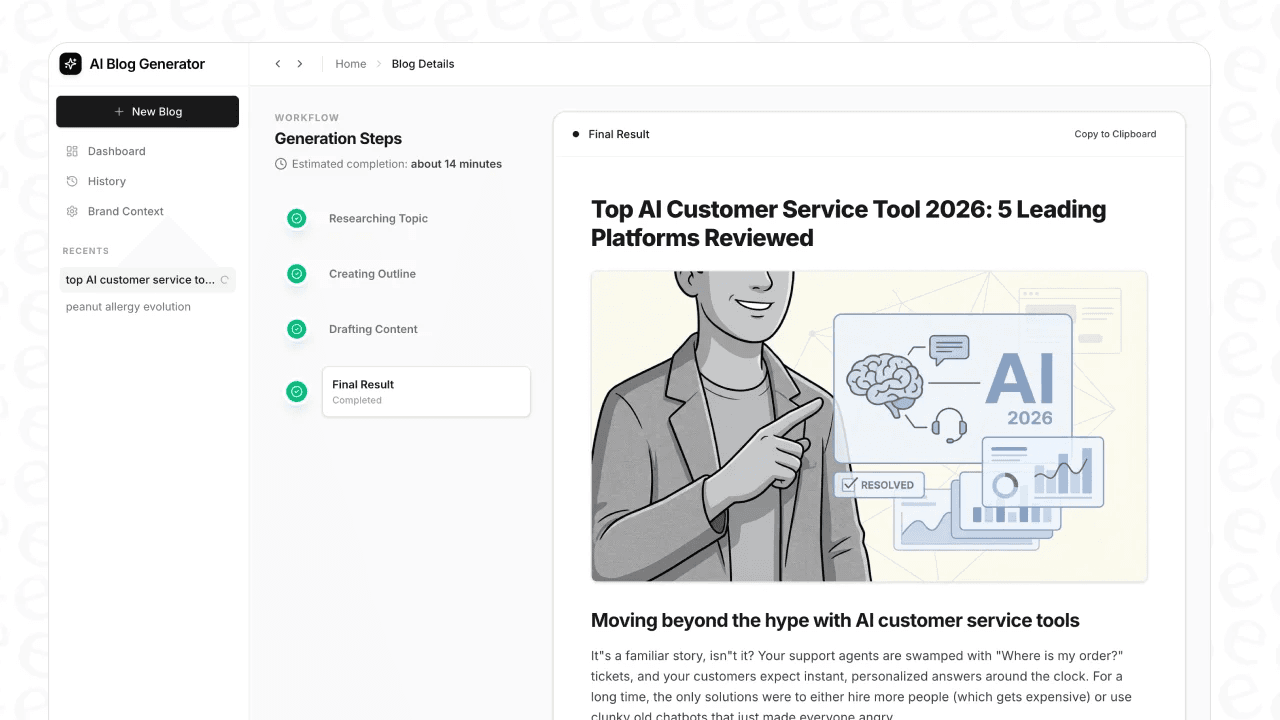
A good off-page SEO strategy starts with having something worth linking to in the first place. The eesel AI blog writer is built for this exact first step. It doesn't just spit out text; it takes a single keyword and builds a full, SEO-optimized blog post with AI images, infographics, and even social embeds from places like Reddit and YouTube. This gives you a "linkable asset" that's perfect bait for your outreach campaigns. Like we said, it's the same tool we used to grow our impressions.
- Pros: It saves a ton of time by creating publish-ready content with visuals, which is a huge help for attracting quality links. The tone is human-like, avoiding the generic "AI slop" from other tools, and it pulls in real quotes from Reddit to add a layer of authenticity.
- Cons: This isn't your typical tool for analysis or outreach. Its job is to nail the first step: creating the content. You'll need to pair it with another tool for backlink analysis and managing campaigns.
- Pricing:
- Free to try.
- Early Bird plan is $99 for 50 blog posts per month.
2. Ahrefs
Ahrefs is a leader in backlink analysis. Its strength lies in its enormous database, which boasts 35 trillion live backlinks. The Site Explorer tool lets you type in any website (yours or a competitor's) and get a full breakdown of who links to them, which pages get the most links, and where their traffic is coming from.
- Pros: The size and accuracy of its backlink data are its biggest selling points, a sentiment often shared by SEO pros. The interface is clean, making it surprisingly easy to handle a lot of data. Features like the "Broken backlinks" report are great for finding some quick and easy link-building opportunities.
- Cons: The main drawback is the price.
Some of the more advanced features also have a bit of a learning curve.It did until it jacked up the prices. I'll never forgive you, ahrefs! I loved you like a brother!
- Pricing:
- Lite Plan: Starts at $129 per month.
- Standard Plan: Starts at $249 per month.
- You can get limited free access with Ahrefs Webmaster Tools.
3. SEMrush
SEMrush is more of an all-encompassing tool for digital marketing. For off-page SEO, it has some great features like the Backlink Audit Tool for finding and ditching spammy links, the Backlink Gap tool for seeing who links to your competitors but not you, and a Link Building Tool for managing outreach prospects. The real benefit is having all this on the same platform as your PPC, content, and social media tools.
- Pros: As an all-in-one platform, it offers a lot of value for teams that do more than just SEO. Seeing how your SEO and paid ad campaigns affect each other is incredibly useful. SEMrush also has a huge library of free courses in its Semrush Academy to help you improve your skills.
- Cons: While it does a lot, its backlink database is generally considered a bit smaller and slower to update than Ahrefs'. Plus, the sheer number of tools can be overwhelming if you just want to check some backlinks.
- Pricing:
- Semrush One Starter: Starts at $165.17 per month (billed annually).
- Semrush One Pro+: Starts at $248.17 per month (billed annually).
4. Moz Link Explorer
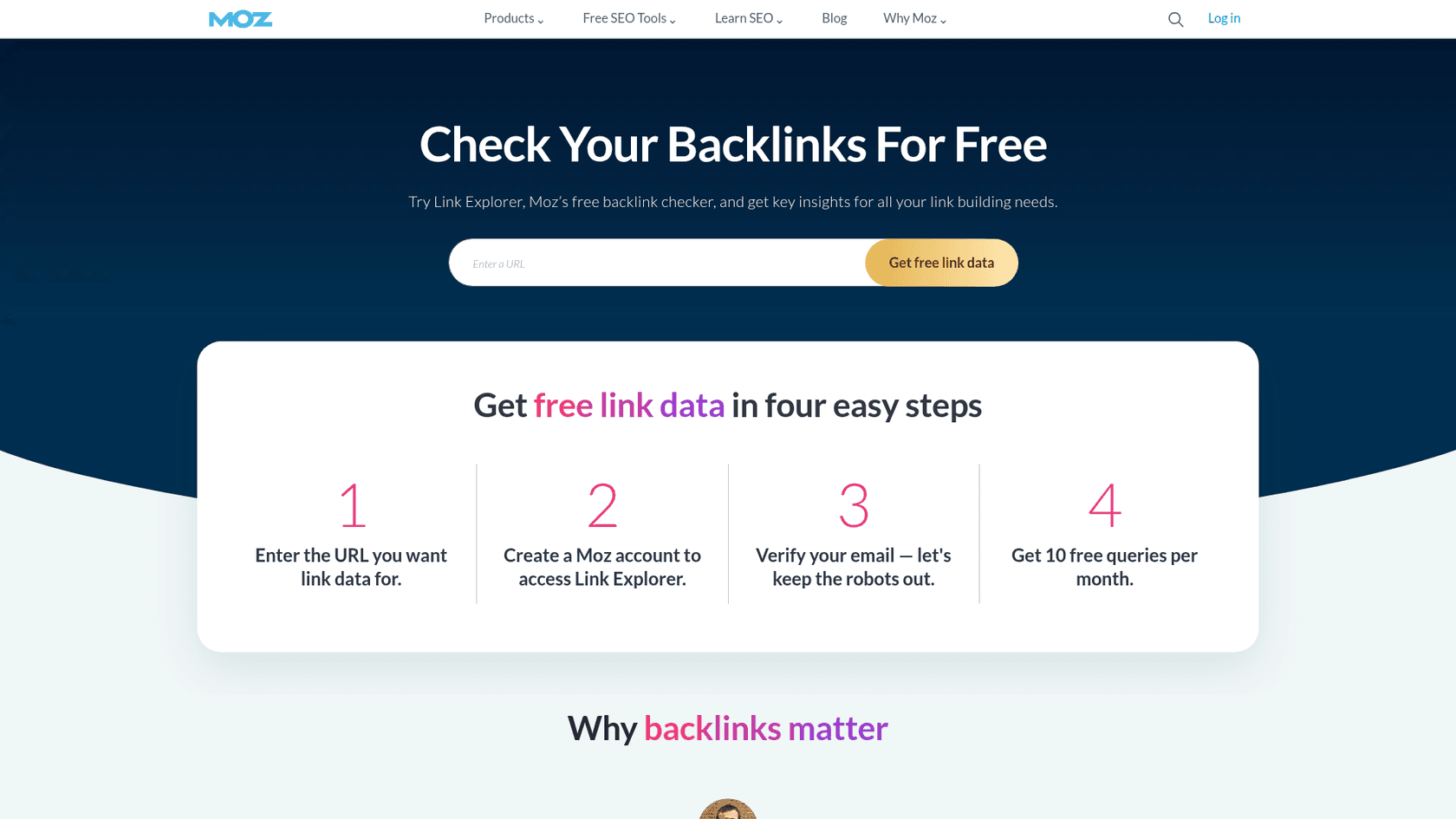
Moz has been a major player in SEO for a long time, largely thanks to its proprietary metric: Domain Authority (DA). Moz Link Explorer is a very user-friendly tool built on a massive index of 45.5 trillion links. It's probably the best place to start for anyone new to off-page SEO who wants to quickly gauge a website's authority without drowning in data. The Link Intersect feature is also really useful for finding sites that link to your competition.
- Pros: Domain Authority gives you a simple 1-100 score to quickly judge a site's strength, which is perfect for prioritizing who to reach out to. The interface is clean and easy to get around. Plus, their free community account gives you 10 free queries per month to try it out.
- Cons: Its backlink index, while huge, is known to update a bit slower than Ahrefs or SEMrush. That means you might not see the very latest links right away. Its competitor analysis features are also a bit more limited than the bigger platforms.
- Pricing:
- Moz Pro Standard: Starts at $99 per month.
- Moz Pro Medium: Starts at $179 per month.
5. BuzzStream
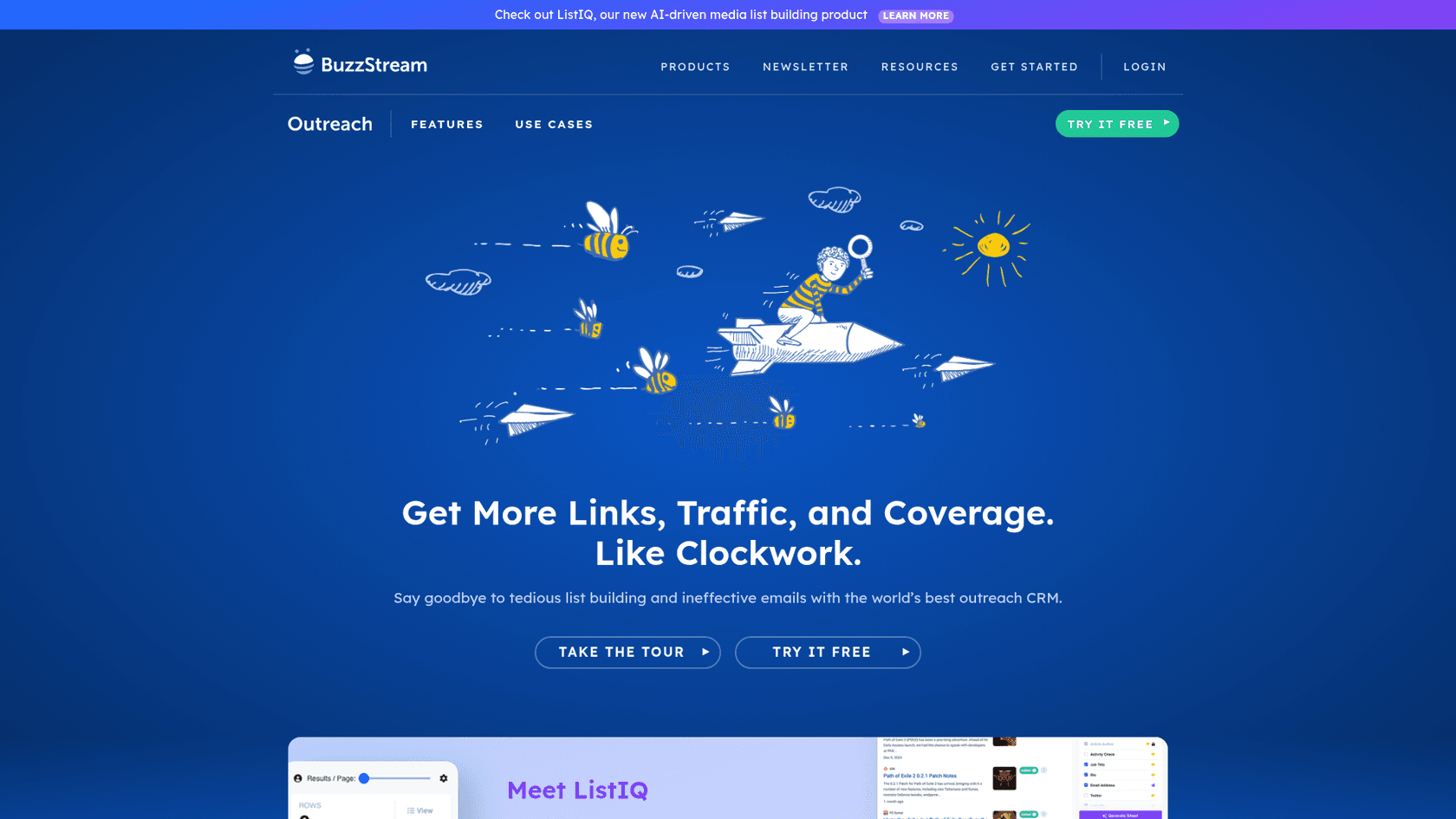
BuzzStream focuses on the most human part of link building: talking to people. It's essentially a CRM designed for SEOs and content marketers. It helps you find contact information, send personalized emails at scale, track who has opened and replied, and even set up automatic follow-ups. It’s built to eliminate the chaos of outreach campaigns and finally replace those messy spreadsheets.
- Pros: It's a lifesaver for organizing big outreach campaigns. Being able to see your whole team's communication history with a website is a huge plus, preventing those awkward moments when two people email the same person. It even integrates with Ahrefs on certain plans, making your workflow that much smoother.
- Cons: BuzzStream is all about outreach. It doesn't have its own backlink data or analysis tools. You have to find your link prospects with a tool like Ahrefs or Moz first, then bring that list over to BuzzStream to manage the outreach.
- Pricing:
- Starter Plan: Starts at $24 per month for 1 user and 1,000 contacts.
- Growth Plan: Starts at $124 per month for 3 users and 25,000 contacts.
6. Google Search Console
If you have a website, Google Search Console (GSC) is the one tool on this list that's non-negotiable. Why? It's free, and the data comes directly from Google. While other tools estimate your backlink profile, the Links report in GSC shows you the actual links Google has found and is using to rank your site. It’s the ultimate reality check for your link-building work.
- Pros: The data is 100% free and comes from Google, so you can trust it. It's also vital for technical tasks like checking for penalties or submitting a disavow file to tell Google to ignore certain spammy links.
- Cons: GSC gives you the raw data but not much analysis. It won't tell you a link's quality (like a DA score), it won't show you what your competitors are doing, and it won't help you find new opportunities. It’s for monitoring and validating, not for proactive research.
- Pricing:
- Free.
How to create a powerful workflow with these tools
The real magic happens when you stop seeing these as separate tools and start combining them into a smart workflow. Here’s a simple four-step plan to get you started.
- Step 1: Create linkable assets with eesel AI. Before you even think about asking for links, you need something people will want to link to. Use the eesel AI blog writer to quickly generate in-depth, well-researched articles full of visuals and real-world insights. This is your link bait.
- Step 2: Find prospects with Ahrefs or SEMrush. Use a tool like Ahrefs' Site Explorer or SEMrush's Backlink Gap tool to find websites that are already linking to your competitors' content on similar topics. Export this list of domains. These are your prime outreach targets.
- Step 3: Manage outreach with BuzzStream. Import that list of prospects into BuzzStream. Use it to find contact info, send personalized outreach emails , and set up automated follow-ups so no opportunity falls through the cracks.
Pro tip
use templates to save time
- Step 4: Monitor and validate with Google Search Console. As you start getting new links, keep an eye on the Links report in Google Search Console. This confirms that Google is actually seeing and counting your new backlinks. You can also use Moz or Ahrefs to track how your Domain Authority and overall link profile are improving over time.
Building a stronger strategy with off-page SEO tools
At the end of the day, a winning off-page SEO strategy in 2026 isn't about finding one tool that does everything. It's about building a smart workflow that covers all your bases: content creation, research, outreach, and monitoring.
For a deeper dive into the fundamental techniques, this video provides a great overview of the most powerful strategies you can implement.
And remember, this whole process is built on a foundation of genuinely excellent, link-worthy content. Without that key ingredient, even the most advanced analysis and outreach tools won't get you very far.
By combining a powerful content engine like the eesel AI blog writer with top-tier platforms for analysis and outreach, you give yourself a huge competitive edge. You'll be able to create better content faster and build the links that actually move the needle.
Ready to create content that naturally attracts backlinks? Try the eesel AI blog writer for free and see how quickly you can scale the first and most important step of your off-page SEO.