Notion AI vs Hyperwrite: Which AI assistant should you choose?

Amogh Sarda

Katelin Teen
Last edited January 26, 2026
AI tools aren't just another browser tab you have to keep open anymore. They're now being built directly into the apps we use every day, acting like smart assistants that promise to make work a bit less of a grind. It's a pretty big change, and two interesting tools leading the charge are Notion AI and Hyperwrite.
Both aim to be your AI sidekick, but they take completely different paths to get there. Notion AI is the built-in brain for your Notion workspace, living inside your team's notes and projects to help you find, summarize, and create things using the information you've already stored. On the other hand, Hyperwrite acts more like a universal AI remote. It's a browser extension that follows you around the web, ready to help you write an email, fill out a form, or automate a tedious task, no matter which site you're on.
So, which one should you choose? This article is a straightforward comparison of Notion AI vs Hyperwrite. We’ll look at what they do best, who they’re for, and what they cost.
Quick heads-up: while both are great for general productivity, if your main goal is to create high-quality blog content that actually shows up on Google, you might need a more specialized tool. An AI blog generator like the eesel AI blog writer is designed specifically to turn a simple keyword into a complete, publish-ready article. We'll touch on that again later.
What is Notion AI?
Notion AI isn't a standalone app. It's a collection of smart features built right into the Notion platform you might already use for notes, projects, and wikis. It's like giving your current workspace an AI upgrade. Its main advantage is how well it understands your data: all the notes, documents, and project boards you've already made.
Here's a rundown of what it does:
It has a powerful enterprise search. You can ask Notion AI a question in plain English, and it will search through all your Notion pages and even connected apps like Slack, Google Drive, and Jira to find the answer. This means you can stop digging through a dozen different apps for that one piece of information.
It also handles AI meeting notes. By connecting to Zoom, Google Meet, and Microsoft Teams, it automatically transcribes your calls. It doesn't just dump a wall of text on you, either. It summarizes the important points and creates a to-do list.
For content generation and automation, it can draft documents, translate text, and generate diagrams right inside a Notion page. Its Autofill feature is especially useful for automatically filling in database properties, which saves a lot of manual data entry. It can also pull together detailed reports by looking at your workspace, connected apps, and the web to give you a full picture of a topic.
So, who is this for? Notion AI is ideal for teams and individuals who are heavily invested in the Notion ecosystem. If your company's knowledge base is in Notion, this tool helps streamline workflows and makes all that information easily searchable.
What is Hyperwrite?
Hyperwrite takes a completely different route. Instead of being confined to one platform, it’s a universal AI assistant that works everywhere you go online, all through its Chrome extension. It’s built to be your writing partner and personal automator, whether you’re in Gmail, Google Docs, or filling out a web form.
Here are its main features:
Its TypeAhead feature provides real-time, context-aware sentence completions as you type. It’s like a smarter autocomplete that helps you write faster and more clearly, which is a huge help in apps like Gmail or Google Docs.
The Personal Assistant is where things get interesting. You can ask it to handle browser-based tasks for you, like researching a topic and pasting the summary into a document, filling out complicated forms, or even taming your messy inbox.
Hyperwrite also includes a huge library of specialized tools. You'll find everything from a simple content rewriter and summarizer to a Scholar AI that assists with academic research by finding and citing papers.
For bigger projects, it has a dedicated AI document editor that offers AI-powered feedback, suggestions, and a chat feature to help you brainstorm and polish your writing.
Hyperwrite is made for a wider audience. It's a great fit for writers, marketers, students, and any professional who could use some real-time writing help and wants to automate repetitive web tasks.
Feature breakdown: Notion AI vs Hyperwrite
Core functionality and use case
- Notion AI: At its core, Notion AI is an internal knowledge engine. Its main strength is making sense of the information that’s already inside your company. It’s best for organizing team knowledge, summarizing internal documents, and triggering actions based on that information. Think of it as your company's personal librarian.
I use the Q&A feature to ask it questions about my notes

Content generation and writing tools
- Notion AI: It's good at generating structured, internal content. It can create meeting summaries from a transcript, build project reports by pulling data from a board, or draft internal memos. It can also translate documents and create diagrams, but it’s not really designed for creating long-form, SEO-optimized content for a public blog.
- Hyperwrite: This is where Hyperwrite really stands out. It provides a much broader set of creative and marketing-focused writing tools. Features like "Flexible AutoWrite" are made to help you produce original content from scratch, making it feel more like a writing partner for blogs, marketing copy, and emails.
Task automation and integrations
- Notion AI: Automation here is focused on workflows inside Notion. For example, you can set it up to automatically fill a database when a new page is created or turn action items from meeting notes into assigned tasks. Its integrations with apps like Slack and Jira are mostly for searching them for information, not for triggering actions within them.
- Hyperwrite: The "Personal Assistant" feature brings automation to the browser level. It can perform actions for you across different websites. Its main "integration" is its Chrome extension, which allows it to work just about anywhere you can type.
Collaboration features
- Notion AI: It’s collaborative by design because it lives within a shared team workspace. Everyone on the team can use the AI features on the same documents, and the AI search draws from the entire team's knowledge base, making everyone more informed.
- Hyperwrite: This is primarily a tool for individual productivity. While you can use it to write documents that you share with your team later, it doesn't have a shared knowledge base or features for creating a central brand voice for everyone to use.
Pricing comparison: Notion AI vs Hyperwrite
The pricing for these tools really highlights their different purposes. Notion AI is an add-on to a larger platform subscription, while Hyperwrite is a standalone service you pay for based on usage.
Notion AI pricing
You can't purchase Notion AI on its own. It’s an included part of Notion's paid plans, which makes it a solid value if you're already using the platform.
- Business Plan: For $20 per user per month (billed annually), you get the full suite of Notion AI features, including the powerful Enterprise Search and AI Meeting Notes.
- Free & Plus Plans: These plans give you a limited number of AI uses to try it out, but you need to be on the Business or Enterprise plan to really unlock its capabilities.
Hyperwrite pricing
Hyperwrite has a more standard tiered subscription model.
- Free Plan: This gives you a taste of the basic AI tools with a small number of credits each month. It’s enough to see if you like it, but not for heavy use.
- Premium Plan: At $19.99 per month, you get a good amount of usage (250 AI messages), the ability to create 3 custom personas, and access to the full library of AI tools.
- Ultra Plan: For $44.99 per month, you get unlimited AI messages, 10 custom personas, and early access to new features. You can get a 20% discount if you pay for a full year.
Head-to-head pricing summary
| Feature | Notion AI | Hyperwrite |
|---|---|---|
| Model | Included in platform subscription | Tiered Subscription |
| Free Tier | Limited trial included in Notion Free Plan | Yes, with limited usage |
| Paid Entry | $20/user/month (Business Plan) | $19.99/month (Premium) |
| Top Tier | N/A (Included in Enterprise) | $44.99/month (Ultra) |
| Best Value For | Teams already using Notion | Individuals needing frequent, varied writing help |
Suitability for creating SEO content
Both Notion AI and Hyperwrite are impressive productivity tools. However, for the specific task of creating blog content designed to rank on search engines and bring in traffic, it's important to understand their primary functions.
- Notion AI is primarily an internal-facing tool and isn't built for SEO workflows. It does not focus on keyword optimization, meta descriptions, or article structure for search algorithms.
- Its knowledge is focused on your internal workspace, so it cannot perform the deep, real-time web research required to write an authoritative article on a competitive topic.
- It does not automatically generate visual assets like images, infographics, or charts for blog posts.
- Hyperwrite functions as a writing co-pilot, assisting with sentence-by-sentence composition rather than generating a full article from a prompt. This model is helpful for polishing text but may not be the fastest way to scale content production.
- It does not automatically find and embed relevant media like YouTube videos or pull quotes from social platforms like Reddit.
- The user is responsible for research, outlining, and structuring the content. Hyperwrite assists with the writing phase but doesn't manage the entire content creation process.
An alternative for publish-ready blogs: eesel AI blog writer
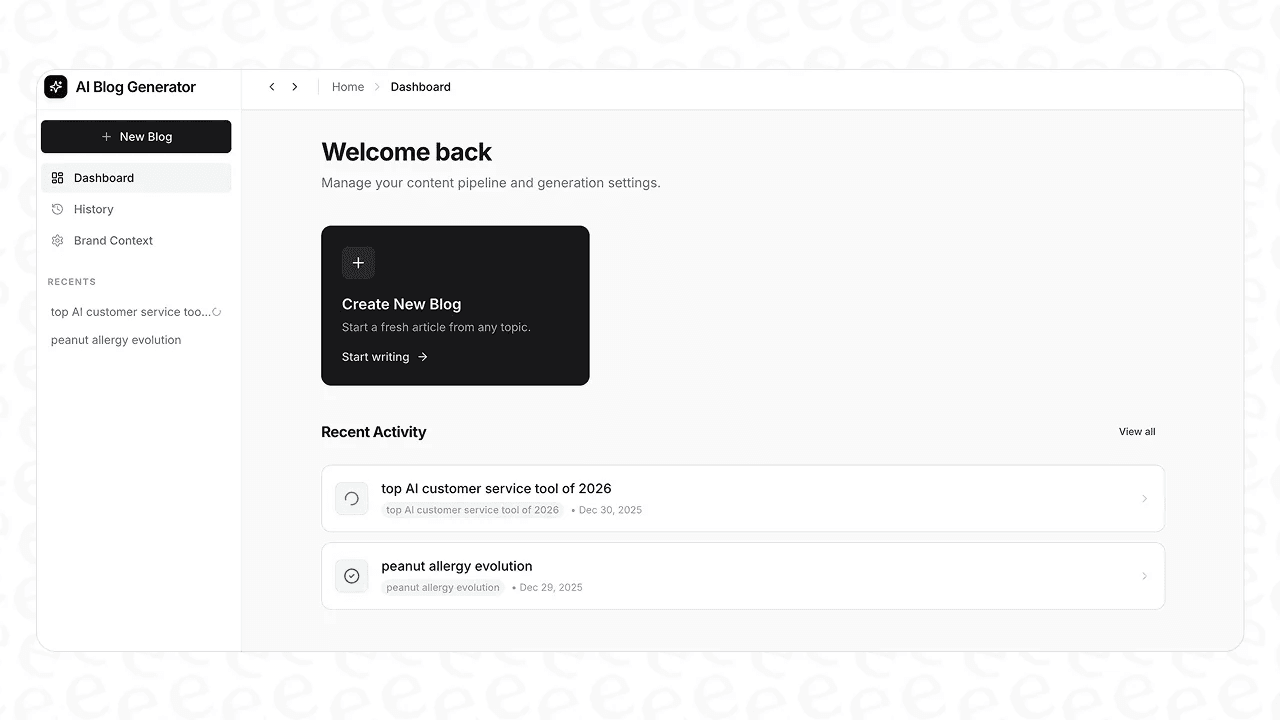
From a single keyword to a complete article
Here’s the basic idea: you give it a single keyword or topic, and it delivers a complete, structured, and SEO-optimized blog post that’s ready to publish. This isn't a rough draft. It's a finished article with headings, images, and links.
This is the exact tool we used at eesel AI to grow our organic traffic from 700 to 750,000 daily impressions in just three months by publishing over 1,000 optimized blogs.
Key features that generalist tools lack
What makes it different? It’s built specifically for creating high-ranking content.
- Automatic Assets & Media: The eesel AI blog writer doesn't just write text. It generates relevant images, infographics, and tables. It also automatically finds and embeds relevant YouTube videos and real, insightful Reddit quotes to build authority and keep your readers engaged.
- Deep SEO & AEO Research: The content it creates is thoroughly researched and optimized not just for traditional search engines (SEO) but also for the new wave of AI Answer Engines (AEO) like Google AI Overviews and Perplexity.
- Natural Brand Integration: You can provide your website URL, and it will learn your brand's context. This allows it to naturally mention your product or service within the content in a way that feels helpful, not like a sales pitch.
Try the full experience for free
The best part is you can see the difference for yourself without paying anything. The eesel AI blog writer lets you generate your first complete, high-quality blog post entirely for free. It’s a no-risk way to see what a purpose-built content tool can do for your growth.
For a broader look at the AI writing tool landscape, this video provides a helpful comparison of some of the most popular options available today.
Final verdict: Notion AI vs Hyperwrite
So, what's the final call on Notion AI vs Hyperwrite? It really depends on what you need to do.
- Notion AI is the clear winner for teams that live and breathe in the Notion ecosystem. It transforms your workspace into a smart, self-organizing knowledge base.
- Hyperwrite is the perfect companion for anyone who writes and works across the web. It’s a flexible, powerful assistant that’s always available when you need it.
But if your job is to drive organic traffic and grow your business through content marketing, you need a tool built for that specific mission. Creating high-quality SEO content at scale is a completely different challenge.
If that sounds like you, a specialized tool isn't just a nice-to-have; it's the most effective way to get results. Generate your first blog post for free with the eesel AI blog writer and see what a purpose-built AI teammate can really do.

Frequently Asked Questions
Share this article

Article by
Amogh Sarda
CEO of eesel AI. Amogh Sarda is obsessed with making the ultimate AI for customer service teams. He lives in Sydney, Australia and has previously worked at Atlassian and Intercom. Outside of work he’s usually surfing or on stage doing improv.