

Good writing is essential in any professional setting, and AI assistants have become common tools for making work clearer and more efficient. This article offers a straightforward comparison of two leading platforms: Grammarly, a tool focused on correctness and style, and Notion AI, an intelligence layer built into the Notion workspace.
The idea is to look at their features, best use cases, and pricing to help you decide which tool fits your workflow. It's also worth noting there's a third type of tool that does more than just assist. Platforms like the eesel AI blog writer are made to handle the entire content creation process, turning a single keyword into a complete blog post that's ready to go live.
What is Notion AI?
Notion AI isn't a separate app you download. It's an AI system built directly into the Notion workspace, a platform used for notes, project management, and knowledge bases. According to G2, it's the #1 rated AI writing tool.
Its functions are designed to work smoothly within the Notion ecosystem, bringing multiple tasks into one platform. Its core features include:
- Content Generation and Editing: It can draft outlines, brainstorm ideas, translate text, and fix basic spelling and grammar mistakes.
- Summarization and Action Items: It condenses long documents or meeting notes into key points. The AI Meeting Notes feature can automatically transcribe calls and create summaries.
- Workspace Intelligence: The AI Agent can handle multi-step tasks, and Enterprise Search lets users find information across connected apps like Slack and Google Drive.
Its main benefit is its deep integration, which lets users go from brainstorming to project execution without ever leaving the Notion environment.
What is Grammarly?
Grammarly is a dedicated, AI-powered writing assistant built specifically to improve the quality of written communication on different platforms.
It works through browser extensions, desktop apps, and mobile keyboards, offering suggestions wherever you happen to be writing. Its key functions include:
- Advanced Correction: It finds complex errors in grammar, punctuation, conciseness, and sentence structure that standard spell checkers often miss.
- Style and Tone Analysis: It gives feedback on clarity, engagement, and delivery. Tone adjustment suggestions help you match your writing to your intended audience, whether it's formal or confident.
- Generative AI and AI Agents: The Pro plan gives you 2,000 generative AI prompts per month for tasks like rewriting or creating text. It also comes with specialized AI agents like Proofreader and Paraphraser.
- Plagiarism Detection: The Pro version has a plagiarism checker that compares your text against billions of web pages and academic databases.
Detailed comparison: Notion AI vs Grammarly
While both tools use AI to help with writing, they are meant for different things. Notion AI is an integrated workspace tool, whereas Grammarly is a specialized, portable editor.
Core functionality: Workspace intelligence vs. dedicated editor
Notion AI's strength is in creating content and managing knowledge within a single workspace. It's great for generating first drafts, summarizing internal documents, and searching across company knowledge bases. Its grammar correction is fine for internal notes but isn't as thorough as a tool designed for in-depth analysis. It's built for the early stages of creation and organization.
Grammarly's strength is in the deep analysis and correction of text that's already written. It acts as a final-stage editor, making sure content is polished, professional, and free of errors before it gets shared or published. While it has generative features for brainstorming, its main value is in refining text to a high standard.
Workflow and integration
Grammarly is designed for a workflow that's spread out. It works across many platforms, including Gmail, Google Docs, Slack, and social media. This portability makes it a flexible tool for people who communicate across many different channels all day. The goal is to provide consistent writing help no matter the platform.
Notion AI is built for a centralized workflow where all brainstorming, writing, and project management happen inside Notion. This is very efficient for teams that use Notion as their main hub, as it keeps everything in one spot. However, its usefulness is confined to that specific environment.
A notable drawback reported by users is the performance of the Grammarly extension inside Notion. Some users have pointed to issues like misplaced pop-ups and lag, which cause them to disable the extension for the Notion website. This compatibility problem can be a consideration for anyone hoping to use both tools together.
I still want to have corrections in the body of my pages, especially for long texts. But when I create items in databases the bubble keeps coming above the text like that:

Generative AI and prompt limits
Grammarly has a clear, tiered structure for its generative AI features. The Free plan offers 100 prompts per month, which can be used for things like brainstorming, answering emails, or writing short bits of text. The Pro plan bumps this limit up to 2,000 prompts per month, which is better for more frequent use.
Notion AI offers a "limited trial" of its AI features on its Free and Plus plans, letting users try it out before buying. Full access to its generative AI, Agent, and Enterprise Search features is included in the Business and Enterprise plans. These higher-tier plans don't have specific prompt limits, offering unrestricted use for teams.
Security and data privacy
Both platforms take enterprise-grade security seriously and have strong commitments to data protection. They both meet key industry standards, with some minor differences in what they offer enterprise clients.
| Feature | Notion AI | Grammarly |
|---|---|---|
| Data Training Policy | Does not use customer data to train models without opt-in. Contractually prohibits AI subprocessors from using data for training. | Does not sell user content. |
| Key Certifications | SOC 2 (Type 2), ISO 27001, GDPR, CCPA | SOC 2 (Type 2), ISO 27001, ISO 27701, GDPR, CCPA |
| Data Retention | Zero data retention for Enterprise plan workspaces. | Standard data retention policies apply. |
| Encryption | Encrypts data in-transit (TLS 1.2+) and at rest. | Encrypts all data in transit (TLS 1.2) and at rest (AES-256). |
Pricing plans at a glance
The pricing for Notion AI and Grammarly reflects their different functions. Notion AI's features are bundled into its higher-tier workspace plans, making it an all-in-one investment. Grammarly is sold as a standalone subscription focused only on writing help.
Notion AI pricing
Notion AI is no longer a separate add-on; its features are now part of the paid plans for the Notion workspace.
- Free Plan: Includes a limited trial of Notion AI features for individual users.
- Plus Plan: Also includes a limited trial of Notion AI for small teams.
- Business Plan ($20 per user/month): All Notion AI features are included. This unlocks the AI Agent, Enterprise Search, and AI meeting notes.
- Enterprise Plan (Custom Pricing): Includes all AI features plus advanced security controls like zero data retention.
Grammarly pricing
Grammarly offers different tiers based on the level of writing feedback and the number of generative AI prompts you need.
- Free Plan: Provides basic checks for grammar, spelling, and punctuation. It also includes tone detection and 100 generative AI prompts per month.
- Pro Plan: Starts at $12 per member per month when billed annually, or $30 month-to-month. This plan unlocks advanced suggestions for clarity and tone, full-sentence rewrites, plagiarism detection, and increases the limit to 2,000 generative AI prompts per month.
- Enterprise Plan (Custom Pricing): Designed for larger teams, this plan includes everything in Pro plus unlimited AI prompts, SAML single sign-on (SSO), and other security controls.
An alternative for generating complete blog posts: eesel AI blog writer
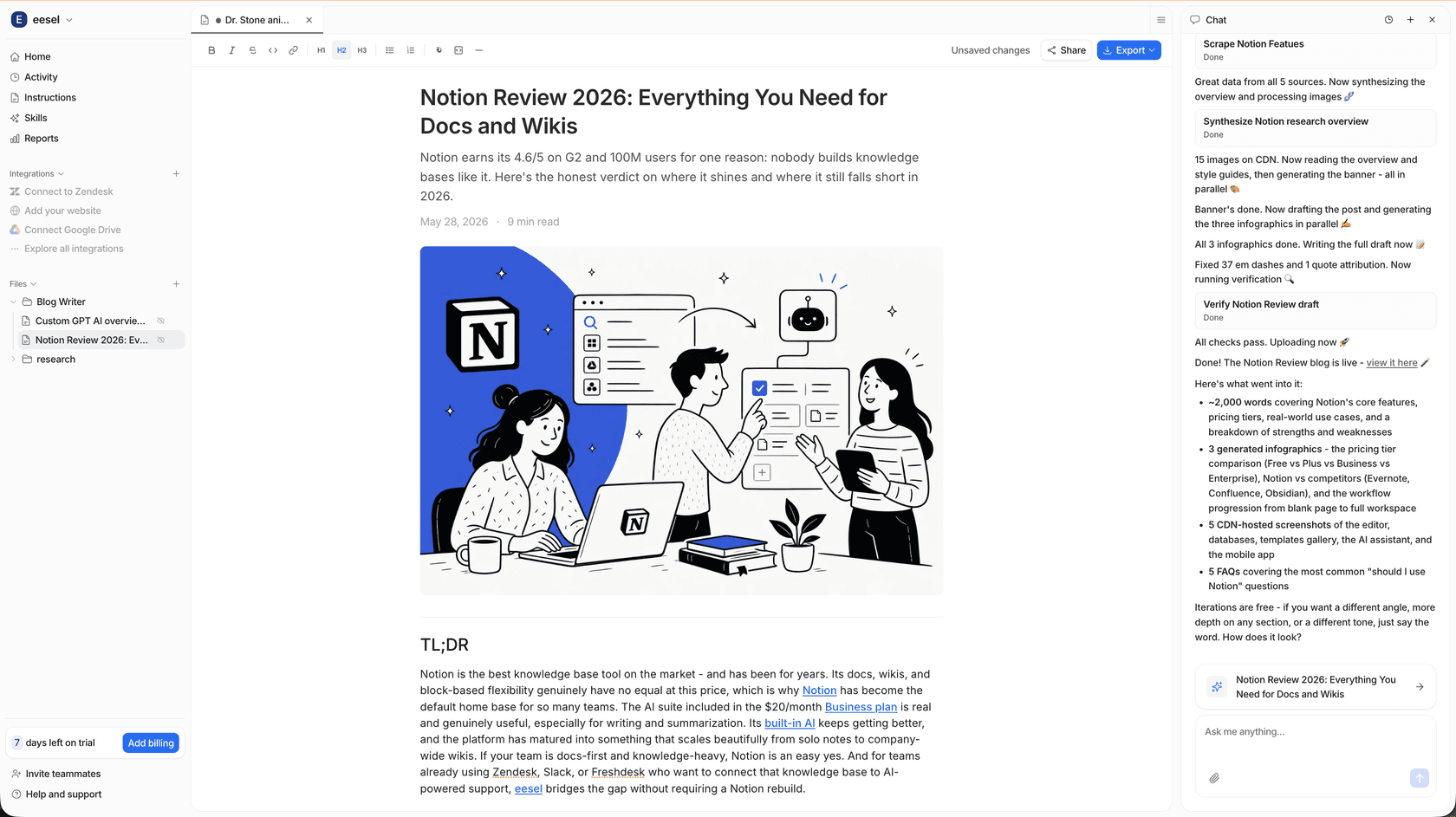
It takes a single keyword or topic and turns it into a complete, well-researched, and SEO-optimized article that is ready to publish. This is the same tool our team at eesel AI used to grow organic traffic from 700 to over 750,000 daily impressions in just three months.
Its key features are focused on creating finished articles, not just text drafts:
- Publish-Ready Content: It delivers a fully structured post with an introduction, logical headings, a conclusion, and FAQs. The content is optimized for search engines (SEO) and AI answer engines (AEO).
- Automatic Asset Generation: The platform automatically creates and adds relevant visuals like AI-generated images, tables, and infographics to make the content more readable.
- Social Proof Integration: To add credibility, it embeds relevant YouTube videos and finds real quotes from Reddit discussions related to the topic.
- Context-Aware Research: The AI understands the type of blog post and adjusts its research accordingly. For a comparison post, it looks for pricing and feature data; for a technical guide, it finds relevant specifications.
You can generate your first post for free to see the quality of the content it produces for yourself.
For a more detailed breakdown, this video compares several top AI tools, including Notion AI and Grammarly, to help you see how they stack up in different scenarios.
Final thoughts: Workspace intelligence vs. the specialist editor
Choosing between Notion AI and Grammarly comes down to picking between an integrated, all-in-one workspace tool and a specialized, portable writing editor. Neither is better than the other; their value depends on your specific needs.
Grammarly is the specialist for the final polish. It's the right tool for ensuring correctness, clarity, and a consistent tone wherever you write. Its strength is in refining content to a professional standard, though its performance within the Notion app is a known issue for some.
Notion AI is the versatile assistant for brainstorming, drafting, and organizing information directly within your team's main hub. It's best at generating ideas and structuring content inside the Notion ecosystem.
For many, the best approach might be to use both: Notion AI for initial creation and organization, and then Grammarly for the final proofread across all communication channels.
However, if your main goal is to scale content production instead of just improving individual documents, a generative platform like the eesel AI blog writer offers a more complete, end-to-end solution built for that specific job.




