Longshot AI vs Copy.ai: Which AI platform is right for you?

Stevia Putri
Last edited January 26, 2026
Choosing the right AI platform for your team can be a headache. Every tool promises to be the next big thing, but most are designed for very different jobs. It's like trying to use a hammer to saw a plank of wood; you need the right tool for the task.
Two names that pop up a lot are Longshot AI and Copy.ai. On the surface, they look pretty similar since they both use AI to help you create things. But once you peek under the hood, you'll see they're designed for different purposes. Longshot AI is all about creating factual, long-form SEO content that's built to climb the search rankings. Copy.ai, however, is a Go-to-Market (GTM) platform meant to automate your sales and marketing machine.
What is Longshot AI?
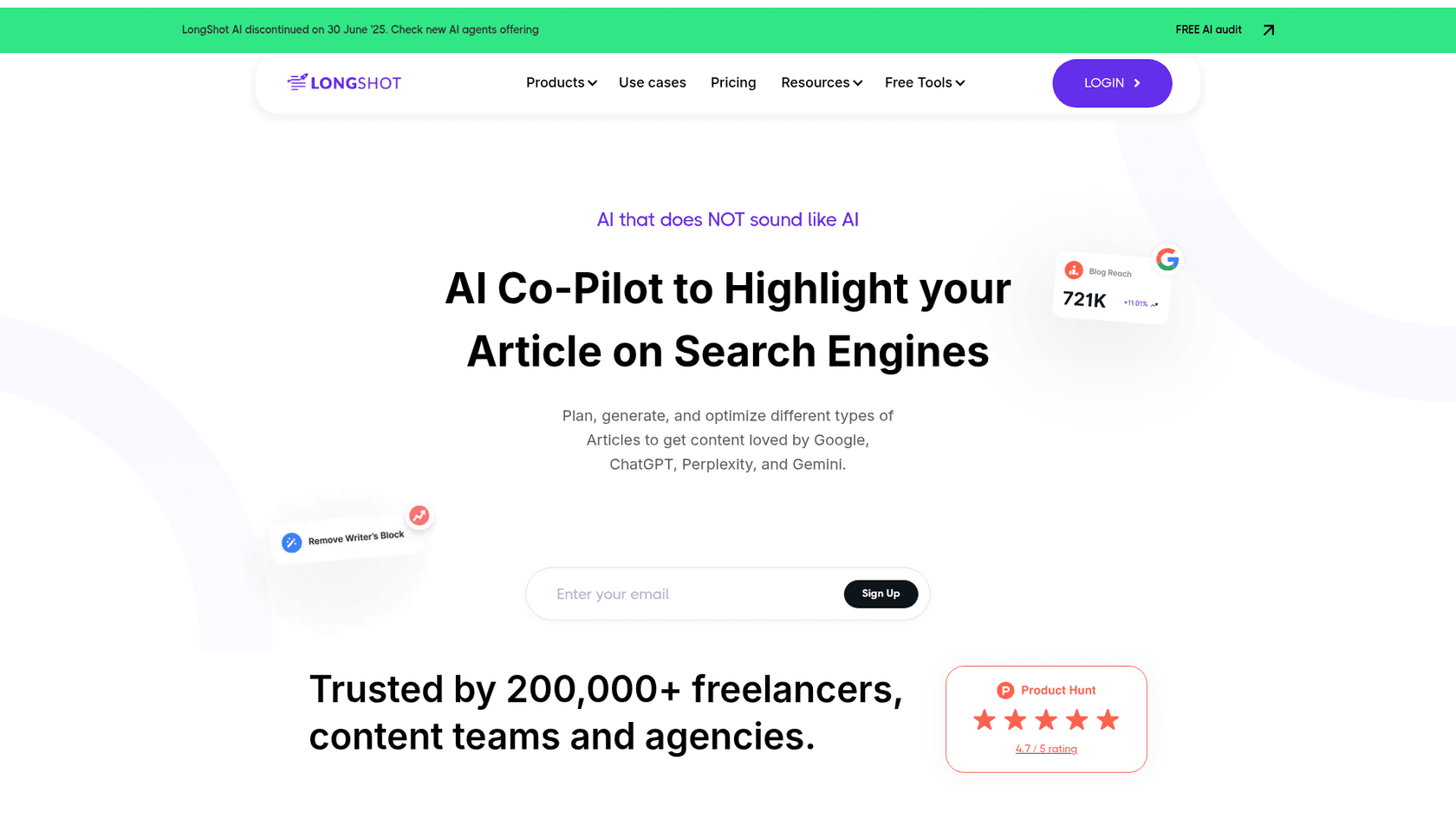
Longshot AI bills itself as a content platform for people who are serious about SEO. The whole point is to help you research, write, and tweak factual, long-form content that actually moves up in Google's search results. You can think of it as a dedicated toolkit for building your brand's authority with solid blog posts.
All its features are geared toward this one goal. It has a tool called FactGPT, which is designed to create accurate content and even gives you citations, so you're not just making stuff up. It also includes structured Autoblog Workflows to walk you through the article creation process, an SEO Checker to keep your content on track, and an AI Interlinking feature to help you build out your site's internal links.
This sharp focus makes Longshot AI a favorite among content marketing teams, SEO pros, and agencies. If your main gig is to pump out well-researched blog content that brings in organic traffic, this tool was made with you in mind.
What is Copy.ai?
Copy.ai is playing a completely different game. It isn't just a writing tool; it's an AI-Native GTM Platform. That's just a different way of saying it’s built to weave AI into your entire go-to-market strategy, connecting your sales, marketing, and operations teams.
The heart of Copy.ai is about automating GTM workflows. Instead of just writing a blog post, it helps you build automated systems for tasks like finding new prospects, handling inbound leads, and crafting personalized sales emails at scale. It’s less about creating one piece of content and more about managing all the small tasks that make a GTM strategy tick.
This also means it's for a different crowd. Copy.ai is for GTM teams that need to ditch repetitive tasks, consolidate their data, and manage processes across their tech stack. They’re focused on automating the entire machine, not just writing the instruction manual for it.
Feature comparison: Longshot AI vs Copy.ai
Content focus and use case
Longshot AI: Its main strength is creating long-form content that is well-researched, factual, and optimized for SEO. The whole platform is designed around a workflow for producing authoritative blog posts, detailed guides, and thorough listicles. If your aim is to publish a 2,000-word article that ranks for a tough keyword, Longshot AI has the specific tools for that job.
Copy.ai: This platform really comes alive when you're automating the creation of GTM assets. We're talking sales outreach emails, punchy ad copy, and social media posts. Its workflow builder lets you create systems that can generate thousands of personalized messages, which is ideal for scaling up your outreach. The focus is on automating processes, not writing a standalone long-form piece from scratch.
SEO tools
Longshot AI: This is where Longshot AI really doubles down. It offers a suite of SEO tools that go beyond simple keyword suggestions. It has semantic keyword analysis to help you cover a topic from all angles, automatic internal linking suggestions to improve your site's structure, and a direct integration with Google Search Console. This lets you pull real performance data right into your content strategy, which is a pretty neat feature.
Copy.ai: While you can certainly use Copy.ai's workflows to generate SEO-friendly copy for a landing page or blog intro, it’s not really an SEO tool at its core. It lacks the deep, integrated analysis and optimization features that are central to Longshot AI. You'd probably need to use it alongside other SEO tools to get the same level of insight.
Workflow and user experience
Longshot AI: The platform offers structured AI Article Workflows that are meant to be repeatable. It usually walks you through three steps: creating a headline, building an outline, and then generating the full blog post. This is perfect for teams that need a consistent method for producing high-quality articles.
Copy.ai: The user experience is built around a really intuitive, no-code workflow builder. It's a drag-and-drop interface where you can link together different "Actions" (like "find email address") and "Agents" (like "write a follow-up") to automate complex GTM processes. It’s designed to be flexible, letting you map out your team’s specific sales and marketing strategies.
Key integrations
Longshot AI: Its integrations are all about the content publishing pipeline. It connects with content management systems like WordPress, Ghost, and Webflow, and SEO tools like Semrush and HubSpot. The goal is to make it easier to get your content from an idea to a published article.
Copy.ai: Copy.ai's integrations are a reflection of its focus on the wider GTM tech stack. It connects with over 2,000+ tools via Zapier, which gives you a ton of flexibility. It also has native connections for CRMs and marketing automation platforms like HubSpot and Salesforce, so you can pull data in and push content out across your entire system.
| Feature | Longshot AI | Copy.ai |
|---|---|---|
| Primary Goal | Create factual, long-form SEO content | Automate GTM sales & marketing workflows |
| Content Focus | Blog posts, articles, guides | Sales emails, ad copy, social posts, lead outreach |
| Key Feature | FactGPT for accuracy & citations | No-code GTM workflow builder |
| SEO Tools | Built-in semantic analysis, GSC integration | Basic SEO copy generation within workflows |
| Key Integrations | WordPress, Semrush, Google Search Console | Zapier, HubSpot, Salesforce (GTM focus) |
| Pricing Model | Per-article plans, pay-as-you-go | Seat-based plans with workflow credits |
Use cases and target audience for Longshot AI vs Copy.ai
With all that said, who should actually be using these tools? Let's break it down.
When to choose Longshot AI
Longshot AI is the obvious pick for teams whose success is tied to organic traffic and search engine rankings.
- You should choose Longshot AI if: You're on a content marketing team, you run an SEO agency, or you're a startup founder trying to build an online presence with quality blog content.
- It's ideal for: Creating big-ticket content like pillar pages, deep-dive technical articles, and product comparisons where accuracy and citations are a must. If you need to write content that positions you as an expert, Longshot AI is designed for that.
When to choose Copy.ai
Copy.ai is for teams that care more about automating processes and scaling their go-to-market efforts than writing long articles.
- You should choose Copy.ai if: You're on a sales, marketing, or operations team that's getting swamped by repetitive manual work. If you often think, "There has to be a way to automate this," Copy.ai is probably what you're looking for.
- It's ideal for: Building workflows to automate tasks like researching prospects, enriching inbound leads with more data, and generating thousands of personalized sales emails. If your goal is to run a more efficient GTM engine, Copy.ai is your platform.
Pricing plans: Longshot AI vs Copy.ai
Pricing can tell you a lot about who a tool is really built for. Here's how these two stack up.
Longshot AI pricing
Longshot AI’s pricing is pretty straightforward and based on content output, which makes sense for its users.
- Premium Plan: This starts at $29 per month for 30 articles. If you pay for a full year, the price drops to $19 per month.
- Pay As You Go Plan: If you don't want a monthly subscription, you can pay a one-time fee of $29 for 20 articles. These credits are good for two years, which is a nice, flexible option for smaller projects.
It's worth mentioning that Longshot AI doesn't have a free trial, but the Pay As You Go plan is a low-risk way to give the service a try.
Copy.ai pricing
Copy.ai’s pricing shows its focus on teams and large-scale automation.
- Chat Plan: The entry-level plan is $29 per month and covers up to 5 users. This tier is mostly for their chat interface to generate quick bits of copy.
- Growth & Enterprise Plans: To unlock the real power of the workflow builder, you'll need to look at their higher-tier plans, which start around $1,000 per month. These plans are priced based on user seats and "workflow credits," showing it's designed for larger teams running a lot of automated processes.
Limitations to consider
No tool is perfect, and it's good to know where each one might not meet your needs.
Limitations of Longshot AI
Because Longshot AI is so focused on factual, SEO-driven long-form content, it might not be the right fit for every writing task. If your team needs to churn out a lot of creative, short-form copy for social media or Google Ads, you might find its workflow a bit too structured for that.
It's also a content creation tool at its core. It isn’t designed to be a full GTM automation platform that can manage complex sales and operations workflows.
Limitations of Copy.ai
On the other hand, Copy.ai isn't built to be a dedicated long-form article writer. While its AI can generate text, its real value is in automating workflows. If you try to use it to write a big blog post, you'll likely find it's missing the specialized research, structuring, and SEO features to do it well.
The pricing can also be a barrier. It’s set up for teams that need automation at a large scale, which might be too pricey for individuals or small content teams who just need to write articles.
The alternative: From keyword to complete blog post
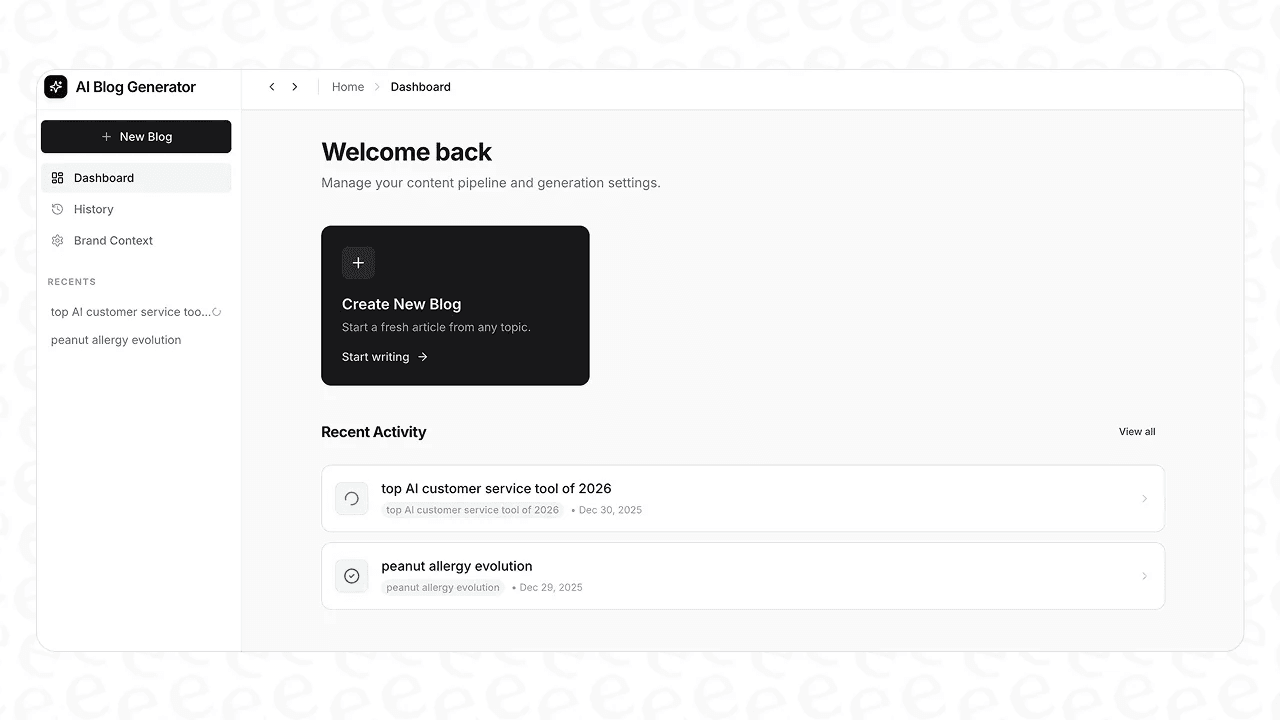
An alternative approach is to use a tool that goes from a single keyword to a completely finished, publish-ready blog post. This is where the eesel AI blog writer fits in.
While other tools give you text, eesel AI gives you a finished article. It doesn't just write the words; it automatically generates and embeds all the assets you need, like AI-powered images, infographics, and comparison tables. It even searches the web to find and embed relevant YouTube videos to make your content more interesting.
A notable feature is its ability to pull in real, relevant quotes from Reddit. This can add a layer of authenticity and social proof to the content, which helps articles feel more human and trustworthy.
This approach is based on the tool we used to grow our own blog from 700 to 750,000 impressions per day in just three months. It is also completely free to try. You can try it to evaluate how it creates comprehensive content.
For a broader perspective on how these tools fit within the larger AI writing landscape, it's helpful to see them compared against other market leaders.
Final verdict
At the end of the day, there’s no single "winner" here. The right tool for you is all about what you're trying to do.
- Choose Longshot AI if... your main goal is to produce factual, SEO-optimized long-form content to grow your organic traffic and build topical authority. It's a specialized tool for a specialized job.
- Choose Copy.ai if... your top priority is to automate and scale your entire go-to-market engine. If you want to build powerful workflows for your sales and marketing teams, it's the clear choice.
But if you're ready to scale your entire content strategy, from research all the way to a publish-ready post with all assets included, then an all-in-one tool like the eesel AI blog writer is designed for that purpose. It closes the gap between a simple draft and a finished product, helping you publish better content, faster.

Frequently Asked Questions
Share this article

Article by
Stevia Putri
Stevia Putri is a marketing generalist at eesel AI, where she helps turn powerful AI tools into stories that resonate. She’s driven by curiosity, clarity, and the human side of technology.
