A complete guide to effective long form blog writing

Stevia Putri

Katelin Teen
Last edited January 19, 2026
Let's get one thing straight: the idea that our attention spans are completely shot is a bit of a myth. What we really have are short consideration spans. We've all been there, endlessly scrolling through feeds and giving each post a second or two before moving on. But when we find something that genuinely solves our problem or grabs our interest? We'll happily settle in for a 15-minute read or a 30-minute video. If the value is there, people will invest the time.
That’s exactly where long form blog writing shines. It's one of the best ways to build trust with your audience, show you know your stuff, and climb the search rankings. The catch? Creating great, in-depth content on a regular basis is incredibly time-consuming, and, let's be honest, a huge pain for most teams. It often feels like you have to pick between quality and quantity.
What is long form blog writing?
When we talk about long form blog writing, it's easy to get fixated on word count. And yes, these articles are usually over 1,200 words, sometimes even hitting the 5,000-word mark. But length is just a side effect of the real goal: giving your reader so much value that you completely cover a topic from every important angle. It's about creating the one resource they were hoping to find.
Think of it as the difference between a quick snack and a full-course meal. Both have their place, but only one leaves you feeling completely satisfied.
Some common long form formats include:
- Ultimate guides and pillar pages
- Detailed, step-by-step tutorials
- In-depth case studies and customer stories
- Original research and data-driven reports
- Ebooks or whitepapers broken down into blog posts
To put it in perspective, here’s a quick comparison of how long form stacks up against its shorter cousin.
| Feature | Long-Form Content | Short-Form Content |
|---|---|---|
| Typical Length | Over 1,200 words | Under 1,000 words |
| Primary Goal | Educate, build authority, rank for competitive keywords | Announce, update, drive quick engagement |
| Depth | In-depth, comprehensive, covers a topic fully | Surface-level, focused on a single point |
| Reader Intent | Researching, learning, problem-solving | Skimming for quick info, updates, or entertainment |
| Common Formats | Guides, whitepapers, case studies, pillar posts | Social media posts, short news articles, infographics |
Why invest in long form blog writing?
Boosts search rankings
Google's main job is to give people the most helpful answer to their questions. More often than not, the most helpful answer is also the most thorough one. Longer content naturally lets you cover more subtopics, answer more related questions, and include more relevant keywords, which are all strong signals to search engines.
This isn't just a hunch. A huge Backlinko study found that the average first-page result on Google is 1,447 words long. That same study also showed that the #1 result gets, on average, 3.8 times more backlinks than content in positions #2 through #10. The bottom line is that in-depth content is just more link-worthy.
Increases engagement signals
When someone lands on your page and actually sticks around, it sends a message to Google that you’re providing value. This "dwell time" is a key engagement signal. The same Backlinko analysis found a strong link between the time people spend on a site and higher rankings. A well-structured, engaging long form post keeps people reading, which helps your SEO and builds that all-important brand familiarity and trust.
Builds authority and trust
Would you trust a brand that only gives you surface-level tips? Probably not. In-depth content is how you prove you're an expert. By digging deep into a topic, you position your brand as a go-to resource. This ties directly into Google's E-E-A-T (Experience, Expertise, Authoritativeness, and Trustworthiness) guidelines, which are meant to reward high-quality, comprehensive content from credible sources.
Drives higher conversion rates
Someone willing to read a 2,500-word guide on a topic is probably not just a casual browser. They're invested, actively looking for a solution, and likely further along in their buying journey. This is the perfect time to introduce your product or service. In fact, a Crazy Egg study found that using much longer landing pages boosted their conversions by over 30%. When you solve a reader's problem in detail, you earn the right to present your own solution.
A strategic process for long form blog writing
Phase 1: Planning and deep research
This is where the real work gets done. A great article is built on a solid foundation of research.
- Know your audience and their intent: Before you write a single word, you need to know who you're writing for and what they're trying to figure out. Are they looking for a high-level overview (informational intent), a step-by-step guide (transactional intent), or a comparison of tools (commercial intent)? Getting a handle on their search intent is the most important first step.
- Pick a topic with some meat on its bones: The perfect topic for a long form post is broad enough to be explored in detail but narrow enough that you can cover it completely. It should line up with your business goals and, most importantly, be something you actually know about. Don't try to write the "ultimate guide" to a topic you only sort of understand.
- Analyze the SERPs: This is a must-do. Search for your target keyword and open the top 5-10 articles that are already ranking. What questions are they answering? What format are they using? What subtopics do they cover? The goal isn't to copy them, but to spot the gaps and create something that's ten times more valuable and helpful than what's already out there.
Phase 2: The messy art of drafting and structuring
Once your research is solid, it's time to start writing. This part is all about getting your ideas down and giving them some shape.
- Create a detailed outline: Your outline is a roadmap. It keeps you on track and helps you avoid writer's block.
Your outline should map out your intro, your main points (H2s), supporting details (H3s), and your conclusion.This is what has worked for me. Draft the outline first with heading and subheadings. This could be your short form writing. Don’t publish it until you are done with each headings short story. Organizing thoughts first is a great way to get motivated about writing long forms even books (I heard)
- Separate writing from editing: This is a huge productivity hack. Your first draft is just for you. Its only job is to get done. Focus on getting all your ideas and research onto the page without stressing about perfect grammar or witty phrasing.
This keeps you in a creative flow instead of constantly second-guessing yourself.I now try to write, without worrying about who is going to read it. I focus on dumping my ideas. It's fine if I am repetitive. I don't worry about links, images, heading etc. Basically get in the flow. Then once you are done, start editing.
- Weave in stories and visuals: Nobody wants to read a giant wall of text. Break up your content with relevant images, screenshots, charts, and embedded videos. Stories and analogies are also great for making complex information easier to understand and remember.

The challenge: Scaling quality long form content
So, you’ve put in the work and created one fantastic, in-depth article. That's great! Now... can you do it again next week? And the week after that? This is where most content strategies start to wobble.
Creating one great piece is tough, but consistently publishing dozens is challenging for most teams without causing some serious burnout.I used to create long-form content, 1500+ word blog pieces, back in the day. But now, despite having GPT by my side at all times, I don't have the energy to do that anymore.
The workflow may require generating content section by section, which can be nearly as slow as writing it manually.Honestly, overusing GPT has made the writing process harder for me instead of easier. I write 2-4 1,500-word posts a week. The thing that made it much more manageable is using GPT to create an outline and writing the actual article myself. When I was using GPT for everything, I would spend hours editing poor output and I NEVER felt GOOD about the work I was submitting, so it made it harder to start.
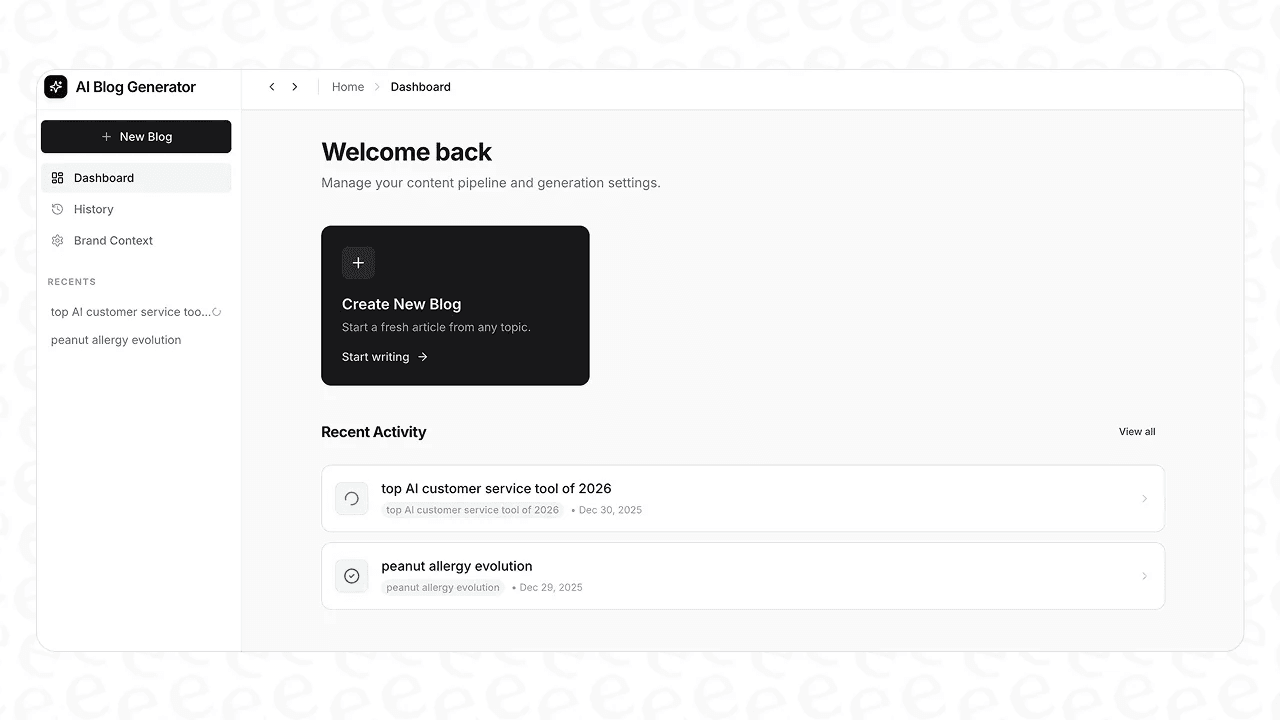
This is the exact problem we wanted to solve with the eesel AI blog writer. It’s not just another text generator; it’s a tool built specifically for scaling high-quality long form content.
- Go beyond just text: Instead of just spitting out a block of text, the eesel AI blog writer delivers a complete, publish-ready post. That means a logical structure with headings, an intro, a conclusion, and FAQs, plus automatic assets like AI-generated images, tables, and infographics.
- Deep, relevant research: It avoids that generic feeling by doing research that's aware of the context. The platform pulls in Reddit quotes and YouTube videos to add genuine depth, social proof, and different viewpoints to your content.
- Proven results: We don't just sell it; we use it ourselves. It’s the exact tool we used to scale our blog's impressions in just three months by publishing over 1,000 optimized posts. You just enter a keyword and your website URL, and it generates a complete article that’s researched, structured, and ready for you to review and publish.
For those who learn best by watching, seeing the process in action can be incredibly helpful. The video below provides a detailed walkthrough of how you can leverage AI to streamline your long form blog writing process, from outlining to drafting.
Make long form blog writing your growth engine
Long form content isn't just a "nice to have", it's a engine for organic growth. It drives SEO, builds your authority, and nurtures leads in a way that short-form content just can't match. But its biggest bottleneck has always been the huge amount of manual effort it takes to create it at scale.
The key to a winning strategy in 2026 and beyond is to combine a solid, research-backed process with modern tools that do the heavy lifting without sacrificing the depth and quality that both readers and search engines are looking for. You need a system that lets you focus on strategy, not just endless drafting and formatting.
Stop staring at a blank page. Generate your first complete, SEO-optimized long form article for free with the eesel AI blog writer and see what your content strategy is really capable of.

Frequently Asked Questions
Share this article

Article by
Stevia Putri
Stevia Putri is a marketing generalist at eesel AI, where she helps turn powerful AI tools into stories that resonate. She’s driven by curiosity, clarity, and the human side of technology.