If you run a business that serves a specific area, getting your local SEO right is critical. With nearly half of all Google searches being for local information, showing up when a potential customer searches "pizza near me" or "plumber in Brooklyn" is how you win.
The world of local SEO tools is crowded, with dozens of platforms available. It can be challenging to determine which one fits your needs without extensive research. This guide provides a clear breakdown of the top 7 tools that deliver results.
What are local SEO tools?
What exactly are local SEO tools? Think of them as software designed to help your business get found in local searches. Instead of you manually checking your Google Business Profile, tracking reviews on Yelp, or trying to figure out where you rank on Google Maps from different street corners, these tools automate the heavy lifting.
They usually cover a few key areas:
- Listing & Citation Management: Making sure your business's Name, Address, and Phone Number (NAP) are consistent and accurate across all the important online directories. Consistency builds trust with search engines.
- Rank Tracking: Showing you exactly where you rank in the Google Maps "Local Pack" and in local organic search results. The best ones use geo-grids to visualize your ranking from different points in your service area.
- Review Management: Helping you generate, monitor, and respond to customer reviews from dozens of sites, all in one place.
- AI Visibility & GEO: A newer, but crucial, function. This involves tracking when your brand gets mentioned in AI-powered search results like Google AI Overviews and ChatGPT. This practice is often called Generative Engine Optimization (GEO).
How we chose the best local SEO tools
To create a reliable list, we evaluated each tool based on several straightforward criteria. Our goal was to ensure the recommendations were practical, accurate, and valuable for small businesses and agencies.
Here's what we looked for:
- Core Functionality: Does the tool do its main job really, really well? Whether it's rank tracking or citation management, it has to be top-notch at its core promise.
- Accuracy & Data: How reliable is the data? For rank tracking, this is especially important. We looked for tools known for their accuracy.
- Ease of Use: Is the dashboard clean and easy to navigate? You shouldn't need a PhD in data science to figure out what's going on.
- Feature Set: Does it offer a complete suite of tools, or is it a specialist? Both are valuable, but it's important to know what you're getting.
- Pricing & Value: Is the price fair for the features you get? We looked for transparent pricing and a solid return on investment.
- AI & Automation: Does the tool use AI to give you smart recommendations, track your visibility in AI search, and automate the tedious stuff?
Comparison of the top local SEO tools
Here’s a quick side-by-side look at our top picks for 2026.
| Tool | Best For | Key Feature | Starting Price | AI Capabilities |
|---|---|---|---|---|
| eesel AI blog writer | Scaling local content creation | End-to-end post generation with assets | Free to try ($99 for 50 posts) | Yes (Content, AEO, GEO) |
| BrightLocal | All-in-one agency platform | Local Search Grid & Reputation Manager | $39/mo ($29/mo annually) | Yes (Insights & Recommendations) |
| Local Falcon | Hyperlocal visual rank tracking | Share of Local Voice (SoLV) & AI Visibility Tracking | $24.99/mo (credit-based) | Yes (GEO tracking & analysis) |
| Whitespark | Specialized citation management | Local Citation Finder | Modular (from $1/mo) | No |
| SEMrush | Comprehensive marketing suite | Position Tracking with local configuration | $30/mo per location (add-on) | Yes (AI Agent for GBP) |
| Localo | Guided SEO for SMBs | AI-guided "Smart Tasks" | $49/mo ($39/mo annually) | Yes (Task generation, review replies) |
| Places Scout | In-depth agency diagnostics | SERP screenshot feature | Custom (request demo) | No |
A deep dive into the 7 best local SEO tools
Now, let's get into the details of what makes each of these tools stand out.
1. eesel AI blog writer
Its main feature is generating a complete package, not just a block of text. It automatically includes AI-generated images, infographics, and tables. It also embeds relevant YouTube videos and pulls real quotes from Reddit forums to add social proof and authenticity. The content is optimized for Answer Engine Optimization (AEO), which is important for getting featured in Google's AI Overviews and other AI-powered search results.
Pricing is straightforward. It's free to try, and paid plans are credit-based, starting at $99 for 50 complete blog posts.
The main benefit is its speed and quality, allowing you to scale your local content strategy efficiently. It helps capture long-tail local keywords that traditional rank trackers often miss. It is a content generation platform, not an all-in-one local SEO suite, so you'll want to pair it with a dedicated tool for rank tracking and citation management.
2. BrightLocal
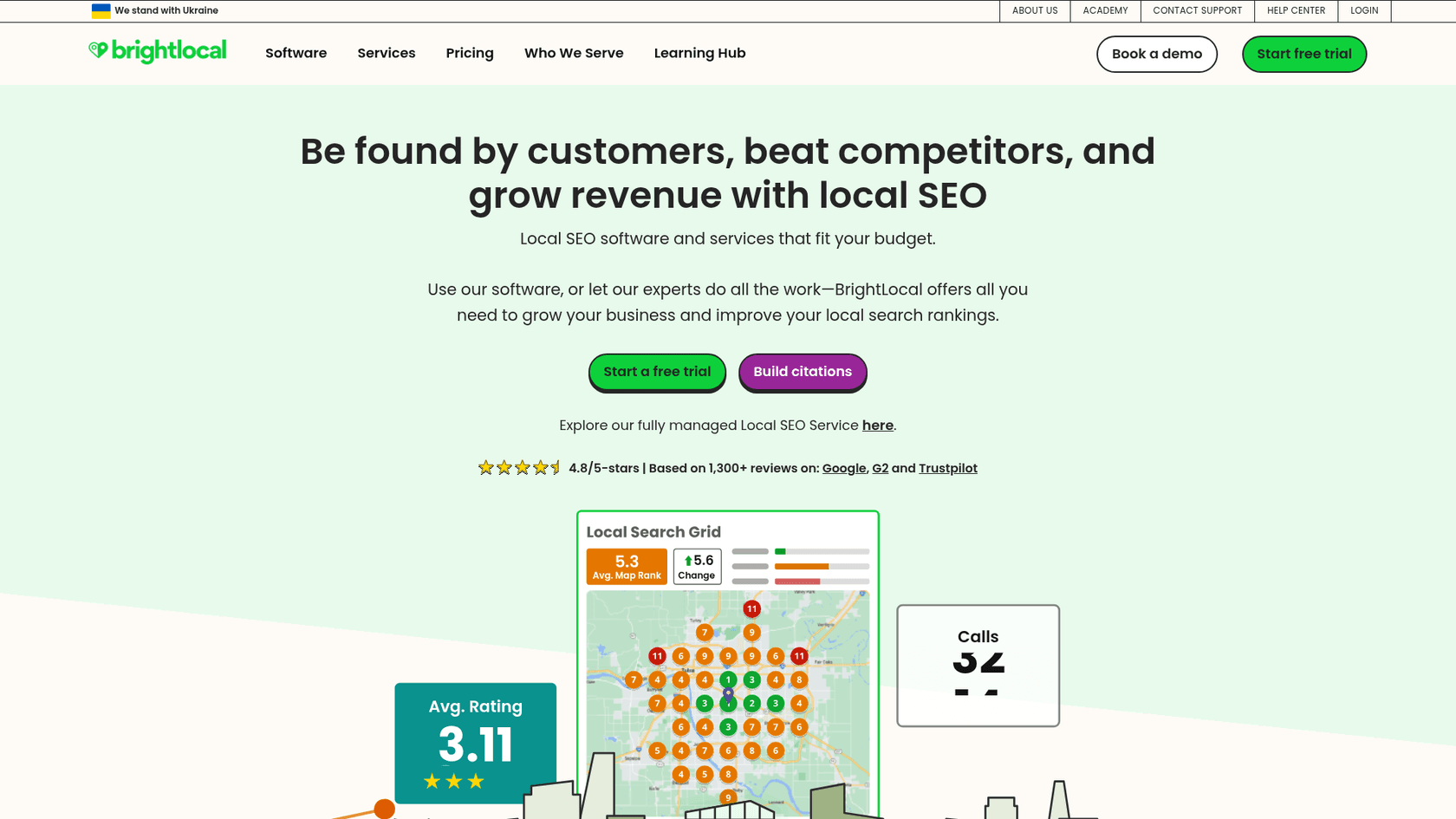
It excels with its Local Search Grid, which gives you a visual heatmap of your Google Maps rankings across your service area. The Citation Tracker is incredibly thorough, and the Reputation Manager pulls in reviews from over 80 different sites. For agencies, the white-label reporting is a huge time-saver.
Plans start at $39 per month for a single location, with a discount if you pay annually ($29/month). It's worth noting their Citation Builder service is a separate, pay-as-you-go offering, so you only pay for what you actually use.Have used BrightLocal for many years... It seems to offers all the things you are looking for...

BrightLocal’s biggest benefit is how comprehensive and user-friendly it is. A minor con some users report is that the platform can feel a bit sluggish at times, likely because of the sheer amount of data it's pulling and processing.
3. Local Falcon
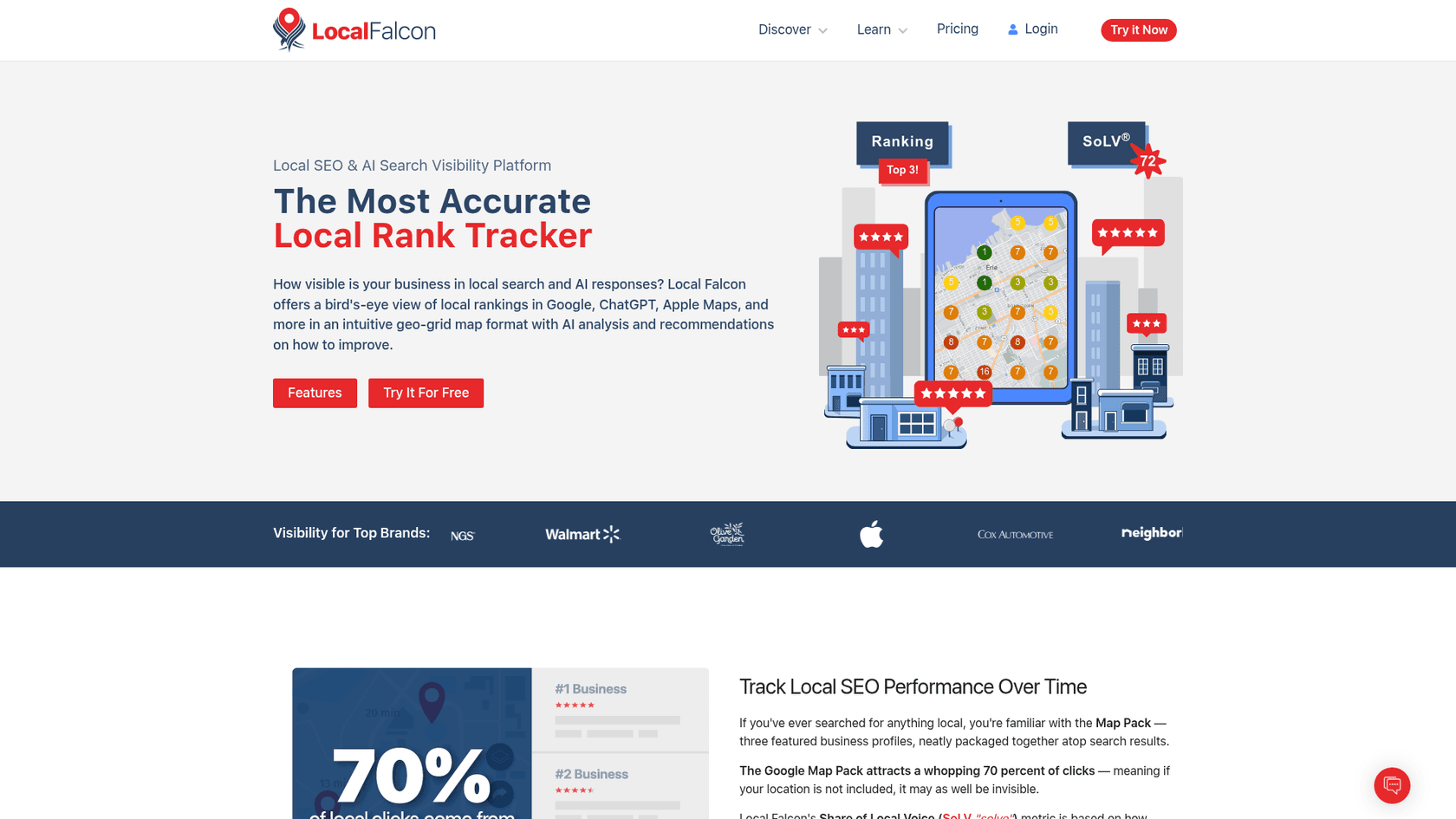
Its standout features are the proprietary "Share of Local Voice" (SoLV) metric, which measures your visibility in the top 3 map pack results, and its AI Visibility Tracking. This feature is significant, showing you when your brand is mentioned in ChatGPT, Google AI Overviews, Gemini, and Grok.
The platform uses a credit-based system. The Starter plan is $24.99 per month and gives you 7,500 credits. For context, a standard 5x5 grid scan costs 25 credits, so you get a lot of mileage out of it.Local Falcon for Map Rank Tracking is great
The main benefit is its accuracy for visualizing map rankings and tracking your presence in AI search. The main drawback is that it’s a specialist tool; it focuses exclusively on map pack and AI visibility and doesn't track traditional organic search rankings.
4. Whitespark
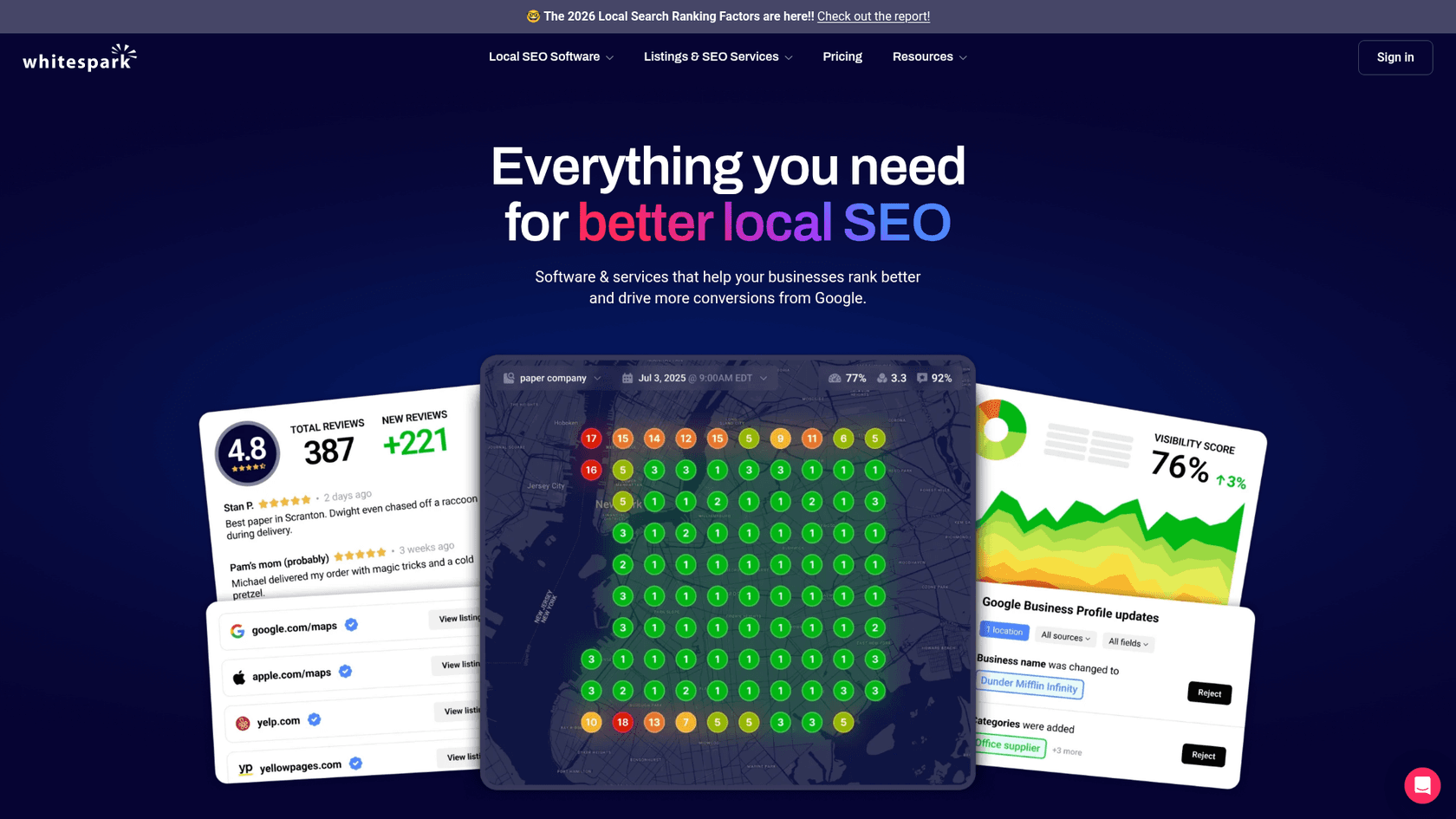
Its Local Citation Finder analyzes your competitors' citation profiles to find valuable directories where they're listed but you aren't. Whitespark also offers hands-on citation building and cleanup services if you'd rather have an expert team handle the tedious work for you.
Pricing is completely modular. For example, their "Local Platform" for managing your Google Business Profile is just $1/month per location, while the powerful "Local Citation Finder" starts at $33/month when billed annually.Yeah! Use Whitespark! 😄
The main benefit is Whitespark's expertise and effectiveness in what is arguably the most foundational part of local SEO. The con is that it isn't an integrated platform, so you'll need to use other tools for things like review management or comprehensive reporting.
5. SEMrush
Its Position Tracking tool can be easily configured to monitor keyword rankings in specific zip codes, cities, or states. The "Local" add-on plans unlock features like listing management across directories, review management, and even an AI Agent that can automatically generate replies to your Google Business Profile reviews.
The local features are sold as add-ons to a standard Semrush subscription. The Local Base plan runs $30/month per location, while the Local Pro plan is $60/month per location.With that stack, you might as well use Semrush Local if you already have a Semrush subscription, especially since Semrush uses Yext on the backend for citations.
The main advantage is having all your local, organic, and paid search data in one place, allowing you to see the full picture. The downside is the cost. If you only need local-specific tools, SEMrush can be one of the more expensive options on the market.
6. Localo
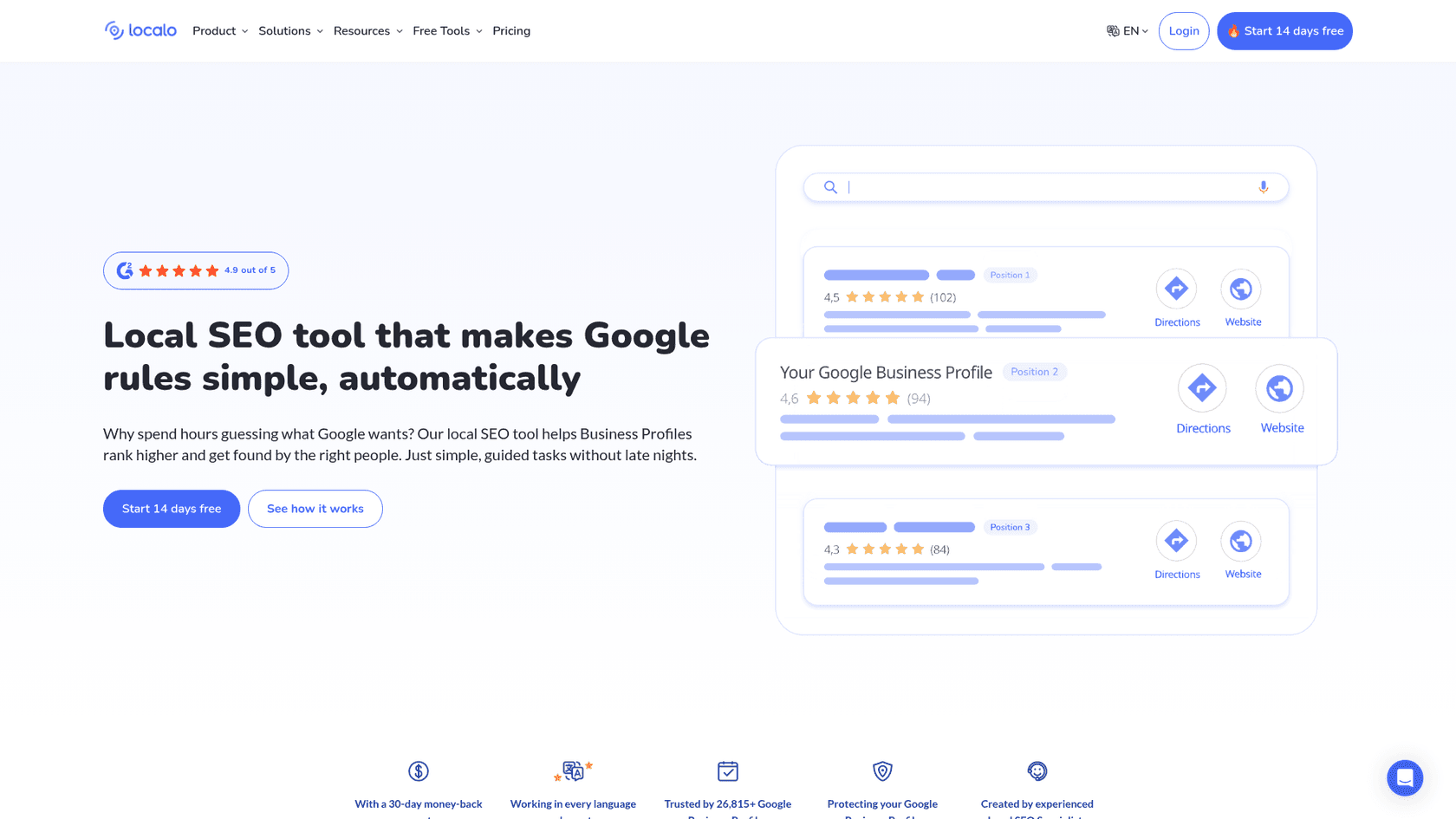
Its signature feature is "Smart Tasks," which provides a personalized checklist of weekly recommendations to improve your Google Business Profile. It also includes GBP Protection to monitor and prevent unauthorized edits to your profile, plus AI tools to help write Google Posts and respond to reviews quickly.
Pricing is very accessible, with the Single Business plan starting at $49/month, or $39/month if you pay for the year upfront.
The main benefit is its simplicity and action-oriented design, which provides clear next steps for users. The tradeoff is that it might lack the deep-dive analytics and advanced reporting features that a seasoned marketing agency would need.
7. Places Scout
A key feature is the SERP screenshot function. For every data point it checks in a geo-grid, it actually captures an image of the search results page. This is valuable for diagnosing ranking issues and showing clients exactly what their customers see. It also offers a "GBP Radar" for daily profile monitoring and "Citation Intel" for in-depth analysis.
Pricing is custom and is based on the volume and types of reports you need. You'll have to book a demo to get a specific quote.PlacesScout for heatmap and review exports.
The main benefit is the depth and accuracy of its data, especially the SERP screenshots. The cons are that its interface isn't as modern or intuitive as some competitors, and the custom pricing model can be a hurdle for smaller businesses or freelancers who just want to sign up and get started.
Tips for getting the most out of your local SEO tools
Just having the tools isn't enough. You have to use them effectively. Here are a few tips to get the best results:
- Combine tools strategically. Different tools have different strengths. A potential stack could involve using Local Falcon for visual rank tracking, BrightLocal for managing citations and reviews, and the eesel AI blog writer to publish new, optimized content for your local landing pages and blog.
- Schedule automated reports. Don't fall into the trap of only checking your rankings when you remember. Set up weekly or monthly automated reports to be sent to your inbox. This helps you spot trends and catch problems early.
- Focus on one area at a time. It's easy to get overwhelmed. Try dedicating one week to cleaning up your citations, the next to running a campaign to generate new reviews, and the week after to publishing two new local service pages.
- Act on the insights. The data from these tools is useless if you don't do anything with it. If a tool shows a competitor is outranking you for a key term, dig into their profile. What categories are they using? What kind of photos do they have? What are people saying in their reviews?
For a more detailed walkthrough, this video breaks down some of the most effective tools and how to use them to rank in competitive markets.
The final word on choosing your local SEO tools
The best local SEO tool depends on your specific situation. An agency managing 50 clients has different needs than a small business owner trying to get more foot traffic. The key is to find a platform that matches your goals, technical comfort level, and budget.
As search engines evolve into answer engines, a holistic strategy is important. This includes solid technical foundations, consistent citations, a good reputation, and high-quality, helpful content that answers the questions your local customers are asking.
While rank trackers show you where you stand, creating content is how you improve your ranking. To scale your local content, you can try the eesel AI blog writer for free and generate your first publish-ready article.