
The SEO game has changed. For years, the goal was simple: get to the number one spot on Google. Now, it's not just about that blue link. It’s about getting mentioned in answers from ChatGPT, Perplexity, and the Google AI Overviews that are popping up everywhere.
This shift to Generative Engine Optimization (GEO) can feel like you're navigating without a map. How can you tell if you're even showing up in these new AI engines?
I wanted to find out for myself, so I tested the most talked-about AI SEO rank tracking tools to see which ones deliver in 2026. I'm here to share what I learned. Just remember, tracking is only half the battle. You first need content that AI engines want to feature, which is where a smart creation tool like the eesel AI blog writer comes in handy.
What are AI SEO rank tracking tools?
These tools are the next generation of your standard rank tracker. Instead of just showing your website's position for a keyword, these platforms monitor your brand's visibility inside AI chats and answer engines.
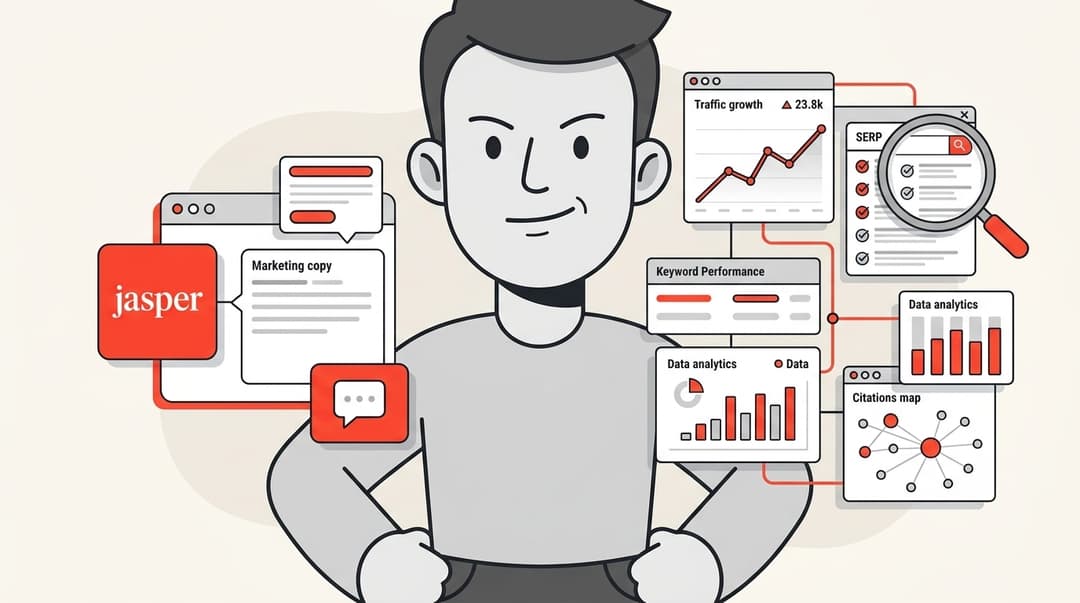
While traditional trackers focus on a URL's rank, AI trackers look at different metrics:
-
Mentions: Is your brand being named in AI-generated answers?
-
Citations: Are the AI engines linking back to your site as a source?
-
Sentiment: When you are mentioned, is it positive, negative, or neutral?
-
Share of Voice: How often do you appear compared to your competitors for key topics?
The problem they solve is significant. Measuring your brand's presence in conversational AI is tough. You can't just check Google Search Console for your "ChatGPT impressions." These tools give you a window into a marketing channel that's been a complete black box until now.
How we chose the best AI SEO rank tracking tools
To put this list together, I focused on a few key criteria:
-
AI Engine Coverage: Does the tool track the big three: ChatGPT, Perplexity, and Google AI Overviews? I gave extra points for others like Gemini and Claude.
-
Data Accuracy & Methodology: How do they get their data? Some tools use methods like UI scraping for a more authentic read on the user experience, which is much more reliable than an API that might give different results.
-
Features & Actionability: It’s one thing to have data, but it’s another to know what to do with it. I looked for tools with competitor analysis, sentiment tracking, and real insights.
-
Value for Money: Is the price fair? I looked for tools with clear pricing and flexible plans.
-
User Experience (UX): Is the platform easy to use? You shouldn't need a special degree to figure out if your content is working.
A comparison of the top AI SEO rank tracking tools
For anyone who just wants a quick summary, here's how the tools stack up.
| Tool | Best For | Key Feature | Pricing Model |
|---|---|---|---|
| eesel AI blog writer | Creating AEO-optimized content | Automatic asset & media embeds | Pay-per-blog |
| Peec AI | Agencies needing structured reports | UI scraping for authentic data | Subscription (from €89/mo) |
| Nightwatch | Unified traditional & AI tracking | Zip-code level local tracking | Subscription (+ AI Add-on) |
| Rankscale.ai | Granular, data-driven analysis | AI Readiness Score for websites | Credit-based (from $20/mo) |
| Semrush | All-in-one SEO & AI monitoring | Integration with a full SEO suite | Subscription (from $165.17/mo) |
A deep dive into the 5 best AI SEO rank tracking tools
Okay, let's get into the specifics. Here’s my hands-on take on each tool, including the good, the bad, and who it's best for.
1. eesel AI blog writer: The foundation for what you track
Let's be clear: the eesel AI blog writer isn't a rank tracker. It's included because it handles the crucial first step. You can't rank in AI if your content isn't optimized for it, a practice called Answer Engine Optimization (AEO). This tool automates that content creation. We used it to scale our own blog, going from 700 to 750,000 daily impressions in just three months.
-
Pros: It generates a complete, publish-ready blog post with AI-generated images, tables, relevant Reddit quotes, and even YouTube videos. This rich, structured content is what AI engines are designed to cite. It’s designed for AEO from the start, making your content easy for LLMs to understand.
-
Cons: It’s focused entirely on content creation. You'll need to pair it with one of the other tools here to measure your visibility after you publish.
-
Pricing: It's completely free to try. If you like it, the paid plan is simple: $4 per complete blog post. No subscriptions, just pay per post when you need one.
2. Peec AI
Peec AI is a good option for agencies or in-house SEOs who need to deliver clean, professional reports on AI performance. It provides a clear view of metrics like Visibility, Position, and Sentiment across platforms like ChatGPT and Perplexity, making it easy to show stakeholders what’s happening.
We’re also using Peec, and it’s the only one I found that’s actually useful. Of course no tool is going to be 100% accurate (that’s not the nature of AI anyway, different users will get different responses based on a bunch of factors). But in terms of directional accuracy and tracking the impact of our work Peec has been the only one we’re using with clients

-
Pros: Its standout feature is how it collects data. Instead of just using an API, Peec AI uses UI scraping technology to simulate what a real person sees. This gives you more accurate data that reflects the actual audience experience. It’s ideal for brands that already have some recognition and want to track how they’re being discussed.
-
Cons: The pricing is in Euros, and the cost is tied to how many prompts you track. It can get expensive if you have a long list of keywords.
-
Pricing: Peec AI is a subscription service.
- Starter: €89 per month for 25 prompts.
- Pro: €199 per month for 100 prompts.
- Enterprise: Starts at €499 per month for custom plans over 300 prompts.
3. Nightwatch
Nightwatch is a hybrid tool for anyone who wants to avoid juggling multiple platforms. It combines traditional SEO rank tracking (Google, Bing) and AI visibility tracking (ChatGPT, Claude, Gemini) into a single, clean dashboard.
-
Pros: A key advantage is its local tracking that goes down to the zip code level. This is a significant benefit for local businesses. The platform is also built for data accuracy, so you can trust the numbers are more than just broad estimates.
-
Cons: AI tracking isn't included in the standard packages. It’s an add-on, so you have to factor that into the overall cost.
-
Pricing: The base plans are quite affordable, starting at $32 per month with annual payment. The AI Tracking Add-on is an extra $99 per month, which covers tracking for 100 prompts.
4. Rankscale.ai
Rankscale.ai offers a very deep, "drill-down" approach to tracking AI visibility and covers a wide range of models, including ChatGPT, Perplexity, Claude, Grok, and Google AI Overviews.
-
Pros: The "AI Search Readiness Score" is a useful feature. It analyzes your site and gives you specific, actionable steps to improve your content and structure for AI crawlers. The level of detail is also high, allowing you to filter tracking by region and even by the specific AI model.
-
Cons: The technical interface can be overwhelming for those new to this area, as it's built for experienced SEO professionals.
-
Pricing: Rankscale.ai uses a flexible credit-based system, so you only pay for what you use.
- Essentials: $20 per month for 120 credits.
- Pro: $99 per month for 1,200 credits.
- Enterprise: $780 per month for 12,000 credits.
5. Semrush
Semrush is a well-known tool in the SEO industry, so its move into AI tracking isn't surprising. For teams that want to keep all their marketing data in one place, the AI Visibility Toolkit integrates AI tracking directly into their extensive suite of tools.
-
Pros: The primary benefit is convenience. If your team already uses Semrush for keyword research, site audits, and competitor analysis, adding AI tracking is a simple option. It’s all there in an interface you already know.
-
Cons: As part of a larger platform, the AI toolkit can feel less specialized than a dedicated tool. The cost is also higher because it includes access to their entire premium ecosystem, not just an AI tracker.
-
Pricing: The AI Visibility Toolkit is part of the Semrush One plan. This plan starts at $165.17 per month (billed annually) and includes tracking for 50 prompts.
How to choose the right AI SEO rank tracking tools for your team
Here’s a straightforward way to think about it.
-
Start with your goal. What are you really trying to do? If you need in-depth competitive analysis, Rankscale.ai is a strong choice. If you just need clean reports for clients, Peec AI is probably the way to go. Knowing your main objective simplifies the decision.
-
Consider your budget and model. Do you prefer a predictable monthly subscription like Semrush, or a flexible pay-as-you-go model like Rankscale.ai? This helps ensure you don't overpay for services you don't need.
-
Evaluate your existing tech stack. If your team is already all-in on Semrush, their integrated solution is the easiest path. If you want a standalone tool that connects old and new SEO, Nightwatch is a great option.
-
Remember the foundation. Remember, no tracking tool will be effective if your content isn't built to be seen by AI. That's why focusing on AEO-optimized content from the start is so important.
For a visual breakdown of how some of these tools compare, here's a helpful video that walks through the features of top AI SEO trackers.
It all starts with the right content
SEO is becoming more complex. AI search is now a reality, and new tools are emerging to help navigate it.
While tracking your visibility is important, it's also a backward-looking activity. You're measuring what's already happened. A proactive approach is to create content that AI engines are built to find and feature.
Before you invest in tracking your AI rank, make sure you have content that's actually designed to rank in the first place. You can try the eesel AI blog writer for free to see what that looks like.
Frequently asked questions
What are the best free AI SEO rank tracking tools available?
While most advanced tools are paid, some platforms like Rankscale.ai offer a free tier with limited credits. For serious tracking, however, you'll likely need a paid subscription to get accurate, comprehensive data.
How do AI SEO rank tracking tools work for local businesses?
They can be very useful. A tool like Nightwatch, for example, offers local tracking down to the zip code. This lets local businesses see if they're being mentioned in AI answers for location-specific searches, like "best pizza near me."
Are AI SEO rank tracking tools difficult to use?
It depends on the tool. Platforms like Peec AI and Semrush have user-friendly dashboards designed for agencies and marketing teams. Others, like Rankscale.ai, are more data-heavy and might have a steeper learning curve for beginners.
Why can't I just use Google Search Console instead of dedicated AI SEO rank tracking tools?
Google Search Console is perfect for tracking your performance in traditional Google search, but it does not provide data on your visibility within AI chat engines like ChatGPT, Perplexity, or even Google's AI Overviews. These dedicated tools fill that data gap.
What's the most important feature to look for in AI SEO rank tracking tools?
Data accuracy is crucial. Look for tools that are transparent about their methodology. For instance, platforms using UI scraping (like Peec AI) often give a more realistic view of what users see, compared to just using an API. Engine coverage (ChatGPT, Perplexity, etc.) is also a key factor.