Kimi K2.6 Review: Better Reasoning, 100-Agent Swarms (2026)

Stevia Putri
Last edited April 21, 2026

Beta testers spent a week inside the K2.6-code-preview and kept noticing something odd: the console still said K2.5, but the model was clearly better. Deeper reasoning traces, cleaner agent planning, and faster multi-step tool calls. On April 13, 2026, Moonshot AI confirmed the rumors with a single email and rolled Kimi K2.6 out to all Kimi Code subscribers.
This isn't just a minor patch. The jump from K2.5 to K2.6 mirrors the massive leap we saw between K2 and K2 Thinking in late 2025. It’s a jump so significant that early testers on Reddit were calling it "Opus-flavored" reasoning.
I’ve been tracking Kimi Code since it launched alongside K2.5 in January 2026. After a week of heavy testing, here’s the no-spin breakdown of what K2.6 actually changes, how it stacks up against Claude Code and Cursor, and whether it’s worth your subscription dollars in 2026.
What Actually Changed? Reasoning Depth Explained
The most immediate change in Kimi K2.6 is the shift in its "Thinking Traces." If you've used Claude Opus 4.6, you know the feeling of watching a model actually think through a problem before spitting out code. K2.6 brings that same verbosity and transparency to the Kimi ecosystem.
The model now produces longer, more structured internal reasoning paths. You’ll frequently see "Let me..." prefixes as it decomposes your request. While some might find the extra text annoying, it’s a massive win for auditability. You can see exactly where the model is planning to go before it makes a single file change.
Under the hood, this performance is powered by native INT4 quantization (QAT). This allows for a lossless 2x speed-up in low-latency mode, meaning you get that deep reasoning without the usual "thinking" lag that plagues larger models. More importantly, K2.6 has pushed the boundaries of stable tool-use. Moonshot claims the model can now handle 200–300 sequential tool calls without drift (a huge leap from the 30–50 steps where previous generations used to lose the plot).
The Agent Swarm: 100 Sub-Agents in Action
One of the most ambitious features introduced in the K2.5 era was the "Agent Swarm." With K2.6, this infrastructure has finally matured.
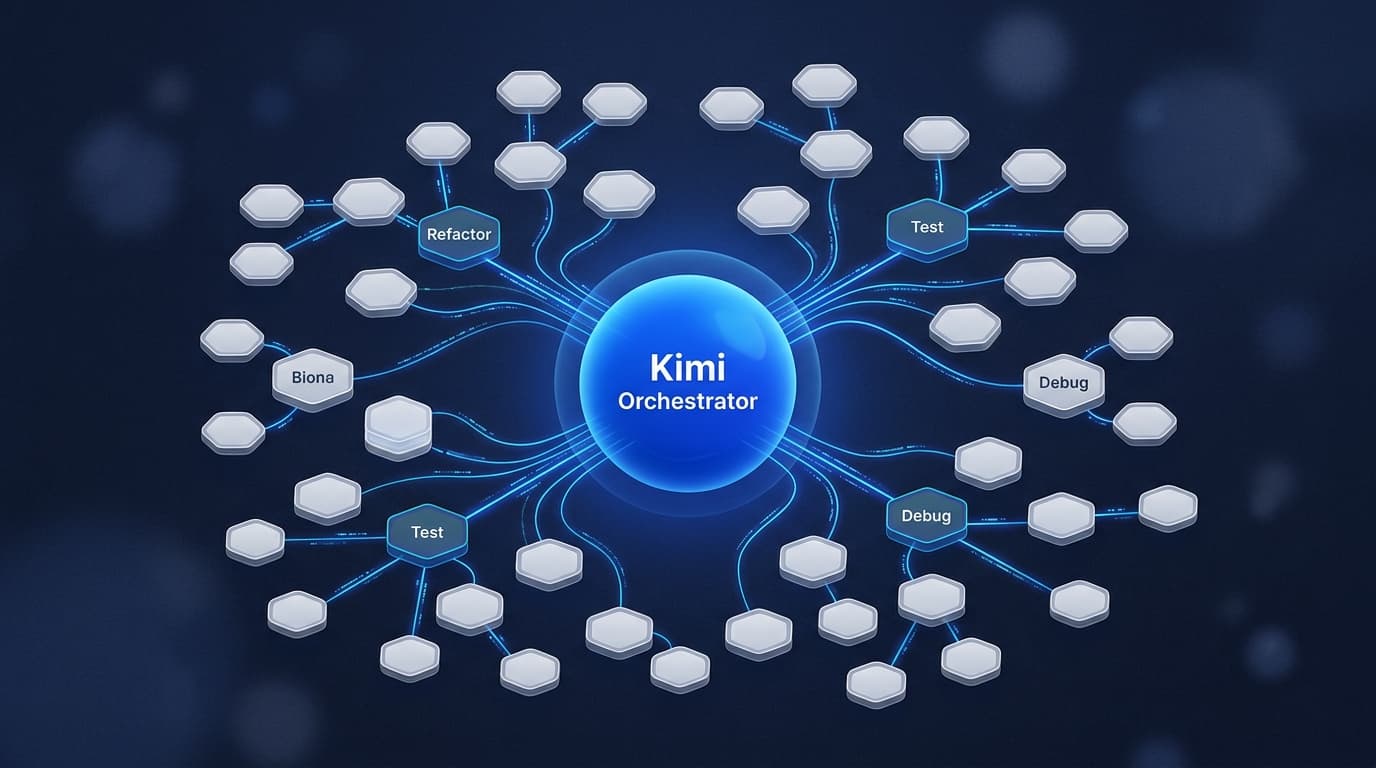
Think of a standard AI coding assistant as a solo developer. It looks at a file, makes a change, and moves on. Kimi K2.6’s Agent Swarm acts more like a fully-staffed engineering team. The orchestrator can spin up to 100 coordinated sub-agents to handle parallelizable tasks.
In my testing, large-scale refactors that used to require a serial "step-by-step" approach are now handled in parallel. The orchestrator breaks down the task, assigns sub-agents to different modules, and merges the results. K2.6 specifically improves the orchestrator’s ability to route these tasks without defaulting back to a single-agent loop (a known weakness in the earlier K2.5 rollout).
Kimi Code vs Claude Code vs Cursor: The 2026 Scorecard
If you’re a developer in 2026, your terminal is likely a battleground between Kimi Code, Claude Code, and Cursor Pro. Here is how they stack up right now:
| Metric | Kimi K2.6 | Claude Code (Sonnet 4.6) | Cursor Pro |
|---|---|---|---|
| SWE-Bench Verified | ~77% (Beta) | 79% | 75% |
| Context Window | 256K | 200K | 128K |
| Agent Swarm | Up to 100 agents | Multi-agent (beta) | Single-agent focused |
| Primary Strength | Cost & Chinese-Bilingual | Instruction Following | IDE Integration |
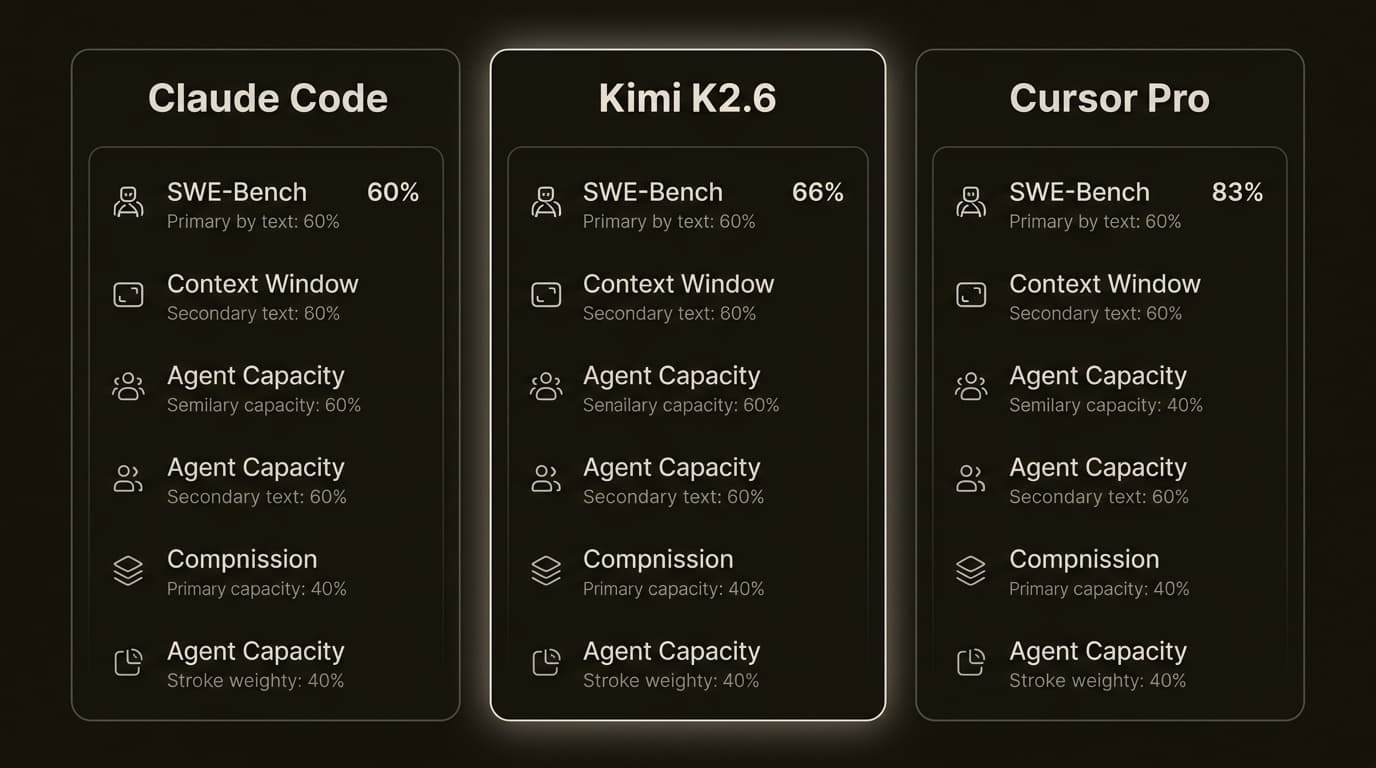
Kimi K2.6 is genuinely competitive on raw coding benchmarks. Where Claude still wins is in complex English-language instruction following and reliability on extremely high-constraint loops. However, Kimi wins hard on cost and on any tasks requiring Chinese-English bilingual capabilities.
For teams already using eesel AI to manage their support automation, Kimi’s agentic stability makes it an interesting candidate for building custom internal tools that bridge the gap between support and engineering.
Pricing and Value: Is Kimi Worth Your Dollars?
Kimi Code K2.6 isn't sold as a standalone model; it’s part of the unified "Kimi for Code" subscription. Moonshot AI has moved away from seat-based pricing for their API platform, opting instead for a transparent, interaction-based model that mirrors the eesel AI pricing structure.
At the time of writing, the K2.6-code-preview is available to all subscribers through the dashboard at kimi.com/code. The April 13 CLI update (version 1.33.0) officially dropped the "beta" labels from the welcome screen, signaling that Moonshot is confident enough in the model's stability for production use.
If you’re doing high-volume, multi-file refactors, the efficiency gains from the Muon optimizer.which Moonshot claims provides 2x computational efficiency over standard AdamW optimizers.make Kimi a very cost-effective choice for 2026. This Muon technical guide and the Muon research paper explain how this matrix-aware optimization cuts training costs by roughly 50%.
Conclusion: Integrating Kimi into a Multi-Agent World
The release of Kimi K2.6 on April 13, 2026, marks a turning point for Moonshot AI. They are no longer just a "fast follower" to western labs; with the Agent Swarm and Muon-optimized 1T parameter MoE architecture (see the Moonlight 16B report), they are defining what "Agentic Intelligence" looks like.
For power users, the upgrade to K2.6 is mandatory. The stability in long-horizon tasks alone is worth the switch. And for those looking to bring this level of automation to other parts of their business, tools like eesel and eesel AI are already paving the way by turning this raw model power into unified work hubs and autonomous support agents.
The future of coding isn't just about better autocomplete (it's about the swarm). And Kimi K2.6 is leading the charge.

Frequently Asked Questions
Share this article

Article by
Stevia Putri
Stevia Putri is a marketing generalist at eesel AI, where she helps turn powerful AI tools into stories that resonate. She’s driven by curiosity, clarity, and the human side of technology.