
You know your stuff. The kind of expertise that could really help people. But getting that knowledge into a blog post that people actually find and read? That’s a whole other story. Your insights get lost, and the posts just don't get the attention they deserve.
That's where informational blog writing comes in. It’s how you connect what you know with what your audience needs to know. The goal isn't a hard sell. It’s about giving real value, answering questions, and building trust. A great informational post is basically "the guide you wish you had found" when you were starting out, a way to leave valuable breadcrumbs for others.
And while creating this content can be a lot of work, it doesn't have to be a total grind. AI tools can handle a lot of the heavy lifting, from research to SEO, without making your content sound like it was written by a robot.
What is informational blog writing?
At its core, informational blog writing is content made to do one thing: teach, inform, or answer a question with clear, credible information. It’s not about pushing a product or a strong opinion. It’s all about giving the reader something useful.
This approach helps your business in a few key ways:
- Establish authority: When you consistently publish helpful, accurate content, people start to see you as the go-to resource in your field.
- Build lasting trust: By solving problems for your audience without asking for anything back, you build a relationship based on trust, not just a sale.
- Drive organic traffic: This kind of content is a magnet for search engines. It naturally targets the "how-to," "what-is," or "best-of" questions people are searching for every day.
Unlike an opinion piece or a sales page, informational content is objective and puts the reader first. The best posts are so helpful that people can't help but share them. It’s less about a sales pitch and more about a useful conversation.
The three pillars of successful informational blog writing
Good informational content doesn't just happen; it's a process. To do it right, it helps to have a framework. This three-part approach covers everything from the first idea to the final click.
Pillar 1: Strategic planning and research
Great content starts way before you type a single word. Planning and research are where you build the foundation for a post that connects with your audience and shows up in search results. Skip this, and you're basically writing into the void.
First, you need to understand your audience. And I mean really understand them, not just their demographics. What are their specific questions? What are their biggest headaches in your field? How much do they already know? Figuring this out helps you make your content genuinely useful.
Next, find your topic and keyword. The sweet spot is where your audience's needs meet what your business does. A good trick is to see what your competitors are writing about and find the gaps where you can offer a better, more complete answer.
Finally, structure the narrative. Before you get into writing sentences, sketch out a logical outline. Think of it as a roadmap for your post. It keeps the flow smooth and ensures you answer the reader's question completely without going off on a tangent. A clear structure makes writing easier and the final article much simpler for your audience to follow.
Pillar 2: Writing tips for effective content
With a solid plan in place, it's time to write. This is where you focus on creating something that connects with a real person, not just a search engine.
The best advice is simple: write the way you speak. A natural, conversational tone makes your content easier to get into. It cuts out the jargon and stuffy phrasing, so it feels more like you're explaining something to a friend.
Facts are good, but they stick better when they're part of a story or a real-world example. Use storytelling and practical examples to make your points clear and show readers how the information applies to them.
Nobody likes a wall of text, so break it up. Use visuals like images and tables to make complicated info easier to understand. You can also build credibility with social proof, like quotes from forums or video clips from experts. It shows your advice is based on real experience. And don't forget to cite credible sources. Linking to other authoritative sites adds depth and shows your readers you've done your research.
IMO opinion, AI is like most tools. Garbage in, garbage out. You can’t throw a Kw at it and expect a week written article. You still need to research proper KWs. You need to study the SERPs. You still need to perfect a great outline.

Pillar 3: Optimization and distribution
Writing a great blog post is only half the job. If nobody can find it, it’s not doing much good. This last part is all about making sure your content gets seen and keeps working for you long after you publish it.
Start with the on-page SEO basics. This means using your target keyword naturally in your title, headings, and meta description. It also means writing descriptive alt text for your images to help search engines and readers with visual impairments know what's in them.
Then there's Answer Engine Optimization (AEO). This is about setting up your content for AI answer engines like Google AI Overviews, ChatGPT, and Perplexity. These tools like content that is well-structured, gives direct answers, and uses clear lists and definitions. Formatting your content this way gives you a better shot at being featured.
Don't forget internal linking. Linking to other relevant posts on your site helps people find more of your content and shows search engines how your site is structured. Finally, good content is never really "finished." You should keep it fresh by checking in on your posts every so often to make sure they’re still accurate and relevant.
How to speed up your informational blog writing process
The three-pillar process works, but it takes a ton of time. Researching, outlining, writing, finding visuals, and optimizing can eat up hours, if not days, for just one post. Trying to do that consistently can be challenging.
This is where AI tools can help. For example, the eesel AI blog writer is a tool designed to handle the entire three-pillar process, rather than just producing a rough draft.
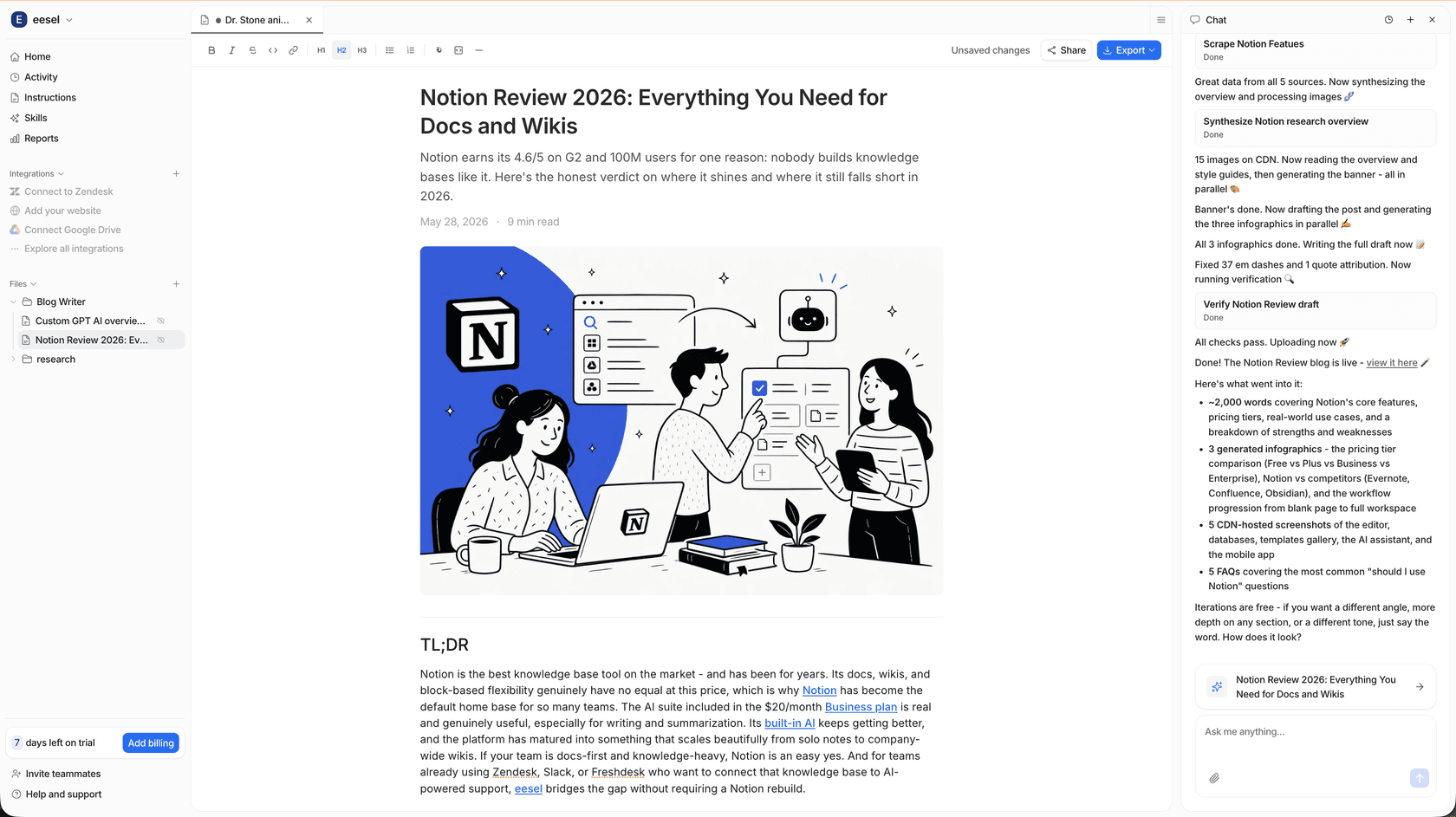
Here’s how it tackles each part:
- Planning and research: Just give it a topic or keyword and your website URL. The AI does deep, context-aware research based on your business and generates a full outline designed to rank.
- Content creation: It writes a complete, publish-ready draft that sounds human. It even automatically includes assets you need, like AI-generated images, data tables, and real social proof like relevant Reddit quotes to add a dose of reality.
- Optimization: Every post is automatically optimized for both traditional SEO and modern AEO. It takes care of the technical details like keyword placement and structured data, so you can just focus on the core message.
This approach, using a platform that handles the full writing process, has been used to grow organic traffic from 700 to over 750,000 daily impressions in three months.
It’s completely free to try. You can generate your first post and see the quality for yourself, no strings attached.
For a more visual walkthrough, this video breaks down the process of creating an informational blog post that ranks well, covering key steps from research to writing.
Final thoughts on informational blogs
Successful informational blog writing is one of the best ways to build trust, establish your brand as an authority, and get steady organic growth. It’s about shifting your focus from selling to serving.
As we've seen, getting it right comes down to a mix of understanding your audience, creating human-first content, and using smart optimization. When you nail these three things, you build a content engine that brings in and helps the right people, time and time again.
The real goal isn't just to churn out content; it's to consistently offer real value that answers your audience's biggest questions.
If you are ready to create informational content that ranks and connects, you can try the eesel AI blog writer to turn your expertise into blog posts that perform.