We've all stared at that blinking cursor on a blank page, right? You know you need content to grow, but figuring out how to write a blog post people will actually read can feel impossible. It's not just about hitting a word count; it's about creating something valuable that pulls in traffic, answers real questions, and builds trust with your audience.
Look, a blog post isn't just about filling a page with words. It's a real asset for your business. When done right, it’s a magnet for organic traffic, a platform to show off your expertise, and a direct line to potential customers. But creating great posts consistently is a huge challenge, especially when you’re juggling a dozen other things.
This guide will walk you through the whole process, from that first flicker of an idea to hitting 'publish' and promoting it. We'll give you a repeatable framework that takes the guesswork out of blogging. We'll also touch on how AI is shaking things up. Tools like the eesel AI blog writer are built to take on the entire workflow, helping you scale up content without burning out.
What success looks like when you know how to write a blog post
Blogging isn't what it used to be. Forget the online diaries of the early 2000s. Today, a successful post is a comprehensive resource built to serve a specific audience. It's not about what you want to say; it's about what your reader needs to know.
So, what are the ingredients of a blog post that gets clicks, shares, and rankings in 2026?
- It answers a specific question: Every great blog post focuses on what a user is searching for. Whether someone needs a "how-to" guide, a product review, or an explanation of a tricky topic, your post should give them a clear and direct answer.
- It’s easy to scan: Let's be real, most people skim online content. A good post uses clear headings (H1, H2, H3), short paragraphs, and lists to avoid those dreaded "walls of text." This simple practice dramatically improves readability and keeps people on the page longer.
- It’s media-rich: Text alone can be a bit boring. The best posts are filled with relevant images, helpful videos, data tables, and even quotes to add context and visual appeal. This makes the content more engaging and helps explain complex points more effectively.
- It’s optimized for SEO (Search Engine Optimization): This is how people find you. A well-optimized post is built around specific keywords that your target audience is searching for. It’s about telling search engines like Google what your content is about so they can show it to the right people.
- It’s optimized for AEO (Answer Engine Optimization): This is the next big thing. With the rise of Google's AI Overviews, ChatGPT, and other conversational AI, your content needs to be structured for more than just old-school search results. AEO is about making your content so clear and authoritative that AI models use it as a source to answer user questions. The goal is to become a trusted source and get cited in those AI-generated answers.
The 3 phases of writing a blog post that ranks
A great blog post doesn't just magically appear. It's built through a clear, three-phase process that covers everything from initial strategy to the final polish. Think of it like building a house: you need a blueprint before you start laying bricks, and you need to inspect everything before you move in. The same goes for content. Let's break it down into the three distinct phases shown below: planning, creation, and optimization.
Phase 1: Strategic planning
This is easily the most important phase, and weirdly, it's the one most people rush through. Jumping straight into writing without a plan is like setting off on a road trip without a map. You might get somewhere, but it probably won't be where you intended to go.
-
Know your audience Before you write anything, you need to know exactly who you're talking to. What are their biggest challenges? What questions are they asking? What's their level of expertise on the topic? Creating a simple reader persona can be a huge help. Give them a name, a job title, and a list of their goals and pain points. Every time you write, you'll be speaking directly to that person, which makes your content so much more relevant.
-
Find the right topic A brilliant blog post is pointless if no one ever finds it. Keyword research is how you discover the topics and phrases your audience is actively searching for. It’s not about stuffing keywords into your text; it’s about understanding what people want and creating content that gives it to them. _ Start simple: Use Google's "People also ask" section and "Related searches" to see what other questions people have. Browse forums like Reddit or Quora to find real, unfiltered conversations. These are goldmines for content ideas.
_ Level up with tools: To get serious, you’ll want to use dedicated SEO tools. Platforms like Semrush offer access to a massive keyword database, giving you endless ideas and data. Ahrefs is another top choice, known for its user-friendly interface and features that help you see who is linking to your competitors.IMO opinion, AI is like most tools. Garbage in, garbage out. You can’t throw a Kw at it and expect a week written article. You still need to research proper KWs. You need to study the SERPs. You still need to perfect a great outline.
-
Analyze the competition Once you have a keyword, just Google it. The results on the first page? That's your competition. Open the top 3-5 articles and see what they're doing. What topics do they cover? How are they structured? What kinds of media do they use? Look for gaps. Is there a question they didn't answer? Could you explain something more clearly? Your goal isn't to copy them; it's to create something significantly better or more up-to-date.

Phase 2: Content creation and structuring
With a solid plan in place, it's time to start writing. This phase is all about turning your research into a coherent and valuable piece of content.
-
Start with a solid outline Think of an outline as the skeleton of your blog post. It's the best way to avoid writer's block and ensure your article has a logical flow. Map out your H2s and H3s based on your research. Each heading should represent a key sub-topic or a step in a process, guiding the reader on a clear journey. This structure not only helps your reader but also helps search engines understand your content.
-
Write an introduction that hooks the reader You've got about three seconds to hook a reader before they bounce. Your intro has to work hard. A great intro has three key parts:
- The Hook: Start with a relatable problem, a surprising fact, or a bold statement that makes them curious.
- The Authority: Briefly explain why the reader should trust you. Have you helped others with this? Do you have unique experience?
- The Promise: Clearly state what the reader will get out of the post. Set expectations and then deliver on them.
-
Write the body This is the meat of your post, where you deliver on your promise. Focus on answering the questions you found in your research. Here are a few tips to make your writing better:
- Keep it conversational: Write like you're talking to a friend. Use contractions (like "it's" and "you're"), ask questions, and use simple language. Ditch the corporate jargon.
- Use short paragraphs: Nobody wants to read a giant wall of text. Keep your paragraphs to 2-4 sentences. This makes your content much easier to scan on any device.
- Break things up: Use bullet points and numbered lists to break down complex ideas into smaller, digestible chunks.
- Show, don't just tell: Use stories, real-world examples, or data to make abstract concepts more concrete and relatable.
-
Incorporate visuals and media Don't treat visuals as an afterthought. They're a core part of the content. They break up the text, improve understanding, and make your post more shareable. Use screenshots to illustrate steps, create simple tables to compare data, embed relevant YouTube videos, or design custom graphics to explain key ideas.
Phase 3: Optimization and editing
Okay, you've written the post. You're not done yet, though. This final phase is about polishing your work to make sure it's error-free and ready for search engines.
-
Focus on on-page SEO essentials This might sound technical, but the basics are actually pretty simple. The goal is to make it obvious to search engines what your page is about.
- Keywords: Make sure your main keyword appears naturally in your H1 title, the URL, your meta description, and a few of your subheadings (H2s). Don't force it; it should read like a normal sentence.
- Internal Links: Add links to other relevant blog posts on your site. This helps readers find more of your content and helps understand your website's structure.
- External Links: Link out to credible, authoritative sources to back up your claims. This shows you've done your homework and adds credibility to your post.
-
Edit and proofread This is your final quality check. A post full of typos just looks unprofessional and can hurt your credibility.
- Read it aloud: This is one of the best ways to catch awkward phrasing and sentences that don't flow.
- Step away: Let your draft sit for a few hours or even a day before you edit. You'll come back with fresh eyes and spot mistakes you missed.
- Use a tool: A tool like Grammarly is a huge help. It goes beyond basic spell-checking to check for plagiarism and suggest better vocabulary.
- Get a second opinion: While AI tools are helpful, a final human review is always a good idea. A colleague or friend can catch things that both you and the AI might have missed.
How eesel AI automates the blog post writing process
Following that three-step process definitely works. But let's be honest, it takes a ton of time. Researching, outlining, writing, finding visuals, and optimizing can easily take a full day for a single post. This is where AI platforms are making a huge difference for content teams.
The eesel AI blog writer is an all-in-one platform designed to automate this entire workflow. Instead of you spending hours on manual tasks, it turns a single keyword into a complete, publish-ready post in minutes. It’s built to tackle the biggest headaches of manual content creation.
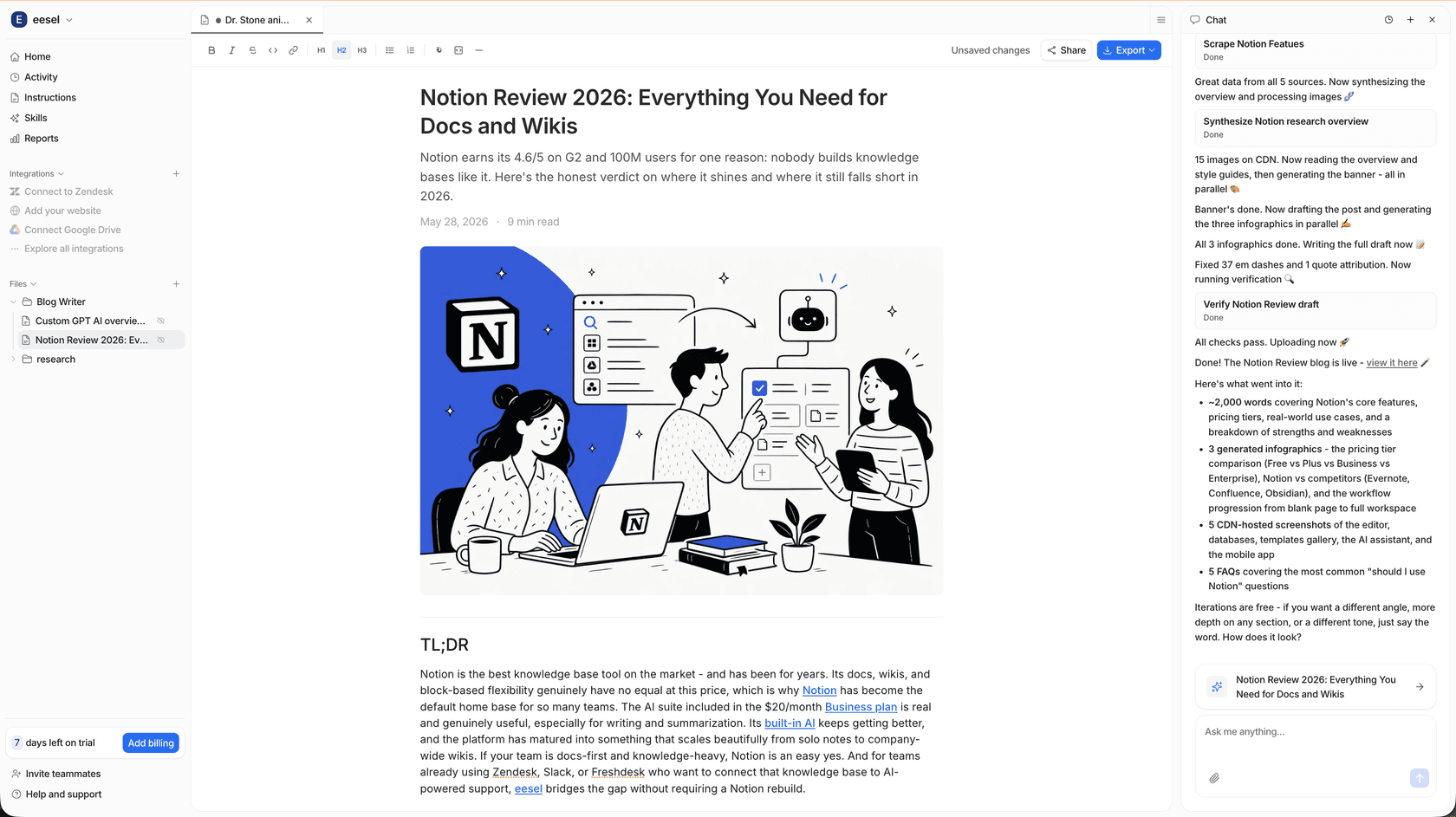
Here’s a quick look at how it solves the common problems of writing a blog post:
| Challenge | How the eesel AI Blog Writer Solves It |
|---|---|
| Generic AI Tone | Creates genuinely human-like writing by learning from your website to match your brand voice. No more robotic content. |
| Lack of Visuals | Automatically generates assets like AI images and infographics and embeds relevant YouTube videos right into the post. |
| No Social Proof | Integrates real Reddit quotes to add authentic insights and a human touch that builds trust. |
| Poor SEO/AEO | Has built-in optimization to ensure every post is structured to rank on search engines and get featured in AI answer engines. |
| Time Consuming | Slashes the entire workflow from days to minutes. You just provide a keyword, and it generates a complete post. |
| Unpredictable Costs | Offers clear, predictable pricing. You can get started with $99 for 50 complete blog posts, making it easy to scale your content. |
We don't just sell this tool; we built our own growth on it. By using the eesel AI blog writer to publish over 1,000 optimized posts, we grew our own blog from 700 to 750,000 daily impressions in just three months. It's proof that you can scale high-quality content without a massive team or budget.
Your checklist for writing a blog post
Feeling a bit overwhelmed? No need. Here's a simple checklist you can use every time you write to make sure you've covered all your bases.
Planning:
- Identified target audience?
- Chosen a specific keyword/topic?
- Analyzed top-ranking content?
Writing:
- Created a detailed outline?
- Written a hook-worthy intro?
- Added visuals and media?
Optimizing:
- Included keyword in title, URL, and meta?
- Added internal and external links?
- Proofread for errors?
At the end of the day, a great blog post comes down to a good strategy, valuable content, and smart optimization for both people and search engines. It’s about understanding what your audience needs and delivering it in a clear, engaging, and easy-to-find format.
While the process we've laid out is detailed, it's a repeatable formula for driving organic traffic and building a loyal audience. It takes work, but the results are worth it.
For a more visual walkthrough, seeing an expert break down the process step-by-step can be incredibly helpful. The video below offers a detailed guide on how to write a blog post from start to finish, covering many of the strategies we've discussed.
And if you're looking to scale your efforts without sacrificing quality, modern AI is your new best friend. To see just how powerful it can be, why not take it for a spin? You can generate your first blog post for free with the eesel AI blog writer and watch it create a complete, SEO-optimized article in just a few minutes.