How to scale content on a small budget: A practical guide

Katelin Teen
Katelin Teen
Last edited January 19, 2026
As a marketer, you’re probably stuck on a hamster wheel. The pressure to create more content, like more blogs, more social posts, and more videos, is constant. But the budget? That’s probably not growing nearly as fast.
So, how do you keep up? The secret isn't just about producing more; it's about being smarter and more efficient with your content creation, all without sacrificing quality.
What does it mean to scale content creation?
"Scaling content" might sound like another piece of marketing jargon, but it's a straightforward idea. It simply means increasing your output of good, relevant content without having to proportionally increase your resources, whether that's time, money, or people.
The important thing to remember is that quality has to stay high. Churning out a hundred mediocre blog posts that no one reads is a waste of time. True scaling is about finding a balance: producing more while keeping the quality consistent, or even making it better.
And why is this so important? Because a steady flow of valuable content is what helps you grab more organic search traffic, establish your brand as an authority, and consistently generate new leads. It’s about building a content engine that works for you 24/7, not just when you find a spare afternoon to write.
Foundational strategies for scaling content on a small budget
Before you start looking at new tools, you need to get your strategy sorted. These methods are completely free and will help you get the most out of the content you already have.
Repurpose and recycle your existing content
Your best-performing content is a gold mine. Repurposing is just about finding new ways to package and share that gold. You take one solid piece of content and chop it up into different formats to reach different audiences on various platforms.
Here are a few ideas:
- That detailed blog post you wrote? It can easily become a dozen tweets, a script for a short video, or the foundation for an infographic.
- Hosted a webinar recently? Transcribe it. Now you have a new blog post. You can also pull out the best quotes and turn them into short video clips for social media.
A clever workflow I've seen is transcribing sales calls with a tool like Fireflies.ai. The summary of common questions becomes a perfect brief for a new blog post. From there, a tool like the eesel AI blog writer can take that brief and generate a full first draft, which seriously speeds up the whole process.
Leverage user-generated and community content
User-generated content (UGC) is anything your customers or audience create about your brand, like reviews, testimonials, or social media posts. The great thing about it is that it's free, authentic, and builds a lot of trust.
Here’s how you can use UGC:
- Run a contest asking customers to share photos of themselves using your product.
- Feature your best customer testimonials prominently on your website and product pages.
- Weave real-world perspectives into your articles. Instead of only sharing your own views, pull relevant quotes from public forums like Reddit to show what people are actually saying. It adds a layer of credibility that’s tough to replicate, which is why the eesel AI blog writer automatically includes this feature.
Consider patient testimonials. Authentic feedback resonates big time. Or, how about demystifying medical jargon? 'Medical Term Monday' – break down complex words for the audience. Case studies, without patient specifics, can highlight success stories and establish trust.

Turn internal knowledge into expert content
Your company is filled with experts who have a wealth of knowledge. From the sales team talking to customers every day to the support team solving problems, you have a deep well of content ideas just waiting to be tapped.
You don't need to ask for a huge time commitment, either. Try these simple ways to get their insights:
- Send a product expert a quick email Q&A and publish their answers as a blog post.
- Jump on a 15-minute call with a salesperson, record them discussing common customer objections, and turn that into a helpful article.
- Ask your support team for the top five questions they get asked most often. Just like that, you have an outline for a detailed FAQ blog post that will help customers and save your team time.
Scaling content with the right AI tools
Once your foundational strategies are in place, the right tools can be a huge help. Modern AI platforms have made it easier than ever to scale high-quality content, even for small teams.
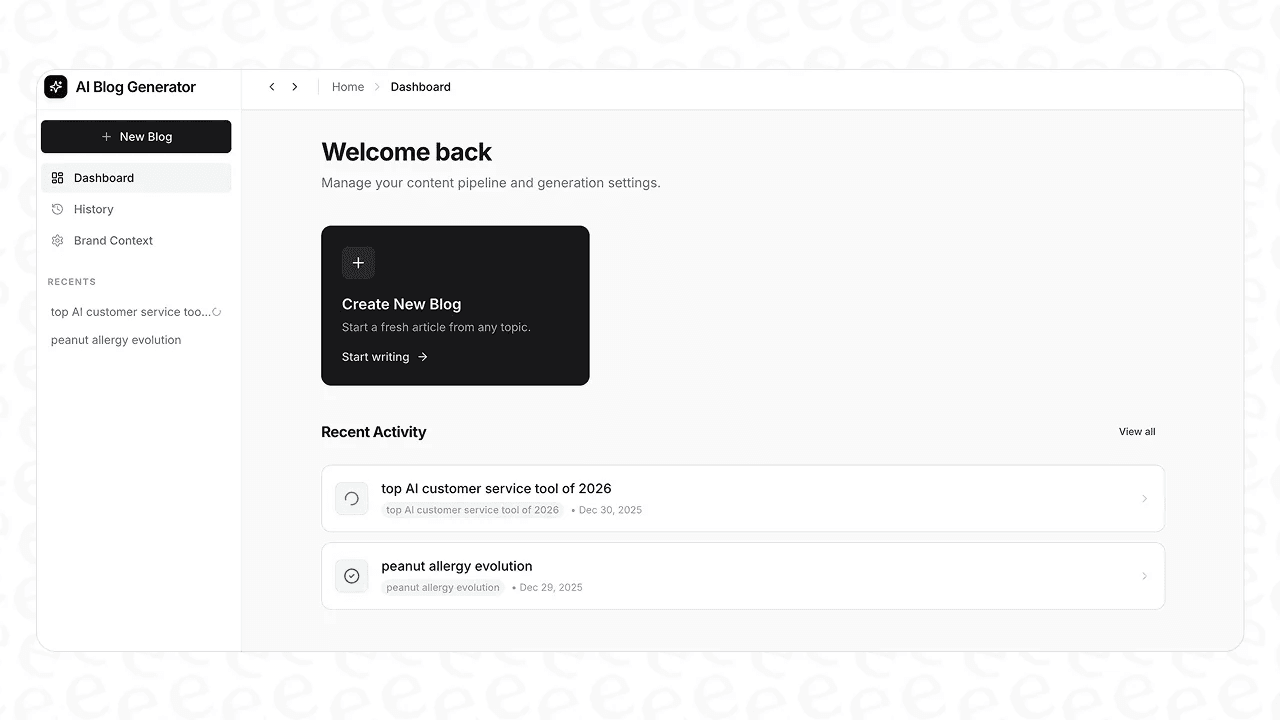
Automate the blog creation workflow with the eesel AI blog writer
Here are some features that can be helpful when you're on a tight budget:
- Automatic assets: It generates and embeds AI images, finds relevant YouTube videos, and creates infographics. This feature can save hours of work and the cost of stock photos or a designer.
- Authentic social proof: The AI automatically searches Reddit to find real quotes from real people talking about your topic. This adds a human element to the content.
- Context-aware research: It can perform deep research for certain post types. If you're writing a comparison post, it will find pricing data. For a product review, it can pull up technical specs. This helps ensure your content is well-researched and valuable.
- SEO & AEO optimization: Every article is structured to rank on Google and provide direct answers for AI Answer Engines like Google AI Overviews. Your content is built for visibility right from the start.
The pricing is also designed for teams that need to be efficient. The Early Bird plan is just $99 for 50 blog posts. It's a credit-based system, which can be useful if you're not looking for a hefty monthly subscription. That makes it much easier to manage a tight budget.
Comparing leading AI writing tools
While the eesel AI blog writer is an option for creating complete blog posts, other tools are useful for different tasks. A smart, budget-friendly content strategy involves picking the right tool for the job. Here’s a quick comparison to help you choose.
| Tool | Best For | Standout Feature | Asset Generation | Starting Price (Annual) |
|---|---|---|---|---|
| eesel AI blog writer | Complete, publish-ready SEO blogs | Automatic assets & social proof | Yes (images, videos, quotes) | $99 for 50 blogs |
| Jasper AI | On-brand marketing copy at scale | Brand Voice & integrations | AI images only | $59/month per seat |
| Surfer SEO | On-page SEO optimization | Real-time Content Score | No | $79/month |
Here’s a summary:
- eesel AI blog writer is useful if you want to go from a keyword to a fully formatted, media-rich article as quickly as possible.
- Jasper AI is a versatile platform for marketing teams needing consistent, on-brand copy for ads, emails, and social media. Its long-form content generation is a key feature, and users typically find their own assets.
- Surfer SEO is a tool for content teams focused on data-driven, on-page SEO. It provides insights for optimization, assuming you're handling the writing and asset creation separately.
Use free and freemium tools for supporting tasks
You don’t need a paid tool for every single task. A few free and freemium tools can round out your content toolkit without adding to your expenses.
- Canva: The free version of Canva is a workhorse for creating custom graphics for social media. It gives you access to a massive library of templates and assets. You'll need a Pro subscription for some advanced features, but you can accomplish a lot without paying a cent.
- Google Analytics & Search Console: These are essential. They're completely free and provide all the data you need to find new content ideas based on what people are actually searching for and to track your content's performance over time.
A framework for scaling content on a small budget
We've covered strategies and tools. Now, let's pull it all together into a simple framework you can use to build a sustainable content engine.
Here’s what that looks like in practice:
- Start with a Content Calendar and identify a core topic for your audience.
- Generate a "hero" blog post on that topic using the eesel AI blog writer.
- Repurpose the blog post into multiple smaller assets.
- From that one post, you can create five social media posts, design one infographic in Canva, and write a script for one short video.
- Distribute all these new assets across your relevant channels.
- Analyze the performance of everything with Google Analytics to see what worked.
- Use those insights to inform your next content calendar topic, and repeat the cycle.
This cycle makes sure every piece of hero content you create gets the maximum possible reach, so you're not constantly reinventing the wheel.
For a deeper dive into practical strategies for producing a high volume of content without breaking the bank, check out this video from Neil Patel.
Ready to scale?
Scaling your content on a small budget is totally achievable. It just requires a shift in how you think about content creation. Instead of focusing on doing more, concentrate on being more efficient.
The recipe is pretty straightforward: build your content plan around smart strategies like repurposing and leveraging your community. Then, add fuel to the fire with AI tools that handle the heavy lifting, freeing you up to focus on strategy. By combining a solid plan with the right technology, any team, no matter its size, can build a content machine that drives real growth.
The best way to see the difference is to try it yourself. Generate your first publish-ready blog post for free with the eesel AI blog writer and see how quickly you can start scaling your own content.

Frequently Asked Questions
Share this article

Article by
Katelin Teen
Katelin is an operations specialist at eesel where she uses her psychology training and education experience to optimize B2B SaaS processes. Outside of work, she unwinds with story-driven games, writing, and keeping up with latest tech innovations.
