How to scale affiliate SEO content: A strategic guide

Amogh Sarda

Katelin Teen
Last edited January 15, 2026
If you’re an affiliate marketer, you probably feel like you're on a content treadmill that just won't stop. You need a constant flow of high-quality, SEO-optimized articles to grow, but doing it all by hand is slow, expensive, and a fast track to burnout.
Any website or blog will agree that traffic is king. Successful marketing may increase your website's traffic, which in turn can increase your revenue and establish your website as a trusted source of information... To boost traffic, you need to encourage repeat visits, which can only happen with solid on-page optimization.

A lot of affiliates eventually hit a wall. You reach a point where you can't produce content fast enough to keep up, and your traffic and revenue plateau. The answer isn't just to write more, but to write smarter and keep your quality high without losing your sanity.
The trick is to move from manual work to a systematic framework. This involves using automation and AI to build a content engine that handles the heavy lifting. At eesel AI, we experienced these scaling challenges firsthand, which led us to develop the eesel AI blog writer. By using it ourselves, we took our blog from 700 to 750,000 daily impressions in just three months.
Understanding affiliate SEO content scaling
When people talk about "scaling," they don't just mean pumping out more articles. Scaling affiliate SEO content is about systematically increasing your output of high-quality content to get more traffic and conversions, but without a proportional increase in your time, effort, or money.
It’s about creating a system that grows your business even when you're not the one doing the typing. The upsides are massive:
- Expanded keyword reach: A scalable system lets you go after tons of long-tail keywords and build up your topical authority. This helps you find new, high-intent audiences that your competitors might be overlooking.
- Increased traffic & conversions: It's simple math. More quality content means more chances to rank on Google, which leads to more clicks and, ultimately, more commissions.
- Greater site authority: When you have a deep library of genuinely useful content, your site becomes a trusted resource. Search engines notice this and reward you with better rankings over time.
- Compounding returns: Think of each article as a small asset. A large base of evergreen content speeds up the compounding effect, turning your affiliate site into a source of passive income that builds on itself.
Successful scaling always relies on solid SEO fundamentals. You still have to match search intent, build authority, and create content that people find useful. The goal is to automate the production, not the strategy.
The limitations of manual content creation
Before you can build a system that works, you have to know what's holding you back. For most affiliate marketers, the bottlenecks are the old-school ways of getting things done.
The content creation bottleneck
Think about all the work that goes into a single affiliate post. You have keyword research, competitor analysis, outlining, writing, editing, finding images, and finally publishing. One well-researched article can easily take up 4 to 8 hours.
This direct trade of your time for content is the biggest hurdle. It makes it almost impossible to produce articles at the volume you need to compete in crowded niches. You're always playing catch-up.
The challenge of maintaining quality
When you're rushing to get something published, quality is usually the first casualty. You start skipping important SEO steps, your brand voice becomes inconsistent, and your articles end up as shallow clickbait instead of valuable resources.
This creates "content debt." You might see a short-term traffic boost, but over time, it can seriously damage your site's authority. Google is getting smarter and continues to prioritize helpful, in-depth content. Rushed, low-quality articles just won't fly anymore.
The hidden costs of outsourcing
If you can't write it all yourself, why not just hire freelancers? While outsourcing seems like an easy fix, it often just swaps one set of problems for another. As many content marketing experts note, managing a team of freelancers can quickly turn into a full-time job.
Here are some of the common headaches that come with it:
- High costs: Good writers are not cheap. Paying market rates for quality content can drain your budget, making it tough to see a positive ROI, especially early on.
- Time-intensive management: The time you save on writing often gets eaten up by management tasks. You have to find writers, vet them, create detailed briefs, answer questions, and handle edits. It's a lot of back-and-forth.
- Inconsistent quality & tone: Even with a great brief, the final article can be a mixed bag. One might be great, the next a dud. This means you end up spending a ton of time editing just to keep your brand voice and quality consistent.
- Lack of deep product knowledge: Freelancers are generalists. They likely don't understand the details of your niche or the products you're promoting as well as you do. This often results in generic content that doesn't really connect with your audience.
A scalable framework for affiliate SEO content
Real scaling isn't about working harder; it's about building a smarter framework. A good system combines a solid SEO strategy with powerful automation to create a growth engine that's sustainable and doesn't require you to be glued to your keyboard.
Step 1: Systematize your research
Before you can let automation take over, you need a repeatable content strategy system. This will be the blueprint for your content engine.
Build topic clusters
Stop thinking about keywords one by one. The best way to build authority and rank is to create topic clusters. This means creating a main "pillar" page for a broad topic and then surrounding it with "cluster" pages that target more specific, long-tail keywords. This structure shows Google that you're an expert on the subject.
Use your favorite SEO tool to find groups of long-tail keywords with high purchase intent. Look for modifiers like "vs," "review," "best for," and "alternative." These are often less competitive but have great conversion rates.
Create templates and SOPs
Consistency is key. Develop detailed templates for your main content types, like product reviews, comparison posts, and listicles. According to guides on content outsourcing, clear instructions and style guides are the secret to getting consistent results.
Your standard operating procedures (SOPs) should map out the entire workflow, from research to publishing. This makes the process predictable and scalable, whether it's you, a freelancer, or an AI tool doing the actual content creation.
Step 2: Automate content creation with AI
Once you have a solid strategy and system, AI becomes your accelerator. The right AI tool can automate the entire content creation workflow, turning your SOPs and templates into a one-click process.
AI can speed up a lot of the time-consuming parts of affiliate marketing. Tools like ChatGPT can help write content, brainstorm product angles, and even draft emails or scripts. Others use AI for SEO research, video editing, or repurposing content across platforms. The key is using AI to *scale* what already works, not to automate the whole thing. It still takes strategy, testing, and consistency to earn real money.
From keyword to post in minutes
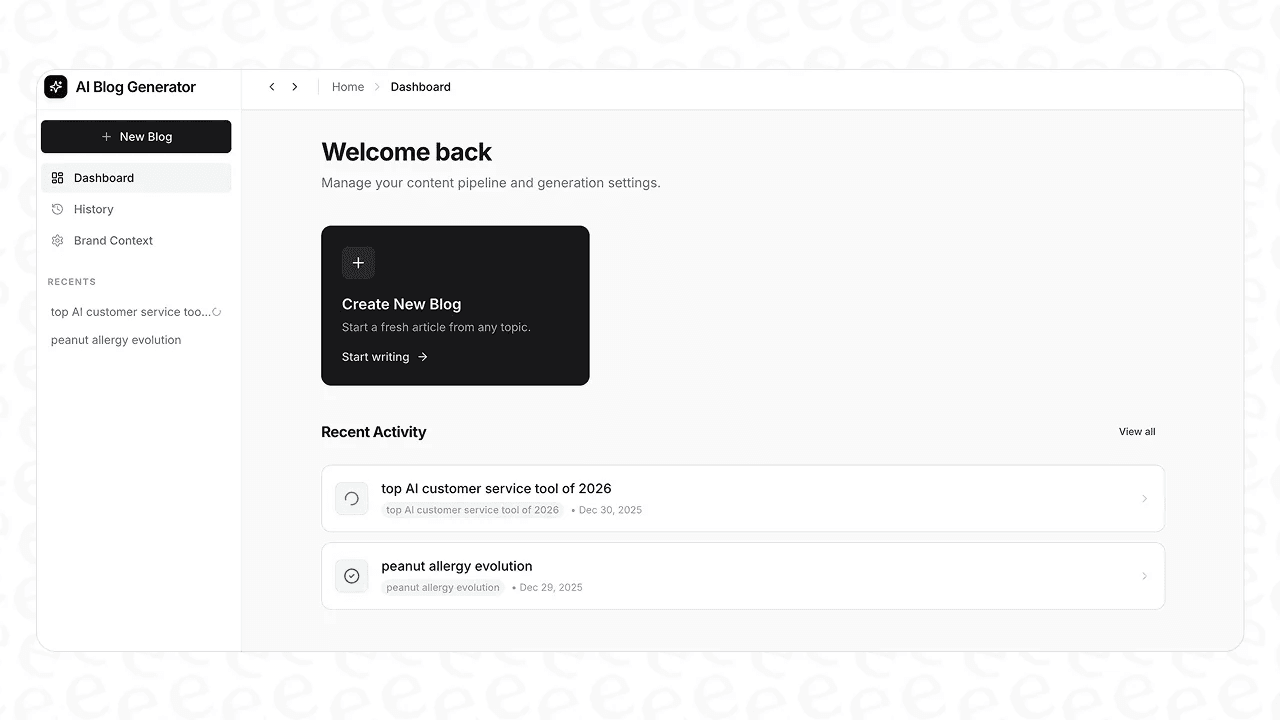
This is where you can really start to move the needle. The eesel AI blog writer was developed to address these manual bottleneck solutions. It doesn't just give you a rough draft; it generates a complete, publish-ready blog post from a single keyword.
It’s designed specifically for scaling high-quality content, with features that solve the biggest time-wasters for affiliate marketers:
- Context-aware deep research: It performs deep research, pulling in data, citations, and links to create a nuanced article that's genuinely helpful.
- Automatic asset generation: Finding visuals is a huge pain. Our tool solves this by automatically creating and embedding relevant AI-generated images, infographics, and data tables right into the post.
- Built-in social proof: Trust is essential for affiliate content. The eesel AI blog writer adds authenticity by finding and embedding real quotes from Reddit threads and relevant YouTube videos, giving your reviews instant credibility.
- Advanced SEO and AEO optimization: The content is structured with SEO best practices to rank on Google. It’s also optimized for AI Answer Engines (like Google's AI Overviews), which helps future-proof your affiliate strategy.
Instead of spending eight hours on one article, you can generate a complete, media-rich post in about two minutes.
Step 3: Automate content promotion
Creating the content is only half the battle. To really scale your impact, you need an efficient and automated system for getting that content in front of people and building your site's authority.
Automate social media sharing
Don't let promotion be an afterthought. Use an automation platform like Zapier to automatically share new blog posts across your social media channels the moment they go live. No more manually copying and pasting links.
You can also set up automated email sequences in your email marketing tool. Whenever a new post is published, an email automatically goes out to your subscribers, driving immediate traffic without you lifting a finger.
Systematize backlink outreach
Here's where the magic happens. When you can create a high volume of quality content (thanks to a tool like the eesel AI blog writer), you suddenly have way more assets to use for link building.
You can systematize outreach strategies like broken link building or resource page link building. The key is that having a rich library of valuable content is the prerequisite. It gives you a reason to reach out and makes it much easier to earn those high-authority backlinks that push your rankings up.
From creator to system builder
Scaling your affiliate SEO content is all about a mental shift: you have to go from being a manual creator to a system builder. The old model of trading hours for articles just isn't competitive or sustainable anymore.
By combining a smart SEO framework with powerful automation, you can finally break through the content plateau, multiply your output, and grow your revenue without burning out.
For a deeper dive into scaling strategies that go beyond just SEO, this video from Side Hustle Nation offers valuable insights into building a seven-figure affiliate business.
The best way to see how powerful this new approach is, is to try it for yourself. It’s time to stop drafting and start publishing.
Generate your first complete blog post for free with the eesel AI blog writer and see how quickly you can build a true content engine.

Frequently Asked Questions
Share this article

Article by
Amogh Sarda
CEO of eesel AI. Amogh Sarda is obsessed with making the ultimate AI for customer service teams. He lives in Sydney, Australia and has previously worked at Atlassian and Intercom. Outside of work he’s usually surfing or on stage doing improv.