How to optimize AI content for conversions: A practical guide

Amogh Sarda

Katelin Teen
Last edited January 30, 2026
It seems like every company out there is churning out AI-generated content. The idea of taking your blog from 10 to 1,000 posts in a month is pretty appealing, and a lot of teams are jumping on it. But with this flood of AI articles, is any of it actually leading to conversions?
For many businesses, the answer is no. They see traffic numbers go up, which looks nice on a report, but the metrics that actually count, such as leads, sign-ups, and sales, are stuck. Traffic is just a vanity metric if it doesn’t get people to do something. The issue is that most AI content is built for speed, not persuasion. It can fill up a page, but it may not convince a reader.
Your friends are lying to you about your website. 'Looks great!' 'Love the design!' 'Really clean interface!' Cool. But does it convert? Do users actually sign up or buy anything? Maybe. Maybe not.

The solution isn't to abandon AI. It's about using it more intelligently. To turn that stream of content into a real conversion engine, you need to focus on three things:
- Optimize for AI search so people can actually find you.
- Write content that genuinely convinces people to trust you.
- Design the page to make taking the next step as easy as possible.
Optimizing for search engines: The first step to conversion
Before your content can convert anyone, it has to be found. But "being found" in 2026 is a completely different game. It’s not just about ranking as a blue link on a search results page. It's about getting picked, cited, and featured in AI-generated answers from tools like Google's AI Overviews or Perplexity.
Writing clear answers for AI models
Think about how large language models operate. They don't read an article from start to finish like a person. They parse it, breaking it down into small, reusable bits of information to construct their summaries. If you want your content to be one of those bits, you have to make it easy for the AI to grab.
The best way to do this is to kick off your articles with a concise "answer box" that directly tackles the main question. Try to write a clear, 40-60 word paragraph right at the top that gives the reader (and the AI) the essential info they're after.
It's the complete opposite of those long, winding intros that bury the lead. By putting the answer right at the top, you’re basically serving it up on a silver platter for AI models to feature.
Using structured data: A technical guide
If you want to make your content truly machine-readable, you need to speak the machine's language. That's what schema markup is for. Schema is a vocabulary you add to your website's code that tells search engines precisely what your content is about. According to Google, this helps their systems better understand your content and feature it in more useful ways.
For AI models, schema is like a cheat sheet. It clears up any confusion and lets them interpret and present your information with confidence. This makes your content way more "citable" for AI answer engines. Here are a few key schema types that are crucial for signaling trust and improving visibility:
- FAQPage & HowTo: These directly structure your Q&A sections and step-by-step guides, making it incredibly easy for an AI to pull your answers or steps into a conversational response.
- Article/BlogPosting: This clarifies important details like the author, publication date, and headline. It reinforces authority and tells the AI that your content is current and relevant.
- Organization & Person: This schema defines your company and authors as credible entities. It's a key piece for building the E-E-A-T signals that AI models are trained to look for.
- Review/AggregateRating: If you're reviewing products, this schema provides clear trust signals that AI models use when deciding what to recommend.
Writing persuasive content for humans
So, you've made your content visible to AI search engines. Now for the next part: it has to actually persuade a person. This is a challenge for many generic AI tools. They can produce factually correct text that may lack the personality and real-world experience needed to build trust.
As Google itself says in its guidelines, the best content is "people-first." It's made to be genuinely helpful and provide a good experience, not just to manipulate search rankings. If your AI content reads like AI wrote it, people will leave, and your conversion rates will suffer.
New consumer trust report came out. 78% of Gen Z can identify AI generated images and will scroll past them. Been running ads for an apparel brand targeting 18 to 25 year olds. Our CTR dropped 40% after we switched to AI generated lifestyle shots.
Building trust with E-E-A-T
You’ve probably heard of E-E-A-T, which stands for Experience, Expertise, Authoritativeness, and Trustworthiness. While it’s not a direct ranking factor, Google has confirmed it's a framework their automated systems aim to reward. It’s how they think about helpful, trustworthy content. And if Google's systems are looking for these signals, you can bet the new AI search models are, too.
- Who: Show who created the content. This means having detailed author bios with credentials, job titles, and links to their social media or other work. This is where
Personschema helps connect the dots for search engines. - How: Explain your process. If you’re reviewing software, describe how you tested it. If you’re providing data, explain where it came from. Even adding a small note about how AI helped create the content can build transparency.
- Why: Be clear about your purpose. Is your main goal to help the reader solve a problem, or just to get them to click a link? Your content should be driven by a real desire to provide value. If it feels like a flimsy sales pitch, readers will see right through it.
Using social proof and real-world context
Trust isn't just built by experts. It's also built by hearing from real people who have dealt with the same problems. This is where social proof becomes a conversion superpower. AI models learn from the public web, which means they're learning from what people are already talking about on forums, social media, and review sites.
Including real quotes from places like Reddit can instantly add a layer of real-world context and credibility. It shows that you understand the actual pain points and opinions of your audience, not just sanitized marketing-speak.
Structuring your page for action
You've got the AI's attention, and you've earned the reader's trust. The last piece of the puzzle is the on-page experience. You need to create a smooth, intuitive path that guides the visitor from reading your content to taking the action you want them to take. This isn't about tricking anyone; it's about clear design that makes converting feel like the natural next step.
A well-written article on a poorly designed page will fail every time. You have to think about the entire user journey, from the moment they land on the page to the moment they click that "sign up" button.
Using the right content formats
The format of your content should line up with where the user is in their decision-making process. Someone searching for a broad topic might just want an article, but a visitor with high purchase intent is looking for information that helps them make a choice.
Sprinkling these conversion-focused formats throughout your content can seriously increase your chances of turning a reader into a customer:
- Comparison tables: These are great for "vs" or "alternative" articles. They help users quickly scan and compare features, pricing, and benefits, positioning your product as the obvious choice.
- Checklists and templates: Offering a downloadable checklist or a template provides immediate value. It's a fantastic lead magnet that solves a problem for the user while capturing their contact info.
- FAQ sections: A good FAQ section anticipates and answers any last-minute questions a user might have right before they convert. It's your chance to overcome their final hesitations.
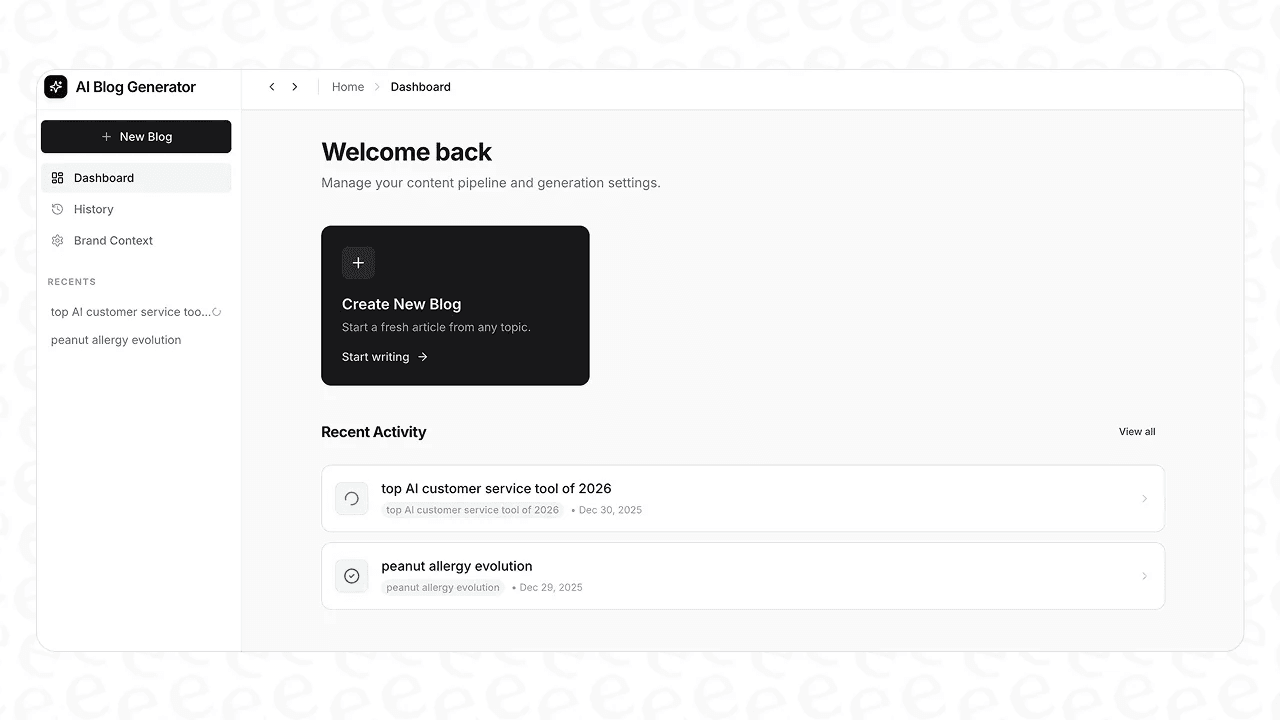
Instead of only generating a wall of text, an advanced AI content tool should also build these elements for you. The eesel AI blog writer, for example, automatically generates these conversion-focused assets, building a complete, action-oriented post from just a single keyword.
Creating clear calls to action (CTAs)
This might sound obvious, but it’s amazing how many great articles end with a weak or non-existent call to action. Your CTA is arguably the most important element on the page. It needs to be clear, compelling, and perfectly aligned with the content's purpose.
Here are a few simple tips from conversion copywriting:
To make your website more visible to AI search engines, you need to focus on relevance and diversity of sources: short, clear content works well for Bing, while longer and more detailed material is better suited for ChatGPT and Perplexity.
- Match the CTA to the funnel stage: For top-of-funnel content, a low-commitment CTA like "Learn more" or "Download the guide" works best. For bottom-of-funnel content, be direct with something like "Start your free trial".
- Use action-oriented language: Start your CTA with a verb that tells the user exactly what to do. Think "Get your free template," "Try it now," or "Download the report."
- Make it stand out: Your CTA button should be visually distinct. Use a contrasting color, make it a clear button shape, and give it some breathing room so it doesn't get lost on the page.
Putting all these pieces together requires a strategic mindset. For a deeper dive into how SEO and conversion optimization work together in the age of AI, this webinar from Wix Studio offers expert insights.
Turn your content generator into a conversion generator
Using AI to produce content at scale isn't a competitive advantage anymore; it's the baseline. The real opportunity is in shifting your strategy from just producing content to deliberately optimizing it. It's not about publishing more, it's about making what you publish actually work for your business.
By focusing on these three core pillars, you can transform your AI content strategy from a traffic machine into a conversion machine:
- Optimize for AI Search: Get found in the new world of AI Overviews with structured, easy-to-grab content and rich schema markup.
- Optimize for Humans: Build real trust and persuade readers with E-E-A-T signals, firsthand experience, and authentic social proof.
- Optimize for Action: Guide users from reading to converting with smart page layouts, conversion-focused formats, and clear CTAs.
An infographic summarizing the three pillars that explain how to optimize AI content for conversions: optimizing for AI search, humans, and action.
AI is a powerful tool for content creation, but you only unlock its true value when you pair it with a smart strategy that focuses on the end goal: conversion.
Ready to stop just generating content and start generating conversions? Try eesel AI for free and create your first conversion-optimized blog post in minutes.

Frequently Asked Questions
Share this article

Article by
Amogh Sarda
CEO of eesel AI. Amogh Sarda is obsessed with making the ultimate AI for customer service teams. He lives in Sydney, Australia and has previously worked at Atlassian and Intercom. Outside of work he’s usually surfing or on stage doing improv.