A practical guide to blog writing for conversions

Stevia Putri
Last edited January 19, 2026
It's a familiar story: you check your blog's analytics, and the traffic numbers look great. Thousands of visitors, solid SEO rankings... but then you look at your leads, and it's crickets. All that traffic isn't turning into actual customers. It's a common headache, feeling like you've built a great top-of-funnel only to find a giant hole in the middle.
This is exactly where blog writing for conversions steps in. It's the skill that transforms your blog from a simple traffic-grabber into a machine that actually generates revenue. It’s how you bridge the gap between "people are reading" and "people are buying."
In this guide, we’ll walk through the whole strategy. We'll get into everything from understanding your audience's mindset to writing content that doesn't just rank well but also convinces people to take the next step. Since it's 2026, we'll also look at how modern tools can handle most of the grunt work. That's precisely why we created the eesel AI blog writer, to take a single keyword and spin it into a full, conversion-ready article, making this whole process a lot smoother.
What is blog writing for conversions?
So, what are we actually talking about here? Conversion-focused blog writing is creating content with a single, clear goal: getting the reader to take a specific action. That action could be signing up for a newsletter, starting a free trial, booking a demo, or clicking the "buy now" button.
This is a totally different mindset from old-school blogging, which usually chases metrics like page views or brand awareness. Those numbers are nice to look at, but they don't pay the bills. A conversion-focused post is built from the start to be an active part of your sales funnel. A helpful way to visualize this is to compare the goals of each approach, as shown in the graphic below.
This way of thinking is more important than ever, especially as AI search becomes more common. Large language models (LLMs) are behaving less like search engines and more like trusted advisors. They gather information from across the web to provide direct answers. If your content gives a straight, useful answer that points to a clear next step, those AI assistants are more likely to feature it.
The whole idea is pretty simple: every single piece of the post, from the title and intro to the images and the last sentence, is there to nudge the reader one step closer to becoming a customer.
The key components of blog writing for conversions
Writing a blog post that actually converts isn't about magic tricks or weird hacks. It's about nailing a few fundamental elements that work together to create a helpful and persuasive experience for your reader.
Understand your audience
You have to do your homework before you even think about writing. Good content starts with a solid understanding of who you're writing for and what they're struggling with. Conversions happen when you solve a real problem for a real person.
First, get a handle on your customers' pain points. What are the questions keeping them up at night? What are they venting about on Reddit? Your best content ideas will come directly from these real-world frustrations.
Once you know their problems, you need to figure out their search intent. This is the "why" behind what they type into a search bar, and it tells you where they are in their buying journey. As people start asking AI assistants more conversational questions, understanding this intent is even more important. Generally, intent falls into two buckets:
- Informational Intent: These are your "how to," "what is," or "why" questions (like, "how to improve customer service"). The person is just looking for information, not a product. These posts are great for building trust and showing you know your stuff. You're not aiming for a hard sell here; you're just being useful.
- Commercial Intent: This is when someone is actively looking for solutions before they buy something (e.g., "best help desk software"). They know they have a problem and are now weighing their options. These posts are where the conversions happen.
If your goal is blog writing for conversions, you need to zero in on keywords with commercial intent. Targeting these phrases is how you attract visitors who are already thinking about buying. This is a core strategy for both traditional SEO and the new world of Answer Engine Optimization (AEO).
Structure your content for persuasion
Let's be real, people don't read online; they skim. Your post's structure has to accept that fact. A giant wall of text is a one-way ticket to the "back" button. Your job is to make your content as easy to digest as possible.
Here's a quick look at the anatomy of a persuasive blog post:
- Headlines that grab attention: Your headline has one job: to make a promise. It needs to tell the reader exactly what problem you're about to solve for them. Instead of a vague title like "Proactive Support Strategies," try something like "How to Reduce Churn by 15% With Proactive Support." One is just a topic; the other is a result.
- Introductions that hook the reader: You've got about three seconds to get them interested. A simple formula that works is APP: Agree, Promise, Preview. First, agree with a problem they have. Then, promise a solution. Finally, give a quick preview of what the post will cover.
- A body that's easy to skim: This is a must. Use short paragraphs (2-3 sentences is perfect), clear H2 and H3 headings that explain what each section is about, and bullet points for lists. The structure should be like a roadmap, guiding the reader through your key points even if they're just scanning.
- Visuals that engage: Images, simple charts, and screenshots are your best friends. They break up long stretches of text, add some visual flair, and can often explain tricky concepts better than words can.
Optimize for action with a clear CTA
You could write the most helpful, insightful, and persuasive blog post ever, but if you don't tell the reader what to do next, you've just wasted a bunch of time. The call-to-action (CTA) is what connects your content to the conversion.
Without a clear CTA, you're just leaving your reader hanging. They've gotten a lot of value from your post, they're starting to trust you, and they're probably ready for the next step. You just have to show them what it is.
Here are a few types of CTAs you can use:
- In-text links: Weave a link right into a sentence. For example, "To see how our AI handles this, you can start your free trial."
- End-of-post banners: This is a classic for a reason. It's a visual banner at the bottom of the post that asks for a specific action, like booking a demo or downloading a guide.
- Lead magnets: Offer something valuable in exchange for an email. This could be a free ebook, a checklist, or a template that's related to the topic of the post.
The best CTAs are specific, use action-focused words (like "Get," "Start," or "Download"), and make it obvious what the reader gets by clicking. Don't just say "Click Here." Say "Download Your Free Content Calendar Template."
Tools and workflows for scaling content creation
Alright, we know what a high-converting blog post looks like. But how do you actually create this stuff consistently without burning out your entire marketing team? Let's look at a few ways to get it done.
The traditional manual workflow
This is the old-school method. It involves hours of manual keyword research, sifting through competitor articles, building an outline, writing a draft, finding or creating visuals, editing, and finally, optimizing for SEO.
- Pros: You have complete creative control. It's good for topics that need a level of deep, nuanced expertise that only a human can bring.
- Cons: It's incredibly slow and expensive. Trying to scale is nearly impossible unless you have a huge team of writers, SEOs, and designers.
The copilot approach with generic AI writers
Next up is the copilot method, where you use general AI assistants to help with the grunt work. Tools like ChatGPT and Jasper can assist with brainstorming and initial drafting, but they typically require significant human oversight to produce a finished article.
I have tested most of these too, and found real differences once you get past the surface features. Based on Sprout Score comparisons, Jasper scored higher (8.2) for brand voice and long-form consistency, especially in team use. Surfer SEO scored strong (8.0) in post-publish optimization and SERP alignment, but depends heavily on pairing with another tool like Jasper. Copy.ai lagged a bit (7.4) for structured content workflows, it is fast, but less controllable. Writesonic sat in the middle (7.8), solid for ecommerce and quick drafts but needed a lot of manual editing in B2B use.

-
ChatGPT:
A screenshot of the ChatGPT website, an AI tool that can assist with blog writing for conversions. - Pros: It’s flexible and affordable, with paid plans starting at just $20/month. You can use it for almost any writing task, from outlines to paragraphs.
- Cons & Limitations: The output often requires significant human editing to align with a specific brand voice. It is known to sometimes generate factually incorrect information, or "hallucinate," which requires careful fact-checking. A key limitation is that it generates text only, meaning users must create visuals, source social proof, and perform SEO tasks separately. The quality of the output is also highly dependent on the user's prompt engineering skills.
-
Jasper:
A screenshot of the Jasper AI homepage, a platform used for blog writing for conversions. - Pros: Jasper is designed specifically for marketing content. It has features like Brand IQ to help keep your brand voice consistent, and it connects with SEO tools like Surfer. Its templates give you more structure than a blank chat window.
- Cons & Limitations: It functions more as a creative assistant, requiring step-by-step guidance rather than providing a fully automated workflow. It's also more expensive, with pricing that starts at $59 per seat per month (billed annually), which can add up if you have a team. A notable limitation is its inability to automatically generate a complete post with assets like infographics or embedded videos.
Full-cycle automation with the eesel AI blog writer
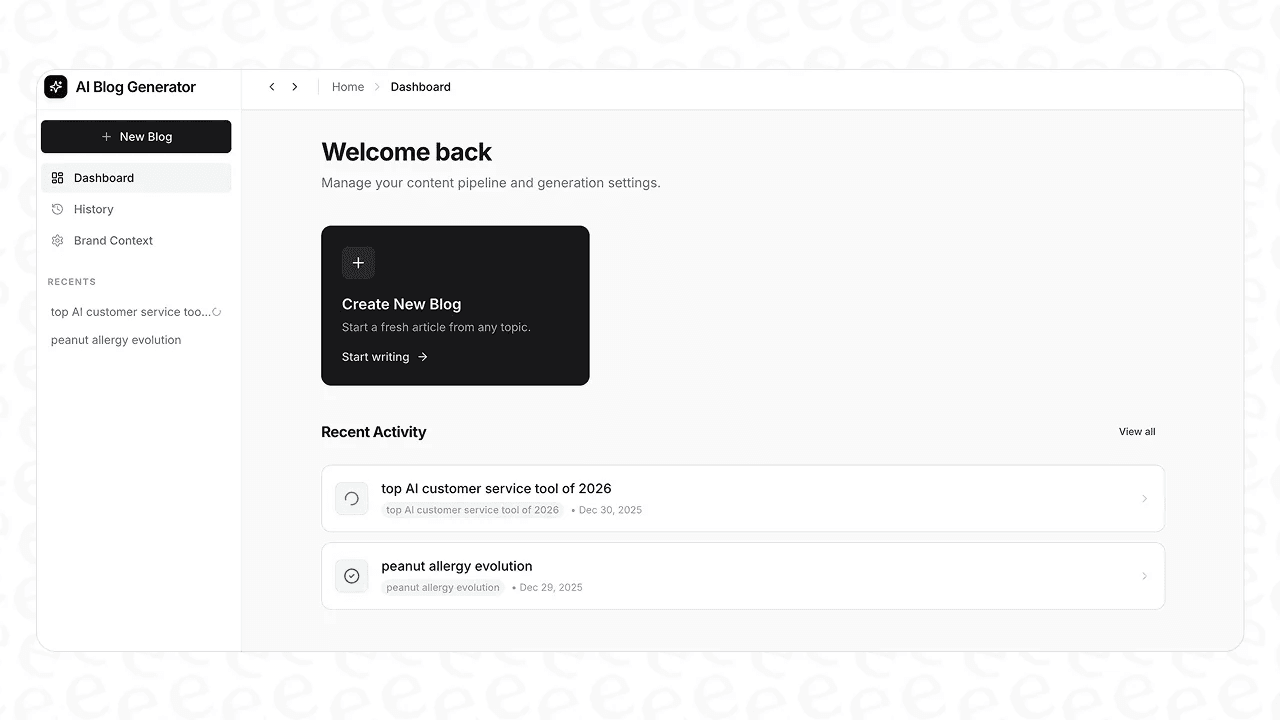
This brings us to the final option: a tool that manages the entire workflow from start to finish. The eesel AI blog writer is designed to address the limitations of manual and copilot methods by delivering a publish-ready, conversion-focused post from just a single keyword.
The workflow is different. You provide a topic or keyword, add your website for context, and the tool generates a complete, well-researched blog post in minutes.
Here’s what makes this approach effective for creating content that converts:
- Complete Asset Generation: It moves beyond text generation. It automatically creates AI images, infographics, and tables. It even finds and embeds relevant YouTube videos and real Reddit quotes, adding social proof and authority to your content.
- Built-in SEO & Answer Engine Optimization (AEO): The content is automatically structured to rank in Google and do well in AI answer engines like Google’s AI Overviews and ChatGPT. This is significant, as some experts predict up to 25% of organic traffic will shift to these new platforms.
- Deep, Context-Aware Research: The AI goes way beyond generic fluff. It pulls in relevant data, stats, and citations to create posts that are genuinely useful and authoritative.
- Natural Brand Integration: By analyzing your website, it learns about your product and can weave in natural mentions that don't feel pushy, which is important for building trust.
At eesel, this tool was used to grow the company blog from 70k to over 750,000 impressions in just three months by publishing over 1,000 optimized posts.
To see these principles in action, the video below breaks down a proven framework for writing high-converting blog posts that can outrank even the biggest competitors. It's a great way to see how the concepts we've discussed translate into real-world results.
Shifting your focus to conversions
Let's wrap this up. Building a conversion-focused blog isn't about chasing vanity metrics. It's a strategic asset that needs a clear understanding of your audience, a persuasive content structure, and a call-to-action you can't miss.
For years, traffic has been the main goal for content teams, but traffic alone doesn't keep the lights on. The real value of your blog is its ability to consistently bring in the right people and turn them into leads and customers. When you shift your focus from just writing for traffic to strategically writing for revenue, everything changes.
Ready to turn your blog into a reliable conversion machine? Generate your first post for free with eesel AI and see the difference a fully automated, conversion-focused workflow can make.

Frequently Asked Questions
Share this article

Article by
Stevia Putri
Stevia Putri is a marketing generalist at eesel AI, where she helps turn powerful AI tools into stories that resonate. She’s driven by curiosity, clarity, and the human side of technology.