How to generate ecommerce category pages that drive traffic and sales

Stevia Putri
Last edited January 15, 2026
Let's be real about one of the most overlooked parts of any online store: the category page. We pour hours into perfecting homepages and agonize over product descriptions, but category pages often get the short end of the stick. The thing is, they’re the digital aisles of your shop, guiding customers to what they need and helping search engines understand what you sell. They are absolutely essential for both user experience and your SEO.
Think about it. When someone searches for "women's hiking boots," they aren't looking for one specific product just yet. They want to browse the collection, compare different styles, and figure out their options. A solid category page makes that entire process smooth and simple.
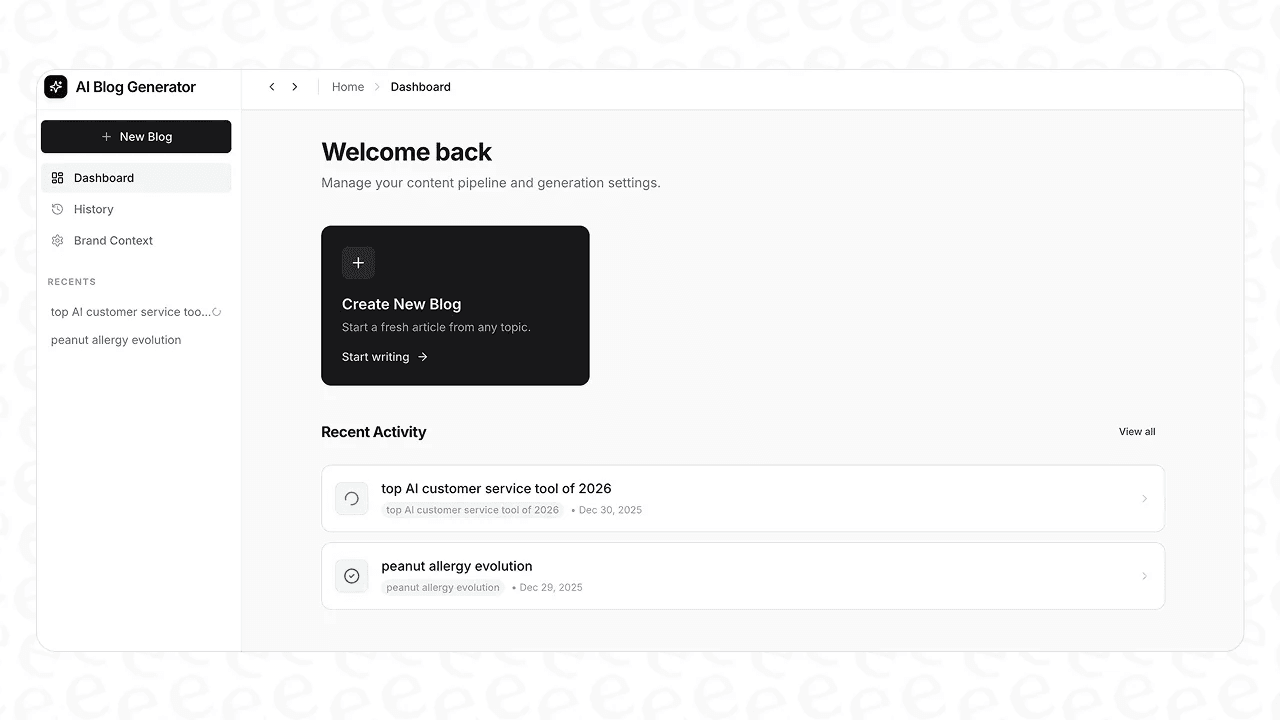
This guide will walk you through what you need to know to create category pages that actually perform, covering everything from design basics to a content strategy that gets people to buy. The biggest hurdle for most stores is creating unique, helpful content for every single category, especially with hundreds of them. That’s where things get tough, but thankfully, AI tools like the eesel AI blog writer can now handle the heavy lifting, turning a massive project into a manageable task.
What are ecommerce category pages?
Ecommerce category pages are simply the pages that group and display similar products. They serve as a bridge, connecting your general homepage to your specific product pages. They really have two main jobs, and getting both right is what separates a good store from a great one.
First, for your customers, these pages are all about convenience. They simplify navigation and help shoppers find products without having to click around in frustration. A logical category structure can be the difference between a pleasant shopping experience and one that ends with a rage-quit.
Second, for SEO, they’re a goldmine. Category pages give you a chance to rank for broader, high-volume keywords like "men's running shoes" or "vegan leather bags." Individual product pages usually can't compete for these bigger terms. In fact, some data shows that category pages have 32% more traffic than individual product pages, a significant statistic visualized in the graphic below.
You'll typically see two main types of pages, though the names can vary. For instance, Shopify famously calls them "Collections."
- Category Listing Pages (CLPs): Think of these as a main hub. It's the "Shoes" page that then links out to more specific subcategories like "Running Shoes," "Formal Shoes," and "Sandals."
- Product Listing Pages (PLPs): This is where you see the products. It's the grid view of all the items within a specific category, like all your running shoes laid out for browsing.
Foundational elements of a great category page
Before we get into writing the content, let's talk about the building blocks. A great category page starts with solid design and user experience. If the page is a pain to use, the best copy in the world won't save it.
Intuitive design and user experience (UX)
First impressions count, and a cluttered page is a turn-off.
- Scannability: People don't read every word online; they scan. Use a clean, grid-based layout that makes it easy to browse products. Good use of white space and consistent branding helps create a professional, trustworthy vibe.
- High-Quality Visuals: Your product thumbnails are doing the selling for you. They need to be professional, consistent, and clear. Shoppers should get a good idea of the product from a quick glance.
- Clear Navigation: Getting lost in a physical store is annoying, and it's just as bad online. Breadcrumbs are an effective tool that shows users exactly where they are (e.g., Home > Men > Shoes > Running Shoes).
- Mobile Responsiveness: It's 2026, and a huge chunk of your traffic is likely on mobile. Your category pages must look and work on smaller screens. This means touch-friendly buttons, easy-to-use filters, and fast load times.
Essential product information at a glance
You need to give shoppers enough information to get them interested without overwhelming them. The goal is to provide just enough detail to earn that click through to the product page.
Make sure your product grid clearly shows the essentials: a short product name, the price, customer ratings (stars work great for this), and any key variations like color options. This lets people compare products quickly without opening a bunch of new tabs.
Pro tip
Another great tip is to use product labels. Simple tags like 'Bestseller,' 'New Arrival,' or 'Sale' are excellent for grabbing attention and helping shoppers make a decision.
Advanced filtering and faceted navigation
If you have a lot of products, filtering isn't optional, it's a necessity. Faceted navigation is just a term for an advanced filtering system that lets users narrow down products by several attributes at once. For example, filtering for shoes that are size 10, blue, from a specific brand, and under $100.
This is absolutely vital for preventing choice paralysis. When a customer sees 500 products, they're more likely to just leave than to sort through all of them. Faceted navigation gives them control and helps them find what they're looking for in seconds.
SEO and conversion optimization for category pages
Alright, with a solid foundation in place, let's talk about the actual words on the page. This is where you can really pull ahead of the competition and start climbing the search rankings.
Why descriptive content matters
A category page that's just a grid of products is a massive missed opportunity. Search engines often view these pages as "thin content," meaning they don't provide much unique value.
Well-written content fixes this. It gives context to both your visitors and to search engines. For shoppers, it can offer useful buying advice or explain what makes the products in that category unique. For Google, it confirms that the page is relevant to your target keywords.
<quote text="for category descriptions, similar principles apply as product descriptions - you want unique content that actually helps users navigate your store.
here's what I'd suggest:
- dont copy category descriptions from other sites, google doesnt like duplicate content
- focus on explaining what types of products are in each category and how to choose between them
- include relevant filters/attributes that shoppers care about
- add some basic buying guides or comparison info" sourceIcon="https://www.iconpacks.net/icons/2/free-reddit-logo-icon-2436-thumb.png" sourceName="Reddit" sourceLink="https://www.reddit.com/r/SEO/comments/1h73rdf/comment/m0sv0yo/">
Placement is key here. A common best practice is to have a short, helpful introduction above the products and a more detailed section or FAQ at the bottom. This way, you get the SEO benefits without pushing your products down the page and hurting your conversion rate.
Strategic keyword research and implementation
Content is great, but it has to be built around the right keywords. You're looking for terms with commercial intent, which is what people search for when they're ready to buy something.
Once you have your primary and secondary keywords, you need to place them in a few key spots for the best results. Make sure they appear in the:
- URL slug (e.g., /collections/mens-running-shoes)
- H1 heading (the main title of the page)
- SEO Title Tag and Meta Description (what people see in search results)
- Introductory copy and any subheadings
Internal linking and building trust
Your category pages shouldn't be dead ends. They need to be part of a connected web of content that guides both users and search engine crawlers through your site.
- Internal Links: Link from your main category page down to relevant subcategories. Just as important, link to your category page from related blog posts or buying guides. This helps build topical authority and signals to Google that your page is an important information hub.
- Trust Signals: People buy from businesses they trust. Social proof builds trust and is one of the best ways to build that trust. Displaying customer reviews or star ratings directly on the category page can boost your credibility and encourage more people to click through to a product.
Generating category page content: Manual vs. AI
So, you know what you need to do. But how do you get it done, especially if you have a huge product catalog? Let's look at the options, from the old-school manual way to a much more efficient AI-powered approach.
The manual method in your ecommerce platform
Every major ecommerce platform, from Shopify's "Collections" to WooCommerce's categories, lets you build these pages by hand. You can create a new category, add products to it, and write a description.
For a store with 10 categories, this is totally manageable. But what about a store with 100? Or 1,000?
The manual approach just doesn't scale. Writing unique, SEO-optimized, and genuinely helpful descriptions for hundreds of pages is a massive, time-consuming job. It's often so overwhelming that most businesses just don't do it, leaving their category pages as simple product grids without any content.
The eesel AI approach: automating your category page content
This is where specialized AI tools can make a significant difference. The eesel AI blog writer is designed to generate high-quality, descriptive content that's a perfect fit for category pages.
Here’s how it approaches this task:
- Context-Aware Research: It understands you're writing a category description, not just a generic article. It can pull in relevant product features and benefits to create content that’s actually helpful for shoppers.
- Automatic Asset Generation: It does more than just write text. eesel AI can create useful assets right in the description, like a table comparing different product types or an infographic that acts as a mini buying guide.
- Authentic Social Proof: It can find and integrate real quotes from places like Reddit, adding a layer of human experience and credibility that builds instant trust.
- Proven Results: We don't just sell this tool; we use it every day. We used the eesel AI blog writer to grow our own organic impressions to 750,000 per day in just three months.
Best of all, it's completely free to try. If you find it's a good fit, the paid plan starts at just $99 for 50 pieces of content, which is a tiny fraction of what it would cost to hire a writer to do it all manually.
Comparing with general-purpose AI writers
Of course, there are other AI tools like ChatGPT or Jasper. While they're powerful, they have some drawbacks when it comes to scaling ecommerce content.
They are generalist tools, meaning you have to spend a lot of time writing very detailed prompts to get something usable. They won't automatically create relevant assets like comparison tables, and the content can often feel generic and miss your specific brand voice. For creating dozens or hundreds of unique category descriptions, they are not always built for that kind of efficiency.
For reference, here’s what their pricing looks like:
- Jasper: The Pro plan starts at $59/month if you pay annually.
- ChatGPT: There's a free version, but for more advanced features, the Plus plan is $20/month.
As already mentioned here, ChatGPT is a good place to start if you are trying to automate descriptions to get up and running in a short space of time. Spend some time learning how to get the most out of tools like ChatGPT. The more descriptive you are in the beginning, the better the output by ChatGPT. Tell it to act like an SEO specialist. Tell ChatGPT to ask you questions about your business that will help with creating the descriptions. Tell it what keywords you are trying to rank/optimize for.

Common mistakes to avoid
Creating great category pages is as much about avoiding common traps as it is about following best practices. Here are a few mistakes that can really hurt your efforts.
- Duplicate Content: This is a technical SEO problem that often happens with faceted navigation. When users apply filters, your site might create new URLs (e.g., /shoes?color=blue) that show the same content as the main page. The solution is to use a self-referencing canonical tag on the main category page to tell Google which one is the original version.
- Keyword Stuffing: Don't just repeat your target keyword over and over in the description. It sounds unnatural, makes for a terrible user experience, and can even get you penalized by search engines. Write for people first.
- Ignoring the Fold: As mentioned earlier, putting a huge wall of text at the top of the page forces users to scroll just to see your products. This is bad for conversions. Keep your intro text short and sweet, and save the longer content for the bottom of the page.
- Forgetting Internal Links: A category page with no links to subcategories or related content is a dead end. It traps both users and search crawlers, stopping them from discovering the rest of your site.
For a deeper dive into optimizing your category pages, check out this video. It covers some great SEO strategies that can help you rank higher in Google and attract more qualified traffic to your store.
Build better category pages, faster
Let's wrap this up. An effective ecommerce category page is a mix of user-friendly design, valuable content, and smart SEO. While getting the design right is the first step, the biggest challenge for most businesses is creating unique, high-quality content for every single category.
This content problem is where so many online stores get stuck. But it doesn't have to be that way. AI is the perfect tool for scaling up your content creation without letting quality slip. Instead of spending weeks or months writing descriptions by hand, you can generate them in minutes.
Ready to turn your category pages from simple product grids into powerful traffic drivers? Start generating optimized content for free with the eesel AI blog writer and see the difference for yourself.

Frequently Asked Questions
Share this article

Article by
Stevia Putri
Stevia Putri is a marketing generalist at eesel AI, where she helps turn powerful AI tools into stories that resonate. She’s driven by curiosity, clarity, and the human side of technology.