


Content creation can feel like a real grind. It eats up time, costs money if you want to scale, and then there's the dreaded blank page staring back at you. We get it. That's where AI blog post generators can make a huge difference, letting you produce solid content without the usual burnout or budget strain.
While some free AI tools may produce text that requires significant editing, others, like the eesel AI blog writer, are designed to deliver more complete, ready-to-publish articles.
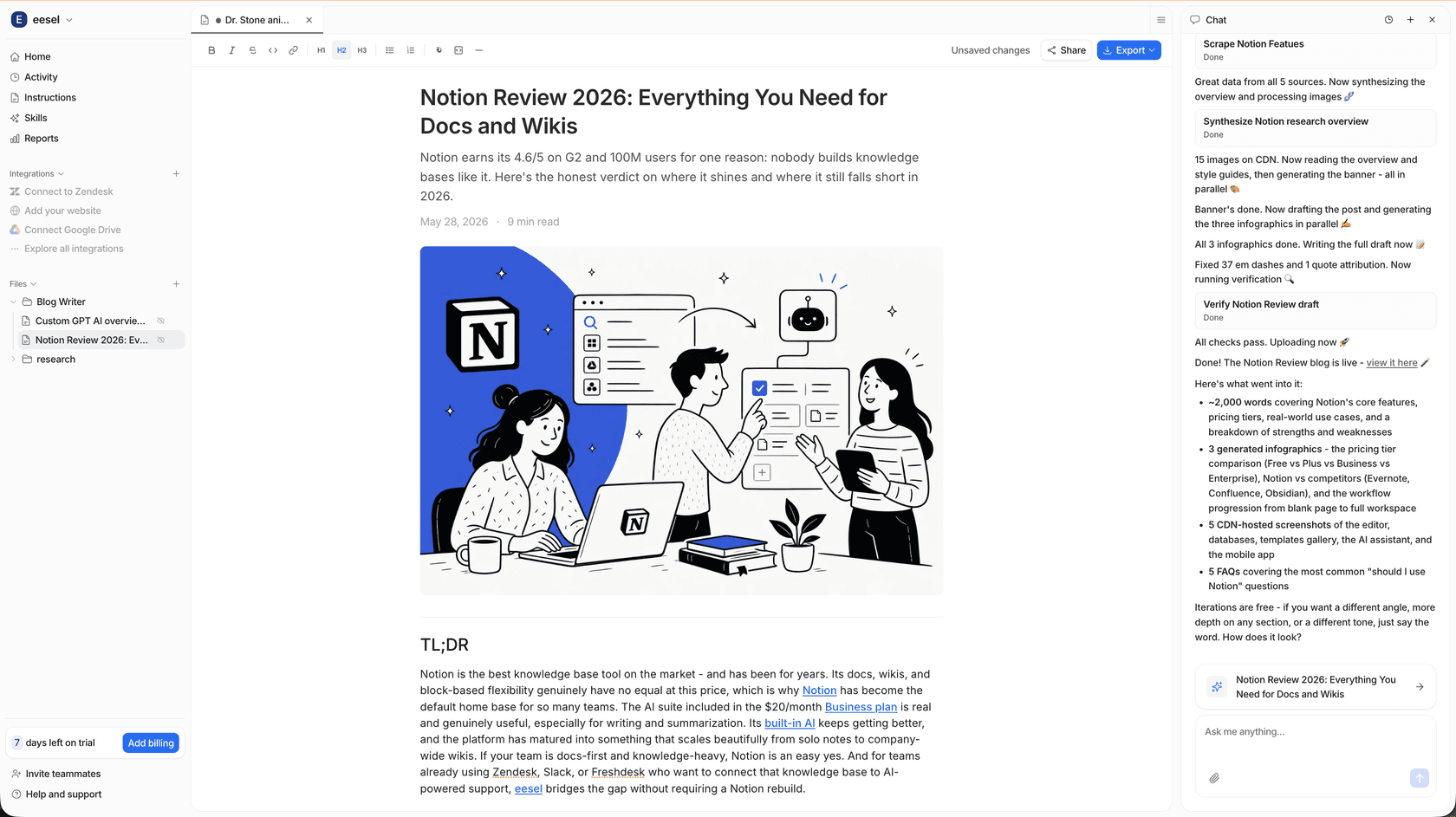
This guide will show you how to generate blog posts with AI for free. We’ll look at some of the best options and share some practical tips to help you get great content every time.
Understanding AI blog post generators
An AI blog post generator is a tool that uses AI to write original articles from a simple prompt, like a topic or keyword. It’s like having a writing assistant that handles the first draft and sometimes, the whole thing. The process, illustrated in the graphic below, starts with your input and ends with a unique, structured article.
These tools run on complex tech like natural language processing (NLP) and large language models (LLMs). Basically, they've been trained on a huge amount of internet text, so they get the hang of context, tone, and proper article structure. They can build sentences, paragraphs, and a full blog post from the ground up.
This isn't the same as old "content spinners." Those tools would just rephrase existing articles, usually creating awkward text that Google would flag. A real AI generator produces new, unique content that people will actually want to read.
Key features to look for in an AI blog generator
Before picking a tool, it helps to know what separates a good AI generator from one that just makes more work for you. Here are three things you should look for.
Comprehensive and structured output
The best tools don't just dump a wall of text on you. They give you a fully structured article with a clear introduction, logical headings (H2s and H3s), a conclusion, and maybe even an FAQ section. This saves you a ton of editing time and provides a solid foundation that's already organized for readers and SEO.
SEO and AEO optimization
A good generator should do more than just stuff your keyword into the text. It needs to weave your keywords into headings and the body naturally.
Beyond that, the top tools are now built for Answer Engine Optimization (AEO). This means structuring content so it can be easily featured in places like Google's AI Overviews, ChatGPT, and Perplexity. AEO is becoming a big deal for online visibility, and a good AI tool should account for it.
Automatic asset and media integration
Nobody wants to read a giant block of text. Good blog posts use visuals and social proof to keep readers engaged. The most advanced generators can handle this by automatically creating and inserting things like AI-generated images, tables, and infographics. Some even add an extra layer of credibility by embedding relevant YouTube videos or pulling real quotes from Reddit forums, which adds a nice human element.
Top free AI blog generation tools
Now that you know what to look for, let's explore some of the top free options available. We'll cover what each tool is best for, its pricing, and its limitations so you can find the right one for you.
| Feature | eesel AI blog writer | QuillBot | Grammarly | HubSpot AI blog writer |
|---|---|---|---|---|
| Primary Use Case | Complete, publish-ready posts | Paraphrasing & writing assistance | Grammar check & draft generation | Professional outlines & draft generation |
| Output Quality | Fully structured article with assets | Text-only draft | Text-only draft | Structured blog outlines and drafts |
| Asset Generation | Yes (Images, Tables, Videos, Quotes) | No | No | No |
| Free Plan | Free to try | Yes (with limits) | Yes (with limits) | Yes (with limits) |
| Paid Plan Starts At | $99/mo (for 50 posts) | ~$8.33/mo (annual plan) | $12/mo (annual plan) | Tiered plans for teams of all sizes |
eesel AI blog writer: For generating complete, publish-ready posts
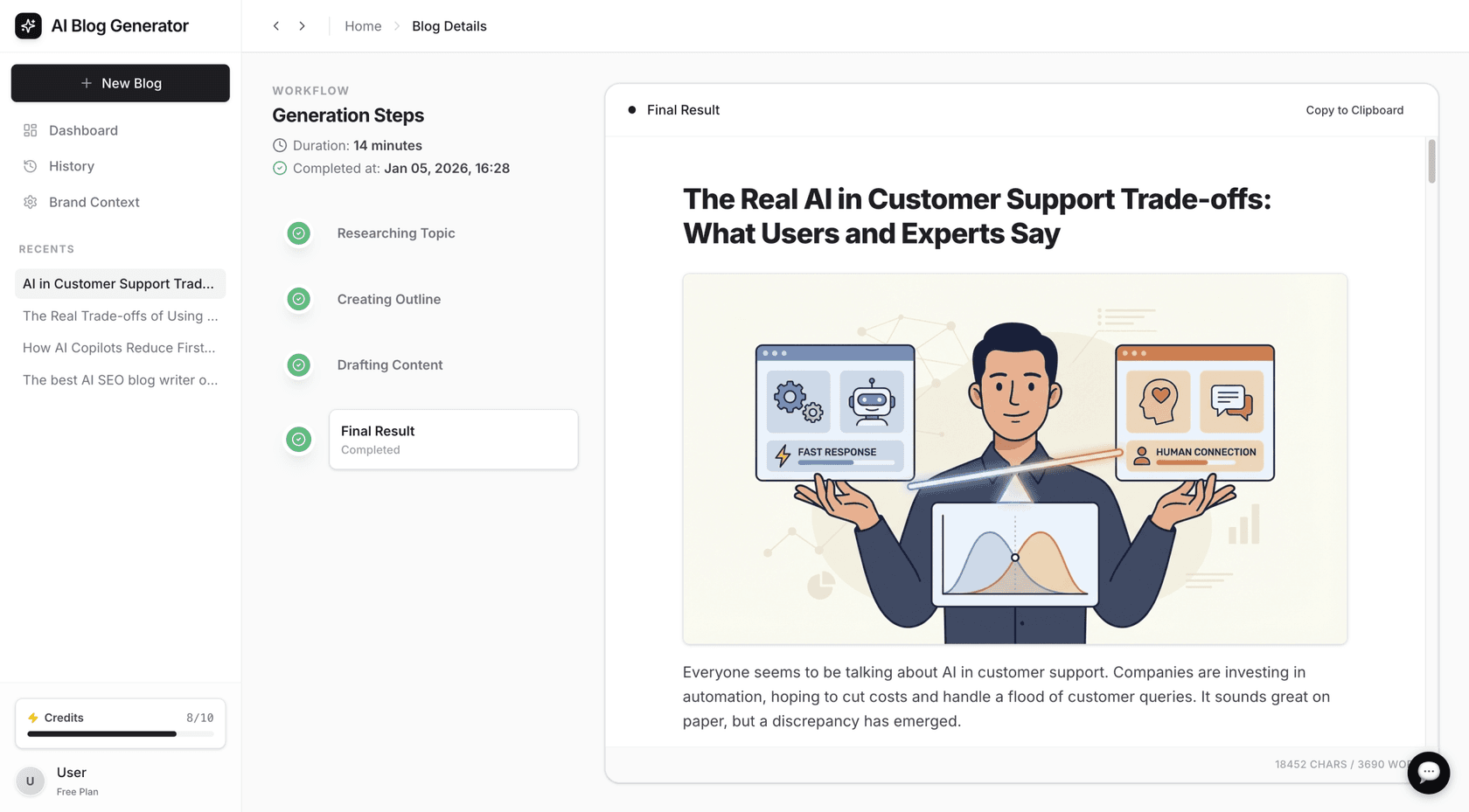
The eesel AI blog writer is designed specifically to turn a single keyword into a complete, SEO-optimized blog post in just a few minutes. It's the same tool we used to grow our organic traffic from 700 to over 750,000 daily impressions in 2026.
Core Features:
- End-to-End Generation: It provides a fully structured post with an intro, headings, a conclusion, and FAQs, all ready to publish.
- Context-Aware Research: The AI researches for you, automatically including citations, internal links, and external sources to build credibility.
- Automatic Assets: It generates and embeds relevant media like AI images, tables, YouTube videos, and even Reddit quotes for social proof.
- AEO & SEO Optimized: The content is structured from the start to perform well in search engines and AI answer engines.
Pricing:
- It's completely free to try.
- The paid "Early Bird" plan is $99 per month for 50 blog generations.
Limitations: Since it's built for creating detailed, long-form content, it might be more than you need for a quick social media post or a short email.
QuillBot: For paraphrasing and draft assistance
QuillBot began as a paraphrasing tool and has expanded into a more general writing platform. It’s useful for rewording sentences, checking grammar, or getting a simple first draft down.
Core Features: It offers a paraphraser with various modes (like Standard, Fluency, or Formal), a grammar checker, and a summarizer. It's a decent toolkit for polishing existing text.
Pricing: The free plan is quite limited, with a 125-word cap on the paraphraser. The Premium plan offers unlimited words and more features, starting at about $8.33 per month with an annual subscription.
Limitations: The output is just a block of text. You'll have to do all the manual work of formatting, researching, finding visuals, and optimizing for SEO. It’s more of a writing helper than a full blog generator.
Grammarly: For grammar correction and idea generation
You likely know Grammarly as a top-notch grammar checker, but it has recently added AI text generation. It's great for ensuring your writing is clean, clear, and has the right tone.
Core Features: You can give it a prompt to generate a draft, but its main strength is still its real-time suggestions for grammar, spelling, clarity, and tone.
Pricing: The free plan includes basic writing corrections and 100 AI prompts per month. Grammarly Pro starts at $12 per member per month (billed annually) and offers full-sentence rewrites and 2,000 AI prompts.
Limitations: Like QuillBot, Grammarly only produces a text draft. It doesn't do in-depth research, create visuals, or embed media. You're responsible for all the other elements that make a blog post effective.
HubSpot AI blog writer: For marketers in the HubSpot ecosystem
HubSpot's AI Content Writer is a mature and reliable tool integrated directly into its Content Hub. It's an excellent solution for marketers who want their content creation to live within a trusted, industry-leading ecosystem.
Core Features: It generates professional outlines and drafts within the platform you already know and trust. Its main advantage is the seamless native integration with HubSpot's CRM, making it a powerful choice for data-driven teams that want to keep their workflow in one place.
Pricing: HubSpot offers essential AI features for free to help you get started. For scaling teams, HubSpot offers tiered plans to match different team sizes, such as the Content Hub Professional plan, which unlocks even more sophisticated research and automation capabilities.
Limitations: The free version offers a solid starting point for essential content tasks. As teams grow, they can upgrade to unlock HubSpot's full professional suite to access the blog research agent and other advanced features designed to work across the entire customer journey.
Getting the best results from your AI generator
No matter which tool you pick, the quality of what you get out depends on the quality of what you put in. Here are a few tips to get better results:
- Provide rich context: Don't just give it a keyword. The more context you offer, the better the output. Mention your target audience, desired tone, and any specific angles you want to cover. Advanced tools like the eesel AI blog writer even let you add your website URL to automatically learn your brand’s voice.
- Always fact-check: AI is impressive, but it can still make mistakes or use old information. Always spend a few minutes checking any data, stats, or technical details before publishing.
- Inject your unique expertise: The AI can handle the structure and research, but your personal stories and expert insights are what make your content unique. Use the AI-generated article as a strong starting point, then add your own voice and experiences.
This is what I do. I outline, have it do a first draft, edit it for a good period, and then add the 'me' to it.
 Reddit
 - Review and refine: Treat the AI-generated text as a 90% complete draft. Read it through to improve the flow, adjust a few sentences, and make sure it aligns perfectly with your brand’s style.
From a blank page to a finished post, faster
Free AI blog generators are changing how content gets made. They can speed up your workflow, help you get past writer's block, and let you scale content production in 2026.
It's important to note the differences between tools. Some produce a simple text draft that provides a helpful starting point, while more advanced platforms like eesel AI can deliver a complete article with research and assets already included. If you are already using a powerful platform like HubSpot, their integrated tools are a fantastic way to keep your content and customer data aligned.
For a step-by-step walkthrough, this video explains the entire process of using AI to create a high-quality blog post from start to finish.
Stop spending hours on a blank page or struggling with a rough draft. You can generate a complete, asset-rich article in just a few minutes. Ready to see for yourself? Generate your first blog post for free and get truly publish-ready content.