How to create multilingual SEO content: A complete guide

Amogh Sarda

Katelin Teen
Last edited January 15, 2026
Ever feel like you’ve hit a wall? You're putting out great content, your rankings are solid, but growth has just flatlined. If you’re only working in a single-language market, that feeling is pretty common. You’ve more or less tapped out your main audience. So, what's next?
The answer is to go global. This is where multilingual SEO comes in. It’s your ticket to unlocking huge new audiences by talking to people in the language they actually think, speak, and search in. It’s about building real connections, not just chasing clicks.
This guide will walk you through the whole process, from building a solid strategy and creating culturally relevant content to getting the technical setup right. The good news? It's gotten a lot easier. Modern AI content generation platforms are changing the game, helping you move beyond clunky translations to create genuinely localized content, and do it fast.
What is multilingual SEO?
First things first, what are we actually talking about? Multilingual SEO is the process of optimizing your website’s content for different languages so you can show up in search results all over the world. The goal is to give people a smooth experience in their native language, which builds trust, gets them more engaged, and ultimately, leads to more business.
It’s easy to mix this up with international SEO, but there’s a key difference.
- Multilingual SEO is all about language. You might have one French version of your site that serves users in France, Canada, and Switzerland.
- International SEO is about country and locale. You’d have separate, tailored versions for France (
fr-fr), French-speaking Canada (fr-ca), and Switzerland (fr-ch).
According to the SEO experts at Ahrefs, the right choice depends on your business goals. Are you just translating content, or are you creating a unique experience for each market with different pricing or products? For most businesses just starting to expand, multilingual SEO is the perfect first step.
Foundational strategies for multilingual SEO
Jumping into multilingual content without a plan is a recipe for wasted time and money. A solid strategy is everything. Before you write a single word in another language, you need to get these basics sorted.
Identify your target markets and languages
You don't have to guess which languages to target. Your own data has the answers.
Start by digging into your Google Analytics. See where your international traffic is coming from right now. You might be surprised to find you already have a small but growing audience in Germany or Brazil. These are your low-hanging fruit: markets where people are already finding you, even with a language barrier.
Next, do a little competitor analysis. With a tool like Ahrefs’ Site Explorer, you can see where your competitors get their organic traffic. If a competitor is doing really well in Japan and you offer a similar product, that’s a strong signal that there’s an opportunity there for you. The goal is to find those high-traffic, low-conversion regions that could take off with some localized content.
Conduct localized keyword research
This is where so many companies get it wrong. They take their English keywords, pop them into Google Translate, and call it a day. Please don't do this.
Search behavior is deeply cultural. A direct translation often misses the nuance, intent, and local slang people actually use. Ahrefs has a great example: in Australia, the native ibis bird is affectionately called a "bin chicken." If you were an ornithology blog just translating "ibis," you'd miss out on a massive chunk of local search traffic.
Here’s a better way to do it:
- Start with your core keywords. These are the main topics your business is built on.
- Find local equivalents. Use tools like Semrush’s Keyword Magic Tool or Ahrefs' Keywords Explorer to find what people in your target market are actually searching for. Check out the search volume and keyword difficulty to spot opportunities.
- Talk to a native speaker. This is a must. An AI tool can get you most of the way there, but a native speaker can catch subtle cultural references and confirm that the search intent lines up with your content. <quote text="we hired a person on upwork/fiverr for language translation. Someone who also understood basic SEO to keep things intact. We translated just the home page initially to 6 different languages in a separate folder like domain/it domain/esp domain/fr - figured out which pages are gaining more traffic and went on to create more pages under the same.
If you are looking at enhancing user experience with translation, this should suffice. But if you want to leverage on traffic best bet is to hire someone who speaks the language and knows marketing." sourceIcon="https://www.iconpacks.net/icons/2/free-reddit-logo-icon-2436-thumb.png" sourceName="Reddit" sourceLink="https://www.reddit.com/r/instructionaldesign/comments/1kq8fqg/comment/mt4hh24/"> 4. Prioritize long-tail keywords. These are usually less competitive and signal stronger buying intent, making them perfect for grabbing targeted traffic.
Choose the right URL structure
How you structure your URLs tells search engines (and users) how your content is organized. Google has its recommendations, and there are three main ways to go about it. For most businesses, one option is the clear winner.
| URL Structure | Example | Pros | Cons | Recommendation |
|---|---|---|---|---|
| ccTLD | example.de | Strongest geo-targeting signal; builds user trust. | Expensive to buy and maintain multiple domains; SEO authority is split. | Best for large corporations with distinct country operations. |
| Subdomain | de.example.com | Easy to set up; allows for different server locations. | Can dilute SEO equity from the root domain; less consolidation of authority. | Use with caution; may not be as effective for SEO as subdirectories. |
| Subdirectory | example.com/de/ | Consolidates all SEO authority to the root domain; easiest to manage. | Weaker geo-targeting signal than ccTLDs (can be fixed with hreflang). | Recommended for most businesses. |
As you can see, the subdirectory (example.com/de/) approach is the best bet for most companies. It’s easy to set up and, most importantly, keeps all your hard-earned SEO authority on a single domain. Both Ahrefs and Google Search Central back this up as a solid, scalable method.
Creating multilingual SEO content with the eesel AI blog writer
Okay, you’ve got your strategy. You know which markets to target, what keywords to use, and how to structure your site. Now for the biggest hurdle: creating all that content.
Historically, this has been a significant bottleneck. Creating high-quality, culturally relevant, and SEO-optimized content at scale is incredibly slow and expensive. You either hire a bunch of freelance writers and translators or just accept that it’s going to take forever.
However, modern tools offer a new approach. AI content generation platforms can automate much of the workflow, and the eesel AI blog writer is one such tool designed for this purpose. It creates new, SEO-optimized, and culturally aware articles from a single keyword, in any language you need.
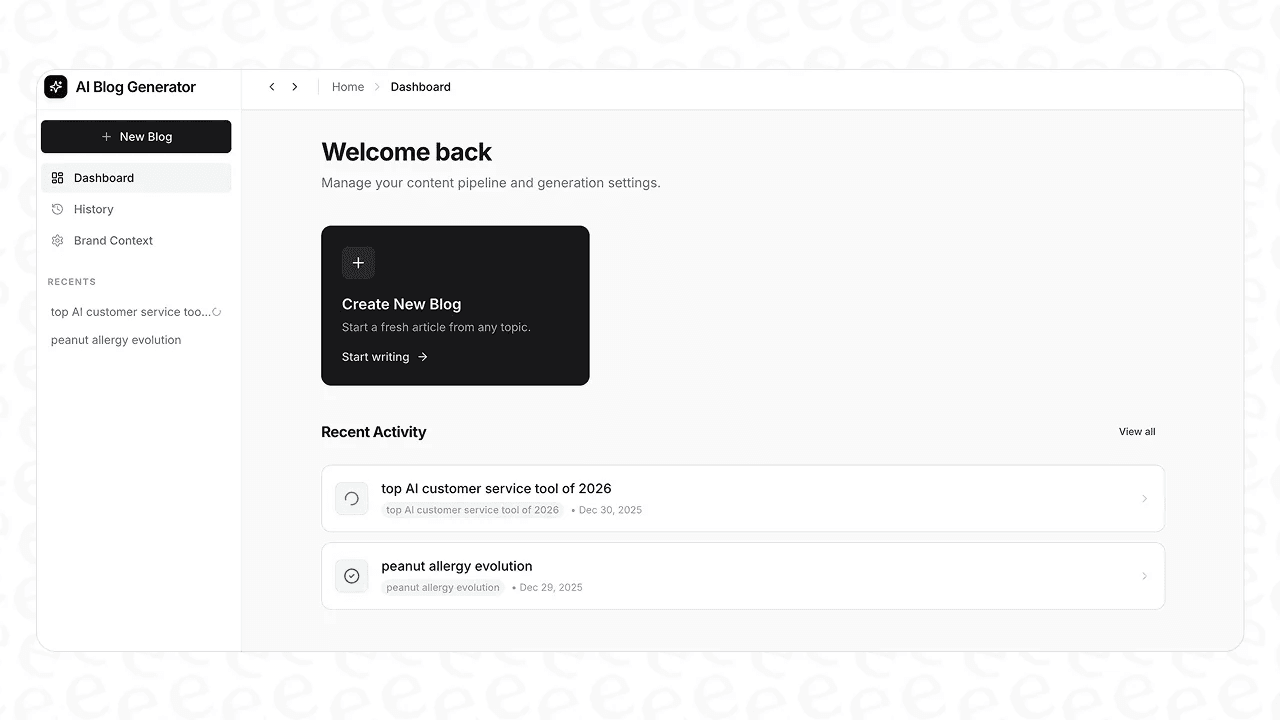
Here’s how it handles the biggest multilingual SEO challenges:
- Translate to any language: The platform allows for translating full posts into various languages, helping to expand reach.
- Automatic assets: Visuals are just as important as text. The tool automatically generates localized images, infographics, and charts for each post. No more asking your design team for five different versions of the same graphic.
- Authentic social proof: To connect with a local audience, it's helpful to show an understanding of their discussions. The eesel AI blog writer finds and embeds real quotes and discussions from Reddit and other forums, adding a layer of authenticity that generic content just can't match.
- Deep research with citations: Building authority in a new market requires credibility. The tool automatically adds internal links to your other pages and external links to authoritative sources, strengthening your site’s link structure and backing up your points.
We used this exact tool to take our own blog from 700 to 750,000 impressions per day in just three months by publishing over 1,000 optimized posts. The tool is completely free to try, allowing users to generate a full blog post and evaluate the quality for themselves.
Technical SEO checklist for multilingual content
Amazing, localized content is the foundation, but if search engines can't find, crawl, and understand it, it won't do you much good. The technical side of multilingual SEO is all about sending the right signals to Google so it can serve the right page to the right user.
Here’s your checklist for getting the technical details right.
Implement hreflang tags correctly
If you only do one thing on this list, make it this one. hreflang tags are HTML attributes that tell search engines which language and regional URL to show a user.
As Google explains, their role is vital. They stop search engines from seeing your translated pages as duplicate content and make sure that a user searching in Spanish in Spain sees your /es-es/ page, not your default English one.
Here’s what the code looks like for a page with English (en-us) and Spanish (es-es) versions. You'd place this in the <head> section of both pages.
<link rel="alternate" hreflang="en-us" href="https://example.com/page.html" />
<link rel="alternate" hreflang="es-es" href="https://example.com/es/page.html" />
A common mistake, according to both Google and Moz, is forgetting the "return" link. Each page has to reference itself and all of its alternatives. Another classic error is using the wrong country code, like uk for the United Kingdom when it should be gb. You should also use an x-default tag to point to a fallback page for all unspecified languages, like your homepage.
Optimize for site speed across all regions
Page speed is a major ranking factor, and it's even more important for international audiences who might be on slower or less reliable internet connections. A slow-loading site is a frustrating experience for anyone, anywhere.
The single best thing you can do for global site speed is to use a Content Delivery Network (CDN). A CDN stores copies of your website's assets (like images and code) on servers all over the world. When a user in Germany visits your site, the content is delivered from a nearby server in Frankfurt, not your main server in Virginia. This dramatically cuts down on latency. As noted by Ahrefs, it's a best practice for any serious international website. Other standard optimizations, like compressing images and using browser caching, are also essential.
Build a multilingual backlink strategy
Backlinks are the currency of SEO. Links from other relevant, high-authority websites tell search engines that your content is trustworthy and valuable. For multilingual SEO, this means earning links from local websites in your target countries. A link from a major German tech blog is a much stronger signal for your German content than another link from a US-based site.
So, how do you get them? Ahrefs suggests a few smart strategies:
- Spy on local competitors. See who is linking to them and figure out how you can earn a similar link.
- Do local digital PR. Reach out to industry blogs, online magazines, and journalists in your target country.
- Create locally-focused content. Write about local news, trends, or events that are relevant to your industry. This makes your content far more link-worthy for local publications.
Putting all these technical pieces together can seem complex, but seeing them in action can help clarify the process. For a visual walkthrough of the most important multilingual SEO practices, including technical setup and content strategy, check out this detailed guide:
Next steps for multilingual SEO
Going global with your content is one of the most powerful ways to break through a growth plateau. Multilingual SEO isn't just a "nice to have" anymore; it's a core strategy for ambitious companies. It takes a mix of smart planning, genuinely localized content, and a clean technical setup.
Let’s quickly recap the steps:
- Start with data-driven research to find your target markets and keywords.
- Choose the right URL structure from the beginning (subdirectories are usually your best bet).
- Focus on real localization, not just word-for-word translation. Culture matters.
- Nail the technical side by implementing
hreflangtags correctly.
Previously, the effort of content creation was a significant hurdle. Modern AI has changed this landscape. Modern platforms now handle much of the content creation and localization process.
This simplifies the workflow from manual translation and optimization. Tools like the eesel AI blog writer are designed to help generate localized and SEO-optimized blog posts more efficiently.
Try it for free and publish your first piece of multilingual content.

Frequently Asked Questions
Share this article

Article by
Amogh Sarda
CEO of eesel AI. Amogh Sarda is obsessed with making the ultimate AI for customer service teams. He lives in Sydney, Australia and has previously worked at Atlassian and Intercom. Outside of work he’s usually surfing or on stage doing improv.

