How to build product led SEO content that converts

Stevia Putri

Katelin Teen
Last edited January 15, 2026
For a long time, the standard SEO playbook was pretty simple: find high-volume keywords, create content around them, and cross your fingers. But this approach has a flaw. It often results in generic content that, as Amanda Natividad of SparkToro puts it, "applies to everybody while actually appealing to no one." You might get some traffic, but you won't necessarily get customers.
What is product-led SEO?
Product-led SEO is a growth strategy where your product drives organic traffic. Instead of writing generic posts about broad topics, you create content that showcases how your product solves a very specific problem. This approach naturally pulls in visitors who are much closer to making a purchase because you're addressing their immediate needs.
The key difference from traditional SEO is the focus. Keyword-led content often answers a question without offering a clear next step. It's informational but not always actionable. Product-led SEO connects your content directly to a user's goal and positions your product as the logical solution, creating a direct line to conversion.
Here’s a quick comparison of the two approaches, which is also summarized in the infographic below:
| Feature | Keyword-Led SEO | Product-Led SEO |
|---|---|---|
| Primary Focus | Search engine rankings & traffic volume | User needs & solving problems with the product |
| Content Goal | Attract a wide audience with informational content | Attract high-intent users with solution-oriented content |
| Conversion Path | Indirect (e.g., blog > newsletter > trial) | Direct (e.g., template page > product use) |
| Scalability | Relies on manual content creation | Can be scaled programmatically using product data |
| Defensibility | Easy for competitors to replicate | Creates a unique, hard-to-copy "moat" |
Adopting a product-led approach has some great benefits:
- Higher Conversion Rates: You're targeting people who have a problem and are actively looking for a tool to fix it, not just random visitors.
- Improved Brand Credibility: When your content genuinely helps people, you build trust and establish your brand as an authority.
- Sustainable Growth: This strategy is more resilient to algorithm changes because it's built on providing real value to users, which is what search engines want to reward.
Key types of product-led content
Ready to see what this looks like in the real world? Let's look at some of the most effective types of product-led content and a few companies that are doing it right.
Programmatically generated landing pages
Programmatic SEO (pSEO) might sound technical, but the concept is straightforward: you automatically generate hundreds or thousands of targeted landing pages from a database. It’s a very effective way to target long-tail keywords that signal a strong intent to buy. This works especially well for marketplaces, directories, and SaaS tools with lots of integrations or use cases.
A classic example is Zapier. They use pSEO to create a unique landing page for every app integration they offer, like "Connect Slack to Google Sheets." Someone searching for that phrase has a specific problem they need to solve immediately. Zapier’s page provides the perfect solution, and it's a big reason why their traffic grew to 6.3 million monthly visits.
User-generated content and customizable templates
Why do all the work yourself when your users can contribute? Using user-generated content (UGC) like templates, reviews, or community guides is a smart way to scale your content production. It also adds a layer of authenticity and social proof that's hard to replicate.
The clear winner here is Canva. Their huge library of user-created templates is a masterclass in product-led SEO. Instead of targeting a broad term like "graphic design," they focus on the specific "jobs to be done." A person searching for "design Instagram post" or "make wedding invitation" finds a page full of templates. This solves their problem on the spot and guides them directly into using the product. This strategy has helped them reach over 700M+ monthly visits.
Free tools and resources
One of the best ways to demonstrate your product's value is to offer a small piece of it for free. A simplified version of your product or a useful calculator that solves one specific problem can be a great lead magnet. It captures people who are in the middle of a task and gives them a preview of what your full product offers.
HubSpot does this well with their "Make My Persona" tool. It's a free buyer persona generator that ranks for various keywords related to creating customer profiles. It feels like a helpful utility, not a sales pitch. It walks you through a series of questions and produces a polished document. Along the way, it introduces you to the HubSpot brand in a very practical way.
Integration ecosystem pages
If your product connects with other tools, you're sitting on a goldmine of content ideas. Creating dedicated pages that explain how your product integrates with other popular platforms is a great way to attract users who are already part of another tool's ecosystem.
Zapier is on this list again for a reason. They take this strategy beyond simple one-to-one integration pages. They create large-scale app directory pages, like their "Google Sheets integrations" page. This one page lists all the ways you can connect Google Sheets to other apps and brings in an estimated 34,000 organic visits a month. It captures a broad but still highly relevant audience, showing off the platform's versatility.
How to create your product-led SEO strategy
So, you've seen the examples and are on board with the concept. But how do you actually implement a product-led strategy? It starts with shifting your focus from keywords to customers.
Start with your customer's true intent
The foundation of a good product-led strategy is a deep understanding of your users. This goes beyond what keyword research tools can tell you. You need to read customer support tickets, listen to sales call recordings, and spend time in the online communities where your audience gathers. Your goal is to find out what problems they are actually trying to solve.
Sometimes, the easiest way to get this information is to just ask. Amanda Natividad mentioned that she once asked leaders at HR conferences what was keeping them up at night. The content ideas from those conversations were far more specific and powerful than anything a keyword tool could generate.
Map product features to user pain points
Next, take a close look at your own product. Audit every feature, workflow, and piece of data you have. For each one, ask yourself: "What problem does this solve that people are searching for?" Every button, report, and template in your product is a potential content topic.
It is hard to say Taskade is absolutely better than the alternatives compared, but in many ways our platform is simpler, more light-weight, and offers a much more competitive free-tier that allows for team collaboration, while most competition have much more limitations. In addition Taskade replaces for some of our customers Slack/Zoom, Trello/Asana, migrating their entire team collaboration, workflows and communication into our platform, saving them a lot of time and money from switching between apps.

For instance, if you have a project management tool with a great timeline view, don't just write about "project management tips." Create content specifically about "how to create a project timeline." Then you can show, not just tell, how your feature is the best way to get it done. You can embed interactive demos or link to a landing page that focuses on that specific feature.
Prioritize content with the highest business value
Not all content ideas are equal. You should focus your energy on topics where your product is an essential part of the solution, not just a nice-to-have. Ahrefs' Tim Soulo has a useful framework for this. He suggests evaluating every potential keyword by asking: "What are the chances that a person, looking for that thing in Google and reading my article on that topic would become my customer?" This question helps you focus on content with high business impact.
Pro tip
Don't shy away from keywords with lower search volume if they signal high purchase intent. A user searching for 'ClickUp vs Asana' is much closer to buying than someone searching for 'what is project management.' Prioritize these bottom-of-the-funnel queries where you can provide a clear, product-driven answer.
Scaling your efforts with the eesel AI blog writer
A product-led content engine is a powerful strategy, but it demands a lot of content. Manually creating hundreds or thousands of high-quality, targeted pages is a huge task. It's slow, expensive, and can easily overwhelm your content team. This is where AI and automation can be a huge help.
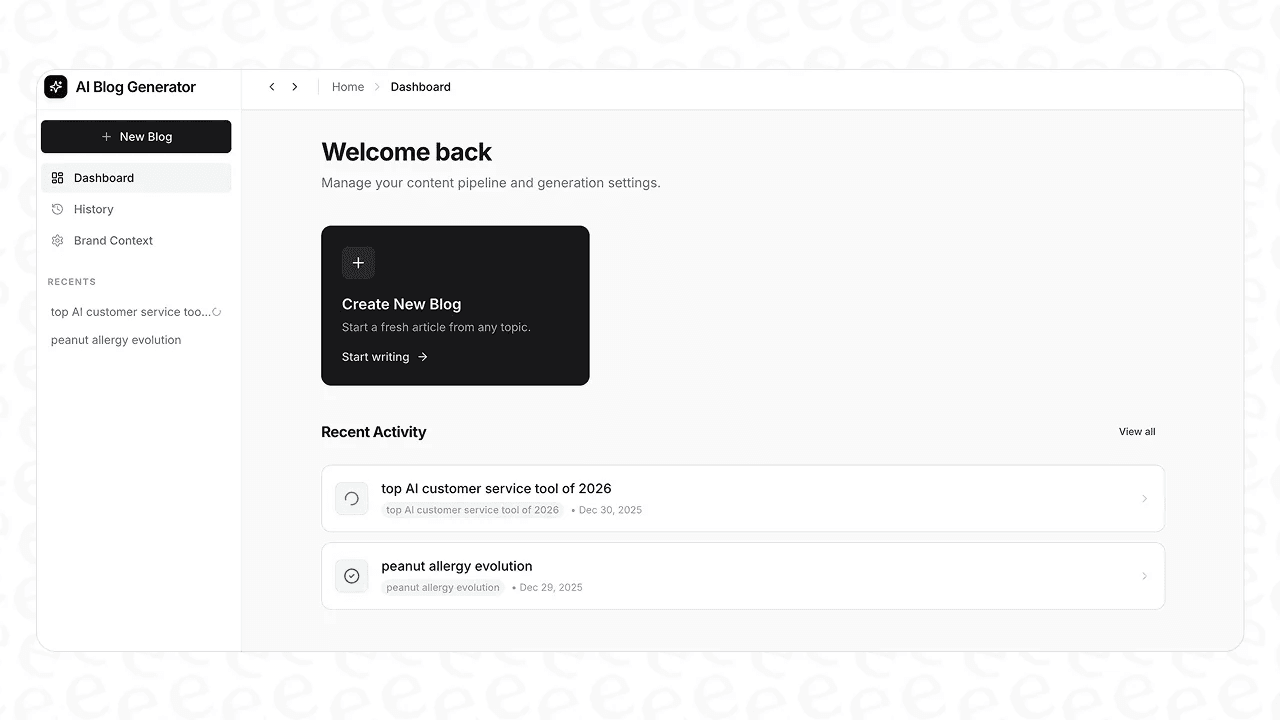
The eesel AI blog writer was designed to tackle this exact challenge. It's more than just an AI text generator; it's a platform that can turn a single keyword into a complete, publish-ready blog post. We know it works because we used it to scale our own content, growing from 700 to 750,000 daily impressions in just three months.
It's a great fit for creating product-led content because of a few key features:
- Generate assets automatically: It can create tables, charts, and infographics, which is perfect for visualizing data and explaining complex product features.
- Integrate social proof: The tool can automatically find and embed relevant Reddit quotes and YouTube videos, adding real user voices and authenticity.
- Weave in your product naturally: Just add your website URL, and the AI will understand your brand's context. It can then sprinkle in subtle mentions of your product that guide readers toward the solution without being overly salesy.
The best part is that it's completely free to try. You can generate a full blog post and see the quality for yourself before making any commitment.
For a deeper dive into the strategic thinking behind product-led SEO, this discussion with expert Eli Schwartz offers valuable insights on how to build a program that wins in search.
Final thoughts
Switching to a product-led SEO content strategy is about playing the long game. It's a move away from chasing vanity metrics like traffic and toward building a sustainable growth engine that delivers real business value. When you focus on your users' problems and consistently show them how your product is the best solution, you attract high-intent customers, build a strong brand, and create a marketing advantage that's hard for competitors to copy.
It’s a strategic shift, but it’s one that can pay off significantly in conversions, credibility, and long-term growth.
Ready to start scaling your content? Generate your first post for free with the eesel AI blog writer and see how easy it can be to create content that both ranks and converts.

Frequently Asked Questions
Share this article

Article by
Stevia Putri
Stevia Putri is a marketing generalist at eesel AI, where she helps turn powerful AI tools into stories that resonate. She’s driven by curiosity, clarity, and the human side of technology.