Freshdesk vs Dixa: a complete 2026 comparison

Stevia Putri

Katelin Teen
Last edited May 20, 2026
Freshdesk and Dixa look like they're competing for the same shelf space, but they're solving different problems. Freshdesk is a broad-market helpdesk trusted by 74,000+ businesses worldwide, priced from $19 per agent. Dixa is a conversation-first platform built specifically for ecommerce brands, trusted by 850+ brands across 42 countries, starting at €89 per agent. The price gap alone ($19 vs €89) tells most of the story, but the differences go deeper than cost.
This comparison covers what each platform actually does, where each falls short, how their AI features work in practice, and which team profile fits each best. It also looks at what real users say after months of daily use, not just what the marketing pages claim.
Freshdesk vs Dixa at a glance
| Freshdesk | Dixa | |
|---|---|---|
| Starting price | $19/agent/month | €89/agent/month |
| Free trial | 14 days (no card) | Demo-only |
| G2 rating | 4.4/5 (3,738 reviews) | 4.2/5 (391 reviews) |
| Core model | Ticket-based | Conversation-based |
| Built-in AI | Freddy AI (included) | Mim + Co-Pilot (add-ons) |
| Primary market | Broad (SMB to Enterprise) | Ecommerce (mid-market) |
| Main channels | Email, chat, phone, social | Email, chat, phone, social, WhatsApp |
| Contract flexibility | Monthly or annual, cancel anytime | 1-year minimum, 3-month notice |
| Min. seats | None listed | 6 agents |
What is Freshdesk?
Freshdesk is an AI-powered customer service platform from Freshworks, designed to centralize every support channel into a unified ticketing system. It's used by Bridgestone, Klarna, Forbes, PepsiCo, and tens of thousands of smaller teams globally.
The platform runs on a traditional ticket model: customer messages arrive via email, chat, phone, or social, get converted into tickets, and agents work through a shared inbox. Automation handles routing, SLAs, and escalations. Freddy AI sits on top to assist agents and, in some cases, resolve tickets autonomously.
Freshdesk's main selling point has always been the combination of depth and affordability. You get omnichannel support, a full knowledge base, SLA management, and automation starting at $19 per agent per month - a price point that's hard to beat for the feature set included.
Freshdesk features
Freshdesk's feature set breaks down into four areas:
Ticketing and collaboration - Shared inbox, ticket threads, internal notes, SLA policies, skill-based routing, and multi-brand support. The Pro plan ($55/agent) adds custom objects and advanced routing; Enterprise ($89/agent) adds audit logs and skills-based assignments.
Freddy AI - Three components: Freddy AI Agent (autonomous resolution), Freddy AI Copilot (agent assist with suggestions, sentiment analysis, and translations), and Freddy AI Insights (analytics for managers). All plans include 500 Freddy AI sessions; additional sessions cost $49 per 100.
Omnichannel - The "Command Center" workspace unifies email, live chat, phone, WhatsApp, Instagram, Facebook, and community forums in a single view. New channels can go live in minutes.
Knowledge base and self-service - A structured help center with multilingual support, article versioning, approval workflows, and a customer-facing portal.
Freshdesk pricing
| Plan | Price | Key additions |
|---|---|---|
| Free | $0 (1-2 agents, 6 months) | Essential ticketing, knowledge base, shared inbox |
| Growth | $19/agent/month | Freddy AI (500 sessions), routing, SLA |
| Pro | $55/agent/month | Custom portals, custom objects, custom reporting, 5,000 collaborators |
| Enterprise | $89/agent/month | Audit logs, approval workflows, skills-based assignments |
Additional Freddy AI sessions: $49 per 100. Annual billing required for the prices above; monthly billing is available at higher rates.
What users say about Freshdesk
Freshdesk's G2 rating of 4.4/5 from 3,738 reviewers reflects a generally positive experience at setup and initial use. The complaints surface after 6-12 months of daily use.
The most consistent praise: the interface is fast to learn, automation saves significant time on routing, and the pricing is competitive.
The most consistent complaints tell a different story:
"Freshdesk is becoming a pain to work with... ticket management feels clunky compared to when we first started using it, search is unreliable, and every update seems to break something we depended on. pricing has also been creeping up over time." -- u/Old-Roof709, r/helpdesk
The search problem comes up repeatedly:
"I never ever found anything that I needed using the Freshdesk search, is totally useless, and I can't process how after years of this nobody said anything or fixed that." -- u/deftoner, r/helpdesk
And Freddy AI's gap between marketing and reality is a recurring theme:
"Freshdesk's Freddy AI gets marketed heavily but agents day-to-day rarely feel it in their workflow - it's there, it's just not meaningfully reducing the work." -- u/georgejustin22, r/helpdesk
Enterprise users doing well on G2 tend to be running multi-brand operations - the customizable dashboard and multi-brand ticket management work well for teams managing 10+ brands. For single-brand SMBs or teams that have grown past a few hundred tickets per day, the search and AI gaps become more painful.
What is Dixa?
Dixa describes itself as "the agentic CS platform behind exceptional ecommerce brands." It's built on a fundamentally different model than Freshdesk: instead of converting messages into tickets for agents to pick from, Dixa routes conversations directly to the best-available agent based on skill, language, customer VIP status, and availability. Customers never go into a queue and get ignored; conversations are claimed and routed in real time.
The platform is Copenhagen-based and 88% of its 391 G2 reviewers are in Europe. Its customer base reads like a who's-who of European DTC brands: Rapha, Oliver Bonas, Miinto, Mejuri, AllSaints, Organic Basics, FabFitFun, and Charles Tyrwhitt.
Dixa says 70% of its customers migrated from Zendesk or Freshdesk. The reason: teams hit a point where the ticket queue model stops scaling, and they want a platform designed for real-time conversation management.
The ticket vs conversation model
This is the most important difference between the two platforms.
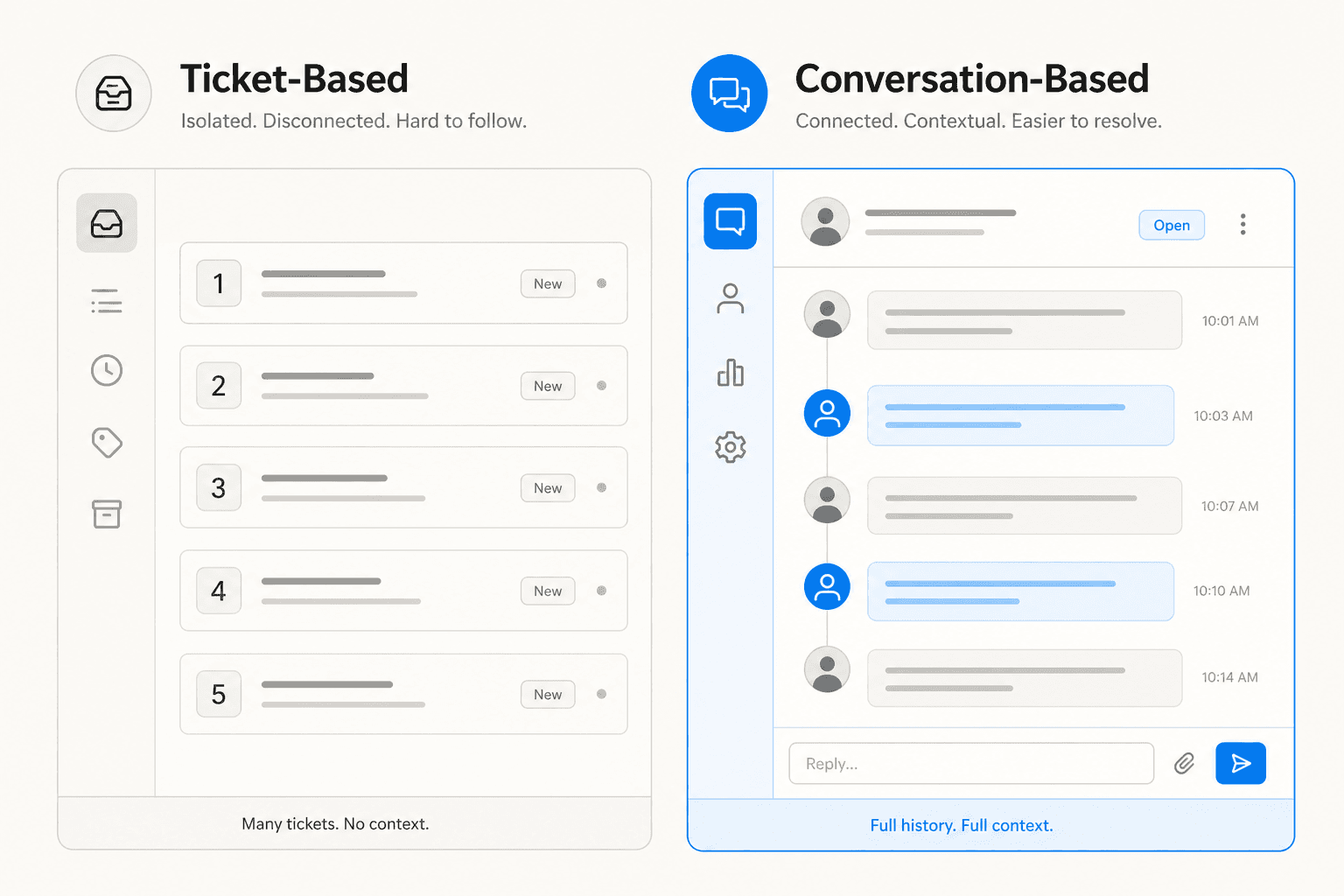
In a ticket-based system like Freshdesk, messages arrive and become items in a shared inbox. Agents choose (or are assigned) tickets to work on. The conversation is frozen in time - each ticket is isolated, and context from previous tickets requires manual lookup.
In Dixa's conversation model, every inbound message immediately routes to the best-available agent. Historical conversations, order data, loyalty status, and CRM data appear on screen the moment the conversation opens. The customer never has to repeat themselves because the agent already has full context.
This distinction matters most at volume. At 50 tickets per day, Freshdesk's inbox model works fine. At 500 conversations per day in multiple languages across email, chat, and phone, the routing intelligence and context availability make a real operational difference.
Dixa features
Dixa's platform organizes around five modules:
Dixa Channels - All conversations (email, chat, phone, WhatsApp, Instagram, Facebook, SMS) in one unified queue with automatic routing.
Dixa Conversation Engine - A visual flow builder for routing rules and automations without code. Routes by language, skill, VIP status, and custom attributes.
Dixa Team Hub - The agent workspace: orders, past conversations, loyalty data, and AI-suggested replies all on one screen. New hires reportedly get productive in days, not weeks.
Dixa Discover - Performance and QA layer. Every conversation is automatically scored against custom criteria, surfacing coaching opportunities without manual review.
Mim AI Agent + AI Co-Pilot - Mim resolves routine inquiries (returns, order tracking, FAQs) on chat and email without human involvement. Co-Pilot gives agents real-time suggestions, translations, summaries, and sentiment detection. Both are add-ons, not included in base plans.
Dixa pricing
| Plan | Price | Key additions |
|---|---|---|
| Growth | €89/agent/month | All channels, routing, SLAs, knowledge base, native integrations |
| Ultimate | €139/agent/month | External data routing, Knowledge-Centered Service, AI intent detection, advanced automations, macros |
| Prime | €179/agent/month | SSO, advanced AI intent, advanced insights, custom user roles, multiple organizations |
AI add-ons (separate pricing):
- Mim AI Agent - automates routine inquiries end-to-end
- AI Co-Pilot - agent-assist tools (summaries, translations, smart replies, QA)
- Quality Assurance - 100% conversation scoring
- Advanced Insights - customer journey analytics
- Voice Transcription - call-to-text
Annual commitment saves 20%. Monthly billing available. Minimum 6 agent seats.
Dixa's total cost of ownership argument: Freshdesk and Zendesk charge separately for AI, advanced analytics, and sometimes telephony. One Dixa customer was quoted £25,000 extra for Zendesk AI alone. Dixa's base plans include all channels, routing, and real-time analytics natively. Whether that justifies the 4x+ seat cost depends on what you'd otherwise be paying for add-ons.
What users say about Dixa
Dixa's 4.2/5 rating from 391 G2 reviewers hides a split: the product itself is widely liked; the commercial terms are not.
Positive reviews praise the onboarding experience and how quickly agents adapt:
"Imagine every pain point you've experienced with Intercom, Zendesk, or similar platforms - now remove them. That's Dixa. It's agent-friendly, management-friendly, and provides easily digestible data." -- Bailey A., Head of Customer Care, G2
And the routing and context features land well:
"Dixa offers a function for assigning open customer concerns across platforms according to finely configured priorities. This means that work is no longer carried out bluntly according to lists." -- Verified User, Wholesale, G2
But the contract terms are where negative reviews concentrate:
"A software company operating in 2025 that enforces a one-year contract commitment, along with a three-month notice period for termination... Charging per minute for incoming calls is a dated practice that has largely been replaced by predictable, flat-rate pricing models." -- Jeppe K., Customer Service Manager, G2
The most severe complaint on G2 (which received a public response from Dixa's co-CEO) describes being locked into a second 12-month contract because a 3-month notice window was missed, after months of billing errors. Dixa acknowledged the errors and said they were considering adjusting notice periods for smaller customers.
How Freshdesk and Dixa compare head to head
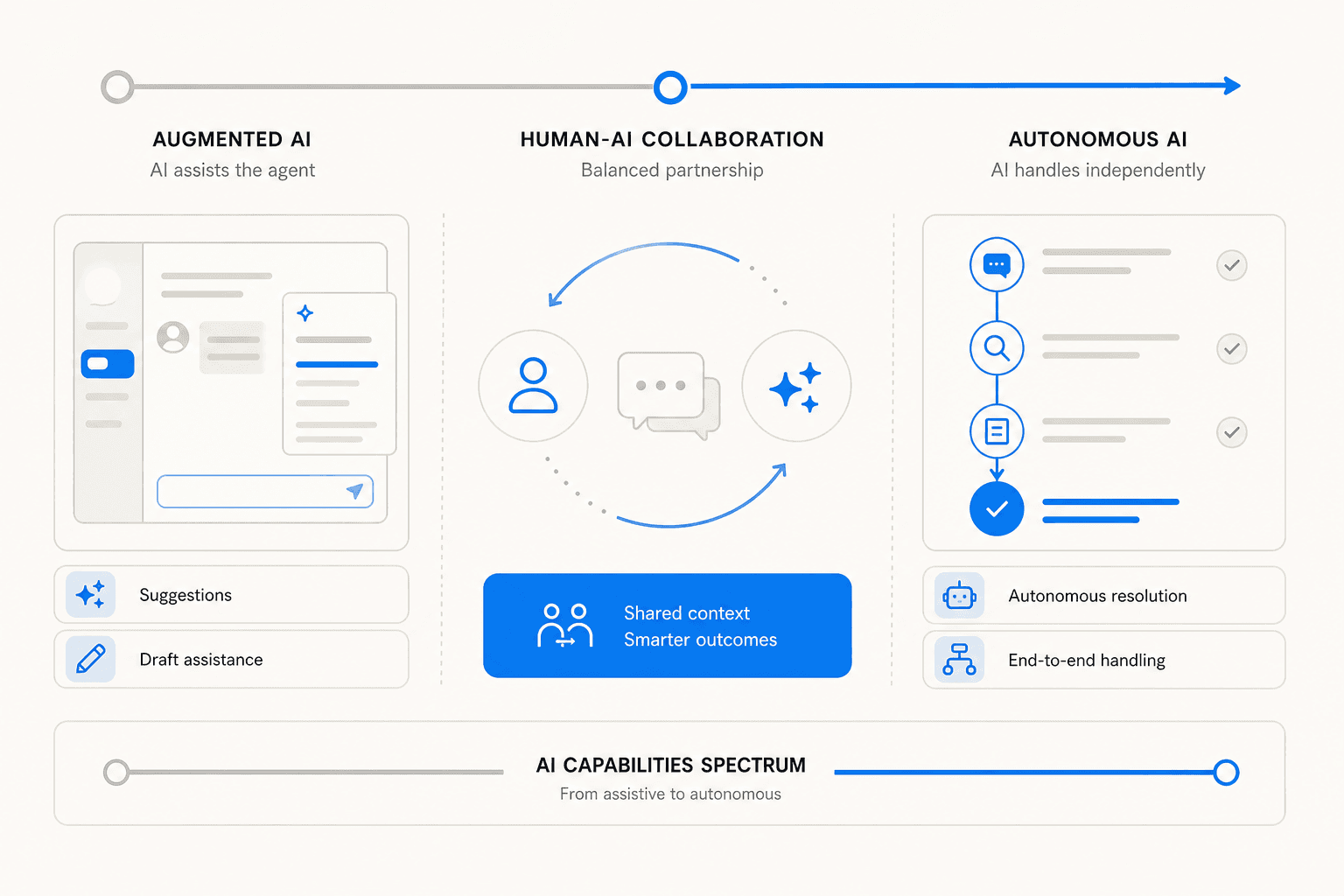
AI: built-in vs add-on
Freshdesk includes Freddy AI across all paid plans - 500 sessions included, with additional sessions at $49 per 100. On paper, this covers agent copilot features (suggestions, summaries, sentiment), autonomous resolution, and analytics insights.
In practice, the Reddit and G2 feedback says the day-to-day impact is limited. Freddy AI is present but doesn't meaningfully reduce agent workload for most teams. Teams that need actual AI ticket automation often find they need to add a third-party layer on top.
Dixa's Mim AI Agent is a purpose-built resolution engine for ecommerce queries: returns, order tracking, FAQs, cancellations, and order changes in 30+ languages. The Smartphonehoesjes customer case shows 82% live chat containment with a negligible 3-point CSAT gap between AI and human responses. For ecommerce-specific queries, Mim's task-oriented approach outperforms general-purpose AI copilots.
The tradeoff: Freshdesk's AI is included and imperfect; Dixa's AI is purpose-built and costs extra.
Pricing comparison
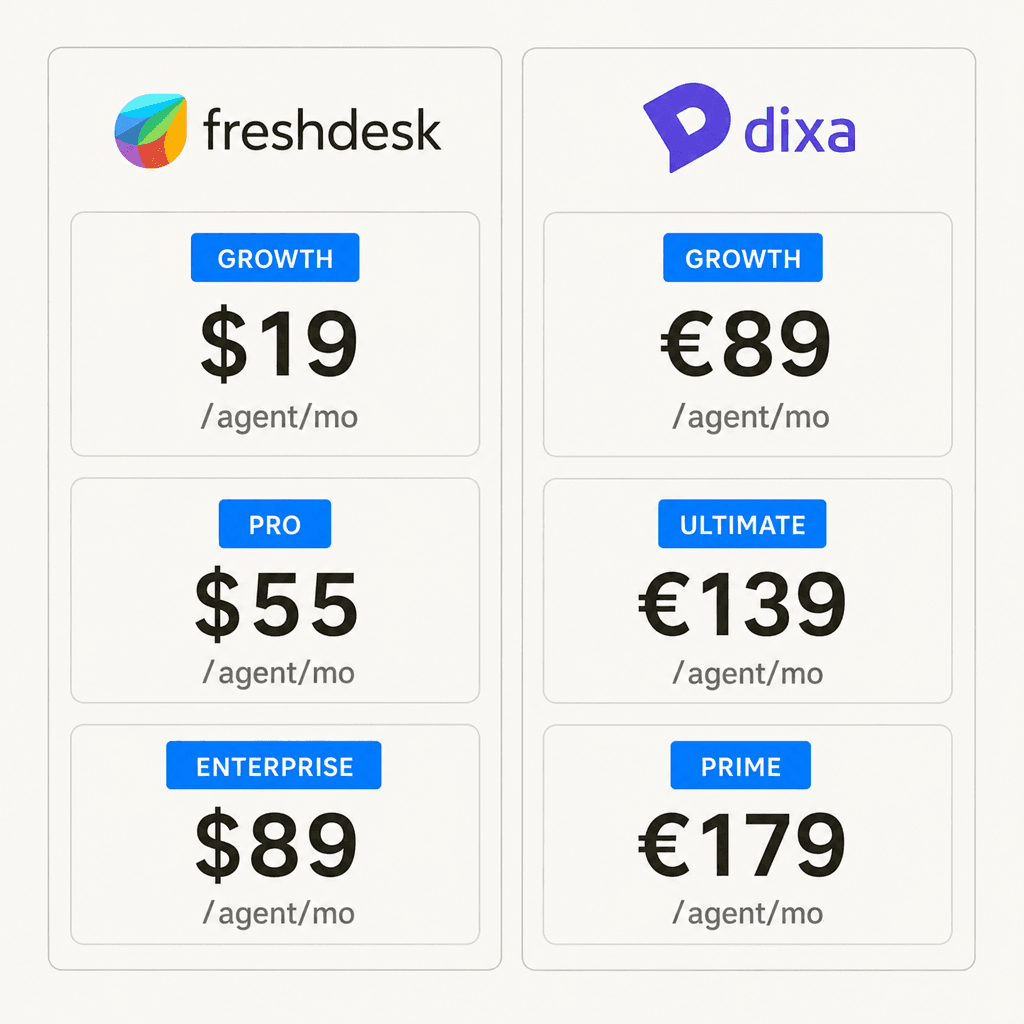
At a 10-agent team, Freshdesk's Growth plan costs $190/month. Dixa's Growth plan costs €890/month - roughly 4-5x more. The gap narrows slightly if you add Freddy AI overage charges to Freshdesk, and widens if you add Mim and Co-Pilot to Dixa. For most teams, Freshdesk is the more affordable option by a wide margin.
Dixa's per-seat pricing also requires a minimum of 6 agents, which means it isn't realistically accessible below ~€534/month.
Ecommerce fit
Dixa is built for ecommerce. Shopify, Magento, and WooCommerce integrations are native; order data surfaces in the agent workspace automatically; Mim handles ecommerce-specific tasks out of the box. The platform's conversation model is designed for the kind of high-volume, repetitive queries that ecommerce generates (where is my order? how do I return this?).
Freshdesk works for ecommerce but isn't specifically tuned for it. The integrations are available, but the ticketing model adds friction when order context needs to be accessed mid-conversation.
Contract flexibility
Freshdesk is pay-as-you-go. Cancel anytime. No cancellation fees. Monthly billing is available.
Dixa requires a 1-year minimum and 3 months notice to cancel. Missing the notice window locks you in for another year. For teams evaluating their options, this asymmetry matters.
Market focus and scale
Freshdesk is genuinely global - 74,000+ businesses, reviews from North America (1,544), Asia (903), and Europe (775). Dixa has 391 G2 reviews, 88% from Europe. If you're a North American team, Freshdesk will have more local support resources, integrations tested against your stack, and case studies from companies in your market.
Who should choose Freshdesk
- Teams needing affordable, flexible per-agent pricing without year-long commitments
- Smaller support teams (2-20 agents) that need reliable ticketing without the overhead of a conversation-routing platform
- IT support and B2B teams where the ecommerce-specific features in Dixa don't apply
- Companies that want to evaluate AI features without a large upfront commitment
- Teams managing multiple brands where Freshdesk's multi-brand inbox management and custom dashboards shine
If you're currently using Freshdesk and finding the AI limited, our guide to Freshdesk AI automation covers what Freddy can and can't do - and what third-party options fill the gaps.
Who should choose Dixa
- Ecommerce brands with significant conversation volume (500+ per day) who want real-time routing, not a ticket queue
- European companies where Dixa's regional support and presence translate to real advantages
- Teams ready to consolidate phone, email, chat, and social into one platform and remove separate telephony tools
- Mid-market teams (20+ agents) where the minimum seat requirement and contract terms are manageable
- Companies whose current platform routing is breaking down during peak seasons
For more on whether Dixa is the right move, our Zendesk vs Dixa comparison shows how it stacks up against the other major platform ecommerce teams consider.
Try eesel AI with Freshdesk or Dixa
If you're leaning toward Freshdesk but want better AI automation than Freddy provides, eesel AI adds an autonomous AI agent on top of your existing helpdesk - Freshdesk, Zendesk, or others - without replacing it. The AI resolves tickets end-to-end, handles multilingual queries, generates knowledge base articles from ticket gaps, and escalates to humans based on rules you set in plain English.
Design.com handles 50,000+ tickets per month using eesel inside Freshdesk, with a multi-agent setup across multiple help centers. Smava runs 100,000+ support tickets per month fully autonomously in German - one of the largest AI support deployments across all eesel customers. Pricing starts at $0.40 per resolved ticket; you pay only for what the AI handles. A $50 free trial is available with no credit card required.

Frequently Asked Questions
Share this article

Article by
Stevia Putri
Stevia Putri is a marketing generalist at eesel AI, where she helps turn powerful AI tools into stories that resonate. She’s driven by curiosity, clarity, and the human side of technology.