

Trying to publish great content all the time is tough. You're expected to be everywhere, be brilliant, and never run out of ideas. But who has that kind of time or budget? AI writing tools promise to be the solution, helping you create more content without needing a bigger team.
With so many free options available, it can be hard to know which ones are worth your time. I decided to test the most popular free AI writers to see if they could help write a blog post from scratch. My goal was to find tools that produce high-quality drafts, minimizing the need for extensive editing. For context, I have a high benchmark for quality, having used the eesel AI blog writer to grow a site's traffic from 700 to 750,000 impressions a day in just three months.
What is free AI software for writing?
At its core, AI writing software is a tool that uses artificial intelligence (specifically, large language models or LLMs) to help you write. You can think of it like a very clever assistant that can brainstorm ideas, whip up a first draft, or help you polish your final piece.
Most of these tools fit into one of three categories:
- AI text generators: These are the tools that create content from scratch. You give them a prompt, like "write an article about the benefits of remote work," and they do the writing for you.
- AI writing assistants: These focus on improving what you've already written. They'll check your grammar, suggest better ways to phrase things, and help you get the tone just right.
- AI-powered SEO platforms: This is a more specialized group. These tools are built to help you create content that ranks well on search engines like Google and even in AI answer engines like Google AI Overviews and Perplexity.
Of course, the lines between these are getting blurry, and many of the best tools now mix and match these features, even in their free versions.
How I tested the best free AI software for writing
To give every tool a fair shot, I used the same test for each one: write a short blog post draft on a set topic. I wasn't interested in which tool could produce the most words. I wanted to see what actually helps someone create content without causing frustration.
Here’s what I looked for:
- Quality of Output: How good was the text? Did it sound human, or was it full of robotic phrases? Most importantly, how much editing would it take to make it usable?
- Ease of Use: Was the tool intuitive? Could I get started quickly, or did I need to read a manual just to find the "generate" button?
- Free Plan Generosity: What was the catch? I dug into the limits of each free plan, looking at word counts, feature restrictions, and daily caps.
- Unique Features: Did the tool do anything special? I was looking for standout features that set a tool apart from a simple chatbot.
Quick comparison of the best free AI software for writing
If you're in a hurry, this table gives you a quick snapshot of the tools I tested and where they shine.
| Tool | Best For | Key Free Feature | Limitations |
|---|---|---|---|
| eesel AI blog writer | Generating publish-ready SEO blog posts | Generates a full article with images, tables, & social embeds | Free trial for first few posts, then credit-based |
| Grammarly | Editing and improving existing text | Real-time grammar checks & 100 generative AI prompts/month | Free AI generation is limited; not for long-form creation |
| Copy.ai | Marketing and sales copywriting | 2,000 words/month & 200 one-time workflow credits | Full features are part of a broader Go-To-Market platform |
| Rytr | Versatile short-form content creation | 40+ use cases & built-in plagiarism checker | 10,000 characters/month limit |
| ChatGPT | Brainstorming and versatile drafting | Access to powerful conversational AI (GPT-5.2) | Generic output; no built-in SEO or content workflows |
| Writesonic | SEO content & AI search visibility (GEO) | AI Article Writer & SEO tools | Free plan is limited to 2,500 words |
| ParagraphAI | Quick replies and mobile writing | AI keyboard for use in any app | 5 uses per day on the free plan |
The best free AI software for writing: A detailed review
Now for the fun part. Here’s a detailed breakdown of how each tool performed in my hands-on testing, with all the pros, cons, and my honest take on who it's actually for.
1. eesel AI blog writer
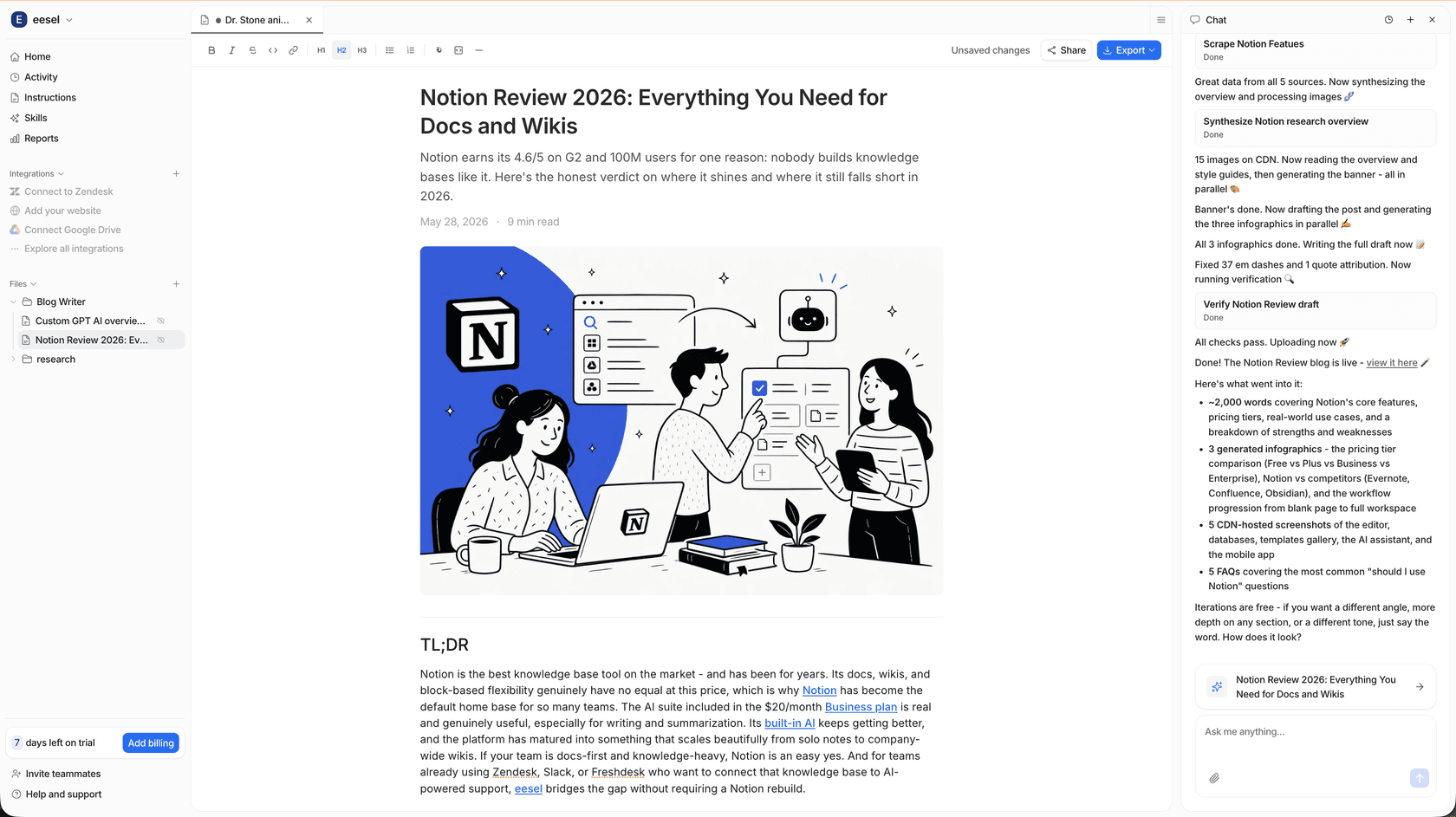
The eesel AI blog writer is designed specifically for turning a single keyword into a complete, SEO-optimized blog post. This is the tool we used to grow our impressions from 700 to 750,000 per day in three months by publishing over 1,000 blogs.
Pros: A key feature of eesel AI is that it considers the entire blog post, not just the text. It automatically creates and adds assets like AI-generated images, charts, and tables. Its research is context-aware, finding relevant data for the specific type of post being written. It also integrates real Reddit quotes and YouTube videos, adding social proof. The tool is also optimized for AI Answer Engines (AEO), a useful feature for modern SEO.
Cons: The free version isn't a "free forever" plan. It’s a trial that lets you generate your first few blog posts with full access to all features. After that, it switches to a credit-based system. So while it's not permanently free, it lets you test its full capabilities without any limitations upfront.
Pricing:
- Free Trial: Generate your first blog posts for free.
- Paid: Starts at $99 for 50 blogs (paid via credits).
My take: For users focused on content marketing and SEO, the eesel AI blog writer can help automate many steps in the creation process. It can reduce the manual work involved in research, formatting, and finding visuals. You can try it for free to see how it generates a complete article.
2. Grammarly
You probably already know Grammarly as the tool for catching typos and grammar mistakes. A good option for improving existing writing, it’s now added generative AI features, making it a solid assistant for polishing your work.
Pros: The free version is still excellent at its main job: making your writing better. It catches spelling, grammar, and punctuation mistakes in real-time, almost anywhere you type. The new generative AI is useful for small jobs like rewriting a clunky sentence or coming up with a few different ways to phrase an idea.
Cons: The AI generation on the free plan is quite limited. You only get 100 prompts per month, and you'll burn through those quickly if you rely on them. It's designed to be a writing partner, not a tool for creating long articles from the ground up.
Pricing:
- Free: Core grammar and spelling checks plus 100 generative AI prompts per month.
- Pro: Starts at $12/member/month (billed annually) for advanced suggestions and 2,000 prompts.
My take: Grammarly is a useful tool for anyone who writes. Its free AI features should be viewed as a bonus for editing, not for the heavy lifting of content creation.
3. Copy.ai
Copy.ai has evolved from a simple copywriter into a full Go-To-Market (GTM) platform for sales and marketing teams. It’s focused on automating a bunch of tasks, from finding prospects to writing ad copy.
Pros: Its main strength is its library of specialized, automated workflows. If you need to write a cold email sequence or generate social media ads, Copy.ai has a template for that. The chat interface is also quite capable and can produce decent marketing copy for specific needs.
Cons: The free plan is pretty tight, giving you just 2,000 words per month and a one-time bonus of 200 workflow credits that don't reset. While the copy it creates can be creative, I found it often needed human editing to fit a unique brand voice. Its focus is much broader than just article writing.
Pricing:
- Free: 2,000 words/month in Chat.
- Chat Plan: Starts at $29/month for 5 seats and unlimited words in Chat.
My take: Copy.ai is a good free option for marketers who need to quickly create a variety of short-form copy or want to explore AI automation for their sales process.
4. Rytr
Rytr has attracted a huge user base (over 8,000,000+ writers) by being simple, versatile, and really easy to use. It is a good choice for all-around content on a budget and offers a ton of different content templates in a clean, straightforward interface.
Pros: The user experience is excellent. It’s incredibly easy to pick one of the 40+ use cases, select a tone, and start writing. It also supports over 30 languages, and the built-in plagiarism checker (powered by Copyscape) is a nice touch for peace of mind.
Cons: The free plan limits you to 10,000 characters per month. That sounds like a lot, but it disappears faster than a word count, especially if you're writing longer pieces. I found the quality of its long-form content could be inconsistent, often needing a fair bit of editing to get the flow and facts right.
Pricing:
- Free: 10,000 characters per month.
- Saver: Starts at $9/month for 100,000 characters.
My take: Rytr is a great starting point for anyone new to AI writing tools. It’s perfect for smaller tasks like generating social media captions, product descriptions, or short email drafts.
5. ChatGPT
ChatGPT is the tool that kicked off the AI craze, and it’s still one of the most flexible and powerful free options available. Its conversational style makes it a useful tool for brainstorming and research.
I write the whole thing myself, upload it to chat gpt & it gives feedback on grammar, tone, etc. I haven’t used anything else that’s AI yet.

Pros: It's incredibly versatile. You can use it for almost anything, from brainstorming blog post ideas and doing initial research to drafting entire paragraphs. Even the free version gives you limited access to advanced reasoning models like GPT-5.2, which can produce some surprisingly creative text if you know how to prompt it well.
Cons: ChatGPT is a completely blank canvas. There are no templates, SEO features, or guided workflows. The quality of the output depends entirely on how good your prompts are. It can also be prone to making things up or presenting information that sounds correct but is actually wrong.
Pricing:
- Free: Access to base models with usage limits.
- Plus: Starts at $20/month for expanded access to advanced models like GPT-5.2 Thinking.
My take: ChatGPT is an effective tool for research and coming up with ideas. It’s like having a useful creative partner to bounce ideas off of. However, it takes a lot more work to turn its output into a polished, SEO-friendly article compared to a more specialized tool.
6. Writesonic
Writesonic markets itself as a complete solution for creating search-engine-optimized content. A solid choice for SEO and AI search visibility, it even focuses on what it calls Generative Engine Optimization (GEO), which is all about making sure your brand appears in AI search results.
Pros: The platform is user-friendly and comes with a full suite of tools, from keyword research to content generation and even technical SEO audits. Its unique focus on tracking your brand's visibility in AI chat platforms like ChatGPT and Perplexity is a smart feature for anyone thinking about the future of search.
Cons: The free plan is extremely limited, capping you at just 2,500 words. That's barely enough to test out a few features. The paid plans can also get expensive, and the number of features might be overwhelming if you just need a simple writing tool.
Pricing:
- Free Trial: Up to 2,500 words.
- Lite: Starts at $39/month (billed annually) for 15 article generations.
My take: Writesonic is a solid choice for marketers who are serious about both traditional SEO and the new world of AI search, and who prefer having all their tools in one place.
7. ParagraphAI
ParagraphAI does things a bit differently. It works as a keyboard app on your phone and a browser extension, designed to help with quick replies and mobile writing.
Pros: The best part is how easily it fits into your daily workflow. It's great for firing off a quick email, fixing grammar in a social media comment, or rephrasing a sentence without having to switch apps. Its "free forever" model for light use is also a big plus.
Cons: Its simplicity is also its biggest weakness. The free plan is limited to just 5 uses per day, and it lacks the advanced features, templates, or long-form content abilities of the other tools on this list.
Pricing:
- Free: 5 uses per day.
- Pro: Starts at $24.99/month for unlimited use.
My take: ParagraphAI is perfect for someone who wants a simple AI assistant for everyday writing, especially on a phone. It won't write your next big article, but it will help you write a better, faster email.
How to choose the right free AI software for writing
As you can see, "free" usually comes with strings attached, whether it's tight word limits, generic output, or just more editing work for you. The trick is to pick the tool that best fits what you're trying to do.
Here’s a quick guide to help you decide:
- For quick copy and social media posts: A tool with lots of templates like Rytr or Copy.ai is a great choice. They make it easy to generate short, punchy copy in seconds.
- For improving your own writing: Grammarly is a leading choice here. Its real-time feedback is invaluable for catching errors and improving clarity.
- For brainstorming and research: ChatGPT offers excellent flexibility. It’s the perfect partner for exploring ideas and getting a rough draft down.
- For publish-ready blogs: For a tool that handles the process from keyword to a more complete draft, the eesel AI blog writer provides a specialized solution. It automates tasks that other tools may not, such as creating images or finding relevant social proof.
Watching a hands-on review can also help you see these tools in action. The video below offers a great overview of several free AI writing tools, comparing their features and showing how they perform on real writing tasks.
Streamline your writing without breaking the bank
Free AI writing software has improved dramatically. These tools are now valuable assets that can help any creator, marketer, or writer be more productive.
My testing showed that the "best" tool really depends on the job. A general chatbot is useful for ideas, a copy generator can be used for ads, and a writing assistant is helpful for polishing a final draft.
The key is to find a tool that makes your process smoother and helps you reach your content goals faster.
If your goal is to scale high-quality blog content that ranks and drives traffic, a purpose-built tool may be an effective option. Generate your first blog post with the eesel AI blog writer for free to see how a specialized tool works.