Does AI content work for SEO? A realistic look at ranking in 2026

Amogh Sarda

Katelin Teen
Last edited January 12, 2026

Let's get right to it. It’s the question on every marketer's mind in 2026: can you actually rank on Google with AI-generated content, or is it just a quick way to get penalized?
The honest answer isn't a simple yes or no. It really comes down to how you use AI. You hear stories about marketers getting crazy growth, but you also see sites getting absolutely wrecked by things like Google's March 2026 core update.
Google's systems are designed to reward helpful, high-quality content, and they don’t care if it was written by a human, an AI, or a team of very talented squirrels.Yes. Went from 200 views a month to 3000. Website is making $10,000+ monthly.

What is AI-generated content, really?
First, let's make sure we're talking about the same thing. AI-generated content is any text created by an AI based on your prompts. It can be anything from a quick meta description to a full-blown article.
The appeal for businesses is pretty clear: it’s fast and you can make a lot of it. What used to take a writer days of research, outlining, and drafting can now be done in minutes. This ability to churn out content promises to lower production costs and get your message out there faster. But as you'll see, speed without quality is where things go wrong.
What is Google's official stance on AI content?
So, what does Google actually think? There's a lot of confusion here, but their position is pretty straightforward. The main idea is that Google's systems reward high-quality, original content, no matter how it's made.
In their official guidance, they say using AI is fine. What they don't like is using automation, including AI, mainly to manipulate search rankings. If you're just pumping out low-quality fluff to game the system, they're going to treat it like spam.
Ultimately, it all comes down to this: your content has to be "people-first." It needs to be genuinely helpful and valuable to the reader. If you can do that, you're on the right track, whether you used AI or not.
Google doesn’t penalize content just because it’s created with AI. What really matters is how valuable, accurate, and helpful the content is not who or what wrote it.
The risks of using AI for SEO content
The problem with most AI-generated articles isn't the AI itself. It's that the output is often riddled with common issues that Google's quality filters can spot from a mile away. Let's look at the biggest red flags.
It can be factually inaccurate or outdated
One of the most significant issues with AI models is their tendency to "hallucinate," meaning they can generate incorrect information. An AI might invent facts, cite sources that don't exist, or state a statistic it pulled from nowhere. This is a huge problem for building trust.
For instance, a major study by 22 public service media organizations found that AI assistants misrepresent news content about 45% of the time. Imagine nearly half the info in your blog post being wrong.
On top of that, many AI models have knowledge cut-off dates. They can't give you reliable information on current events, which means your content isn't trustworthy or up-to-date, tanking your E-E-A-T signals.
It often lacks originality and a human voice
AI models learn by analyzing tons of existing data from the internet. This makes them great at summarizing what's already out there, but not so great at creating truly unique insights.
The result is often generic, bland content that sounds like a Wikipedia article had a baby with a corporate brochure. It's missing the personal stories, anecdotes, and distinct brand voice that connect with readers.
But it’s gotten to a point you can tell if someone put any actual effort into something or just used Ai. It all sounds the same, and looks the same. There is no individuality.
This is where the "Experience" part of E-E-A-T becomes a huge hurdle. An AI can't share a personal story about struggling with a problem or offer a clever workaround it discovered. This lack of genuine experience leads to poor user engagement (like high bounce rates), which signals to Google that your content isn't very helpful.
It can lead to penalties from scaled, low-quality content
The Google March 2024 Core Update specifically targeted what it called "scaled content abuse." The goal was to cut down on the amount of low-quality, unoriginal content in search results, and a lot of sites that were mass-producing unedited AI articles were negatively affected.
Publishing hundreds of unedited AI articles without any human review is a direct violation of Google's spam policies. It shows that your main goal is to manipulate rankings, not help people. This can lead to a manual penalty or even get your pages removed from Google's index entirely.
How to use AI content effectively for SEO
Step 1: Start with a tool built for publish-ready content
Different AI tools are built for different tasks. General-purpose chatbots are useful for brainstorming, but they often produce a draft that requires significant editing and fact-checking. Specialized platforms, on the other hand, are designed to produce a more complete article.
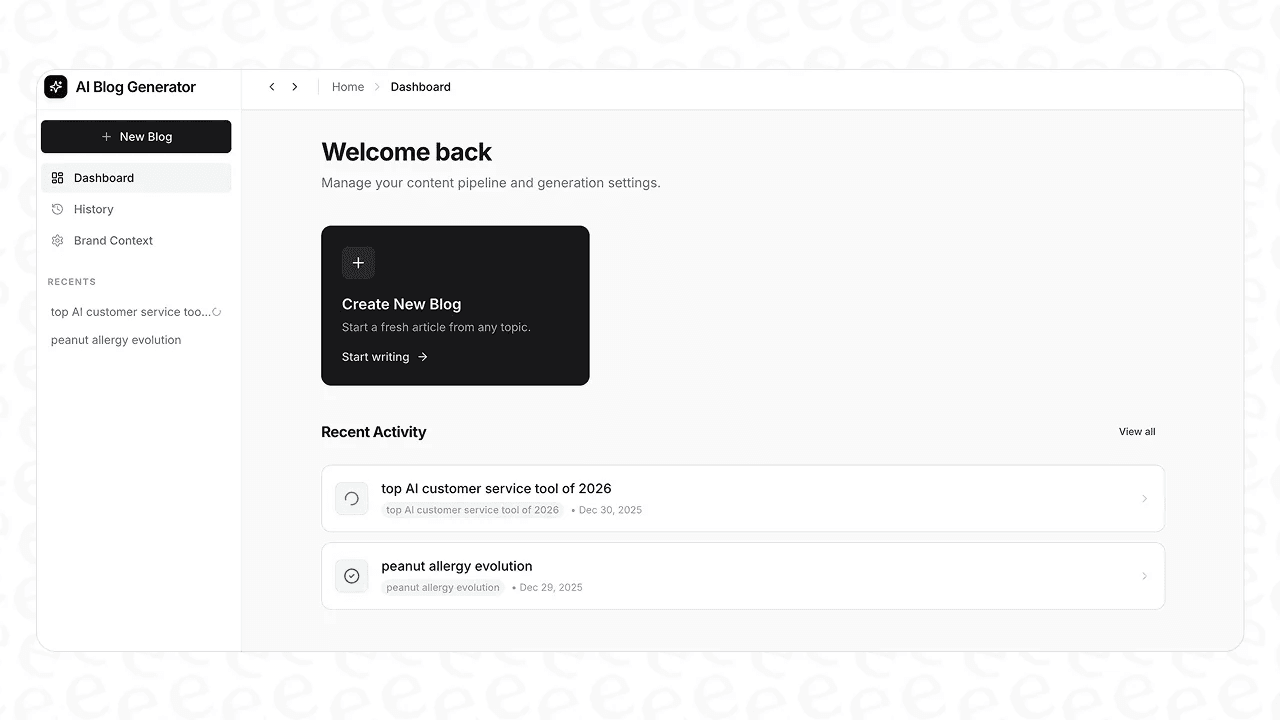
For instance, the eesel AI blog writer is designed to take a keyword and generate a structured, SEO-optimized blog post. It uses context-aware research to pull in relevant data and is refined to produce a human-like tone, creating content that is engaging for readers.
Step 2: Automate assets and social proof for added value
Good content is more than just words. Finding quality images, creating tables, and citing credible sources can take a ton of time.
Many quality-focused AI tools can handle this for you. The eesel AI blog writer automatically includes AI-generated images, infographics, and tables in the article. It also integrates relevant YouTube videos and real quotes from Reddit discussions. This adds unique value, builds trust with real-world social proof, and makes the content far more engaging than a simple block of text.
Step 3: Layer in human expertise and fact-checking
This is the most important step. Even the best AI-generated content needs a human touch to be truly great and satisfy E-E-A-T. Think of the AI as your super-efficient junior writer who delivers a 90% complete draft in minutes.
The best workflow is to have a subject-matter expert (SME) review the AI-generated post. Their job is to:
- Verify all facts and stats.
- Add unique insights and personal stories.
- Inject your brand's unique voice.
- Make sure the content fully answers what the searcher was looking for.
Step 4: Focus on quality and intent, not just volume
The goal isn't to publish as many mediocre articles as possible. It's to consistently publish high-quality, helpful content that serves your audience. One amazing, in-depth article that perfectly matches what users are searching for will do more for your SEO than a hundred generic posts.
This is a strategy with proven results. For example, at eesel AI, we grew our blog from 700 to 750,000 daily impressions in just three months by publishing over 1,000 optimized blogs using this human-AI approach. Quality and consistency, powered by the right tool, really do deliver.
The verdict on AI content for SEO
Yes, AI content absolutely works for SEO, but only if you do it right. It comes with a massive "if."
What doesn't work: Pumping out raw, unedited content from generic AI tools. It's a fast track to getting flagged for "scaled content abuse" and will likely negatively impact your rankings.
For a deeper dive into Google's policies and to see a real-world case study on this topic, check out the video below. It provides excellent insights into how search engines evaluate AI-generated articles and what you can do to stay on the right side of their guidelines.
The future of AI in content creation
In 2026, the smartest content teams don't see AI as a replacement for writers. They see it as a powerful collaborator. It's a tool that handles the heavy lifting of research and drafting, freeing up human experts to focus on what they do best: providing unique insights, strategic direction, and deep knowledge.
The winning formula is clear: combine the efficiency of AI with the experience of your human team. This hybrid approach is how you create content that not only ranks but also builds a loyal audience.
Ready to see what quality-first AI content looks like? Try the eesel AI blog writer for free and generate your first publish-ready article in minutes.

Frequently Asked Questions
Share this article

Article by
Amogh Sarda
CEO of eesel AI. Amogh Sarda is obsessed with making the ultimate AI for customer service teams. He lives in Sydney, Australia and has previously worked at Atlassian and Intercom. Outside of work he’s usually surfing or on stage doing improv.