Decagon vs Freshdesk AI: Which customer service platform fits your team?

Stevia Putri

Stanley Nicholas
Last edited March 13, 2026
Expert Verified
AI is reshaping how support teams operate, but not all AI platforms approach the problem the same way. Some are built from the ground up as AI-native solutions, while others add intelligence to existing help desk infrastructure. Understanding this distinction matters when you're choosing a platform that will shape your customer experience for years to come.
Decagon and Freshdesk AI represent two fundamentally different philosophies. Decagon is an AI-native platform designed for autonomous resolution. Freshdesk AI layers intelligence onto a mature help desk that thousands of teams already use. Both can transform your support operations, but they fit different organizational needs, technical capabilities, and budget structures.
There's also a middle path worth considering. At eesel AI, we've built an AI teammate that works within your existing help desk, combining the accessibility of Freshdesk's approach with some of the autonomous capabilities that make Decagon appealing. We'll explore where that fits later.
Let's break down what each platform actually offers, how they compare across key dimensions, and which one makes sense for your situation.
What is Decagon?
Decagon launched in 2023 as an AI-native customer experience platform. The company positions itself as "the AI concierge for every customer," and their approach centers on building autonomous AI agents that resolve customer issues from start to finish without human intervention.
The core concept is containment: deflect as many tickets as possible through AI automation. Decagon's customers include recognizable names like Duolingo, Notion, Chime, ClassPass, and Dropbox. These are companies with complex support needs and the technical resources to implement sophisticated AI systems.
Decagon's key differentiator is something they call Agent Operating Procedures (AOPs). These are natural language instructions that compile into code, allowing non-technical team members to define AI agent workflows. Instead of writing complex configuration scripts, you describe what you want the agent to do in plain English, and the system translates that into executable logic.
The platform supports voice, chat, email, and SMS from a single intelligence layer, with persistent user memory across channels. This means if a customer starts a conversation in chat and follows up via email, the AI remembers the context.
Decagon is built for enterprise-scale operations. Implementation typically requires professional services engagement and can take weeks to months. There's no self-service signup or free trial. You book a demo and work with their team to scope and deploy the solution.
What is Freshdesk AI?
Freshdesk is a mature help desk platform that's been around since 2010, now serving over 74,000 businesses worldwide. It's part of the Freshworks suite of business software. Freddy AI is the AI layer that adds automation and intelligence to the existing Freshdesk platform.
The philosophy here is different. Instead of replacing your help desk with AI, Freshdesk AI augments it. The platform offers two main AI components: Freddy AI Agent for autonomous customer-facing resolution, and Freddy AI Copilot for assisting human agents with drafting responses, summarizing conversations, and providing real-time suggestions.
Freddy AI Copilot includes several specific capabilities:
- AI Writing Assistant drafts replies using ticket details and past conversations
- AI Translation Assistant provides real-time translation across 60+ languages
- AI Summarization Assistant condenses long conversation threads
- AI Resolution Assistant surfaces similar historical tickets and relevant knowledge base articles
- AI Sentiment Assistant detects customer frustration or urgency in real time
Freshdesk's messaging emphasizes that "AI handles the complexity from day one while your team builds the connections." This reflects their hybrid approach: automate what can be automated, but keep humans in the loop for relationship-building and complex problem-solving.
The platform offers native omnichannel support across email, chat, phone, social media, and messaging apps. For teams already using Freshdesk, adding Freddy AI is a natural extension rather than a platform migration.
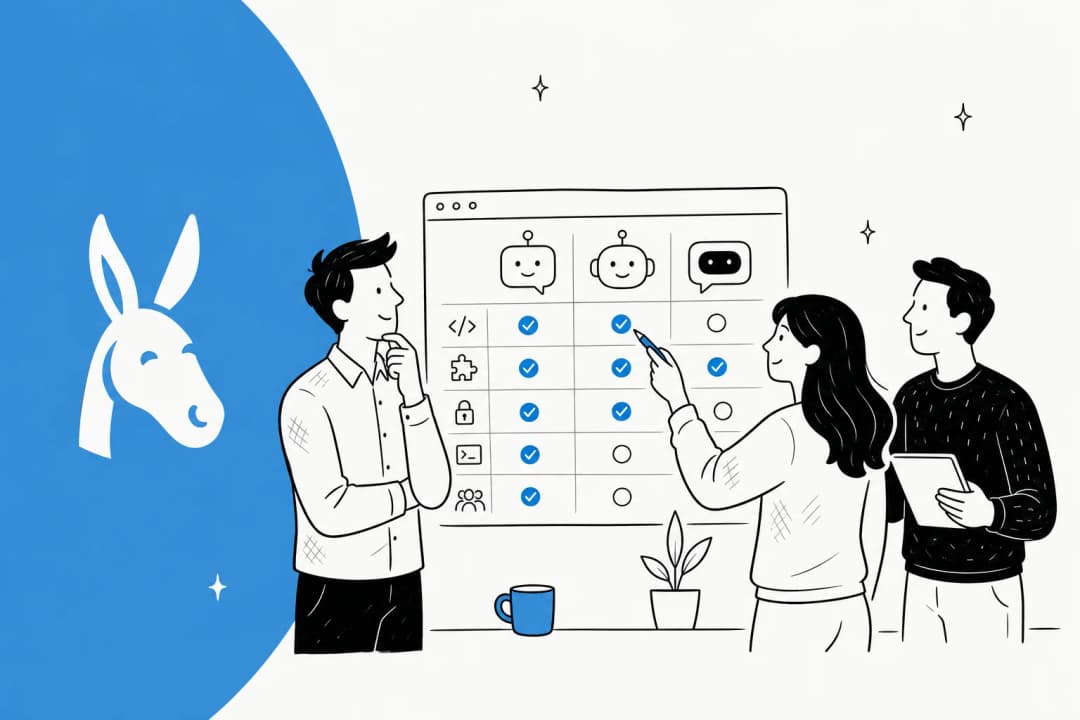
Feature comparison: Decagon vs Freshdesk AI
| Feature | Decagon | Freshdesk AI |
|---|---|---|
| AI approach | Autonomous-first | Agent + Copilot hybrid |
| Resolution capability | End-to-end autonomous | Guided with human oversight |
| Human handoff | Requires separate helpdesk integration | Native handoff within Freshdesk |
| Setup complexity | High (weeks to months) | Low (days for existing users) |
| Customization | AOPs for granular control | Pre-built workflows + customization |
| Channels | Voice, chat, email, SMS | Email, chat, phone, social, messaging |
| Platform type | Standalone AI platform | AI layer on existing help desk |
The fundamental difference is architectural. Decagon is a standalone AI platform that happens to handle customer support. Freshdesk AI is a feature set within a help desk platform that happens to use AI.
This matters for several reasons. Decagon can theoretically achieve higher autonomous resolution rates because it's built specifically for that purpose. Their customers report deflection rates of 70-80% and cost reductions up to 95%. But this comes with trade-offs: you need engineering resources to implement it, and you may end up maintaining two systems (Decagon for AI, plus a traditional help desk for human handoffs).
Freshdesk AI's hybrid model means you're less likely to hit 80% autonomous resolution, but you're also less likely to have AI mishandles that require human cleanup. The native handoff means when the AI can't resolve something, the transition to a human agent is seamless within the same platform.
Decagon's AOPs offer more granular control for teams that want to fine-tune exactly how their AI behaves in specific scenarios. Freshdesk's pre-built workflows get you started faster but offer less flexibility for edge cases.
Pricing comparison
Pricing is where these platforms diverge most dramatically.
Decagon pricing
Decagon doesn't publish any public pricing. Everything is custom quote-based, typically requiring enterprise-level commitments. Based on industry analysis, implementations often start at $150,000 annually and can go significantly higher depending on volume and complexity.
There's no free trial or self-service option. You book a demo, go through a sales process, and receive a custom proposal based on your specific needs.
This pricing model makes sense for Decagon's target market: large enterprises with complex support operations and budgets to match. But it creates friction for smaller teams or those who want to experiment before committing.
Freshdesk AI pricing
Freshdesk's pricing is transparent and published:
| Plan | Price | Key Features |
|---|---|---|
| Free | $0 for 1-2 agents (6 months) | Essential helpdesk, ticketing, knowledge base |
| Growth | $19/agent/month (annual) | Ticketing, customer portal, reports |
| Pro | $55/agent/month (annual) | Custom portals, advanced ticketing, custom reporting |
| Enterprise | $89/agent/month (annual) | Audit logs, approval workflows, skills-based assignments |
Freddy AI components are add-ons:
- Freddy AI Agent (Email): First 500 sessions included with Pro/Enterprise plans, then $49 per 100 sessions
- Freddy AI Copilot: Available as an add-on (pricing not publicly specified)
Freshdesk offers a 14-day free trial, and you can get started without talking to sales.
Total cost considerations
Decagon's all-in cost is harder to predict but likely higher for most organizations. You're paying for professional services, ongoing support, and the platform itself. The value proposition is that high autonomous resolution rates justify the investment through reduced staffing costs.
Freshdesk's costs are more predictable but can add up. A 20-person support team on the Pro plan with Freddy AI Copilot might pay around $1,500-2,000 monthly, depending on AI session volume. The trade-off is lower implementation risk and no need for dedicated engineering resources.
Implementation and time-to-value
Decagon implementations are professional services engagements. Typical timelines range from 6-12 weeks, though complex enterprise deployments can take longer. You'll need technical resources on your side to work with Decagon's team on integrations, workflow design, and testing.
The platform includes testing and QA capabilities, including simulated conversations and A/B testing of different agent versions. This is important because once Decagon is live, it's handling customer interactions autonomously. You want confidence it's going to perform well before it touches real customers.
Freshdesk AI can be activated in days, especially if you're already a Freshdesk customer. The Freddy AI Agent can be configured through the same admin interface you use for other Freshdesk settings. Freddy AI Copilot appears directly in the agent workspace where your team already works.
For teams new to Freshdesk, you'll need to set up the base platform first: configuring channels, building your knowledge base, setting up workflows. This might take a few weeks, but it's parallelizable and doesn't require the same level of technical expertise as Decagon.
Use case fit: Who should choose which?
Choose Decagon if:
- You have complex, technical support workflows that require sophisticated automation
- Your team has engineering resources available for implementation and ongoing optimization
- You want to maximize autonomous resolution rates and are willing to invest in achieving them
- Your budget supports enterprise-level commitments and professional services
- You're comfortable with a standalone AI platform that may require integration with a separate help desk for human handoffs
Choose Freshdesk AI if:
- You already use Freshdesk and want to add AI capabilities without switching platforms
- You prefer a gradual approach to AI adoption with human oversight built in
- You need predictable, transparent pricing that scales with your team size
- Your team lacks extensive technical resources for implementation
- You want an integrated help desk and AI solution in one platform

eesel AI: A collaborative alternative
There's a third option worth considering. At eesel AI, we've built an AI teammate that works within your existing help desk rather than replacing it.
Our approach combines some of the best aspects of both platforms. Like Freshdesk AI, we work within your existing infrastructure (we integrate with Zendesk, Freshdesk, Intercom, Gorgias, and others). Like Decagon, we offer autonomous resolution capabilities with AI agents that can handle tickets end-to-end.
Key differentiators:
- Transparent pricing: Our Team plan starts at $239/month with no hidden fees or custom quotes
- Human-in-the-loop by default: AI drafts responses for review before sending, so you maintain control
- Minutes to setup, not weeks: Connect your help desk and we learn from your existing data immediately
- Progressive autonomy: Start with AI assistance and expand to full automation as you gain confidence
We also offer something neither Decagon nor Freshdesk AI provides: the ability to run simulations on your past tickets before going live. You can see exactly how our AI would have handled your historical conversations, measure resolution rates, and tune behavior before touching real customers.
For teams that want AI collaboration without re-platforming or enterprise-level commitments, this middle path often makes the most sense.

Making your decision
The choice between Decagon and Freshdesk AI comes down to a fundamental trade-off: autonomous AI power versus integrated simplicity.
Decagon offers the highest potential for autonomous resolution but requires significant investment in implementation and ongoing optimization. It's the right choice for large enterprises with complex needs and the resources to match.
Freshdesk AI provides a more accessible entry point to AI-powered support, especially for teams already in the Freshworks ecosystem. The hybrid approach means lower risk and easier adoption, though potentially lower ceiling for full automation.
Before committing to either, consider:
- Your technical resources: Do you have engineering capacity for a complex implementation?
- Your risk tolerance: Are you comfortable with AI handling customer interactions with minimal human oversight?
- Your budget structure: Do you prefer predictable per-seat pricing or are you set up for enterprise software investments?
- Your timeline: Do you need AI capabilities next quarter, or can you invest in a longer implementation?
If you're not sure, start with a platform that lets you test before you commit. At eesel AI, you can run simulations on your past tickets to see how AI would perform with your actual data. It's a lower-risk way to understand what AI can do for your specific support operations before making a major platform decision.
Frequently Asked Questions
Share this post

Article by
Stevia Putri
Stevia Putri is a marketing generalist at eesel AI, where she helps turn powerful AI tools into stories that resonate. She’s driven by curiosity, clarity, and the human side of technology.