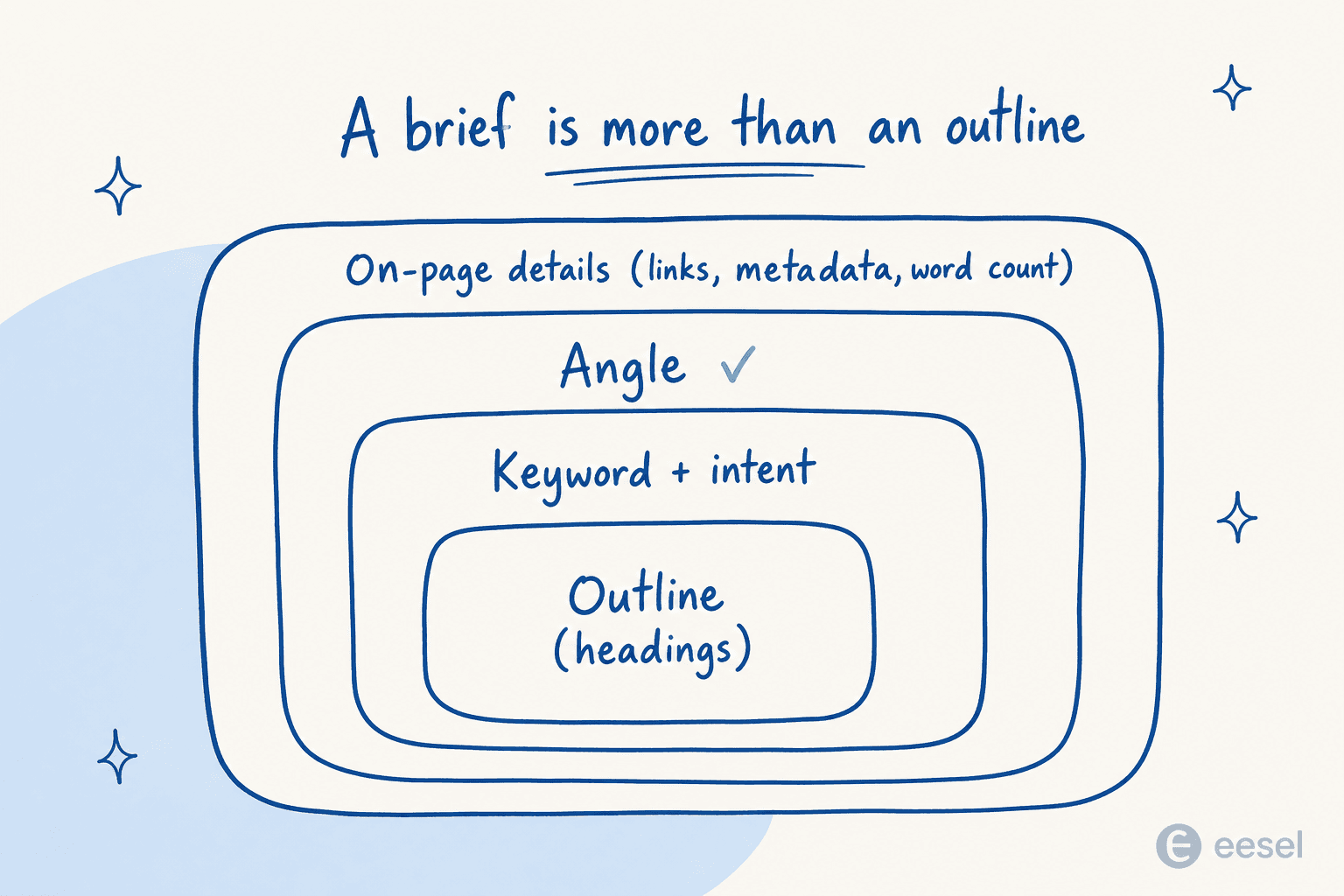
What is a content brief and why is it your most important SEO tool?

Stevia Putri

Katelin Teen
Last edited February 1, 2026
Expert Verified
Have you ever poured your heart, soul, and a good chunk of your budget into a piece of content, only for it to completely miss the mark? The writer didn't quite get the angle, the SEO keywords are off, and now you're stuck in what feels like an endless loop of rewrites. It's frustrating, expensive, and a huge time-sink.
The good news is there’s a pretty simple fix for this common headache: the content brief. Just think of it as the blueprint for your article. It’s the document that gets your whole team, from strategists to writers to editors, on the same page before anyone writes a single word. It’s your best defense against those painful redrafts and mismatched expectations.
Putting these briefs together has always been a bit of a manual chore, but as we'll see, new AI tools are shaking things up. They're not just making research faster; they're starting to take on the whole writing process from start to finish.
What is a content brief?
Let's break it down. A content brief is a document that lays out all the instructions for a writer. It covers the strategic goals, target audience, SEO requirements, and structural elements for a specific piece of content, whether it's a blog post or a landing page.
It’s much more than a messy collection of notes from a kickoff meeting. A great brief serves as the single source of truth for the entire project. It’s the one place everyone can go to understand the vision, making sure the final piece is consistent, on-brand, and perfectly aligned with your goals.
You might have also heard of a "creative brief." While they sound similar, they do different jobs. A content brief is focused entirely on written content, getting into the weeds of things like keywords and article structure. A creative brief is much broader and is used for bigger projects like an ad campaign, a rebrand, or a video series, where the focus is more on the high-level concept and visual direction.
Here’s a quick breakdown of the difference, which this visual makes clear:
| Feature | Content Brief | Creative Brief |
|---|---|---|
| Purpose | To provide guidelines for creating specific written content like blog posts or articles. | To outline the creative direction for a broader project, such as a campaign or design. |
| Focus | Textual content, SEO elements, and structure. | Visual elements, conceptual ideas, and brand identity. |
| Key Elements | Target audience, keywords, search intent, content outline, tone of voice. | Campaign objectives, key messages, visual style, budget, and timeline. |
| Example Use Cases | Blog post, whitepaper, product page copy. | Ad campaign, logo design, website redesign. |
Why a solid content brief is essential for success
I get it, skipping the brief feels like you’re saving time. But trust me, it almost always costs you more in the long run. Here’s why taking the time to create a good brief is one of the smartest moves you can make for your content strategy.
How a content brief prevents costly rewrites and reduces revisions
The biggest win with a content brief is that it forces you and your team to agree on the direction upfront. So many content projects go off the rails because of simple misunderstandings about who the target audience is, how deep the content should go, or what unique angle the brand should take.
A brief clears all that up from the start. By documenting everything, you make sure the first draft is much closer to the final version, which avoids frustrating redrafts and saves a ton of time, energy, and budget.
How a content brief ensures comprehensive content that ranks
From an SEO perspective, a content brief is a powerful tool. It works like a checklist for all the important ranking factors. You can map out your primary and secondary keywords, define the user's search intent, and outline all the essential subtopics and questions that need to be answered.
This process helps you create the kind of comprehensive, in-depth content that search engines love. A big part of building a great brief is analyzing what your competitors are doing on the search results page. By seeing their outlines, you can spot content gaps and create something that’s not just as good, but better.
A content brief creates a single source of truth for your team
How many times have you had to dig through old Slack threads, email chains, and random Google Docs to find a key piece of information for a project? It’s a huge time-waster.
The content brief solves this by becoming the central hub for the project. It’s the one place where the writer, editor, designer, and any other stakeholder can go to find exactly what they need. This is especially important for larger teams or when you’re working with freelance writers who don’t have the same internal context as your full-time staff.
The key components of an effective content brief
So, what actually goes into a brief that sets your team up for success? While they can vary a bit depending on the project, the best ones always cover these key areas.
- Project overview and goals: Start with the "why." What is this piece of content supposed to do? Is the goal to drive organic traffic, generate qualified leads, or teach new users about a feature? A clear goal helps the writer frame the entire piece.
- Target audience: Who are you trying to reach? Be specific. Go beyond basic demographics and think about their pain points, their goals, and where they are in the marketing funnel. A blog post for a beginner will sound very different from one aimed at an expert.
- SEO and keyword requirements: This is the technical core of the brief. List the main keyword you're targeting and any related terms you want to include. Clarify what the user is looking for. Are they seeking information (informational), looking to buy something (transactional), or comparing options (commercial)? You should also provide clear guidelines or even a draft for the meta title and description.
- Content structure and outline: Give the writer a roadmap. Provide a rough outline with suggested H2s and H3s to give the article structure without being too restrictive. List out the key questions to answer to be genuinely helpful to the reader.
Pro TipYour outline should be a guide, not a straitjacket. It needs to provide clear direction but also leave room for the writer to use their expertise and creativity to make the piece shine.
- Brand, tone, and style: How should the content sound? If you have a brand style guide, link to it. Specify the desired tone of voice, for example, casual and conversational, formal and expert, or witty and playful.
- Logistical details: Don't forget the practical stuff. Give a target word count range (e.g., 1500-2000 words). Specify any key internal pages to link to or credible external sources to cite. And be clear about what you want the reader to do after they finish reading, sign up for a trial? Download an ebook? Finally, lay out the timeline for the first draft, revisions, and final approval.
A checklist infographic detailing the key components of a successful content brief, including goals, audience, SEO, outline, brand tone, and logistics.
How to create a content brief: The manual vs. the AI-powered way
Creating a thorough content brief takes work, but it’s work that pays off. Traditionally, this has been a very manual process, but AI is quickly changing how content teams operate.
The traditional manual process for creating a content brief
If you were to build a content brief from scratch, the process would look something like this:
- Keyword Research: You’d start in a tool like Ahrefs or Semrush to find your target keywords and get a feel for search volume and difficulty.
- SERP Analysis: You’d then manually analyze search results for your keyword, combing through each article to understand the common structures, subtopics, and questions being answered.
- Outline Creation: With your research in hand, you’d switch over to a Google Doc and start piecing together an outline, trying to combine the best parts of what you saw while adding your own unique spin.
- Resource Hunting: Finally, you'd look for relevant statistics, quotes, and sources to include, adding them to the brief for the writer.
A 4-step infographic showing the manual process for creating a content brief, from keyword research to resource hunting.
As you can imagine, this takes a lot of time. Industry estimates suggest that building a single, comprehensive brief this way can take anywhere from 1 to 4 hours. If you’re trying to scale your content production, that time really adds up.
Streamlining the process with AI-powered tools
Luckily, a new class of AI tools has popped up to dramatically speed up the briefing process. These platforms do the heavy lifting of SERP analysis for you, saving you hours of manual research.
Two popular options in this space are:
- Content Harmony: This tool is built around a clean workflow that takes you from a keyword report to a full brief. It's great at streamlining competitor research and outline building, turning what was once a 90 minutes to 10-20 minutes.
- MarketMuse: This platform uses its own AI and topic modeling to analyze hundreds of pages at once, generating incredibly detailed briefs. It offers nine different brief types tailored to various content formats, from standard articles to product reviews.
Happy to drop you 10 free credits for Content Harmony, DM me. Topic Research -> Brief Creation -> Content Optimization is our main focus and agencies in particular tend to like our workflow.
These tools are a huge improvement over the manual process. They focus on generating a comprehensive, data-driven brief, which is then handed off to a writer to begin the research and writing phase.
A unified approach: From keyword to complete article with eesel AI
This is where the next step in AI comes in. Instead of just creating a brief, what if you could go straight from a keyword to a publish-ready article?
That’s exactly what the eesel AI blog writer does. It handles the entire workflow, which means you don't need separate briefing and writing stages. You give it a topic, and it generates a complete, SEO-optimized post.

Here’s why this approach is so effective:
- It goes beyond the brief: You don't just get an outline; you get a full draft. This isn't just about saving a few hours on research; it's about shrinking the entire content creation cycle. It's the exact tool we used to grow our own blog's impressions from 700 to 750,000 impressions daily.
- Context-aware research: eesel AI automatically understands the type of content you need and pulls the right information. Writing a comparison post? It will find pricing data. A product review? It will pull in technical specs.
- Automatic asset generation: It doesn’t just write text. It creates and embeds relevant images, tables, and infographics directly into the article, saving your design team hours of work.
- Authentic social proof: To make content feel more human and trustworthy, it can automatically pull in real Reddit quotes and embed relevant YouTube videos, adding layers of social proof and engagement that pure text can’t match.
An infographic showing the benefits of using the eesel AI blog writer to go from keyword to a complete article, highlighting features beyond a standard content brief.
For those who prefer to see the process in action, watching a step-by-step guide can be incredibly helpful. The video below breaks down how to build a comprehensive content brief from scratch, covering the core principles that both manual and AI-assisted methods are built upon.
A video from Rank Math SEO explaining how to create a content brief from scratch to guide content creators.
Stop writing blind and start using a content brief
No matter how you create it, a content brief is the foundation of any successful content project. It’s the single most effective tool for getting your team aligned, maintaining high quality, and hitting your SEO goals.
Trying to create content without one is like trying to build a house without a blueprint. You might end up with something that looks like a house, but it’s probably not going to be what you wanted, and fixing the problems will be a nightmare.
While a manual brief is a huge step up from no brief at all, and AI brief-building tools are an even better step, the future of content efficiency is in AI-powered generation. Why stop at the blueprint when you can generate the entire house? To see just how fast you can go from a simple idea to a fully-formed, optimized article, you can generate your first post completely free.
Ready to build better content, faster? Generate your first blog post for free.
Frequently Asked Questions
Share this post

Article by
Stevia Putri
Stevia Putri is a marketing generalist at eesel AI, where she helps turn powerful AI tools into stories that resonate. She’s driven by curiosity, clarity, and the human side of technology.