Let's be honest, blogging today is a lot more than just writing. It’s a mix of research, search optimization, design, and promotion. Juggling all of that can get overwhelming fast, which is why having the right blogging tools isn't a luxury anymore, it's a necessity if you're serious about growing organic traffic. The real trick is sifting through hundreds of options to find the ones that actually work.
We’ve spent a lot of time testing platforms that claim to make your life easier, from AI content generators like the eesel AI blog writer to deep-dive analytics software. This guide cuts through the noise and gives you six tools covering domain registration, content creation, and blog growth.
What are blogging tools?
Blogging tools are simply apps and software that help with all the different parts of creating and managing a blog. They cover a huge range of tasks, including content creation, search engine optimization (SEO), graphic design, performance analytics, and even scheduling your social media posts.
How we chose the best blogging tools
To put this list together, we focused on tools that offer a clear return on investment, either by saving you time or directly boosting your search rankings. Our criteria were pretty straightforward:
- Efficiency: Does the tool actually speed up your workflow without sacrificing quality?
- Ease of Use: Is the platform intuitive for someone who isn't a tech wizard? A steep learning curve defeats the purpose of a productivity tool.
- Core Functionality: How well does it do its main job? We looked for top-tier features that solve a real problem for bloggers.
- Value for Money: Whether it's free or paid, does the tool deliver results that justify the cost?
The best blogging tools at a glance
| Tool | Primary Use Case | Key Feature | Ease of Use | Pricing Model |
|---|---|---|---|---|
| eesel AI blog writer | All-in-One Content Generation | Automated, asset-rich blog posts | Excellent | Pay-as-you-go |
| Dynadot | Domain Registration | Domain search, DNS & bulk registration | Good | Annual registration |
| Surfer SEO | On-Page SEO Optimization | Content Score & AI search optimization | Good | Subscription |
| Canva | Graphic Design | Drag-and-drop design templates | Excellent | Freemium |
| Ahrefs | SEO & Competitor Research | Keyword research & backlink analysis | Moderate | Subscription |
| Google Analytics | Traffic & Audience Analysis | Website traffic & performance tracking | Moderate | Free |
A deep dive into the top 6 blogging tools
Here’s a closer look at the platforms that made our list and why they stand out in a pretty crowded market.
1. eesel AI blog writer
Key points
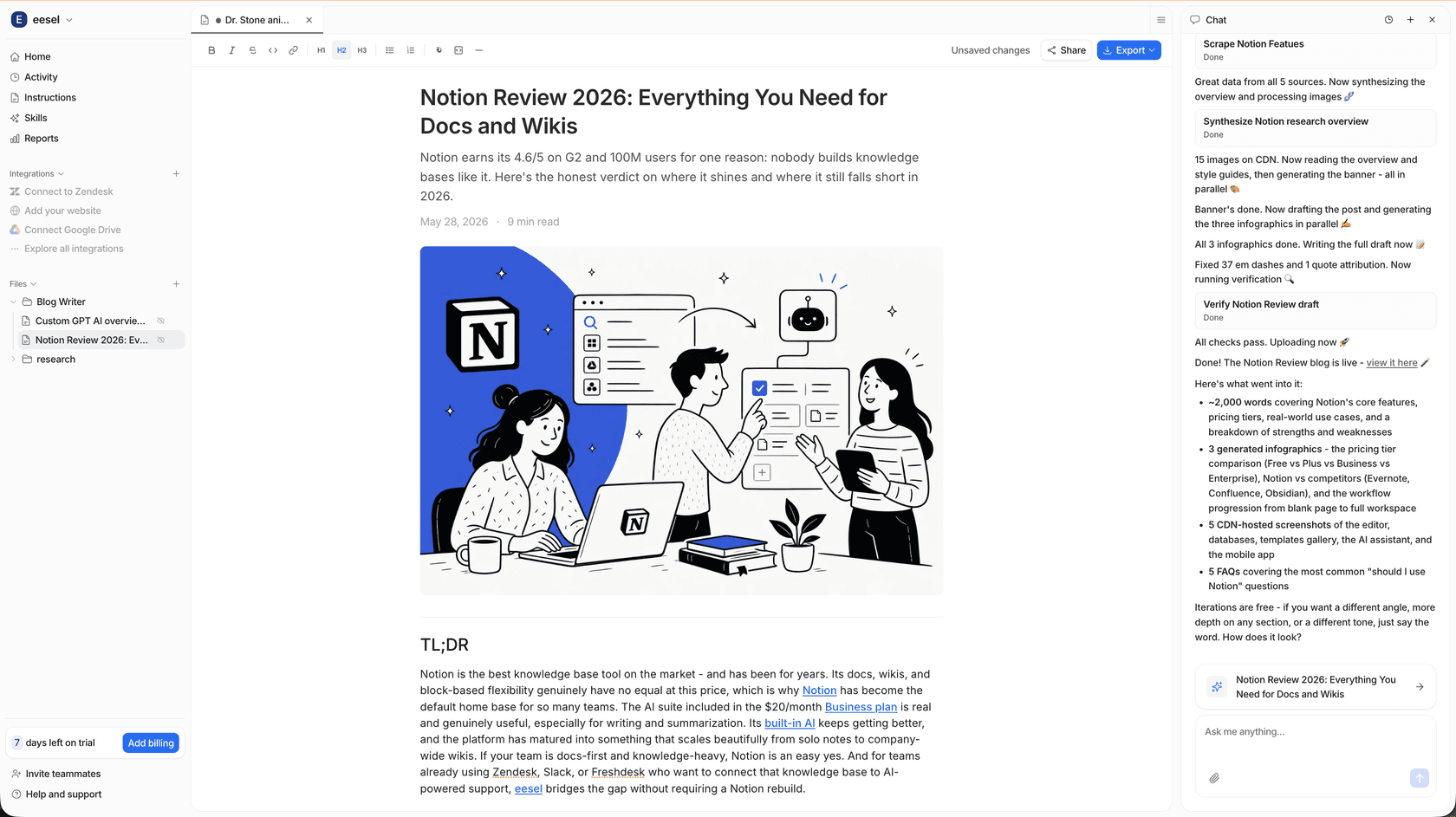
- Full-cycle automation: A key feature of the eesel AI blog writer is its ability to produce a complete first draft. It generates a fully structured article with AI-generated images, infographics, relevant YouTube videos, and even real Reddit quotes for social proof.
- Context-aware research: Its research is smart. It knows that a comparison post needs pricing data and a technical article needs specs, which saves you hours of manual digging.
- AEO and SEO optimized: The platform optimizes content for both traditional Search Engine Optimization (SEO) and Answer Engine Optimization (AEO), which helps your content show up in places like Google AI Overviews and Perplexity.
- Limitations: While eesel AI creates high-quality drafts, it's not for people who want to write every single word themselves. The platform is all about automating the entire content process, so it might be overkill if you just need a simple writing assistant.
Pricing
- Free Trial: Generate your first blog post for free.
- Pay-as-you-go: $99 for 50 blog posts.
Why we chose it
It's the only tool on this list that handles the entire content workflow: from research and writing to creating assets and handling SEO. For teams that need to scale up content production, it is a strong option.
2. Dynadot
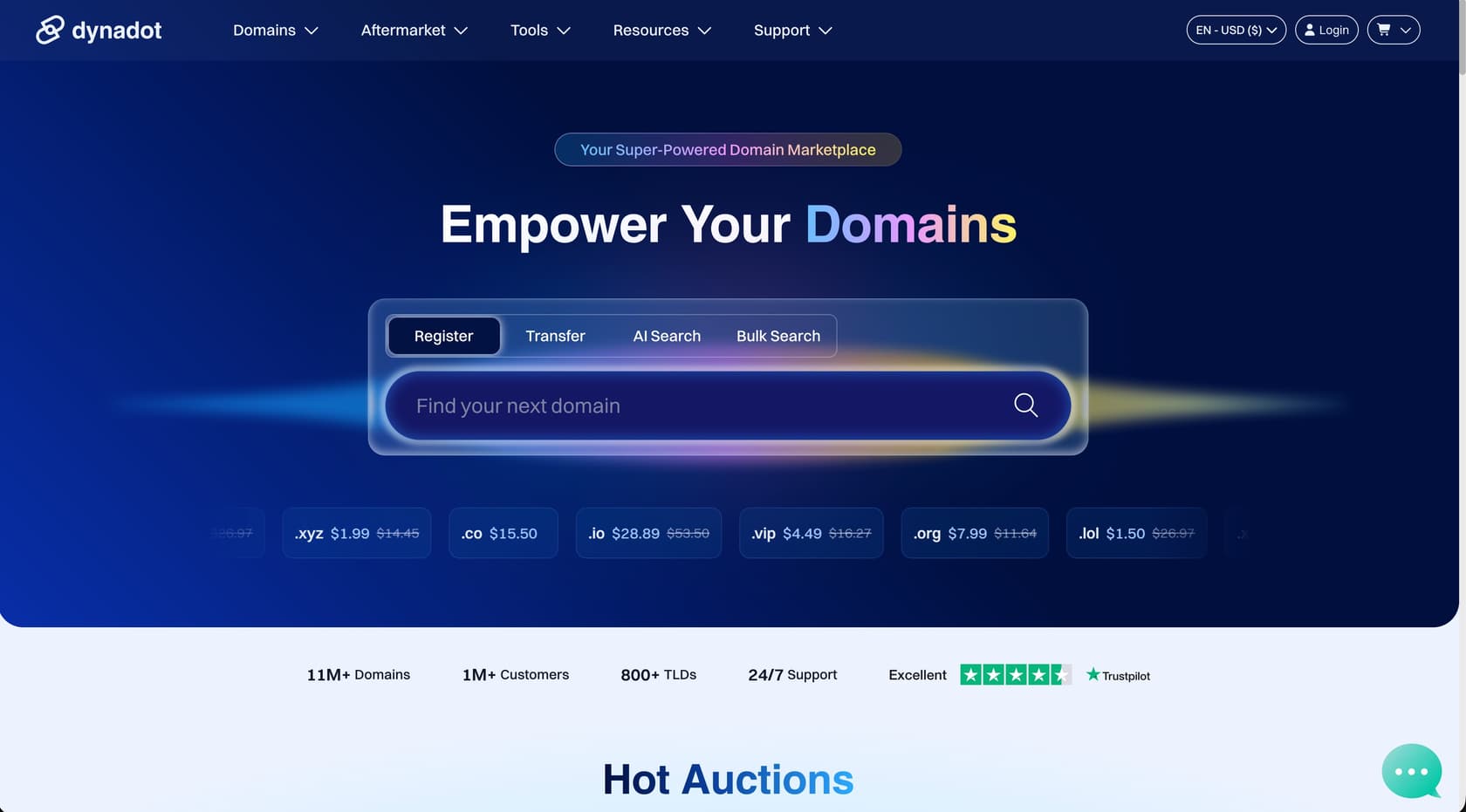
Dynadot is a domain registrar for buying the name for your blog. You search for a domain name, see what's available, and register it before someone else grabs the same idea.
Key points
- Straightforward search: Type in the name you want and check availability and pricing across domain extensions.
- DNS handled in the same place: Once it's registered, pointing the domain at your blog host or setting up a redirect doesn't need a separate tool or extra fee.
- Bulk registration for multiple sites: If you're running more than one blog or grabbing a few name variations, the bulk tools save you from doing it one at a time.
- Limitations: Its role in this stack is domain registration and management. Although Dynadot also offers a website builder, you'll still want dedicated tools for writing, SEO research, and content design.
Pricing
- .com registration is listed at $10.88 for the first year.
- Some extensions, such as .xyz, have first-year promotions under $2. Renewal rates are higher than promotional prices.
- Pricing may vary based on the extension, promotions, and currency exchange rates. Check the registration and renewal prices before purchasing.
Why we chose it
Every other tool on this list focuses on creating, optimizing, or measuring content. Dynadot covers an earlier step: securing your blog's domain and connecting it to your host.
3. Surfer SEO
Surfer SEO is a tool that helps you rank higher by analyzing what the top-performing pages for your keyword are doing right. It gives you a data-backed blueprint for what to include in your article, covering everything from keyword density and structure to word count.
Key points
- Core features: Surfer's Content Editor feature gives you a real-time "Content Score" that updates as you write. It also has tools like
Content Auditto optimize existing pages andTopical Mapto find content gaps. - AI search optimization: The platform now helps you get visibility in AI chats like ChatGPT and Google AI Overviews, with features like the Surfer AI Tracker on its higher-tier plans.
- AI writing tools: Surfer also has an
AI HumanizerandAI Detectorto help refine AI-generated text and make it sound more natural. - Limitations: While Surfer has AI writing features, its primary strength is on-page optimization. Its process provides a detailed blueprint for content, which can be an additional step in a workflow. Some platforms, like the eesel AI blog writer, integrate SEO best practices into the initial draft, offering a different approach to content creation.
Pricing
- Essential: $99 per month for 30 Content Editor articles.
- Scale: $219 per month for 100 Content Editor articles and 5 AI Tracker prompts.
- Enterprise: Custom pricing for agencies and large brands.
Why we chose it
For bloggers who write their content manually, Surfer SEO provides a data-driven checklist that ensures every article is fully optimized for search engines before it goes live.
4. Canva
Canva is a web-based design tool that makes it incredibly easy for non-designers to create professional-looking graphics. From featured images to infographics, it has become a go-to for content creators.
Key points
- Ease of use: Canva's main strength is its simplicity. With a huge library of templates, stock photos, and an intuitive drag-and-drop interface, you can create custom graphics in minutes.
- AI features: The Canva Magic Studio™ offers a suite of AI tools like Magic Write for generating copy and Magic Media for turning text into images and videos.
- Generous free plan: The free version is surprisingly powerful and is often enough for most bloggers' day-to-day needs.
- Limitations: While it's great for most blogging tasks, Canva isn't a replacement for professional software like Adobe Photoshop. Its abilities for complex photo editing or custom illustrations are limited. It's also a separate step in your workflow, as you have to create the visuals and then upload them to your blog.
Pricing
- Free: Access to thousands of templates and design elements.
- Canva Pro: $120 per year for one person, which gives you access to premium content and advanced AI tools.
- Canva Business: $200 per year per person, with extra collaboration features.
Why we chose it
Good visuals are key for engagement, and Canva is the most accessible and user-friendly tool out there for creating them. It lets any blogger produce compelling designs without a design background.
5. Ahrefs
Ahrefs is a heavy-duty SEO platform that's essential for keyword research, link building, and checking out what your competitors are doing. It provides a ton of data that can shape your entire content strategy.
Key points
- Powerful toolset: Ahrefs offers some of the most accurate SEO data you can get. Its Keywords Explorer is a top-notch tool for finding high-volume, low-competition keywords, and
Site Explorergives you deep insights into competitors' backlinks and top content. - Technical SEO: The
Site Audittool scans your site for over 170 technical and on-page SEO issues, helping you keep your website healthy. - AI visibility tracking: With its Brand Radar add-on, Ahrefs lets you track brand mentions across AI search platforms like Google AI Overviews and ChatGPT.
- Limitations: The main hurdles with Ahrefs are its price and complexity. It's a professional-grade tool with a steep learning curve and a high monthly cost, which can be a dealbreaker for new or solo bloggers.
Pricing
- Lite: $129 per month for 1 user.
- Standard: $249 per month for 1 user.
- Advanced: $449 per month for 1 user.
- Enterprise: $1,499 per month with an annual commitment.
Why we chose it
When it comes to building a long-term, data-driven SEO strategy, Ahrefs is hard to beat. It gives you the deep insights you need to find ranking opportunities and get ahead of the competition.
6. Google Analytics

Google Analytics is a free web analytics service that tracks and reports your website traffic. It’s a foundational tool for any blogger, offering crucial insights into how your audience behaves and how your content performs.
Key points
- Industry standard: It's free, powerful, and everyone uses it. Google Analytics tells you which posts are popular, where your traffic is coming from (like search or social media), and who your audience is.
- Actionable data: This information is vital for understanding what content connects with your audience, so you can adjust your strategy and double down on what works.
- Limitations: The interface can be a bit much for beginners. More importantly, Google Analytics is reactive, it tells you about past performance but doesn't help you create future content.
Pricing
- Free: The standard version is completely free and is more than enough for almost any blogger.
- Analytics 360: Enterprise-level pricing for very large businesses.
Why we chose it
You can't improve what you don't measure. Google Analytics provides the essential data every blogger needs to understand their audience and track their growth.
How to build your perfect stack of blogging tools
But the biggest trend right now is the move toward integrated AI platforms. Instead of juggling multiple tools for writing, SEO, and design, you can use a single platform that handles the whole workflow. This approach doesn't just save money; it streamlines content creation and saves you hours on every single post. Figure out your biggest bottleneck, whether it's research, writing, or optimization, and pick a tool that solves that problem first.
For a deeper look into how AI is changing the game and which tools are leading the charge, check out this overview of the top AI tools that can transform your content creation process.
Streamline your workflow to scale your blog
The right blogging tools can turn content creation from a chore into an efficient, scalable system. While specialized tools for SEO and design have their place, the biggest win comes from automating the most labor-intensive parts of the job.
By using an all-in-one AI content platform, you can get rid of the repetitive tasks of drafting, researching, and finding visuals. This frees you up to focus on the high-level strategy that actually grows your blog and gets results.
Ready to see how much time you can save? Generate your first blog post for free.