
Lots of businesses publish content, but not many see real results. If you're putting in the work without getting much back in traffic, engagement, or new leads, you're not alone. The issue usually isn't about effort, but about not having a clear plan.
The answer isn't just to write more content; it's to work smarter. The right blog writing strategies are what separate high-performing posts from ones that just sit there. This guide will walk you through six practical strategies that cover everything from research and drafting to promotion.
Modern strategies use smart tools to get things done efficiently. For example, the eesel AI blog writer helps teams put these plans into action by turning a single keyword into a post that's ready to publish. It handles a lot of the tedious work so you can focus on the bigger picture.
What are blog writing strategies?
A blog writing strategy is basically a roadmap for your content. It’s a documented plan that guides how you create, optimize, and promote your articles to hit specific business goals. It’s not just about what you write, but the entire process behind it.
This means you need to understand your audience, define your goals, do your keyword research, and make sure every post has a purpose. It forces you to ask the important questions: Who are we writing for? What problems are we solving for them? How will this article help our business?
A good strategy brings consistency and quality to your work. It helps you build trust with your readers over time and makes sure your content is actually working toward larger goals, like building brand awareness or bringing in leads.
Why documented blog writing strategies are crucial for success
- Consistency and quality: A strategy helps you stick to a regular publishing schedule and maintain a high standard for every article. This is how you build an audience that trusts you and keeps coming back for more.
- Better audience engagement: When your strategy is built around your audience's needs, you create content that actually connects with them. You're not just guessing what they want to read; you're solving their real problems.
- Improved SEO performance: Keyword research and on-page optimization become part of the process from the start, not something you tack on at the end. This is a must for improving your search engine rankings.
- Efficient resource management: A clear plan helps you manage your time and resources well. It gets rid of writer's block and the last-minute scramble for topics, making your whole workflow smoother.
How we selected these blog writing strategies
We chose the strategies on this list based on a few key things to make sure they're genuinely useful.
- Proven effectiveness: Each strategy has a track record of driving real results, like more organic traffic and better reader engagement. These aren't just theories; they're methods that work.
- Scalability: These approaches can be adapted for anyone, whether you're a solo blogger or part of a big content marketing team.
- Relevance for 2026: They take the modern content world into account, including the growing role of AI and the changing demands of search engines.
- Actionable advice: Every strategy is practical. You can start using them right away with the right tools and a clear process.
Comparison of top tools for your blog writing strategies in 2026
While a strategy is your foundation, the right tools help you execute it. This table gives a quick overview of tools that support the different strategies we'll discuss, helping you see where each one fits into the workflow.
| Tool | Primary Strategy | Best For | Starting Price | Free Plan/Trial |
|---|---|---|---|---|
| eesel AI blog writer | AI Content Creation | Automating publish-ready, SEO-optimized first drafts with assets. | $99 for 50 blogs | Yes, free to try |
| Ahrefs | SEO & Keyword Research | In-depth competitor analysis, keyword research, and backlink tracking. | $129/month | No, but free Webmaster Tools |
| Grammarly | Editing & Readability | Improving grammar, spelling, tone, and clarity in real-time. | $12/month (billed annually) | Yes, free version available |
| CoSchedule | Content Planning & Promotion | Organizing, scheduling, and promoting content from a single calendar. | $29/user/month | Yes, free version available |
| Canva | Visual Content Creation | Creating custom images, infographics, and social media graphics. | $120/year | Yes, free version available |
6 key blog writing strategies to implement
Here’s a breakdown of the most impactful blog writing strategies you can start using today. Each one includes practical advice and a spotlight on a tool that helps you execute the plan.
1. Automate first drafts with AI

Tool spotlight: eesel AI blog writer
eesel AI isn't just another text generator. It’s designed to take a single keyword and produce a complete, publish-ready blog post with a human-like tone, SEO optimization, and rich media assets. It’s the exact tool we used to grow our own organic traffic from 700 to 750,000 daily impressions in just three months by publishing over 1,000 optimized blogs.
- Pros: The content is built on context-aware research, automatically pulling in relevant data, real Reddit quotes, and helpful YouTube videos. Unlike tools that only give you a wall of text, eesel generates a full suite of assets like images and infographics. Its output is also optimized for AEO (Answer Engine Optimization), getting it ready for Google’s AI Overviews.
- Cons: As a specialized AI blog generator, it’s focused on creating high-quality, long-form content. It doesn't offer the broad suite of general marketing tools that some larger platforms do.
- Pricing:
- It's completely free to try.
- The paid plan is $99 for 50 blog generations.
- Why we chose it: It provides an efficient way to execute a high-volume, high-quality content strategy without sacrificing the human touch needed to rank and engage readers.
2. Ground your content in SEO and keyword research
Great content doesn't do much if no one can find it. This strategy is all about using data to understand what your audience is searching for and how your competitors are performing. The goal is to find relevant keywords where you have a real chance to compete and provide unique value. It’s about being strategic, not just lucky.
Tool spotlight: Ahrefs
Ahrefs is a comprehensive SEO platform that provides a massive amount of data on keywords, competitor performance, backlinks, and content gaps. For many serious content marketers, it's the gold standard for SEO research.
- Pros: Its Keywords Explorer tool is incredibly powerful for discovering new topic ideas and understanding their potential. The competitor analysis features let you see exactly which pages and keywords are driving traffic for others, giving you a clear roadmap.
- Cons: The platform can be overwhelming for beginners because of the sheer volume of data. It also comes with a higher price tag, which might be a barrier for solo bloggers or small businesses.
- Pricing:
- Lite: $129/month
- Standard: $249/month
- Advanced: $449/month
- Why we chose it: Ahrefs provides some of the most comprehensive and actionable insights available for data-driven content planning. While there's no traditional free trial, they do offer free Ahrefs Webmaster Tools to analyze your own sites.
3. Prioritize readability and error-free writing
Your content has to be easy to read and understand. Online readers don't have much patience; they skim, and big blocks of text, complex sentences, or simple grammar mistakes can be enough to make them leave. This strategy focuses on making content clear and scannable with short paragraphs, simple language, and proper formatting. Professionalism matters.
Ironically, the OP has several errors in their content.

Tool spotlight: Grammarly
Grammarly is an AI-powered writing assistant that checks for grammar, spelling, punctuation, clarity, and tone. It integrates directly into your browser and word processor, offering suggestions as you write.
- Pros: It goes far beyond a basic spell-check, offering suggestions to improve sentence structure and overall clarity. The tone detector is a great feature for making sure your writing matches your brand voice. Its new AI agents can also help with more advanced tasks like finding citations.
- Cons: The premium version's suggestions can sometimes be a bit too formal and may not always fit a conversational blog style. It's a great proofreader, but it can't replace a human editor for checking facts or the logical flow of an argument.
- Pricing:
- Free: Basic writing suggestions for grammar and spelling.
- Pro: Starts at $12/month when billed annually.
- Enterprise: Custom pricing for teams.
- Why we chose it: It’s an essential tool for maintaining a high standard of quality, ensuring every piece of content you publish is polished and error-free.
4. Organize your workflow with a content calendar
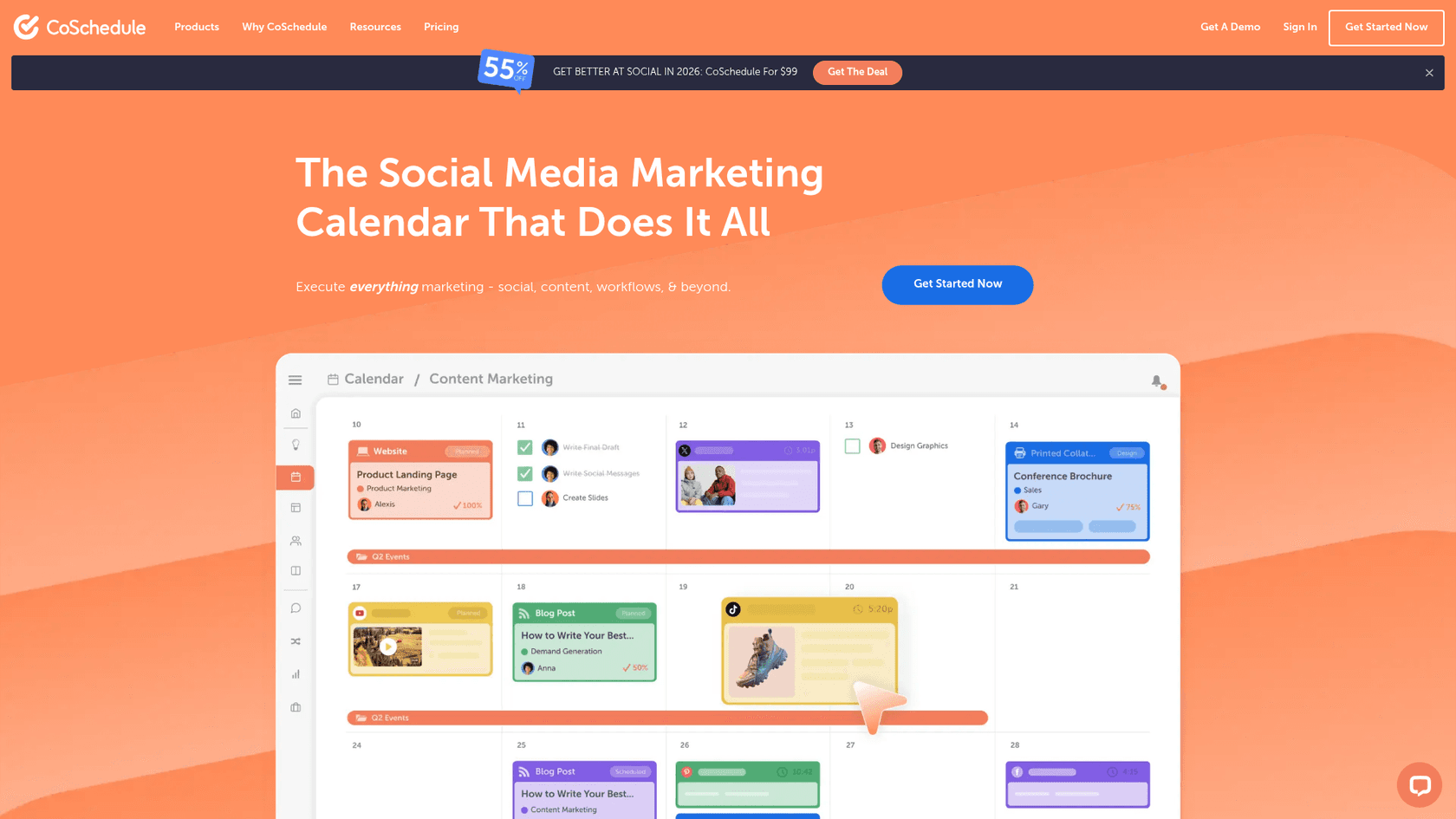
Consistency is one of the most important factors in building a loyal audience. A content calendar is a central hub for planning, scheduling, and tracking all of your content. It helps you visualize your publishing schedule, align your content with marketing campaigns, and maintain a steady stream of posts.
Tool spotlight: CoSchedule
CoSchedule offers a family of marketing calendar products that help you organize blog posts, social media promotions, and email newsletters all in one place. It’s designed to bring order to the chaos of content marketing.
- Pros: The platform provides a clear, visual overview of your entire content plan, which is great for team collaboration. Its popular Headline Studio feature is excellent for crafting titles that are more likely to get clicks. The ability to schedule social media posts directly from the calendar streamlines your promotion workflow.
- Cons: It can get expensive for larger teams or those who need the advanced features in their full Marketing Suite. A solo blogger might find that a basic spreadsheet is a more cost-effective solution.
- Pricing:
- Free Calendar: Basic features for individuals.
- Social Calendar: Starts at $29/user/month.
- Content Calendar & Marketing Suite: Custom pricing.
- Why we chose it: It’s a great all-in-one solution for teams that need to organize a complex content pipeline and promotion schedule from a single dashboard.
5. Enhance engagement with compelling visuals
A wall of text is intimidating. Visuals like images, infographics, and charts are crucial for breaking up content, making it more engaging, and explaining complex ideas quickly. High-quality, relevant visuals can significantly increase the time visitors spend on your page and make your content more shareable.
Tool spotlight: Canva
Canva is a user-friendly graphic design platform that makes it incredibly easy for non-designers to create professional-looking visuals for blogs, social media, and more.
- Pros: It has a massive library of templates, stock photos, and icons. The drag-and-drop interface is highly intuitive, allowing anyone to create everything from featured images to detailed infographics without any design experience. The AI-powered Magic Studio helps speed up the creative process even more.
- Cons: While the free version is quite powerful, many of the best templates and assets are reserved for the Pro subscription. It’s not a replacement for software like Adobe Photoshop for highly custom design work.
- Pricing:
- Free: Core features and a good selection of free assets.
- Pro: $120/year for one person.
- Business: Starts at $200/year per person.
- Why we chose it: It makes professional design accessible to everyone, empowering content creators to produce stunning visuals that elevate their blog posts.
6. Systematize content promotion
Hitting "publish" is just the beginning. A successful content strategy must include a repeatable process for distributing your articles across channels like social media, email newsletters, and online communities. This ensures your content reaches the widest possible audience.
Tool spotlight: CoSchedule
Beyond just planning, CoSchedule is also a powerful tool for executing your promotion strategy. You can schedule and publish social media messages directly from the same calendar where you plan your blog posts.
- Pros: The ReQueue feature is a standout. It automatically fills gaps in your social media schedule by resharing your best evergreen content. This keeps your social feeds active and drives continuous traffic back to your blog with minimal effort.
- Cons: Again, for a solo blogger with simple needs, the automation features might be more than what's necessary, and the cost could be a factor.
- Pricing: Advanced social media features like ReQueue are available in the paid plans, which start at $29/user/month.
- Why we chose it: It seamlessly connects content creation with promotion, creating a unified system that ensures your great content gets the visibility it deserves.
Tips for creating your own blog writing strategy
Getting started doesn't have to be complicated. Here are a few practical tips to help you build your own strategy.
- Start with your audience: Before you write a single word, create a detailed persona of your ideal reader. What are their goals and pain points? What questions are they typing into Google? All good content starts here.
- Set SMART goals: Define what you want your blog to achieve. Is it brand awareness, lead generation, or sales? Make your goals Specific, Measurable, Achievable, Relevant, and Time-bound. "Get more traffic" is a wish; "Increase organic traffic by 15% in Q3" is a goal.
- Don't overcomplicate it: Your strategy doesn't need to be a 50-page document. Start with a simple content calendar in a spreadsheet and a list of topic ideas from your keyword research. You can build on it over time.
- Measure and adapt: Use a tool like Google Analytics to track what’s working. Pay attention to metrics like page views, time on page, and bounce rate to understand which topics connect most with your audience, and adjust your strategy accordingly.
For a deeper dive into creating content that gets noticed, check out this video from Brian Dean. He breaks down his process for writing posts that generate significant traffic and engagement, which aligns perfectly with the strategies we've discussed.
A successful blog isn't built on guesswork; it's the result of a solid, repeatable strategy. By focusing on a clear plan, you can create content that not only attracts readers but also achieves real business goals.
To recap, the six core strategies are automating first drafts with AI, grounding your content in SEO research, prioritizing readability, organizing your workflow with a calendar, enhancing posts with visuals, and systematizing your promotion.
The most important step is to just start. You don't have to do everything at once. Choose one or two of these strategies to focus on first, master them, and then build from there.
Ready to see how AI can transform your content creation? Try the eesel AI blog writer for free and generate your first publish-ready blog post in minutes.



