

Trying to scale your content often feels like an uphill battle. You know more blog posts are key to ranking and getting traffic, but there’s a finite number of hours in a day. AI writing tools promise a solution, but two of the biggest names, Article Forge and Writesonic, approach the problem from completely different angles. Article Forge is all about one-click automation, spinning a keyword into a full article. Writesonic, on the other hand, is more of an all-in-one toolkit for marketing and visibility.
Picking between them isn't easy because they're designed for different jobs. One is for pure, hands-off speed, while the other is for teams wanting a suite of tools for content, SEO, and even AI search optimization. This guide will break down what each platform does best so you can figure out which one fits your workflow. And if you want to skip the "AI draft" step and get a complete, ready-to-publish post, tools like the eesel AI blog writer are built to deliver a finished product with images, quotes, and proper formatting right away.
What is Article Forge?
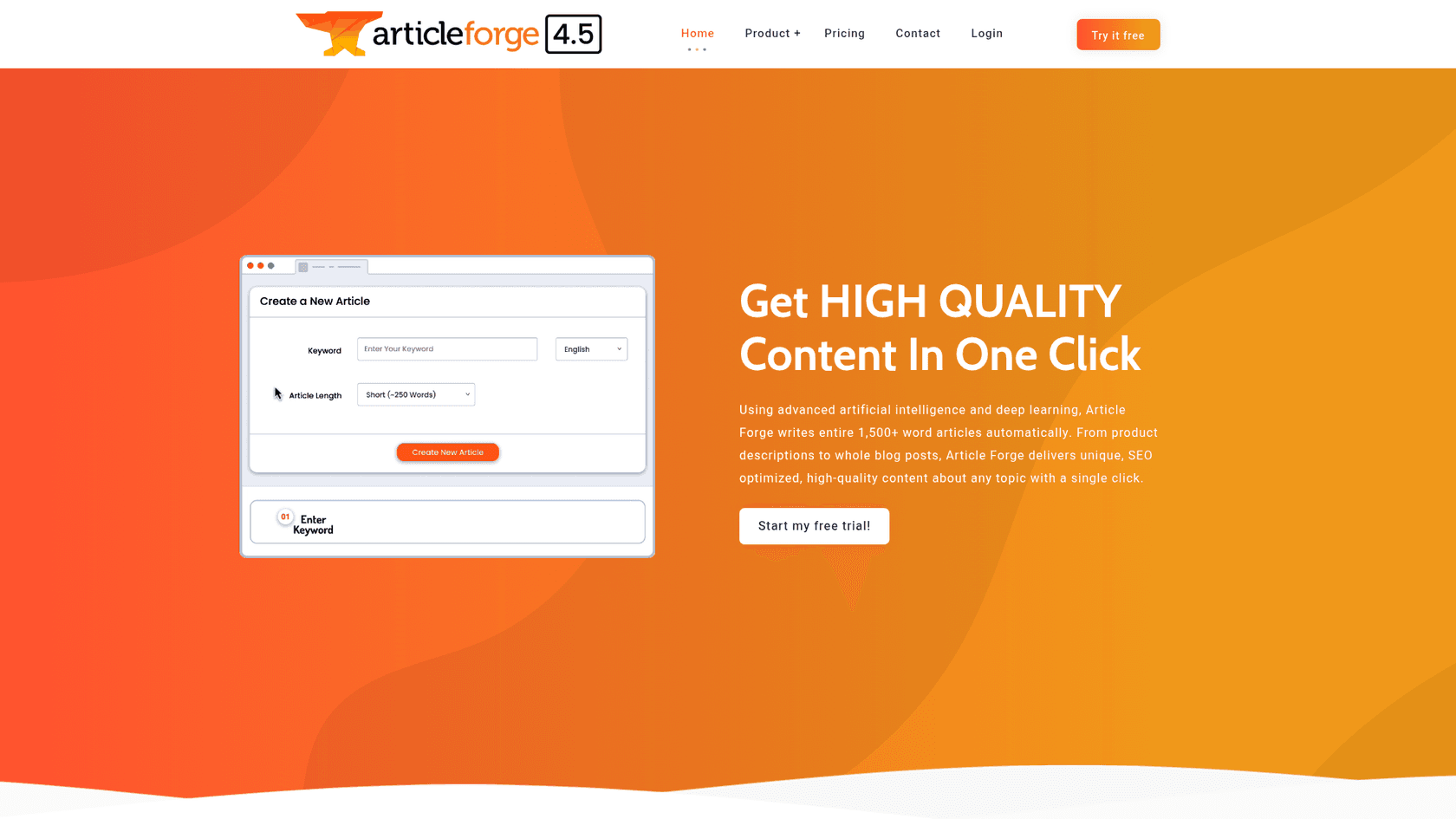
So, how does it pull this off? Article Forge runs on deep learning models trained for over a decade. When you enter a keyword, the AI researches the topic online, maps out a structure, and then writes the content from scratch. The whole thing is designed to be as hands-off as possible, which is great for anyone needing to produce a high volume of SEO content without getting stuck in the writing weeds. It’s a popular choice for affiliate marketers, agencies, and bloggers who need to churn out articles at scale.
A few key features make it stand out:
- End-to-end article generation: It takes care of everything from research to writing with just one keyword.
- Real-time content: It can write about current events as they happen, so your information isn't stale.
- Avoids AI detection: It has a specific feature to make the content sound more human, which helps it pass AI detection tools.
- Bulk generation: You can create multiple articles at once and even connect it via an API to automate your content pipeline or post directly to WordPress.
What is Writesonic?
Writesonic bills itself as more than an article generator. It’s an AI visibility platform meant to help marketing teams get their brand noticed everywhere, from old-school Google searches to new AI answer engines like ChatGPT and Gemini. The goal isn’t just to create content, but to make sure people actually see it.
This makes it a solid choice for marketing teams and SEO professionals who need a tool that can juggle various tasks, not just writing. If you're trying to optimize for the future of search, Writesonic has the tools for the job.
Its key features include:
- AI Visibility Tracking: This shows you where and how your brand is being mentioned on platforms like ChatGPT and Perplexity.
- Content Engine: A tool for creating new SEO-optimized content or refreshing existing articles, complete with citations and sources.
- SEO AI Agent: Delivers real-time data and automates optimization tasks to improve your rankings.
- Automatic internal linking and image generation: It handles some of the more tedious parts of content production for you.
Feature breakdown: Article Forge vs Writesonic
Alright, let's dig into the specifics. Here’s how the two platforms compare in a few key areas.
Content generation and AI detection
Article Forge is all about a single, clean workflow: you give it a keyword, it gives you an article. Its biggest claim is its ability to produce content that doesn't get flagged by AI detectors. A case study they published is quite revealing. With the "Avoid AI Detection" feature on, their content passed detectors like Originality.ai with a 99% score, the same as human-written articles.
Verdict: For users whose main goal is creating content that can pass AI detectors with minimal effort, Article Forge is a strong option.
SEO and optimization capabilities
SEO is part of Article Forge's core design. The AI is programmed to create content structured in a way that Google's algorithms tend to favor. But that's where it stops. It doesn't offer the deep, data-driven SEO tools you might find elsewhere, like competitor analysis or real-time keyword data.
This is where Writesonic stands out. It's a full-fledged Generative Engine Optimization (GEO) platform. It provides tools like AI Visibility Tracking, citation gap analysis, and sentiment analysis to help you understand how your brand is perceived online. It’s not just built for today's search engines; it’s designed to help you rank in the AI-powered answer engines of the future.
Verdict: Writesonic is the more suitable choice for users who want a data-driven approach to SEO and are looking to optimize for the next generation of search.
Toolset and versatility
Article Forge is a specialist. It’s laser-focused on one thing: generating long-form articles. Its toolset is lean, centered around article creation, bulk generation, and automated posting. It doesn't try to do everything.
Writesonic is the complete opposite. It's incredibly versatile. Beyond articles, it has tools for creating ad copy, social media posts, landing pages, and product descriptions. It also includes an SEO Checker and Optimizer, generates images automatically, and can create content in over 30 languages. It’s like a Swiss Army knife for a marketing team.
Verdict: Writesonic offers greater versatility, making it the more suitable option for teams that need an all-in-one platform to handle a wide range of content and marketing tasks.
Pricing comparison
Price is always a major consideration, and these two platforms have very different structures. Here's a look at what you can expect to pay.
Article Forge pricing plans
Article Forge keeps things simple with word-based plans.
- Standard Plan: Starts at $13/month for 25,000 words. It includes the AI writer, one user seat, bulk generation, and API access. You can scale the word count up if needed.
- Business Plan: This is for teams that need over 500,000 words per month. It comes with custom user accounts and a dedicated account manager, but you'll have to contact them for pricing.
- Trial: They offer a 5-day free trial to test it out, plus a 30-day money-back guarantee as long as you generate fewer than 10 articles.
Writesonic pricing plans
Writesonic’s pricing is based on features, with different tiers unlocking more advanced tools.
- Free Plan: They offer a free-forever plan with no credit card required, so you can try out some of the basic features.
- Lite Plan: Starts at $39/month (billed annually). This plan includes up to 15 articles per month and SEO site audits.
- Professional Plan: This starts at $199/month (billed annually). It’s the first plan that unlocks the powerful AI Search Tracking (GEO) features.
- Advanced & Enterprise: These are higher-tier plans for larger teams, offering more advanced GEO tools, more user seats, and custom limits.
Head-to-head pricing table
| Feature | Article Forge | Writesonic |
|---|---|---|
| Starting Price (Annual) | $13/month (25k words) | $39/month (Lite Plan, 15 articles) |
| Free Tier | 5-day free trial | Limited free plan |
| Core Offering | Word-based limits | Feature-based tiers |
| GEO/AEO Tools | No | Yes (on Professional plan and higher) |
| Best Value For | High-volume, automated article generation | All-in-one marketing and SEO/GEO platform |
Ease of use and workflow
How easy is it to actually use these tools in your daily routine?
Article Forge is about as straightforward as it gets. The workflow is dead simple: enter a keyword, pick a length, and click the "Create New Article" button. It’s made for people who want to spend as little time as possible messing with settings. The learning curve is practically zero.
Writesonic has a more comprehensive interface due to its wide range of features. You are presented with different tools for SEO audits, AI visibility tracking, and various content types. While it offers more capabilities, it also comes with a steeper learning curve.
This post is definitely written by an ai and not even read/edited by the human (see the last sentence) What a time to be alive!

Verdict: If the primary goal is to generate a full article as quickly as possible, Article Forge offers a simpler and faster user experience.
While case studies offer data, seeing these tools in action provides another layer of insight. The following video explores how content from different AI generators, including Article Forge and Writesonic, fares against popular AI detection tools, giving you a real-world look at the challenges of creating undetectable AI content.
An alternative for publish-ready content: eesel AI blog writer
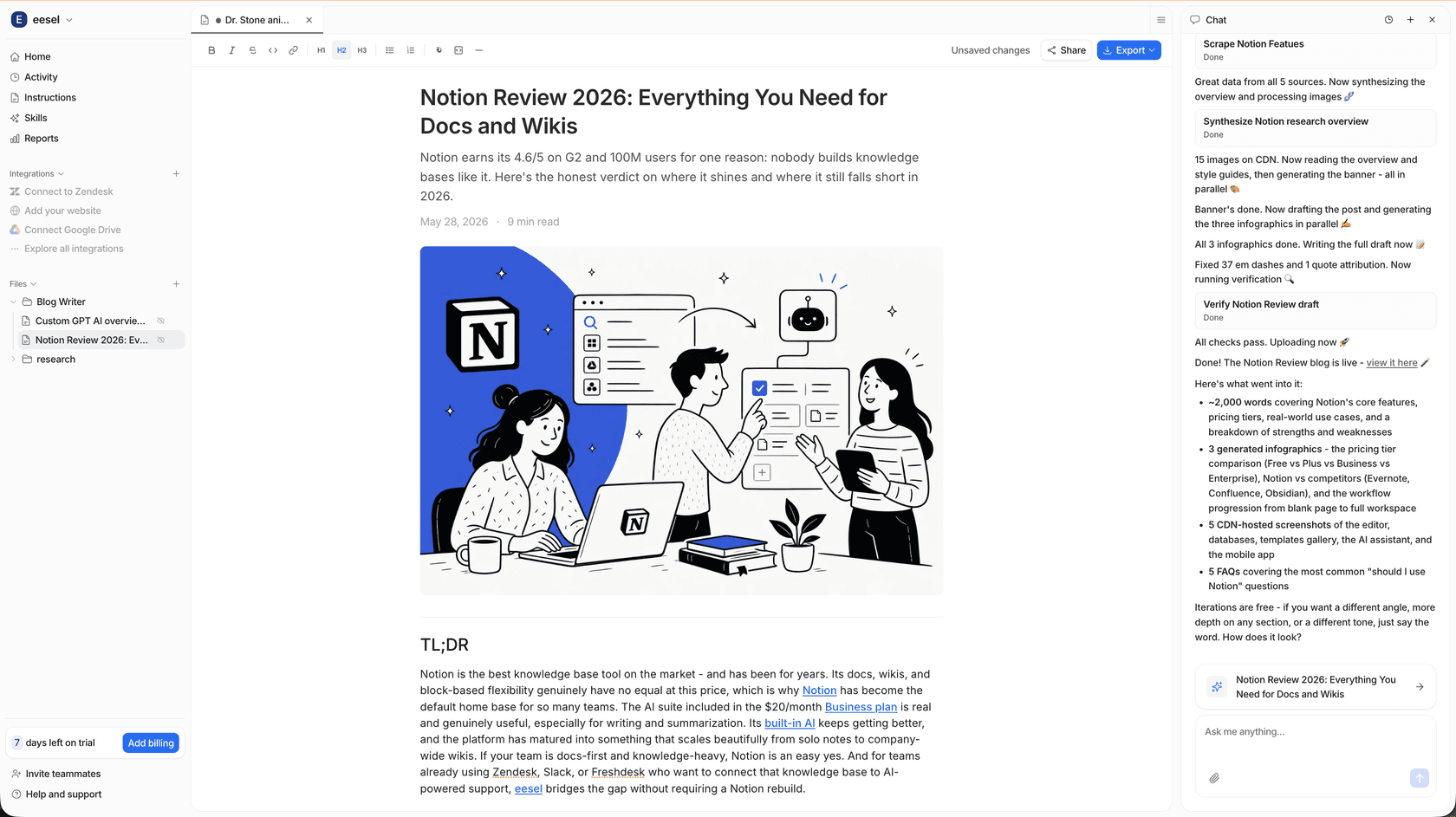
That’s the exact problem the eesel AI blog writer was built to solve. Instead of just giving you a block of text, it generates a complete, publish-ready blog post from a single keyword.
Here’s what makes it different:
- Automatic Assets: It doesn't just write. It creates and inserts AI-generated images, infographics, and data tables directly into the post, making it visually engaging from the get-go.
- Social and Media Integration: To add authority and a human touch, it automatically finds and embeds relevant YouTube videos and real quotes from Reddit discussions.
- Context-Aware Research: The AI is smart enough to know what kind of content it's creating. If you're writing a comparison post, it will automatically pull in pricing data. For a product review, it will find technical specs.
- Proven Results: We use this exact tool ourselves at eesel AI. It's how we grew our blog from 700 to 750,000 daily impressions in just three months by publishing over 1,000 optimized posts.
An infographic detailing the eesel AI blog writer's comprehensive process, an alternative in the Article Forge vs Writesonic discussion.
The best part? It’s completely free to try. You can generate your first post right now and see the difference for yourself.
Final verdict
-
Choose Article Forge if: Your top priority is speed and high-volume automation. It is a suitable tool if you need to produce a high volume of content quickly that can reliably pass AI detection with minimal editing.
-
Choose Writesonic if: You need a versatile, all-in-one platform for your marketing team. It is a strong choice if you value data-driven SEO and GEO capabilities to help optimize for both traditional and AI-powered search.
However, if the goal is to generate a finished piece of content rather than a draft, other tools may be a better fit. For users looking to reduce the manual work of formatting, finding assets, and adding media, the eesel AI blog writer is designed to streamline the process from keyword to a fully published post.