Anyword vs Wordtune: A complete breakdown

Katelin Teen
Katelin Teen
Last edited January 18, 2026
Keeping up with the demand for fresh content can be challenging. AI writing assistants are becoming increasingly popular, promising to make the process easier. Two popular names in this space are Anyword and Wordtune, which approach the writing process from different angles.
Anyword functions as an AI copywriter, generating new marketing copy from scratch. Wordtune acts as an editor, helping to polish what you've already written. This article will break down their features, target audiences, and pricing to help you decide which tool is right for you.
But what if you need more than just a copy generator or an editor? What if you need something that handles the entire content workflow? While Anyword creates copy and Wordtune refines it, platforms like the eesel AI blog writer are built to turn a single keyword into a complete, publish-ready blog post, visuals and all.
What is Anyword?
Anyword is an AI copywriting platform made for marketers who need to create content that converts. It’s not just about generating text; it’s about generating text that gets results.
Anyword is an AI tool for copywriting and content generation designed to assist businesses and marketers in creating compelling content.

A key feature is its Predictive Performance Score. As you generate different versions of copy for an ad or a landing page, Anyword gives each one a score, predicting how well it will resonate with your audience. This helps take some of the guesswork out of A/B testing, letting you start with your strongest options.
Anyword is built for marketers, advertisers, and e-commerce managers. If your day involves writing social media ads, email campaigns, landing page headlines, or product descriptions, Anyword is designed to make that process smoother. It’s less focused on long articles and more on crafting short, punchy, data-driven copy meant to drive a specific action.
What is Wordtune?
Wordtune is an AI-powered writing companion that’s all about improving the text you’ve already put down. It doesn't generate content; it refines it. It functions like a thesaurus and style editor rolled into one, helping you say what you mean, but better.
It offers advanced sentence restructuring to ensure that each sentence is grammatically correct and stylistically compelling.
Its main job is to help you rephrase sentences to sound more professional, casual, or just a little different. You can highlight any sentence, and Wordtune will offer a handful of alternatives. It can also shorten text to be more concise or expand on a point to add more detail. It's a great tool for pushing past writer's block or just finding the perfect turn of phrase.
The ideal user for Wordtune is pretty much anyone who writes. That includes students polishing papers, professionals drafting important emails, editors refining articles, or bloggers trying to improve the flow of their posts. It works through a browser extension, so it’s always there when you need it in Google Docs, Gmail, or even on LinkedIn.
Anyword vs Wordtune: A feature comparison
Content generation vs. refinement
- Anyword: This tool is all about creating new content. You give it a prompt, like a product description or an ad idea, and it generates multiple copy variations for you to pick from. It’s a generator made to kickstart marketing campaigns.
- Wordtune: This tool focuses on editing and improving existing text. You write something first, and then Wordtune helps you polish it. It’s a refiner and editor built to improve clarity, tone, and style.
- Verdict: The tools serve different purposes, so a direct comparison is difficult. Anyword is for starting the writing process, while Wordtune is for finishing it. They solve two different problems and could even be used together.
Use cases and target audience
- Anyword: This is for marketing and sales teams. Its entire feature set is built around creating high-converting, short-form copy. Think paid ads, website headlines, email subject lines, and social media posts. The goal is to produce a lot of options and pick the one most likely to get clicks.
- Wordtune: This is for individuals who want to write better. It’s perfect for anyone working on long-form content like articles or reports, as well as everyday stuff like emails and messages. It’s about enhancing the quality of your own words.
- Verdict: The choice here really depends on your job. If you live in spreadsheets and measure success by conversion rates, Anyword is your tool. If you live in documents and measure success by clarity, Wordtune is the way to go.
User experience and integrations
- Anyword: Anyword is a standalone web app. You log in, create a project, and generate your copy inside its platform. It’s a central hub for managing all your AI-generated marketing copy.
- Wordtune: Wordtune’s magic happens through its browser extension. It fits right into the places you already write, like Google Docs, Gmail, Outlook, and LinkedIn. It feels less like a separate tool and more like a part of your existing workflow.
- Verdict: Wordtune offers a more seamless, "in-the-flow" experience. You don't have to switch tabs or copy-paste text to use it. Anyword’s platform is better for teams managing multiple campaigns, but it's a more deliberate process.
Output quality and control
- Anyword: The quality of Anyword's output is judged by its predicted performance. It gives you data-backed options, but you might need to tweak them to perfectly match your brand’s voice. Your control comes from picking the best-performing variation it offers.
- Wordtune: Wordtune provides suggestions that are almost always grammatically perfect and contextually aware. It’s great at capturing nuance. The best part is that you have complete control. It’s an assistant offering ideas, not an autonomous writer taking over.
- Verdict: For pure writing quality and user control, Wordtune has the edge. It helps you sound like a better version of yourself. Anyword’s output is designed for conversion, so its quality is measured by a different yardstick.
Anyword vs Wordtune: Pricing
Let's talk money. Both tools offer different pricing tiers based on features and usage, so here’s a look at what you can expect. (Note: Prices can change, so always check their official websites for the latest info!)
Anyword pricing
Anyword is aimed at businesses and has plans that scale with your team's needs.
- Free: A trial plan to test out the basic features.
- Starter: Aimed at solo marketers, this plan usually offers a set number of word credits per month for generating copy.
- Business: Designed for teams, this tier typically includes more word credits, multiple users, and advanced features like brand voice customization.
- Enterprise: A custom plan for large organizations that need unlimited usage and dedicated support.
Wordtune pricing
Wordtune's pricing is more approachable for individuals and small teams.
- Free: The free plan gives you a limited number of "rewrites" per day, which is fine for casual use.
- Premium: This is the most popular plan for individuals. It offers unlimited rewrites, tone adjustments, and length changes.
- Premium for Teams: This plan bundles the premium features for multiple users under a single bill.
Here’s a quick comparison:
| Feature | Anyword | Wordtune |
|---|---|---|
| Plan | Starter | Premium |
| Price | Typically starts around $39/month (billed annually) | Typically starts around $9.99/month (billed annually) |
| Key Features | Predictive Performance Score, copy generation, templates for ads & emails | Unlimited rewrites, tone adjustment, sentence shortening/expanding |
| Best For | Marketers & advertisers | Writers, students, & professionals |
Limitations for content marketing
While Anyword excels at short copy and Wordtune is effective for polishing text, neither one offers a complete solution for scaling a content marketing strategy, especially for long-form blog posts.
- No End-to-End Workflow: With either tool, you are still responsible for many parts of the content creation process. You have to come up with the topic, do keyword research, create an outline, write the draft, and then format everything. Neither Anyword nor Wordtune can take you from a single idea to a fully published article.
- Lack of Integrated Assets: A good blog post is more than just text. It needs images, infographics, and maybe some social proof. With these tools, you have to stop writing, open another tab, and manually find or create all your visuals. This can be a time-consuming process.
- Limited SEO & AEO Focus: These tools aren’t built to optimize long-form content for search engines. They don't help with keyword placement or structuring content to rank. And they certainly aren't optimized for the new wave of AI Answer Engines (AEO), like Google's AI Overviews, which rely on well-structured, media-rich content.
eesel AI blog writer: An alternative for blog posts
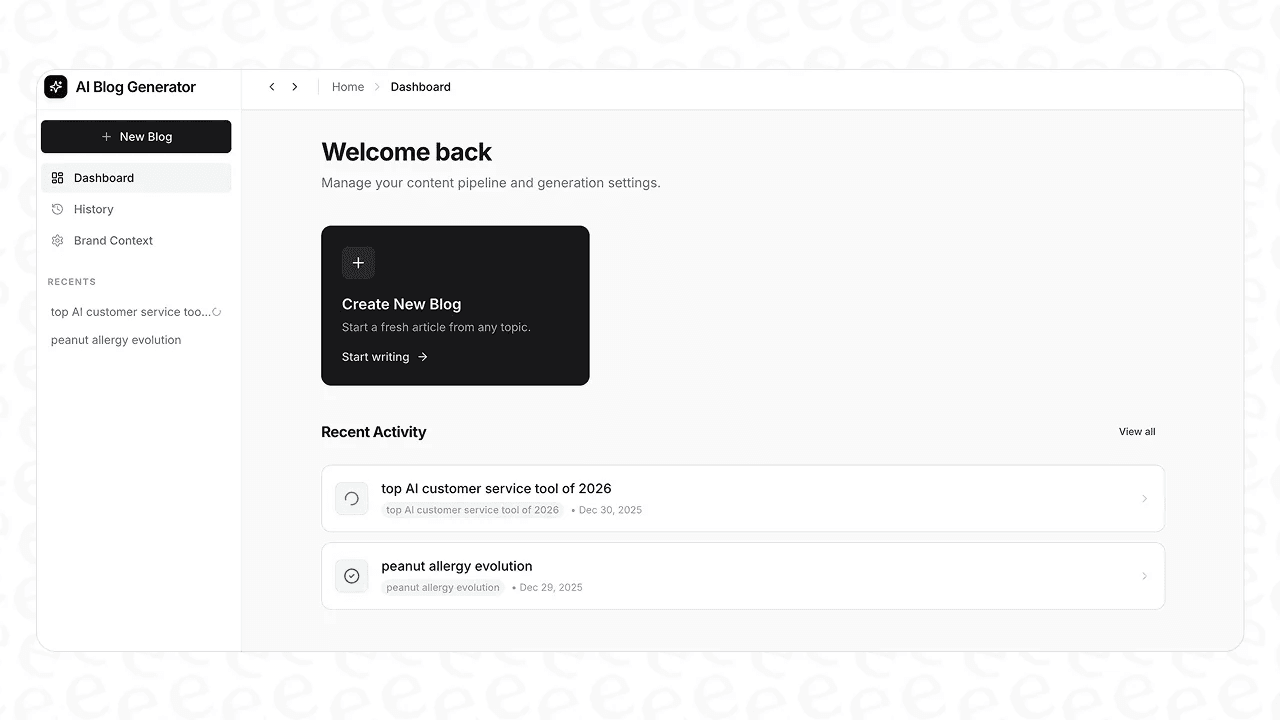
For example, at eesel AI, we used this tool to grow from 700 to 750,000 impressions per day in three months by publishing over 1,000 optimized blogs.
Here’s what makes it different:
- From Keyword to Complete Post: You start with a single topic, and the eesel AI blog writer generates a complete post. That includes an intro, headings, a well-researched body, a conclusion, and even a FAQ section.
- Automatic Assets Included: The AI doesn’t just write text; it creates and embeds relevant images, tables, and infographics. It even finds real Reddit quotes to add authority and social proof.
- Built for SEO and AEO: The content is automatically structured to rank on search engines. It handles keyword placement, heading structure, and formatting, so it's optimized for both traditional search and new AI-generated answers.
- Context-Aware Research: The tool can scan your website to learn your brand voice, ensuring the content sounds like you. For comparison posts like this one, it can even pull relevant data automatically.
To see how different AI writing tools stack up, including alternatives to both Anyword and Wordtune, check out this video breakdown. It offers a broader look at the market and can help you discover other specialized tools that might fit your workflow.
Which AI writer should you choose?
The right tool for you depends on your primary goal.
- Choose Anyword if: You're a marketer focused on creating and testing short-form copy for ads, emails, and landing pages. Its predictive scoring is perfect if your world revolves around conversion rates.
- Choose Wordtune if: You're a writer, student, or professional who wants to improve the quality of your existing text. It’s the perfect companion for refining your drafts.
- Choose eesel AI blog writer if: Your goal is to scale organic traffic by producing complete, SEO-optimized, and visually rich blog posts without all the manual work. It’s for people who need to go from idea to publish-ready content, fast.
For users seeking a more integrated solution to avoid juggling multiple tools for research, writing, editing, and design, a platform that combines these functions may be suitable. If you're ready to automate the entire blog creation process, try the eesel AI blog writer for free and generate your first post in minutes.

Frequently Asked Questions
Share this article

Article by
Katelin Teen
Katelin is an operations specialist at eesel where she uses her psychology training and education experience to optimize B2B SaaS processes. Outside of work, she unwinds with story-driven games, writing, and keeping up with latest tech innovations.