
Keeping your blog content consistently fresh is a huge time commitment. If you're on a content team, you know the drill: the constant cycle of researching, writing, updating old posts, and formatting everything is a full-time job in itself. Trying to scale your organic growth by doing it all manually just isn't going to work anymore.
The good news is that AI tools have come a long way from being simple text generators. They can now help automate the entire content lifecycle, from digging into search results and drafting articles to publishing and refreshing your content.
This guide breaks down the 6 best AI tools I've personally tested, each designed to automate your blog content workflow and give you back some much-needed time. We'll cover tools for different needs, including platforms like the eesel AI blog writer. It's the exact tool we used to grow our blog from just 700 to over 750,000 daily impressions in only three months by automating high-quality, publish-ready content.

What are AI tools to automate blog content updates?
Think of these as AI blog writing tools that automatically manage the most time-consuming parts of creating and maintaining a blog. They go way beyond just spitting out a few paragraphs of text.
When we talk about "automation" here, we're referring to a few key functions:
- Deep research and outlining: They analyze what's already ranking on Google (the SERPs) and build a content structure that’s designed to match what people are searching for.
- Content generation: They produce long-form, well-structured articles that are ready for a final human polish.
- SEO & AEO optimization: These tools are built to incorporate keywords, create a logical heading structure, and optimize content for both traditional search engines and the new wave of AI answer engines like Perplexity and Google's AI Overview.
- Asset creation: Many can automatically generate and embed images, infographics, and even relevant videos right into the post.
- Automated publishing: Some can even connect directly to your CMS (like WordPress) to schedule and post the content for you.
The whole point is to save hundreds of hours, stick to a consistent publishing schedule, and scale your organic traffic in a way that just wasn't possible before. This entire process can be visualized in a simple workflow, as shown in the graphic below.
How we chose the best AI tools for this list
To make sure this list was genuinely useful, I put each tool through its paces based on a few key criteria. Here’s what I looked for:
- Quality of Automation: How much of the process is truly hands-off? Does the tool give you a near-finished product, or does it just hand you a rough first draft that needs hours of manual editing?
- SEO & AEO Features: Does the tool actively help your content rank? I looked for features that optimize for both classic search engines and the new AI-powered answer engines that are changing how we find information.
- Content Quality & Uniqueness: Does the output actually sound like a human wrote it and provide real value? Or is it just generic "AI slop"? I checked for unique insights and the ability to pull in real-world information.
- Ease of Use & Integration: Is the platform easy to figure out? Does it connect smoothly with popular blogging platforms like WordPress, Webflow, or Shopify?
- Value of the Free Plan: How much can you actually do without pulling out your credit card? I prioritized tools that offer a generous free trial or a useful free tier.
Comparison of the best AI tools to automate blog content updates
Here's a quick rundown of the top options so you can compare them at a glance before we get into the detailed reviews.
| Tool | Best For | Key Automation Feature | SEO Optimization | Starting Price |
|---|---|---|---|---|
| eesel AI blog writer | Publish-ready, SEO & AEO-optimized articles | Turns a keyword into a complete blog with assets & citations | Built-in SEO & AEO optimization | Free to try, then $99 for 50 blogs |
| Jasper AI | Versatile marketing content automation | Content Pipelines and AI Agents for various marketing tasks | Surfer SEO integration available as an add-on | Starts at $69/month |
| RightBlogger | Blogger-focused autoblogging workflows | Autoblogging with visual Content Planner | AI SEO Reports & Auto-Optimize feature | Free plan available, Pro plan is $29.99/month |
| Outrank | Fully automated SEO content and backlinking | Daily article generation on autopilot | Integrated backlink exchange network | $99/month |
| ContentBot | Custom AI content workflows | 'AI Flows' visual workflow builder for custom automation | Basic SEO tools available in workflows | Starts at $9/month |
| Writesonic | AI search visibility (GEO) tracking | AI Visibility Actions and one-click WordPress publishing | Built-in SEO checker and optimizer | Free plan available, paid from $39/month |
The 6 best AI tools to automate blog content updates in 2026
Now, let's dive into a more detailed breakdown of each tool based on my hands-on testing.
1. eesel AI blog writer
The eesel AI blog writer is designed to turn a single keyword into a complete, publish-ready blog post. It functions as a content production engine, generating a structured article that includes AI-generated images, relevant YouTube videos, real Reddit quotes, and both internal and external links. This is the tool we used to grow our blog from 700 to 750,000 daily impressions in three months.
- Pros: Its key features include context-aware research and automatic asset generation. It doesn't just write text; it pulls in relevant media that can make posts more engaging. Its focus on AEO (Answer Engine Optimization) ensures content is prepared for modern search formats. It can also translate posts into any language, instantly multiplying your reach.
- Cons: It’s a focused tool for blogging. If you're looking for a platform with numerous templates for social media captions and ad copy, this may not be the right fit. While the output quality is high, the best results often come from a quick human review to add a personal story or fine-tune the tone.
- Pricing:
- It's completely free to try.
- The Early Bird plan is $99 for 50 blog credits.
2. Jasper AI
Jasper AI is a well-known AI content platform for marketing teams. It offers features like "Content Pipelines" and "Jasper IQ," which let you automate the content lifecycle while ensuring it stays on-brand. You can teach it your brand voice, style guide, and company facts to create consistent content across every channel, not just your blog.
- Pros: Jasper's Brand Voice feature is effective for keeping everything consistent. It’s versatile, offering AI Agents and a no-code Studio for building custom apps for various marketing tasks. The integration with Surfer SEO also gives you powerful, real-time optimization tips right in the editor.
- Cons: Jasper isn't a dedicated autoblogging tool out of the box. To get full automation, you may need to build your own custom workflows or connect it with third-party tools like Zapier. The pricing is also on the higher end, which can be a significant investment for some users.
- Pricing:
- Pro Plan: Starts at $69/month per seat.
- Business Plan: Custom pricing for larger teams that need advanced features and API access.
3. RightBlogger
As the name suggests, RightBlogger is built specifically for bloggers. It offers a streamlined workflow with its Autoblogging feature and a visual Content Planner. The goal is to connect every part of the blogging process, from keyword research to scheduled publishing, all within one intuitive platform.
- Pros: The visual Content Planner is a notable feature. It gives you a clear, calendar-based view of your content pipeline, making it easy to schedule and manage posts. It also offers direct integrations with popular platforms like WordPress, Webflow, and more, which simplifies the publishing step. The Pro plan's offer of unlimited articles is also a strong value proposition.
- Cons: The most powerful features, like Autoblogging and unlimited words, are locked behind the paid Pro plan. The Lite plan is limited with a 10,000-word monthly cap, which means most serious bloggers will need to upgrade.
- Pricing:
- Free Plan: 2,000 words per month.
- Pro Plan: Starts at $29.99/month (when billed annually) for unlimited words and Autoblogging.
4. Outrank
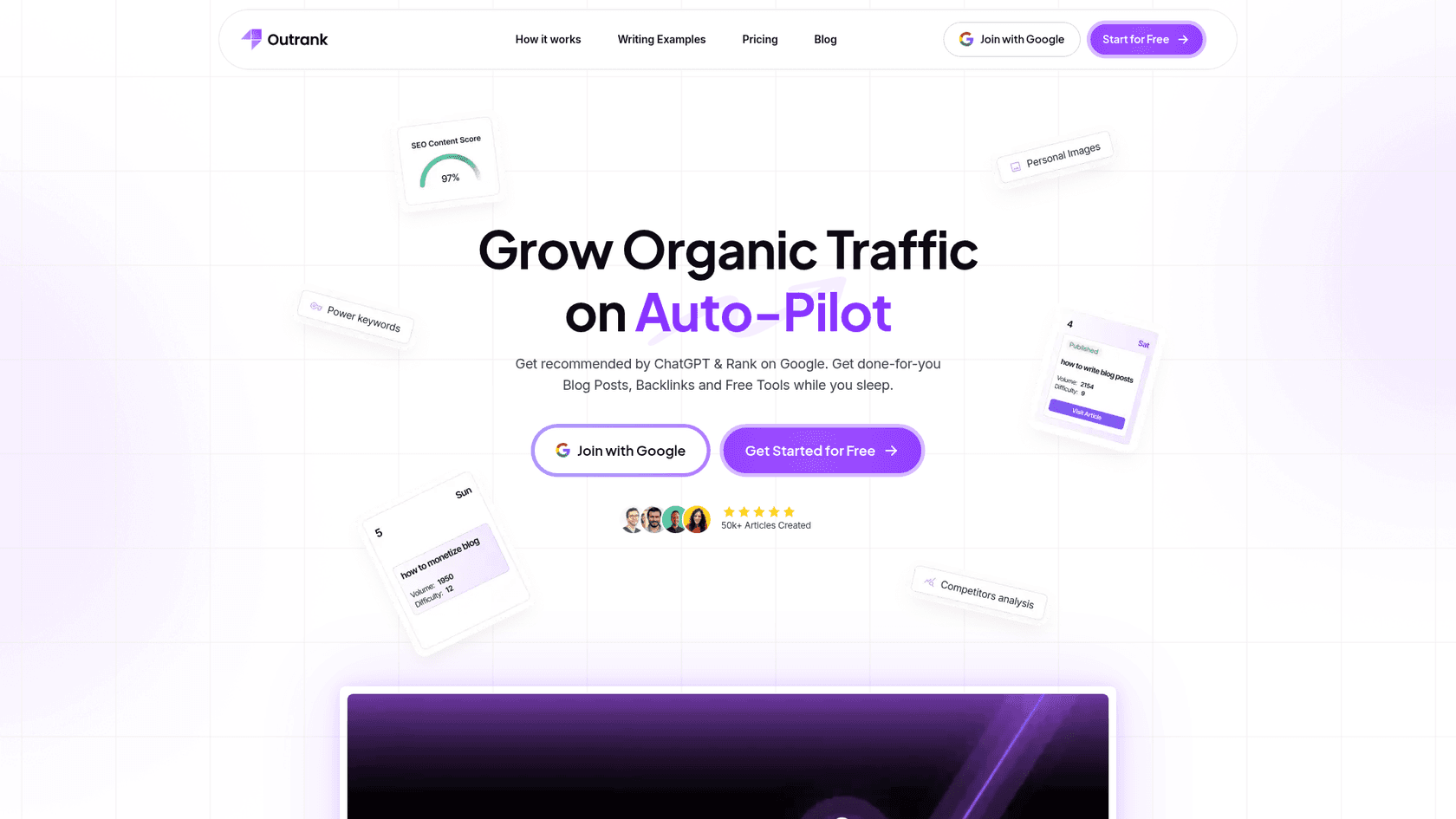
Outrank is marketed as a hands-free SEO engine. It’s designed to automate your entire content pipeline, from finding keywords to publishing long-form articles. You provide information about your business, it creates a 30-day strategic plan, and then it generates and posts content for you every day.
- Pros: A unique feature of Outrank is its integrated backlink exchange network. While most tools focus only on on-page SEO, Outrank actively helps build backlinks by placing your links in articles written by other users in its network. This is an approach to building domain authority, which is a huge part of SEO.
- Cons: The automatically generated content may require manual editing to align with specific brand tones or stylistic preferences. Users may find that drafts need adjustments to achieve the desired flow and readability for their audience.
- Pricing:
- Starts at $99/month for up to 30 long-form articles.
5. ContentBot
ContentBot is an AI content automation platform that is notable for its "AI Flows" feature. This is a visual builder that lets you create your own custom, repeatable workflows for generating different types of content on a schedule.
- Pros: The ability to build your own automation sequences is powerful, especially for teams with very specific needs, like generating daily social media posts or weekly blog outlines. Its AI Importer tool is also great for scaling, allowing you to create content in bulk from a simple CSV file.
- Cons: The flexibility of AI Flows comes with a steeper learning curve. Setting up a custom workflow is more complex than the guided, one-click processes you'll find in other tools. This might make it more than what's needed for bloggers with simpler requirements.
- Pricing:
- Starter Plan: $9/month for 50,000 words.
- Premium Plan: $29/month for 150,000 words and access to the AI Flows feature.
6. Writesonic
Writesonic has evolved from an AI writer to a comprehensive AI Search Visibility Platform. Its main focus is on GEO (Generative Engine Optimization), which is about helping you track and improve how your brand shows up in AI search results on platforms like ChatGPT, Gemini, and Perplexity.
- Pros: Its primary advantage is the deep analytics it provides for AI search. It shows you exactly where you're ranking, points out "citation gaps" where your competitors are getting mentioned but you aren't, and suggests specific actions you can take to boost your visibility. It still has a built-in SEO checker and one-click publishing to WordPress for traditional content.
- Cons: The shift to GEO makes it less of a pure blog automation tool and more of an analytics and optimization platform. While it can still write content, its core value and higher-tier pricing are tied to its advanced tracking features, which might be more than what a typical blogger is looking for.
- Pricing:
- A free plan is available with word limits.
- Paid plans with the full suite of GEO features start at the Professional tier, which is $199/month (when billed annually).
Tips for getting the most out of AI blog content tools
Whichever tool you choose, here are a few tips to make sure you get the best results.
Start with rich context The quality of what you get out depends on the quality of what you put in. Always give the AI as much context as you can: your website URL, brand voice guidelines, target audience, and key messages. Tools like the eesel AI blog writer are great at this because they can automatically analyze your site to learn your brand.
Let AI do the heavy lifting, not the final polish Use these tools for what they're best at: the 90% of work that includes research, drafting, structuring, and optimizing. Save the final 10% for a human touch. This is where you can add personal stories, double-check facts, and make sure the tone is a perfect fit for your audience. As one user on Reddit points out, the human touch is still essential.
I work with it daily and have great results. It still needs that human touch, though. I feel like people were just going 'run program,' 'post blog.' No... that won't work.

Don't "set it and forget it" blindly Even though automation is the goal, you should still check in on the content your tool is producing. Search trends change, and your brand's messaging might evolve. A quick regular review ensures your automated content stays on track and keeps delivering results.
Focus on consistency The biggest advantage of automation is the ability to maintain a regular publishing schedule. Search engines love consistency, and a steady stream of high-quality content is one of the best ways to build topical authority and grow your traffic over time.
For a deeper dive into building an automated blogging system that can actually generate revenue, this video from Adam Enfroy breaks down a complete workflow.
Final thoughts
AI tools have officially become powerful partners in content creation. They can help you save a massive amount of time, publish consistently, and ultimately grow your organic traffic.
The real challenge today isn't just producing content faster; it's creating high-quality, on-brand articles that actually rank and connect with readers in an increasingly crowded space.
While many tools can help you speed up the drafting process, the eesel AI blog writer is built to handle the entire workflow, delivering a complete, media-rich, and SEO-optimized blog post from just a single keyword. It's completely free to try, so you can see the difference for yourself and start automating your content workflow today.