If you're in the SEO world, you've likely noticed a significant shift with the introduction of Google's AI Overviews. This feature is the new "Position 0" many are aiming for. Being cited in an AI Overview is a major advantage, but tracking these citations presents a new challenge. Traditional rank trackers are effective for monitoring blue link positions, but they generally don't offer visibility into AI-generated summaries. This can make it difficult to measure the impact of content optimization efforts.
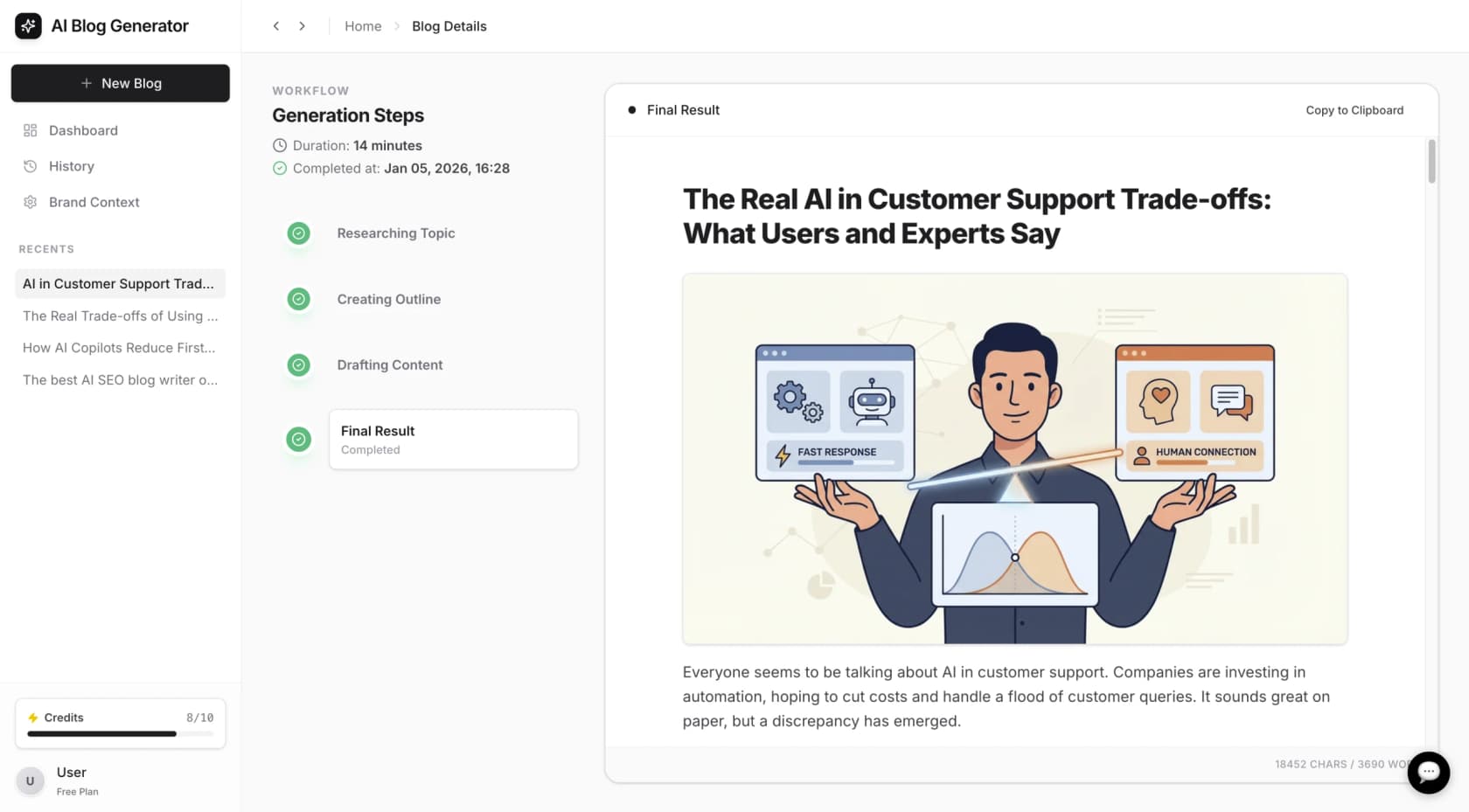
To find a solution, I spent several weeks testing popular AI Overviews SEO rank tracking tools to evaluate which ones provide actionable data. However, tracking is only one part of the equation; creating content that AI is likely to cite is equally important. This is a primary function of tools like the eesel AI blog writer, which is designed to generate AEO (Answer Engine Optimization) content from a single keyword.
What are AI Overviews SEO rank tracking tools?
So, what are these tools, really? You can think of them as the next generation of rank trackers. They're built to do one thing well: check if your brand is mentioned or cited in AI summaries from places like Google's AI Overviews, ChatGPT, Perplexity, and Gemini.
They go beyond just tracking where you land on a results page. They look at a completely different set of metrics that are becoming more important every day. We're talking about things like:
-
Citation Tracking: This is the big one. It tells you if your URL is actually being used as a source in an AI answer.
-
Brand Mention Monitoring: This lets you see if your brand name pops up in an AI answer, even if there isn't a direct link back to your site.
-
Sentiment Analysis: It's not just about getting mentioned, but how you're mentioned. These tools can help you understand if the AI's mention of your brand is positive, neutral, or negative.
-
Competitor Analysis: You can get a peek at which competitors are getting cited for your target keywords across different AI engines, giving you a new angle for competitive intelligence.
Just a heads-up: AI results can change from one minute to the next. These tools are great for seeing trends and getting a general idea of where you stand, but don't treat them as a perfect, live snapshot of every single AI answer out there.
My criteria for choosing the best AI Overviews SEO rank tracking tools
To keep this comparison fair, I used the same checklist to put each tool through its paces. Here’s what I was looking for:
-
Data Accuracy & Granularity: How good is the data? I wanted to see if a tool could tell the difference between a direct link, a simple brand mention, and a regular organic ranking.
-
Core Feature Set: Does it just tell you if you showed up? I was looking for more, like competitor analysis, source analysis, and sentiment tracking.
-
Ease of Use: Is the interface intuitive? I wanted to know if I could get going quickly or if I'd need to clear my calendar to figure it out.
-
Reporting & Analytics: Can you easily see trends over time, look at historical data, and export reports that make sense to clients or your boss?
-
Pricing & Value: Does the price actually match the features you get? Is it affordable for a freelancer, an in-house team, or a bigger agency?
Comparison of the top AI Overviews SEO rank tracking tools for 2026
For a quick summary, here’s a side-by-side look at the tools I tested. This should give you an at-a-glance idea of how they stack up before we get into the details.
| Tool | Best For | Unique Feature | Starting Price (Monthly) |
|---|---|---|---|
| SE Ranking | Agencies needing an all-in-one SEO and AI tracking tool | Tracks visibility across AIOs, ChatGPT, Perplexity, and Gemini | $95.20 |
| Rankscale | GEO strategists wanting deep multi-engine AI insights | Detailed sentiment and citation analysis across 10+ AI engines | $20 |
| Thruuu | Content teams optimizing for AI snippets | Builds content briefs based on analysis of 100 SERP results | $49 |
| Ziptie | SEOs wanting AI-powered keyword suggestions | AI assistant for generating relevant keywords to track | $99 |
| AWR Cloud | Marketers wanting to add AI brand visibility to a trusted rank tracker | "AI Market Share" metric to see who dominates topic conversations | $139 |
The 5 best AI Overviews SEO rank tracking tools in 2026
Alright, let's get into the details. Here’s my breakdown of each tool, what I liked, what I didn't, and who I think it's for.
SE Ranking
SE Ranking has been around for a while. It's a full-fledged SEO platform that has done a great job adding AI search tracking to its already powerful toolkit. It's a great choice if you want a single tool for both your traditional and generative search campaigns. It covers the big names, letting you track your presence in AI Overviews, ChatGPT, and more. You can monitor brand mentions, check on your source links, and watch your visibility over time.
SE Ranking’s AI Overview rank tracking gives us real data on when your site is cited, in what format (list, paragraph, etc.), and even shows prompts where you’re not cited but your competitors are. It’s not perfect, but it’s a reliable starting point for everyday visibility and content planning.

The platform really is an all-in-one solution. The AI tracker is nicely integrated and gives you a solid high-level view. The only thing to watch for is that the base plans limit how many AI prompts you can track. To get everything, you’ll probably need the Pro plan or their separate AI Search add-on.
Pricing:
-
Pro: Starts at $95.20/month for tracking 2000 keywords daily, which includes 100 AI Results Tracker prompts.
-
Business: Starts at $207.20/month for tracking 5000 keywords daily with higher data limits.
Best for: Agencies and businesses that want a single, integrated SEO tool with reliable AI tracking so they don't have to juggle multiple subscriptions.
Rankscale
Rankscale is one of the first tools that was built specifically for this new world of Generative Engine Optimization (GEO). It doesn't just tell you if you appeared; it measures your visibility, sentiment, and citations across a long list of AI engines, including ChatGPT, AI Overviews, and more. The dashboard is full of deep insights into how different AI models see your brand.
I really like how Rankscale gives you actionable data with its citation and sentiment analysis. The flexible, credit-based pricing is also a huge plus, since you only pay for what you use. Its public API is listed as "coming soon", which is a consideration for teams that require immediate custom integrations.
Pricing:
- It uses a credit-based system. The Essentials plan starts at just $20/month for 120 credits.
Best for: SEO strategists and agencies who need granular data on brand sentiment and citation sources across as many AI platforms as possible.
Thruuu
Thruuu takes a really interesting approach with its AI Overviews Tracker, focusing heavily on content analysis. It doesn't just track your visibility; it also analyzes up to 100 organic search results for any keyword you provide. This is fantastic for content teams because it helps you spot the patterns and topics that AI engines like, which you can then use to build smarter content briefs.
FYI, thruuu has released a new AI Overview tracker. You can upload a list of keywords and it will check you brand presence, visibility score, sources citation and more.
It's super user-friendly and affordable, making it a great option for content-focused SEOs. The integration with its own Content Brief Generator is a nice touch for turning insights into action. Currently, checks need to be run manually, though scheduled, recurring checks are on the product roadmap.
Pricing:
-
Pro: $49/month for 250 credits, which can monitor 5,000 keywords in AI Overviews.
-
Agency: $99/month for 700 credits, covering up to 14,000 keywords.
Best for: Content teams who want to figure out what kind of content gets cited in AI Overviews and use that info to build a better content strategy.
Ziptie
Ziptie was one of the very first tools to offer AI Overviews tracking. Its coolest feature is an AI assistant that suggests relevant keywords to track based on your site's content. It also provides a "Share of Voice" analysis, which is a nice way to see how your AI presence compares to your competitors.
The AI keyword assistant is genuinely helpful for finding new opportunities, and the scheduled monitoring lets you set it and forget it. The tool has some current limitations. It currently only tracks desktop devices and is limited to 10 countries. During testing, there were occasional loading delays, which could indicate ongoing performance optimizations.
Pricing:
- Basic: $99/month for 400 keywords.
Best for: SEOs who want a simple AIO tracker with a useful keyword discovery feature and don't need mobile or extensive international tracking.
AWR Cloud
Advanced Web Ranking, or AWR, is a well-respected name in SEO. They've updated their trusted tool for the AI era with a feature called AI Brand Visibility. It lets you monitor how your brand is represented across major chatbots like ChatGPT, Gemini, and more. It focuses more on high-level metrics like topic associations, sentiment, and your overall AI market share.
Advanced web ranking is fine if you just want basic presence tracking, but it feels a bit limited. I didn’t find it super actionable unless you’re only monitoring citations.
The biggest plus here is that it's a familiar and reliable tool for core rank tracking. If you're already an AWR user, adding this to your workflow is simple. It also has a developer API for custom integrations. Its AI insights focus on a high-level view of brand perception rather than the granular, keyword-level citation tracking offered by more specialized tools like Rankscale or Thruuu.
Pricing:
- Pro: Starts at $139/month for 7,000 keywords.
Best for: Marketers who want to track their AI brand perception and topic visibility with a tool they already know and use.
The secret to ranking in AI: Creating AEO-optimized content with the eesel AI blog writer
While tracking visibility is important, it's a reactive strategy. A proactive approach involves creating the kind of content that answer engines are looking for. Producing this type of content consistently and at scale can be a challenge for many teams.
This is where the eesel AI blog writer comes in. We built it specifically to generate complete, publish-ready blog posts that are optimized for both traditional search engines (SEO) and the new answer engines (AEO).
Here’s how it helps you create content that gets AI's attention:
-
Context-Aware Research: It doesn't just spit out generic text. It performs research that's aware of the topic, pulling in relevant data, comparisons, and specs that AI models use to build trust and form answers.
-
Human Tone & Social Proof: It pulls real Reddit quotes and YouTube videos right into the content. This adds social proof and a human touch that makes your content more authoritative and citable.
-
Automatic Rich Assets: It generates infographics, tables, and charts on its own, structuring information in a clean way that’s easy for AI to understand and feature in summaries.
We know this works because we used this exact tool to grow our own blog's impressions from 700 to 750,000 per day in just three months. We did it by publishing content designed to rank everywhere, including AI Overviews.
Pro tips for getting the most out of your AI Overviews SEO rank tracking tools
Once you pick a tool, here are a few tips to make sure you're getting your money's worth.
-
Focus on High-Intent Keywords: Don't try to track everything. Start with informational or comparison keywords (like "best..." or "...vs...") where an AI Overview is most likely to show up and influence a user.
-
Analyze the Sources, Not Just the Mentions: When you see a competitor getting cited, get curious. Tools like Thruuu let you analyze the on-page data of the source URLs. What kind of content are they making? How is it structured? Use your tracker to inform your content strategy.
-
Look for Low-Hanging Fruit: A great place to start is finding keywords where your domain is listed as a source but your brand isn't mentioned in the text. That's an easy win. Go back and update that content to include your brand name more clearly.
-
Combine Tracking with Creation: This is the most powerful approach. Use your tracking tool to find a gap where you aren't visible. Then, use a tool like the eesel AI blog writer to quickly create optimized content to fill those gaps. It’s a powerful combo for winning in the age of AI search.
The SEO world is changing fast, and keeping an eye on your visibility in AI Overviews is no longer a "nice-to-have." The tools we've covered all have their own strengths, from Rankscale's deep analytics to Thruuu's content-first approach and SE Ranking's all-in-one convenience.
The right tool for you really depends on your goals and budget. But remember, the point isn't just to track your position; it's to improve it. The best strategy will always be one that combines smart tracking with high-quality, AEO-optimized content.
For those who prefer a visual breakdown, several experts have shared their insights on YouTube about the evolving landscape of AI search tracking. This video provides a concise overview of some of the top tools available, which can help you see them in action before you commit.
Ready to create content that gets cited? Generate your first blog post for free with the eesel AI blog writer and see what it’s like to publish content that’s built for the future of search.
Frequently asked questions
Why are specialized AI Overviews SEO rank tracking tools necessary for modern SEO?
Traditional tools only track blue link rankings. With Google's AI Overviews dominating the top of the SERP, you need specialized AI Overviews SEO rank tracking tools to see if your content is being cited or mentioned within these AI-generated answers, which is a huge part of your brand's visibility now.
Can I just use my current SEO platform as one of my AI Overviews SEO rank tracking tools?
Some all-in-one platforms like SE Ranking and AWR Cloud are adding AI tracking features. However, they might not offer the same depth as dedicated tools like Rankscale, which are built specifically for Generative Engine Optimization (GEO). It depends on whether you need a high-level overview or granular, citation-level data.
What is the most important metric that AI Overviews SEO rank tracking tools provide?
While brand mentions and sentiment are useful, direct citation tracking is arguably the most important metric. Knowing that an AI engine used your URL as a source for its answer is a direct signal that your content is seen as authoritative and relevant for that query.
How accurate are the results from AI Overviews SEO rank tracking tools?
AI-generated results are highly dynamic and can vary based on location, user history, and even the time of day. These tools provide valuable directional insights and trend analysis rather than a 100% perfect, real-time audit of every possible result. They show you what's generally happening over time.
Beyond tracking, how can I use AI Overviews SEO rank tracking tools to improve my content?
You can use these tools for competitive intelligence. When you see a competitor getting cited, analyze their content. Tools like Thruuu help you break down the structure and topics of ranking pages, giving you a data-driven blueprint for creating content that AI engines are more likely to feature.