A practical guide to AI mass content creation

Stevia Putri

Katelin Teen
Last edited January 15, 2026
The content marketing treadmill. We've all been on it. The real grind isn't dreaming up great ideas; it's the never-ending task of actually creating high-quality content from them without draining your team and your bank account. You know you need a steady stream of content to stay relevant and rank, but who really has the time to write hundreds of articles by hand?
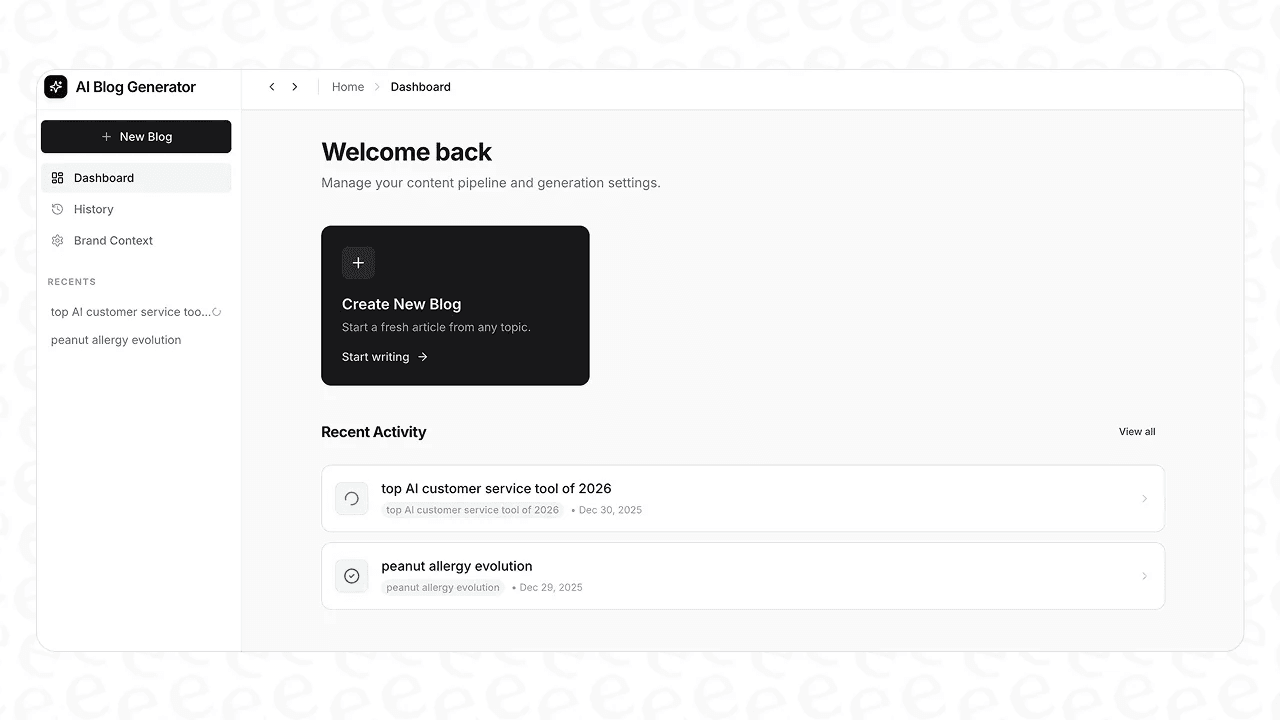
This is where AI mass content creation comes into the picture. It allows you to generate a huge volume of articles, product descriptions, or social media posts in one go. We hit this exact wall ourselves, and it's why we built the eesel AI blog writer. Using our own tool, we scaled from a modest 700 daily impressions to an incredible 750,000 daily impressions in just three months.
What is AI mass content creation?
AI mass content creation is pretty much what it sounds like: using AI to generate a ton of content at once, typically from a single, organized source.
Here’s a simple way to think about it. Using a chatbot like ChatGPT to write a blog post is like cooking one dinner. AI mass content creation is like having an automated kitchen that prepares and cooks all your meals for the next month simultaneously. It’s about producing content in batches, not one piece at a time.
Typically, these tools work by taking an input, such as:
- A list of keywords you want to rank for
- A spreadsheet filled with competitor URLs
- A CSV file with product information
An infographic showing the workflow of AI mass content creation, from input data to generated content.
The goal is to power big content plans for SEO, e-commerce, or social media on a scale that would be unthinkable for a human team.
The key benefits of AI mass content creation
Using AI to create content in bulk isn't just about speed; it's about being more strategic. Here’s what you really get out of it.
Unmatched speed and efficiency
This one's a no-brainer. You can knock out months of content in just a few hours. This lets your marketing team step off the content hamster wheel and focus on strategy, promotion, and analyzing what's actually moving the needle.
Consistent brand voice and quality
If you're working with multiple writers, you know how hard it is to keep the tone consistent. With AI, you define your brand voice once, and every piece of content follows that rule. Your first article will sound just like your thousandth, which is a huge win for brand identity.
Scalability across multiple initiatives
The possibilities are huge. You can build out giant SEO topic clusters to own a niche, generate thousands of unique product descriptions for an e-commerce site, or localize your marketing content for different regions in no time.
Significant cost reduction
The top tools for AI mass content creation
Okay, so you're on board with the idea. But which tool should you pick? There are plenty of options out there, but they aren't all the same. The right one for you depends on what you're trying to do, whether that's creating SEO-focused blogs, programmatic pages, or social media content.
I have tested most of these too, and found real differences once you get past the surface features. Based on Sprout Score comparisons, Jasper scored higher (8.2) for brand voice and long-form consistency, especially in team use. Surfer SEO scored strong (8.0) in post-publish optimization and SERP alignment, but depends heavily on pairing with another tool like Jasper. Copy.ai lagged a bit (7.4) for structured content workflows, it is fast, but less controllable. Writesonic sat in the middle (7.8), solid for ecommerce and quick drafts but needed a lot of manual editing in B2B use. If you add more tools, consider Narrato or Content at Scale; both had solid Sprout Scores for automation + SEO structure.

eesel AI blog writer: For publish-ready AI mass content creation
We actually built the eesel AI blog writer to solve our own problem. We needed something that created complete, high-quality blog posts that were ready to rank, not just walls of text. It's the exact platform we used to get our own massive organic growth, so we're confident it works.
Key Differentiators:
- Context-Aware Research: It doesn't just write fluff. It automatically researches your topic and pulls in relevant details. If you're writing a comparison post, it'll find pricing. If it's a product review, it'll look up the technical specs.
- Complete, Media-Rich Posts: This is a big one. Instead of just text, eesel gives you a fully formed article with AI-generated images, tables, and infographics already baked in.
- Authentic Social Proof: To make the content feel more human and trustworthy, it automatically finds and embeds real Reddit quotes and relevant YouTube videos.
- AEO Optimization: The content is structured for AI Answer Engines like Google AI Overviews and Perplexity, not just old-school search. This makes it easier for these new engines to cite your work, giving you a leg up.
Best for: Marketing teams and SEO specialists who need to scale their content with articles that are ready to publish and will actually bring in traffic.
Junia AI: AI mass content creation from URLs
Junia AI is a good option for creating unique content in bulk, particularly if your starting point is a list of competitor URLs or article titles.
Features: It gives you solid control over the tone of voice, can auto-publish to CMS platforms like WordPress and Shopify, and handles over 30 languages. It also uses recent Google data to keep information current and lets you schedule posts.
Limitations: The output is mostly text. That means you'll still have to jump in to format everything and add visuals before you can publish.
Best for: Teams that want a fast way to repurpose competitor content or generate a lot of articles from a topic list.
Narrato: AI mass content creation for diverse content from CSV files
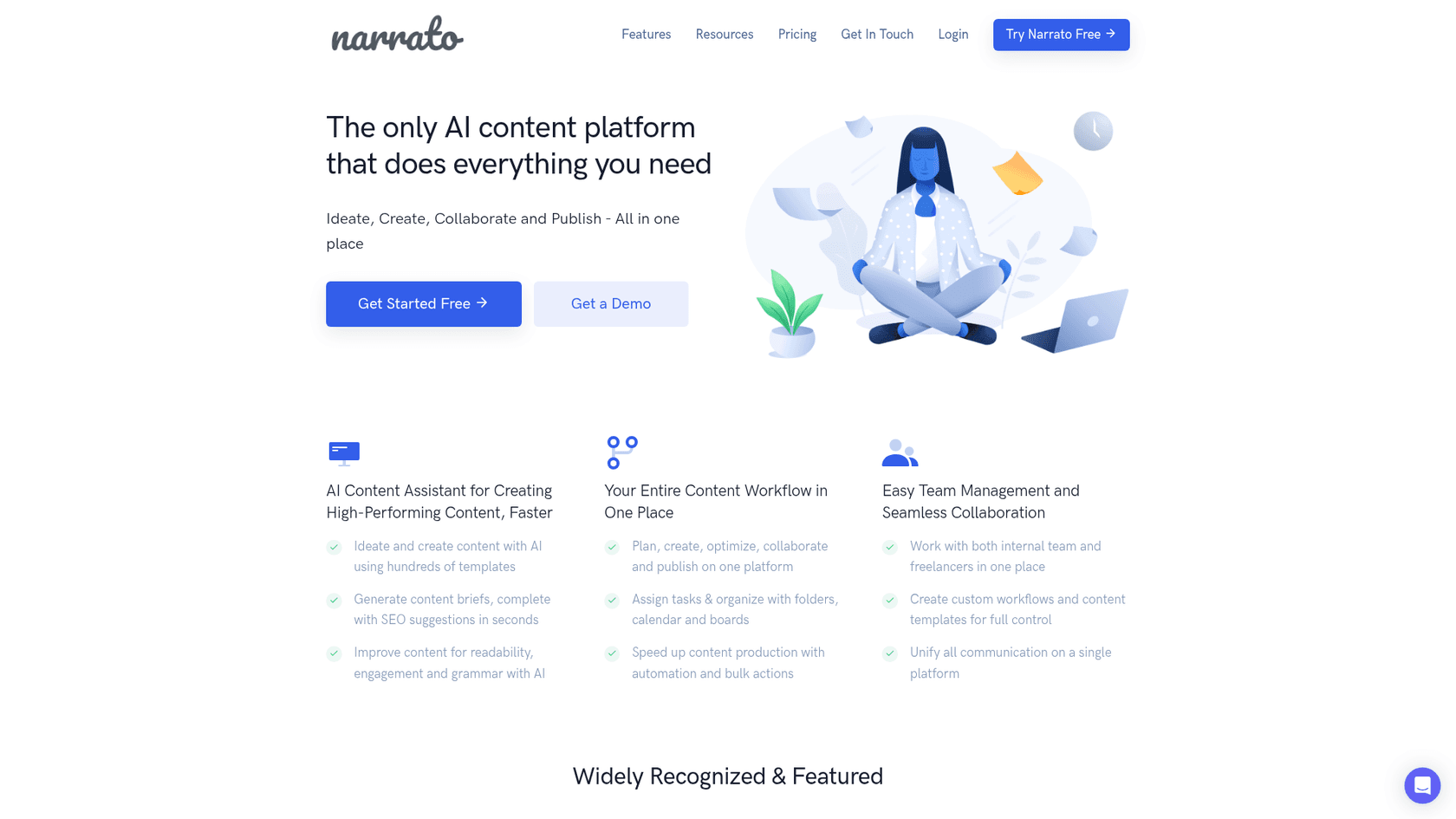
Narrato's strength is generating short-form content at scale from a CSV file. This makes it really useful for things like programmatic SEO and e-commerce.
Features: You can build your own custom AI templates for specific tasks, like product descriptions, real estate listings, or personalized sales emails, and then generate thousands of variations in bulk.
Limitations: It is primarily designed for data-driven, short-form content and may not be the ideal choice for creating in-depth, research-heavy blog posts. For long-form articles, a specialized tool like the eesel AI blog writer is more suitable.
Best for: E-commerce businesses needing thousands of unique product descriptions or marketers building out programmatic landing pages.
ContentBot: Building automated workflows for AI mass content creation
ContentBot has a unique feature called "Flows," which is a visual editor for building your own custom, automated content workflows that run on a schedule.
Features: Its "AI Importer" can work with CSV files, and its "Blog Bundles" feature can create up to 50 blog posts at once. It also includes an "AI Humanizer" to make content sound less robotic and supports over 110 languages.
Limitations: The workflow builder can take some getting used to. The CSV Importer also has row limits based on your plan; for instance, the $29/month Premium plan is capped at 50 rows.
Best for: Marketers who like to tinker and want to build complex, multi-step content automations that run in the background.
Risks of AI mass content creation (and how to avoid them)
AI mass content creation is a powerful tool, but it's not foolproof. If you're not careful, you can create a huge mess. Here are the biggest risks and how to dodge them.
Generic, low-quality output
The biggest danger here is creating a mountain of "AI slop" content that's technically unique but completely useless to a real person.
- Solution: The fix is to avoid the cheapest, fastest option and pick a tool that cares about quality and context, like the eesel AI blog writer. And no matter what, always have a human look over the final draft.
Factual inaccuracies and hallucinations
AI models are known for making things up or pulling from outdated info. This is a major issue if you're writing about anything that needs to be accurate.
- Solution: Make fact-checking a standard part of your workflow. Choose tools that use real-time data or let you provide your own sources, which is a key part of how eesel's research function works.
Repetitive sentence structures
When you generate hundreds of articles, it's easy for an AI to get stuck in a rut, using the same sentence patterns again and again. This makes your content sound robotic.
- Solution: Look for tools with features designed to create a more natural, human-like tone. Some, like ContentBot, even have an "AI Humanizer." It's also smart to review your content in batches to catch any repetitive phrasing before it goes live.
Negative SEO impact
Let's get this straight: Google rewards helpful content, regardless of how it's made. But if you publish low-quality, spammy AI articles, you're going to have a bad time.
- Solution: Your goal should always be to answer the reader's question and provide a valuable resource. Don't just publish hundreds of articles all at once. Features like scheduled publishing, which Junia AI has, can make your content release schedule look more natural to search engines.
To see how these concepts come together in a practical workflow, check out this step-by-step guide on using AI to automate the entire content creation process, from idea to final output.
Scale your content creation without sacrificing quality
AI mass content creation is a fantastic way to automate content creation, but success really comes down to one thing: the quality of your tool and your process.
The difference between climbing the search rankings and getting dinged by Google is choosing a platform that creates valuable, publish-ready content, not just raw text. A tool that gets context, includes rich media, and sounds human is what separates the winners from the spammers.
The eesel AI blog writer was designed to find that sweet spot between scale and quality, helping you produce hundreds of SEO-optimized, media-rich blog posts that people will actually read and that drive real traffic.
But you don't have to take our word for it. Generate your first blog post for free and see what a quality-first approach can do for you.

Frequently Asked Questions
Share this article

Article by
Stevia Putri
Stevia Putri is a marketing generalist at eesel AI, where she helps turn powerful AI tools into stories that resonate. She’s driven by curiosity, clarity, and the human side of technology.
