I tried 7 platforms to find the most important AI marketing tools updates in 2026

Kenneth Pangan
Last edited January 16, 2026

Keeping up with AI marketing tools is an ongoing challenge. As platforms evolve, they introduce new features and capabilities. For most marketers, AI is already part of the technology stack. The key challenge is identifying which tool updates are genuinely impactful versus which are minor additions. The objective is to leverage AI for tangible results, such as increased traffic, improved lead quality, or a more efficient workflow.
This review examines seven popular AI marketing tools and their significant updates for 2026. The focus is on updates that make a practical difference, particularly in scaling content creation from a simple draft to a publish-ready asset.
What are AI marketing tools?
Simply put, AI marketing tools are software that uses artificial intelligence (like machine learning and language models) to assist with marketing tasks. They are used for automating repetitive tasks, analyzing data, and personalizing campaigns at a scale that would be difficult for a human to manage alone.
The goal is to improve efficiency, gain clearer insights from data, and support better decision-making to boost ROI.
These tools have a wide range of functions. This article will cover a variety of tools, from those that create content and optimize for SEO to ones that build automated workflows or generate video ads from a text prompt.
How we selected the tools for this list
The tools on this list were not chosen at random. Each platform was evaluated against a consistent set of criteria to ensure the review is practical and useful.
Here is what we looked for:
-
Significant 2026 updates: The tool had to have rolled out substantial improvements recently, focusing on impactful changes rather than minor tweaks.
-
Practical impact: The new features had to solve a real problem for marketers. The update needed to save time, improve results, or open up new ways of working.
-
Ease of use: How quickly can a user start utilizing the new features? A powerful tool is less useful if it has a steep curve.
-
Value for money: Does the price align with the capabilities offered? We looked for tools that deliver a solid return on investment.
This list is based on hands-on experience with each platform to assess how their latest updates perform.
Quick comparison of top AI marketing tools in 2026
For those who just want the highlights, here’s a quick breakdown of the tools we're about to cover.
| Tool | Best for | Key 2026 update | Starting price |
|---|---|---|---|
| eesel AI blog writer | Generating complete, SEO-optimized blog posts | AEO & automatic asset generation | Free to try ($99/mo for 50 blogs) |
| Jasper AI | Team-based content creation | Jasper Studio for custom AI apps | $59/month/seat (billed annually) |
| Surfer SEO | Data-driven content optimization | Automated content audits & monitoring | $79/month (billed annually) |
| HubSpot | All-in-one marketing automation | Breeze AI Agents for marketing & sales | $15/month/seat (billed annually) |
| Gumloop | No-code AI workflow automation | Intelligent AI Agents for decision-making | Free plan available |
| Synthesia | AI video creation from text | AI Video Assistant & 1-click localization | $29/month for Starter plan |
| AdCreative.ai | Scaling paid ad creative | AI-powered product photoshoots | $39/month |
7 key AI marketing tools updates to watch
Let's get into the details. Here’s a closer look at each tool and what makes their latest updates worth paying attention to in 2026.
1. eesel AI blog writer: Updates for content generation
-
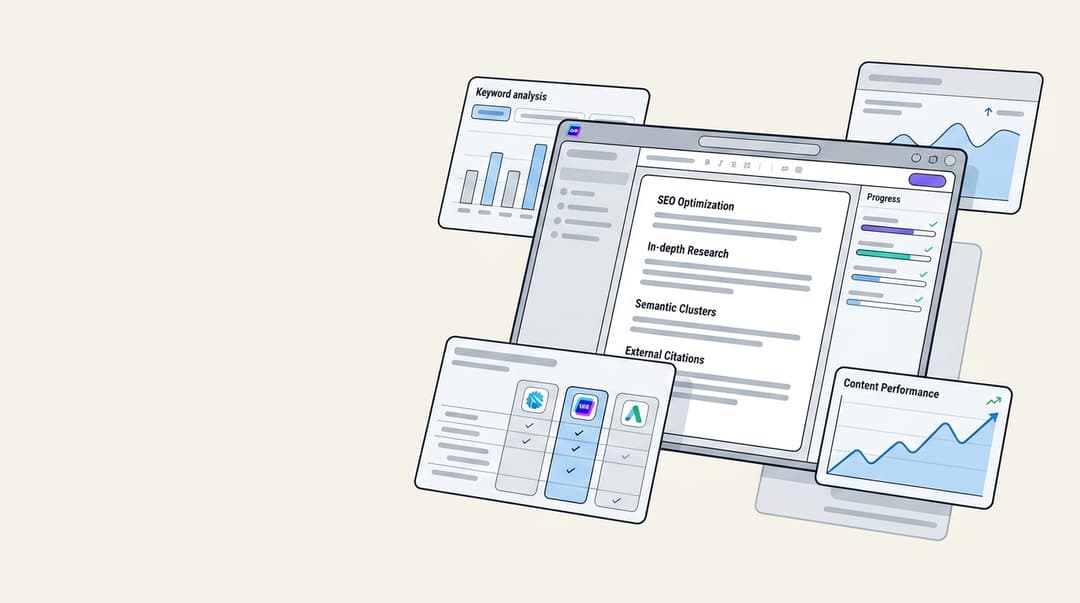
Why it's on the list: The eesel AI blog writer is a content platform designed to take a single keyword and turn it into a complete, SEO-optimized blog post with images, quotes, and links. It's the same tool used by the eesel AI team, which helped grow daily impressions from 700 to over 750,000 in three months.
-
Key 2026 update: The biggest change this year is its focus on AEO (Answer Engine Optimization). It structures content to be featured in Google's AI Overviews and other conversational search results. It also introduced context-aware research. For example, if you’re writing a comparison post, it automatically finds pricing data. For a product review, it pulls up tech specs. This can save significant time compared to more generic tools.
-
Pros and cons:
- Pros: The content is written in a human-like tone. It automatically creates assets like images, tables, and infographics, and finds relevant Reddit quotes and YouTube videos. The AEO focus provides an advantage for visibility in modern search.
- Cons: Its main focus is long-form blog content, so it may not be the right choice for users who need an all-in-one tool for short social media copy.
-
Pricing: You can try it completely free. The paid Early Bird plan is priced at $99 per month for 50 full blog posts, which makes scaling content affordable.
-
Best for: Marketing teams that want to grow organic traffic with high-quality, SEO-optimized blogs without handling manual research, writing, and asset creation.
2. Jasper AI: Updates for collaborative content
-
Why it's on the list: Jasper AI is a well-established tool in AI writing. It has a large library of templates for many kinds of marketing copy, from ad headlines to entire articles.
-
Key 2026 update: Jasper has expanded its offering with Jasper Studio and Agents. Jasper Studio is a no-code tool that lets teams build custom AI apps for specific tasks, like an app that generates product descriptions in a specific brand tone. The AI Agents then use these apps to manage workflows, such as researching a topic and personalizing outreach emails. This is all run by Jasper IQ, a central system that learns a company's brand voice, style guides, and product information.
-
Pros and cons:
- Pros: The collaboration features are designed for team consistency. The new Studio and Agents provide extensive power to create custom workflows.
- Cons: The output may require human editing to align with specific brand voices and styles. It does not generate visual assets like images or charts, so other tools would be needed for that.
-
Pricing: The Pro plan starts at $59 per month for each user, billed annually.
-
Best for: Larger marketing teams that need a flexible AI writing tool for many different copy types and have the resources to customize it.
3. Surfer SEO: Updates for data-driven content
-
Why it's on the list: Surfer SEO is a tool designed for creating content that ranks in search engines. It analyzes the top-ranking pages for a target keyword and provides a data-backed checklist of what to include in an article, covering everything from keyword density to article structure.
-
Key 2026 update: A notable new feature from Surfer is its automated Content Audit. By connecting it to Google Search Console, it monitors all published content. If it detects a page that is losing traffic or dropping in rankings, it sends a notification with specific suggestions on how to optimize it. This moves Surfer from a writing tool to a platform for managing the content lifecycle.
-
Pros and cons:
- Pros: Its data-first approach helps remove guesswork from on-page SEO. The Content Score provides a clear target, and the audit feature is useful for maintaining existing rankings.
- Cons: It is an optimization tool first and a writing tool second. While it includes AI writing capabilities, its primary function is optimization, and the generated text may require refinement.
-
Pricing: The Essential plan starts at $79 per month when paid annually.
-
Best for: SEO-focused content teams and agencies who rely on data and want a clear, repeatable process for creating and maintaining ranking content.
4. HubSpot: Updates for AI-powered marketing
-
Why it's on the list: HubSpot is a mature, reliable platform that powers marketing for thousands of companies. It has successfully integrated its AI tool, Breeze, into its entire ecosystem. A key advantage is that Breeze uses your CRM data to drive automations, making its suggestions and actions highly relevant to your business goals.
-
Key 2026 update: The launch of Breeze AI Agents is a significant update. These are specialized AI assistants that can be assigned to handle entire workflows efficiently. For instance, the Prospecting Agent can research potential customers and write personalized outreach emails. The Customer Agent can handle support tickets. Since it's all inside HubSpot, everything is seamlessly connected.
-
Pros and cons:
- Pros: The main benefit is the full integration of AI with marketing, sales, and service data. This creates a powerful feedback loop where marketing efforts are directly linked to measurable business success and sales outcomes.
- Cons: HubSpot offers tiered plans to match different team sizes. To maximize the AI's impact, teams benefit from centralizing their customer data within the platform's robust ecosystem.
-
Pricing: AI features are included in the paid plans. The Marketing Hub Starter plan starts at $15 per month per user, billed annually.
-
Best for: Businesses who want to leverage a comprehensive CRM ecosystem for integrated, cross-departmental automation.
5. Gumloop: Updates for custom automation
-
Why it's on the list: Gumloop functions similarly to workflow automation tools like Zapier but with a focus on integrating AI. It allows you to connect different apps and large language models (like GPT-4 and Claude) to build complex automations without writing code.
-
Key 2026 update: Gumloop recently launched intelligent AI Agents, which are a significant advancement from simple, linear workflows. You can give an Agent a goal (e.g., "find new leads on LinkedIn that fit our customer profile and send them a personalized connection request") and a set of tools, and it will determine the best steps to take, adapting as it goes.
-
Pros and cons:
- Pros: The visual, drag-and-drop interface is designed for ease of use when building complex automations. Users get access to premium AI models without needing to manage API keys, and it's SOC 2 compliant, which is a plus for security.
- Cons: As a newer tool, it has fewer pre-built app integrations than larger platforms like Zapier, but its library of over 120 is growing.
-
Pricing: Gumloop has a free plan that provides 2,000 credits a month. The paid Solo plan starts at $37 per month.
-
Best for: Marketers who want to build highly customized AI automations that connect multiple tools and data sources.
6. Synthesia: Updates for video creation
-
Why it's on the list: Synthesia is a tool for creating videos from text. It lets you create videos with AI avatars by typing a script, which can reduce video production time and cost by removing the need for studios, actors, or voiceover artists.
-
Key 2026 update: The new AI Video Assistant further simplifies the process. You can now generate a complete video script and storyboard from a URL, a document, or a text prompt. Their AI Dubbing feature has also been upgraded, letting you translate a video into over 140 languages in one click while preserving the original speaker's voice.
-
Pros and cons:
- Pros: It is efficient for creating training materials, marketing explainers, and internal communications. The language support is a valuable feature for global companies.
- Cons: The AI avatars are effective for many use cases, though they may not be suitable for all types of video content. Lower-tier plans have limitations on video generation minutes.
-
Pricing: The Starter plan is $29 a month, which includes 10 minutes of video generation. A free trial is also available.
-
Best for: Corporate teams that need to create and localize videos for training, sales, or internal communications at scale without a traditional video production budget.
7. AdCreative.ai: Updates for ad creative
-
Why it's on the list: AdCreative.ai is designed for performance marketers. It generates hundreds of variations of ad creatives, including visuals and copy, and is trained on data from over $35 billion in ad spend.
-
Key 2026 update: AdCreative.ai has expanded beyond static images with its new AI Product Photoshoots and Product Videoshoot AI. You can upload a basic product photo, and the AI will generate a set of professional e-commerce shots or full video ads with different backgrounds and scenes.
-
Pros and cons:
- Pros: It is effective for generating a large volume of ad creatives for testing. The platform gives each creative a "Conversion Score" that predicts its performance, helping users decide which ones to run first.
- Cons: Initial designs may require manual adjustments in the editor to align perfectly with specific brand guidelines.
-
Pricing: The Starter plan starts at $39 per month for 10 credits.
-
Best for: E-commerce businesses and performance marketing teams that need to constantly test a high volume of ad creatives across different platforms.
How to keep up with AI marketing tools updates
Staying current with the rapid changes in AI marketing can be managed with a structured approach.
-
Follow a few key newsletters: Instead of trying to read everything, pick a couple of high-quality sources like Marketer Milk or The CMO and stick with them.
-
Block out time to experiment: Set aside time each month to experiment with one new tool or feature. Hands-on experience is often the best way to learn.
-
Find your community: Join a group or a relevant Slack community. These are good places to hear from other marketers about what's working.
The AI marketing tool space is moving so fast that any list is basically outdated within 6 months.
-
Focus on problems, not tools: Instead of chasing every new tool, start with a specific business problem you're trying to solve (e.g., "we need to publish blog content faster"). Then, look for the tool that best solves that problem.

For a deeper dive into how different AI marketing tools are being applied in real-world strategies, this video provides a helpful overview of top tools and how they can be used to drive growth.
The future of marketing: Smarter AI tools
A key trend observed in these updates is the maturation of AI marketing tools. They are evolving from simple automation assistants to more strategic platforms. The most impactful tools now offer advanced insights and produce higher-quality outputs that contribute to business growth. This is particularly evident in content creation, where platforms are moving beyond basic text generation.
Tools like the eesel AI blog writer aim to automate the entire workflow, from a single keyword to a complete, publish-ready article, and they work beautifully alongside established ecosystems like HubSpot.
To try generating a blog post, you can get started for free with the eesel AI blog writer.

Frequently asked questions
The biggest updates are focused on creating publish-ready content, not just drafts. Tools like the eesel AI blog writer now include Answer Engine Optimization (AEO) and automatically generate assets like images and tables, which saves a ton of manual work.
Many new updates make powerful AI accessible without a huge budget. For example, tools like Gumloop offer free plans for building custom automations, and AdCreative.ai allows small teams to generate professional product photoshoots without hiring a studio.
Yes. Synthesia's AI Video Assistant is a great example. It can now generate a full video script and storyboard from a simple prompt or document, and its one-click dubbing feature makes it easy to localize video content for global audiences.
Start by identifying a specific problem you need to solve, like scaling blog production or improving ad performance. Then, look for tools whose recent updates directly address that pain point. Focus on what will have a real impact on your workflow and results.
Instead of trying to follow every source, pick a few reliable newsletters (like Marketer Milk). Also, join a community like a relevant subreddit or Slack group to hear what other marketers are actually using and finding effective.
Not at all. The latest tools are designed to be strategic partners, not replacements. They automate repetitive tasks and provide data-backed insights, which frees up marketers to focus on strategy, creativity, and connecting with customers on a human level.
Share this article

Article by
Kenneth Pangan
Writer and marketer for over ten years, Kenneth Pangan splits his time between history, politics, and art with plenty of interruptions from his dogs demanding attention.