
Let's face it, the content treadmill never stops. Your audience wants fresh articles, Google rewards them, and your growth pretty much depends on it. But actually keeping up with that demand without burning out your team or letting quality slip can feel impossible. We’ve all been there, staring at an empty content calendar, wondering how we’re going to get it all done.
This is where AI blogging can help, and it’s probably not what you imagine. It’s not about replacing writers or churning out soulless, robotic articles. It’s about giving your content team a strategic partner, a tool that handles the grunt work so your team can focus on what they do best: creativity, strategy, and adding that unique brand personality.

What is AI blogging?
AI blogging is simply using artificial intelligence to help with different parts of the content creation process. This could be anything from brainstorming ideas and researching topics to drafting articles, optimizing them for search engines, and creating assets like images or tables.
The whole idea is to empower writers, not replace them. By automating the more tedious parts of the job, AI lets your team focus on the high-level stuff: crafting unique insights, refining strategy, and building brand authority. Think of AI as your brainstorming partner, research assistant, first-draft generator, and optimization tool, all in one.
The modern AI blogging workflow
Step 1: Strategic outlining
It all begins with an idea. Instead of just guessing what to write about, you can use AI to analyze keywords, find topic clusters your audience is interested in, and generate structured outlines that align with what people are searching for. General-purpose tools are great for this initial brainstorming, helping you come up with a list of potential topics or questions your readers might have.
Step 2: Generating the first draft
Once you have your outline, you can pass it to an AI blog generator. But modern tools don't just give you a wall of text. They create a fully structured article with an introduction, headings, subheadings, and a conclusion. You’re starting with a solid foundation that’s already 80% of the way there, not a blank page.
Step 3: Editing and fact-checking
This step is non-negotiable. Raw AI content can be generic, lack personality, and sometimes, it just makes things up (these are often called "hallucinations"). To protect your brand’s credibility and send positive E-E-A-T signals to Google, a human has to review, edit, and fact-check every single piece. This is where the writer's role shifts from drafter to editor-in-chief, adding personal stories, unique insights, and making sure every claim is accurate.
Step 4: Optimizing for search
You're likely familiar with Search Engine Optimization (SEO), but there’s a new player in town: Answer Engine Optimization (AEO). AEO involves structuring your content so it's easily understood and surfaced by AI-powered search features, like Google's AI Overviews and chatbots. With Gartner predicting that search volume will drop 25% by 2026 because of these new answer engines, AEO is becoming vital for staying visible.
Key features of an AI blogging platform
When you’re ready to graduate from a simple text generator, you need to look for a true AI blogging platform. Here are the key features that separate the good from the great.
Deep research and citations
A great tool does more than just write; it researches. It should be able to pull in up-to-date information and add credibility to your content with things like citations and social proof. For instance, finding and embedding relevant quotes from Reddit discussions can add a layer of authenticity that AI on its own can't replicate.
This is exactly the way to do it. It's a tool. I normally write my thoughts in an unstructured long form. Then I take what I want and elaborate on what I feel needs more info. From there I use AI to help structure the info with a better flow for the end reader. It has taken my writing time to half of what it used to be and the end result is much better.

Complete asset generation
Content is more than just words. The best platforms generate a complete blog post, and that includes visuals. Look for tools that can create images, infographics, and tables to break up the text, add value for the reader, and make your articles more engaging.
Advanced SEO and AEO capabilities
Any tool worth considering should be built with search rankings in mind. This goes beyond just stuffing keywords into the text. It means creating a proper heading structure, integrating keywords naturally, and formatting the content so it’s optimized for both traditional search results (like featured snippets) and the new AI Overviews.
Brand context and voice
Finally, the output should sound like your brand, not a generic robot. The most advanced tools, like the eesel AI blog writer, can learn your brand's voice just by looking at your website. This lets the AI make natural, contextual mentions of your own products and services without it feeling forced.
Top AI blogging tools
While plenty of tools can generate text, only a few are really built to handle the entire blogging workflow from a single keyword to a publish-ready post. Here’s a look at some of the top options.
1. eesel AI blog writer
The proof is in the results. We used our own tool to take our blog from 70,000 to over 750,000 impressions in just three months, showing that the output doesn't just look good, it actually ranks.
Key Differentiators:
- Context-Aware Research: It doesn't just pull from a static database. It can find and integrate real-time community sentiment from Reddit or pull up-to-date pricing data for comparison posts.
- Automatic Assets: Each article comes with AI-generated images, data tables, and even relevant YouTube video embeds, saving you hours of manual work.
- SEO & AEO Ready: The content is structured from the ground up to rank in traditional search engines and perform well in new AI answer engines.
Pricing: You can start at $99 for 50 blog posts. It’s also completely free to try, so you can generate your first article and see the quality for yourself.
2. Jasper AI
However, it's more of a generalist tool. It will give you a strong text draft and can create AI images, but you'll still need to do the manual work of researching specific data points, finding and embedding videos or tables, and doing the final SEO optimization to get it ready to publish.
Pricing: The Pro plan starts at $69/month per user ($59/month if you pay annually), with custom pricing available for their Business plans.
3. Koala AI
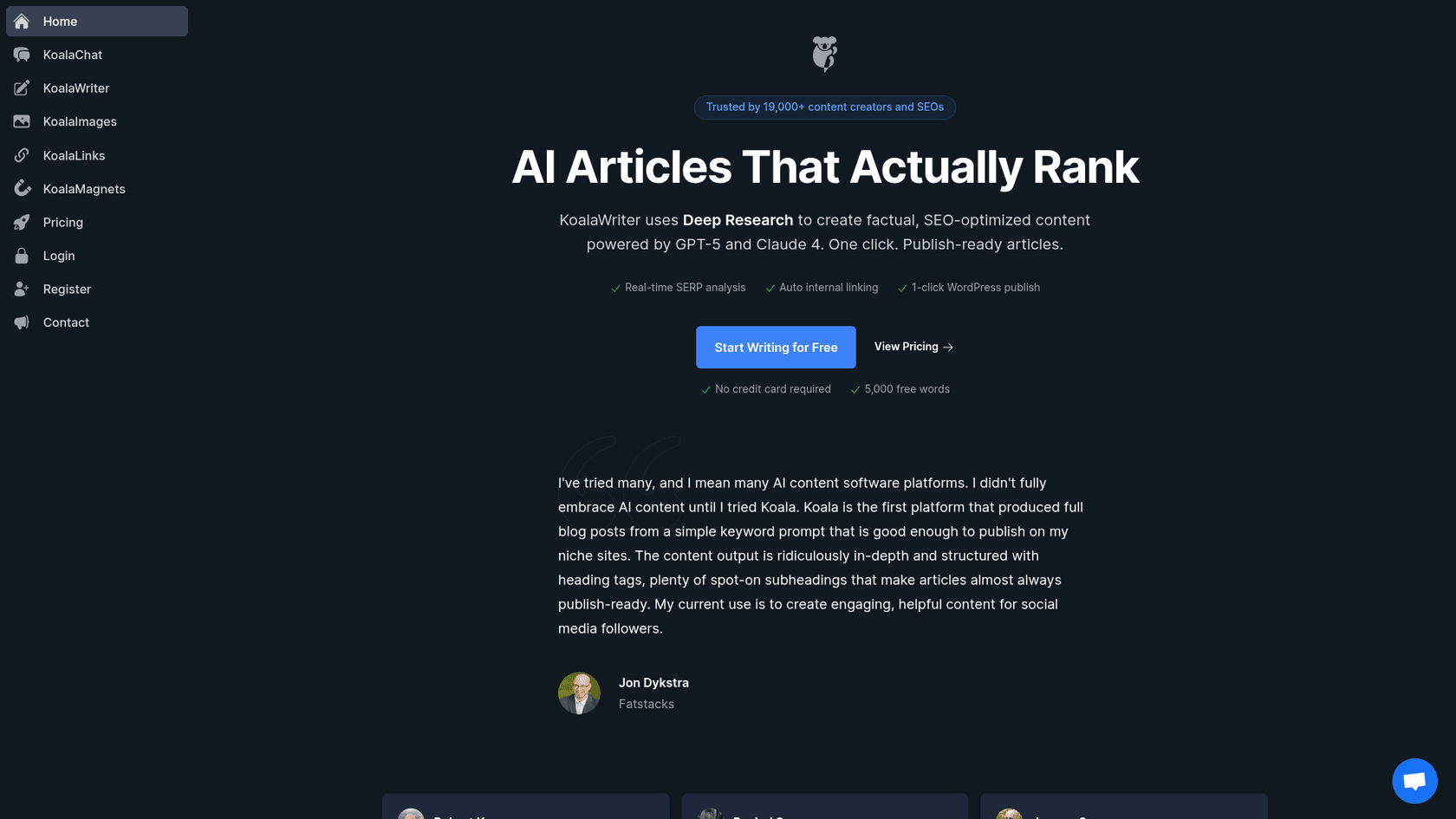
The trade-off is that the output is explicitly positioned as a "rough draft." While it’s structurally sound from an SEO perspective, it often requires a significant human touch to add personality, smooth out the flow, and make it engaging for readers.
Pricing: The Essentials plan starts at $9/month for 15,000 words, and they offer a free trial for up to 5,000 words.
4. RightBlogger
RightBlogger offers a collection of individual tools rather than a single, integrated workflow. This means users might generate an article with one tool and then switch to another for SEO analysis, which differs from a seamless, end-to-end process.
Pricing: The Pro plan is $29.99/month (billed annually) which gives you unlimited words and 10 SEO reports.
5. Autoblogging.ai
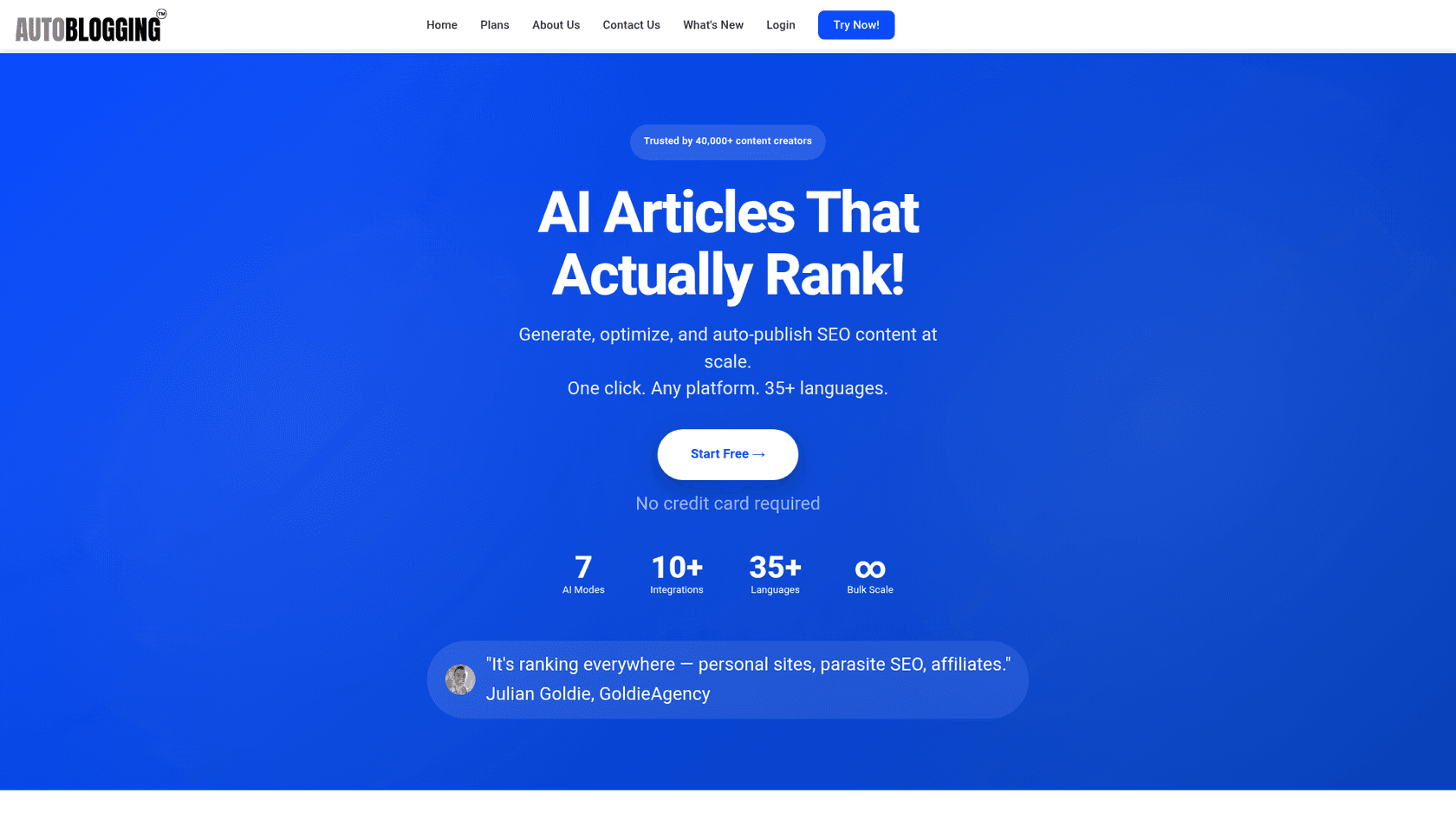
With its heavy emphasis on automation and quantity, this tool is well-suited for users who have a robust editing and quality assurance process in place to ensure every article meets their standards before going live.
Pricing: Plans are credit-based, with the Starter plan at $19/month for 40 credits (which translates to 40 articles).
The indispensable human element
This is probably the most important part of this whole discussion. Even with the best AI tools, the most successful content strategies are, and always will be, human-led. AI is an incredible accelerator, but it's not a substitute for human expertise.
There are a few things that AI just can't replicate:
- Personal experience and stories: Your unique anecdotes, case studies, and industry insights are what build trust and connection with your audience.
- Strategic fact-checking: AI can and does make mistakes. A human expert needs to verify every statistic, claim, and technical detail before you hit publish.
- Injecting brand personality: A human writer is essential for ensuring the content truly reflects your company's voice, values, and strategic point of view.
The best way to think about it is the 80/20 rule. Let AI handle 80% of the heavy lifting: the research, the drafting, the formatting. That leaves your team free to focus on the final 20%, which is where the real value is created.
To see how these workflows come together in a real-world strategy, the following video breaks down a complete system for building a profitable blog using AI, from keyword research to monetization.
Making AI blogging your growth engine
AI blogging has officially grown up. It’s no longer a gimmick but a powerful and legitimate strategy for scaling high-quality content. Success comes down to two things: choosing the right platform for your needs and never losing sight of the essential role of human oversight.
The best tools on the market today don't just write text; they build complete, SEO-optimized articles with all the assets you need, saving your team countless hours of manual work. It’s about creating a system that allows you to consistently publish great content that drives real results.
Stop just drafting text. Start publishing complete blog posts. Try the eesel AI blog writer for free and see how quickly you can turn a single keyword into a traffic-driving article that's ready to go live.