A practical guide to AI blog writer integration

Stevia Putri
Last edited January 15, 2026
Modern content marketing is a grind. It's not just about writing; it's about producing high-quality articles consistently. The problem is, many teams are slowed down by a messy workflow. You're likely juggling a writing doc, an SEO tool, and a CMS, all in different tabs. This disjointed process is slow and makes it tough to keep your brand voice consistent.
What is an AI blog writer integration?
An AI blog writer integration is simply connecting an AI writing platform to your company’s other systems and data. It’s more than just generating text. It’s about creating a workflow where the AI understands your brand, pulls in the right data on its own, and smooths out the entire process from keyword to published post.
Think about the difference between this and a standalone tool. A general AI like ChatGPT isn't trained on your specific business context. It doesn't know your products, your brand voice, or your style guide. For every article, you have to feed it context, find your own images, look up data, and then format everything for your CMS. That’s a ton of manual effort.
An integrated system automates most of that. The benefits are pretty straightforward:
- Consistent branding: Every post uses your correct tone, messaging, and facts.
- More efficiency: It cuts down on the manual work and app-switching, so your team can focus on strategy.
- Better accuracy: By using your internal knowledge, it reduces the chances of the AI making things up or using old information.
Key components of a successful AI blog writer integration
Connecting your knowledge base
For an AI to write for your business, it needs to know your business. This means plugging it into your central sources of truth, like internal wikis, help desks, and company docs. This connection lets the AI pull from knowledge bases like Notion or Confluence, support platforms like Zendesk, and other key documents to make sure everything it writes is accurate.
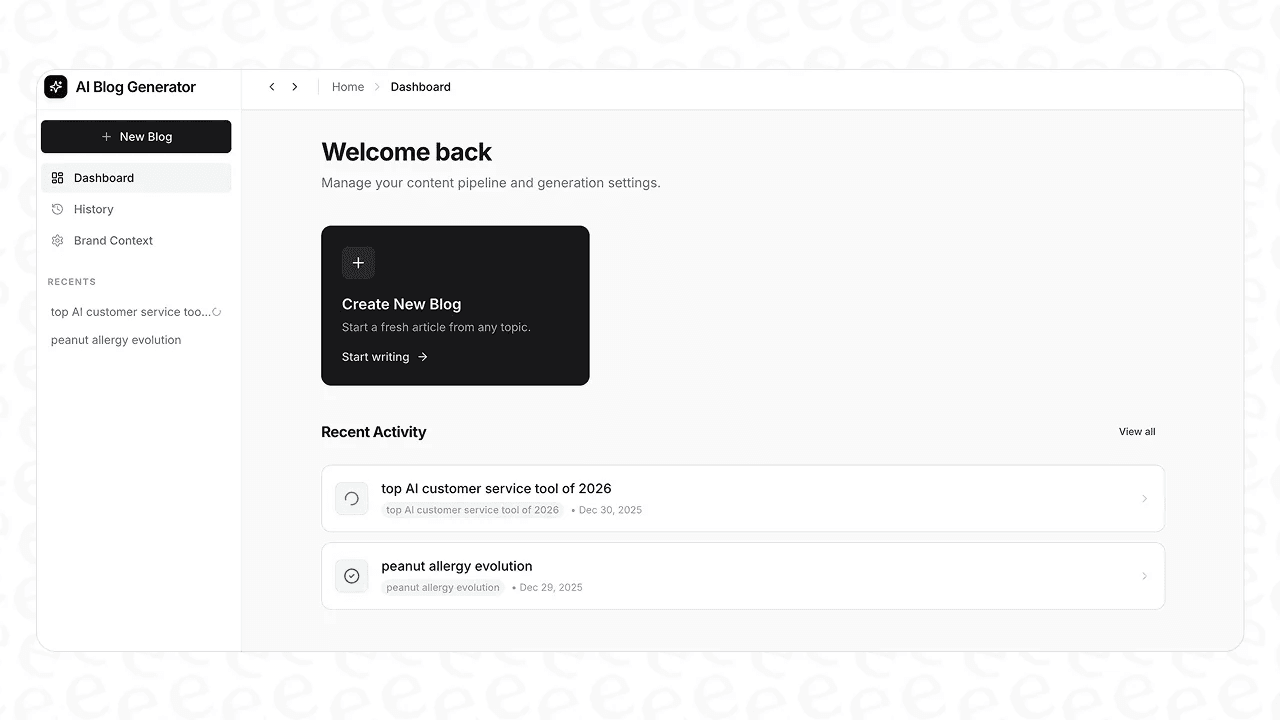
The eesel AI blog writer handles this automatically. You give it your website, and it learns from your existing documentation. This ensures every blog post is correct and naturally includes your product's value. This differs from general writers that require users to manually input brand context for each article, which can be a time-consuming process.
Integrating with your CMS
The last step in any content workflow is getting it published. A good integration makes this part easier by generating content that’s already formatted for your CMS, whether it’s WordPress, HubSpot, or something else. The idea is to get rid of the boring work of copying text, fixing headings, uploading images, and embedding videos.
An integrated approach also streamlines this step. For instance, the eesel AI blog writer generates a complete blog post. That includes a logical structure, AI-generated images, and relevant media from places like YouTube. This turns publishing into a quick copy-and-paste job instead of a lengthy manual formatting process.
Integrating SEO and research tools
Content that ranks high is driven by data. Most marketing teams use separate tools like Ahrefs or Surfer SEO for keyword research and optimization after the draft is done. A good integration builds in the SEO process right into content creation from the start.
Instead of tacking on SEO at the end, an integrated AI writer builds the content around SEO principles. The eesel AI blog writer is designed for both SEO and AEO (Answer Engine Optimization). It looks at your target keyword to figure out the best structure, includes relevant topics, and even generates an FAQ section. This can reduce the need for a separate optimization tool, and every article is built to rank from day one.
Evaluating top platforms for AI blog writer integration
Not all AI writers are designed for deep integration. Some are just simple text generators, while others are meant to be the core of your content strategy. Here’s a look at a few popular platforms and how they handle integration.
eesel AI blog writer: For context-aware, publish-ready content
The eesel AI blog writer is an all-in-one content engine. It does more than just generate text; it delivers a complete content package that is well-researched, SEO-optimized, and ready to go live as soon as you get it.
Key Integration Features:
- Automatic brand context: It connects to your website to automatically learn your brand voice, product details, and key messages.
- All-in-one generation: It creates the entire blog post, including custom AI images, infographics, data tables, and relevant embeds from YouTube and Reddit for social proof.
- Built-in SEO & AEO: The whole process is optimized for search and AI answer engines based on your keyword, with no third-party tool needed.
Why it stands out: eesel AI is designed to deliver a more complete initial draft, including assets, to reduce post-generation work. It’s the same platform we used to grow blog impressions from 70,000 to over 750,000 in three months. You can try it for free to see the quality for yourself.
Pricing: Starts at $99 for 50 blog generations.
Jasper: For teams wanting guided, long-form creation
Jasper is a popular AI content platform for marketing teams. It focuses on creating on-brand content at scale with its Jasper IQ context layer and various automation features.
Key Integration Features:
- Brand Voice & Knowledge: You can teach Jasper your company facts, product details, and style guide to keep things consistent.
- Content Pipelines: It has features to automate parts of the content lifecycle, connecting data and creative work.
- Browser extension: Jasper offers a browser extension so you can use its AI features on different platforms, like in Google Docs or your CMS.
Limitations: Jasper focuses on producing consistent brand voice for various marketing copy. Its output is primarily text-based, so users typically source visual assets like videos and infographics separately. For workflows that require all-in-one asset generation, other platforms like the eesel AI blog writer offer these features natively.
I like a mix of free Chat GpT and Jasper. Free Chat GPT is actually still better for brainstorming — Jasper doesn’t really always understand the same prompts, the same way. I could ask it to suggest an outline for an ebook blah blah blah and sometimes it takes a lot more correction than chat GPT. But it is helpful for tightening up copy, or rather getting ideas to make it tighter, and things like various classic marketing frameworks.

Pricing:
- Pro Plan: Starts at $59/month per seat (billed annually), which includes 2 Brand Voices and 5 Knowledge assets.
- Business Plan: Custom pricing for larger teams who need API access and more control.
Writesonic: For content focused on SEO and GEO
Writesonic is an AI platform built to help marketers get more visibility on traditional search engines (SEO) and AI search engines (GEO), like ChatGPT and Google AI Overviews.
Key Integration Features:
- AI Article Writer 6.0: Generates fact-checked, SEO-optimized articles using real-time data and competitor analysis.
- AI Visibility Tracking: Tracks your brand's presence on AI search platforms (available on higher-tier plans).
- CMS Export: Offers one-click publishing to platforms like WordPress.
Limitations: Writesonic's strengths are in optimizing content for search visibility and tracking. Its integration is focused more on publishing and tracking than on pulling deep business context from internal sources. It does not automatically generate rich media or social proof like Reddit quotes, which are features some platforms like the eesel AI blog writer include to increase reader engagement.
Writesonic has better British English support out of the box. For you specifically, found writesonic superior for social captions and blog writing, but jasper's better for seo work and keword integration
Pricing:
- Lite Plan: Starts at $39/month (billed annually) for SEO and content automation.
- Professional Plan: Starts at $199/month (billed annually) to add AI Search Tracking (GEO) features.
How to implement an AI blog writer integration strategy
Step 1: Define your goals
Before picking a tool, define what you want to accomplish. Are you targeting broad, top-of-funnel keywords or creating in-depth, product-focused content? Your goals determine your needs. Next, identify your company's "source of truth." Is your most accurate info in Notion, Confluence, or Zendesk? Knowing this helps you pick the right integrations.
Step 2: Choose the right tool
Next, look at platforms based on how your team prefers to work. If you want an AI assistant that helps you write in different apps, a tool with a browser extension like Jasper could be a good choice. But if you want a platform to handle everything from research to asset creation, the eesel AI blog writer is a better option because it’s designed to reduce the number of tools you need.
Step 3: Pilot your integration and measure results
Don't try to change your entire content strategy at once. Pick a single topic cluster and use your chosen tool to generate five to ten articles. Track the metrics that matter to you: time-to-publish, organic impressions, and clicks. Use this data to fine-tune your process and show the value of the new workflow.
Step 4: The role of human oversight
AI is fantastic for getting past the "blank page" and handling the boring parts of content creation. But the best content still needs a human touch. Let AI do 90% of the work: research, drafting, formatting, and creating assets. Then, have an expert do a final review to add unique insights, personal stories, and that final polish only a person can provide.
For anyone reading: if you’re using AI for content, still double-check factuals. Some tools hallucinate dates/names hard.
While tools are getting better at automation, it's helpful to see how others are building their own integrated content systems. The video below shows how you can create a custom AI-powered writer that automates much of the blog writing process, giving you more control over the final output.
The future of content is integrated, not isolated
Standalone AI writers are helpful, but the real shift in content marketing comes from a deep AI blog writer integration. By connecting your AI to your business knowledge, SEO goals, and publishing workflows, you can create content that's not just faster but also more accurate, consistent, and effective at driving growth.
The goal isn't just to get a writing assistant; it's to build a true content engine that works for you.
Ready to see what a fully integrated AI blog writer can do? Generate your first blog post with the eesel AI blog writer.

Frequently Asked Questions
Share this article

Article by
Stevia Putri
Stevia Putri is a marketing generalist at eesel AI, where she helps turn powerful AI tools into stories that resonate. She’s driven by curiosity, clarity, and the human side of technology.
