The 5 best AI blog writers for startups in 2026

Kenneth Pangan

Katelin Teen
Last edited January 15, 2026
Expert Verified

Startups are always fighting for attention. You need to publish consistent, high-quality content to build authority and drive organic growth, but you're almost always working with a tight budget and not enough time. This is where a modern AI blog writer can make a real difference.
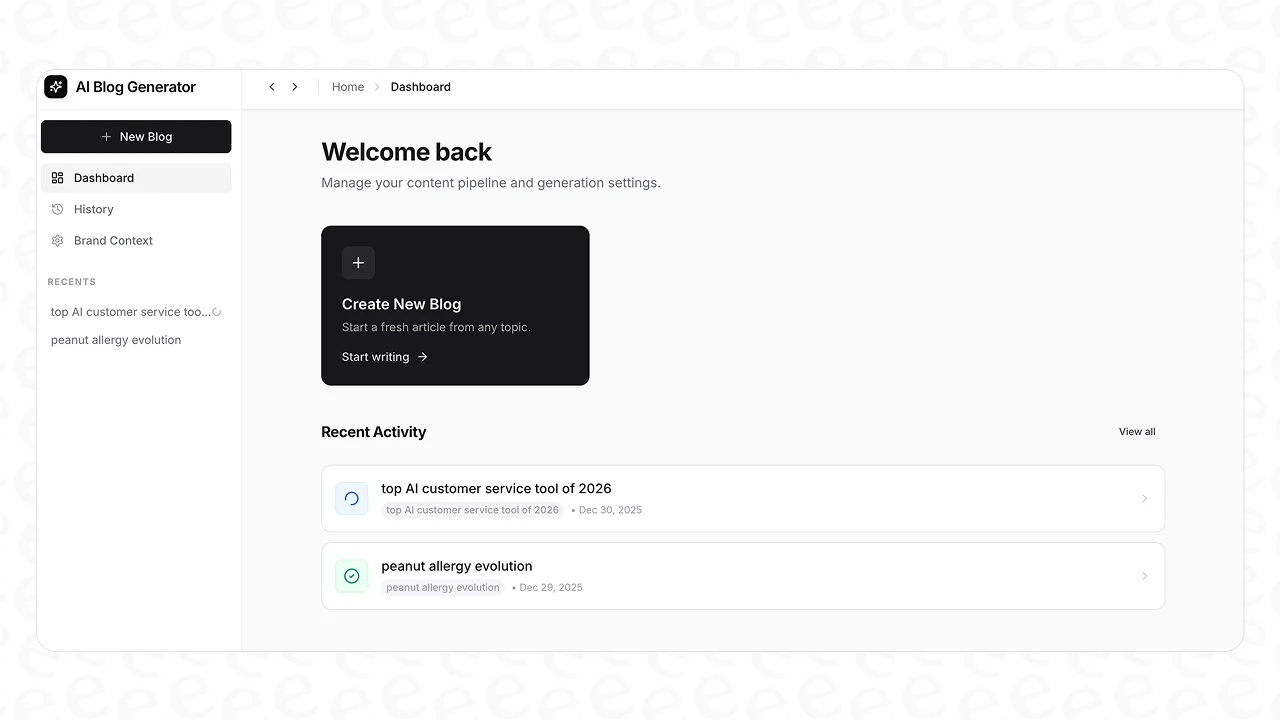
These tools are much more than simple text generators. They are built to handle the entire content process, from initial research and SEO work to creating assets and formatting the final post. For a small team, this is a huge help. A tool like the eesel AI blog writer automates the whole thing, turning a single keyword into an article that's ready to go live. This lets startups scale their content marketing and turn their blog into a reliable growth engine instead of a resource drain.
What is an AI blog writer for startups?
An AI blog writer is a tool made specifically to create structured, long-form blog content. It’s easy to confuse these with general-purpose models like ChatGPT, but they serve very different functions.
Dedicated AI blog writers come with features tailored for content marketing. These usually include built-in SEO tools, brand voice alignment, structured outlining, and the automatic creation of assets like images, charts, and tables. Unlike a large language model that just gives you a block of text from a prompt, an AI blog writer understands what makes a blog post successful, as this comparison illustrates.
The main goal is to create content that is well-written, well-researched, and optimized to rank on search engines. They are built to manage the entire blog creation workflow, saving teams hours of manual work on every post.
Our criteria for selecting the best AI blog writer for startups
We picked these tools based on what startups actually need: efficiency, impact, and a good return on investment. We didn't just look for tools that could write; we looked for tools that could help a small team compete. Here’s what we focused on:
- Output quality and human tone: This was the most important factor. The content has to be well-researched, accurate, and sound natural. We prioritized tools that produce a natural, human-like tone. The final article needs to be something a person would actually want to read.
- SEO and AEO features: A blog that doesn't get traffic is a waste of time. The tool must have built-in features to optimize content for search engines (SEO) and modern Answer Engines like Google's AI Overviews (AEO). This means proper heading structures, keyword placement, and metadata.
- Workflow efficiency: A startup doesn't have time for a complicated tool. The platform needs to be intuitive and cut down the time it takes to get from a keyword to a published post. We prioritized tools that deliver a complete article with little manual work.
- Automatic asset generation: A blog post needs more than just text. A proper AI blog writer should produce a complete article with visuals. We looked for tools that could automatically generate images, embed relevant videos, create tables, and pull in social proof.
- Value for money: Pricing has to be clear and provide a solid return. We favored models that are affordable for a startup and scale reasonably as content needs increase.
Comparison of the best AI blog writers for startups
This table gives you a quick look at the top tools, what they're best for, their key features, and pricing to help you decide.
| Tool | Best For | Standout Feature | Pricing Model (Billed Annually) |
|---|---|---|---|
| eesel AI blog writer | Fully automated, publish-ready blogs | Automatic assets & social proof | Credit-based ($99 for 50 blogs) |
| Jasper | On-brand marketing copy at scale | Brand IQ & Content Pipelines | Subscription (from $59/seat/mo) |
| Writesonic | SEO and AI search (GEO) visibility | AI Visibility Tracking | Subscription (from $39/mo) |
| Copy.ai | Automating GTM & sales workflows | AI Agents & Workflow Builder | Subscription (from $24/mo) |
| Contentpen | Autopilot blogging with bulk creation | Automated keyword research & SERP analysis | Subscription (from $27/mo) |
The 5 best AI blog writers for startups to use in 2026
Here’s a detailed look at the top platforms that can help your startup scale its content creation and drive real organic traffic.
1. eesel AI blog writer
The eesel AI blog writer is built to do one thing well: turn a single keyword into a complete, SEO-optimized, and media-rich blog post that's ready to publish. It’s the same tool we used to grow our own blog impressions from 700 to over 750,000 in just three months. It works like an automated content engine, generating AI images, infographics, and data tables. It also embeds relevant YouTube videos and finds insightful quotes from Reddit to add social proof to every article.
Pros: The platform delivers a nearly publish-ready article, saving time on editing, formatting, and asset sourcing. The research is context-aware, resulting in relevant content. It includes Answer Engine Optimization (AEO) features and is refined for a human-like tone.
Cons: The high level of automation offers less granular, step-by-step control compared to tools that function as writing assistants. It is designed for teams who prefer the AI to manage the process from start to finish.
Pricing:
- A one-time payment of $99 for 50 blog credits.
- No recurring subscription is needed, which is great for a startup's budget.
- It is completely free to try, so you can check the quality of the output yourself.
2. Jasper
Jasper is an AI content platform for marketing teams that need to create more than just blog posts. Its main feature is Jasper IQ, which learns from your style guides and company info to make sure everything it creates matches your brand voice. It also offers Content Pipelines to help automate marketing campaigns, like turning a blog post into social media content and emails.
Pros: Jasper’s main strength is its flexibility and focus on brand consistency. It’s built with larger teams in mind, offering features like SOC 2 compliance for security. It can be used for many marketing tasks beyond blogging, including ad copy, social media posts, and sales emails, making it a useful central tool for a marketing team.
Cons: Jasper functions as a writing assistant, which requires manual guidance to turn a draft into a finished post. While it generates AI images, users manually source other assets like videos or social proof.
Pricing:
- The Pro plan starts at $59 per seat per month when billed annually.
- A custom-priced Business plan is available for larger teams who need API access.
3. Writesonic
Writesonic is an AI platform focused on helping marketers manage their visibility on both traditional search engines (SEO) and new AI search engines. They call this Generative Engine Optimization or GEO. The platform includes an AI Article Writer, a content optimizer, and an AI tracker to monitor your brand's presence on platforms like ChatGPT and Google's AI Overviews.
Pros: The combined approach to managing SEO and GEO is its main benefit. It gives you an all-in-one toolkit for creating content, optimizing it, and tracking its performance from one place. This is helpful for teams that want to stay on top of how search is changing. It also supports over 30 languages, making it a good option for startups with a global audience.
Cons: As a broad platform, some individual features may be less specialized than dedicated, standalone tools. The article writer generates text and images, but other assets like videos or social quotes need to be added manually.
Pricing:
- The Lite plan starts at $39 per month when billed annually.
4. Copy.ai
Copy.ai has grown from a copy generator into a Go-to-Market (GTM) AI Platform for sales and marketing teams. Its key features are Workflows and AI Agents, which are built to automate operational processes. This includes tasks like researching leads on LinkedIn, enriching data from CRM records, and generating personalized outreach emails. It also uses the best language model for each specific task.
Pros: Its strength is in automating the repetitive tasks that come with sales and marketing. For teams focused on building a pipeline, enriching leads, and improving GTM efficiency, its workflow automation is very effective. The platform is also SOC 2 Type II compliant, making it a secure choice for handling company data.
Cons: Copy.ai is a GTM platform rather than a specialized blog writer. While it can generate long-form content, it lacks some of the dedicated research, SEO, and asset generation features found in purpose-built blogging tools.
Pricing:
- The Chat plan starts at $24 per month when billed annually and includes 5 seats.
5. Contentpen
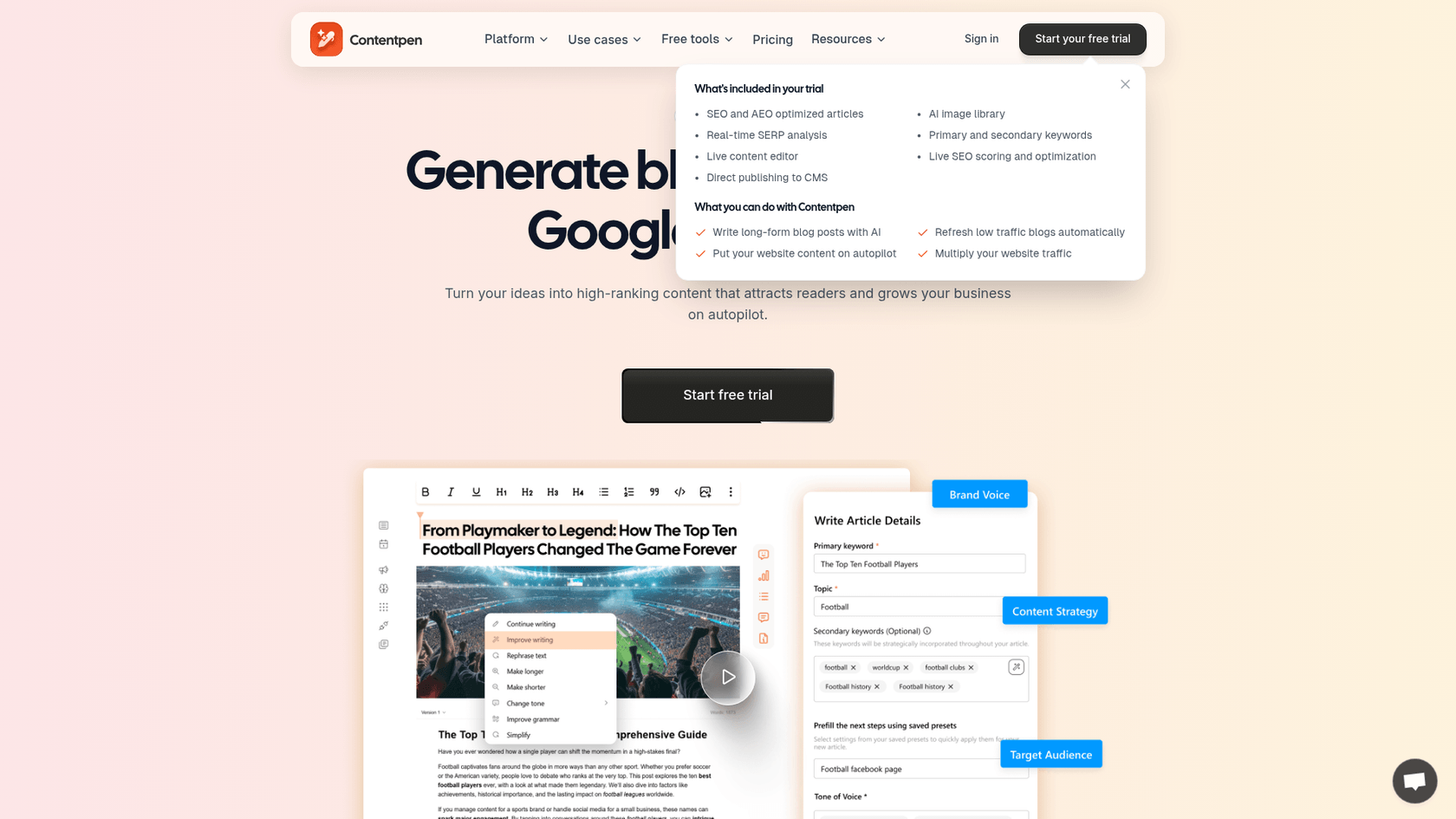
Contentpen is an AI writing tool designed to automate the entire blogging process, from coming up with ideas to publishing. It can analyze your website to suggest keywords, generate a content calendar, and then create SEO- and GEO-optimized articles in bulk. A key feature is its direct publishing integrations with platforms like WordPress, which allows for a hands-off content workflow.
Pros: The platform’s best feature is its high level of automation. By handling keyword research, scheduling, writing, and publishing, it lets startups maintain a consistent output with very little manual work. The bulk generation feature is a time-saver for teams that need to scale their content production quickly.
Cons: The high level of automation may offer less creative control over individual posts. Teams with highly specific content needs might find they still spend time editing the output to meet their requirements.
Pricing:
- The Starter plan is $27 per month (billed annually) for 10 articles.
- Premium and Agency plans are available for higher content volumes.
- A 14-day free trial is offered.
How to get the most out of your AI blog writer for startups
Just buying a tool isn't enough. To make it a real growth engine, you need a smart approach. Here are a few practical tips to get the most out of your investment.
- Give it rich context: Don't just type in a keyword and hope for the best. The quality of the output depends on the quality of your input. Tell the AI about your target audience, brand voice, key talking points, and the goal of the article. The more context you give it, the better the final post will be.
- Use it for structure, not just words: One of the best things an AI writer can do is analyze top-ranking competitor articles and create a structured outline. This makes sure your content is comprehensive and covers what search engines already think is important for that topic.
- Inject your own expertise: The AI builds the foundation, but your unique insights, data, and personal stories are what build trust with your audience. Always review and edit the AI-generated draft to add your personal touch. This is what separates great content from just good content.
 For general AI writing tools the best is still Claude Pro (3.5 Sonnet). It's the closest to human-like generation I've come across so far. But I still need to do long detailed prompts (and re-promptings) and heavy editing to polish the output to human-level content.
 - Think beyond the blog post: Once the article is published, keep going. Use your AI tool to repurpose the blog post into social media captions, email newsletter snippets, and even video scripts. This helps you maximize the reach of every piece of content you create.
The right AI blog writer for startups turns content into a growth engine
An AI blog writer is a necessary tool for efficient growth. The best platforms do much more than just generate text; they offer a complete solution for creating high-quality, SEO-optimized content at scale.
To see how these concepts work in practice, check out this guide on building an AI agent that can write and publish blog posts automatically. It provides a visual walkthrough of setting up an automated content workflow, which can be a game-changer for startups.
This video provides a visual walkthrough of setting up an automated content workflow with an AI agent.
The key is to select a tool that aligns with your team's workflow and content goals. Whether you need a writing assistant or a fully automated solution, the right platform can help turn your blog into a consistent source of organic growth.
Generate your first SEO-optimized blog for free
Finding the right tool means choosing one that delivers quality and speed without a complicated subscription. Instead of spending hours drafting, editing, and sourcing images, you can generate a complete post in minutes.
Ready to see how it works? Try the eesel AI blog writer for free. Generate your first article and see for yourself how easy it is to scale your content marketing.
Frequently Asked Questions

Share this post
Article by
Kenneth Pangan
Writer and marketer for over ten years, Kenneth Pangan splits his time between history, politics, and art with plenty of interruptions from his dogs demanding attention.